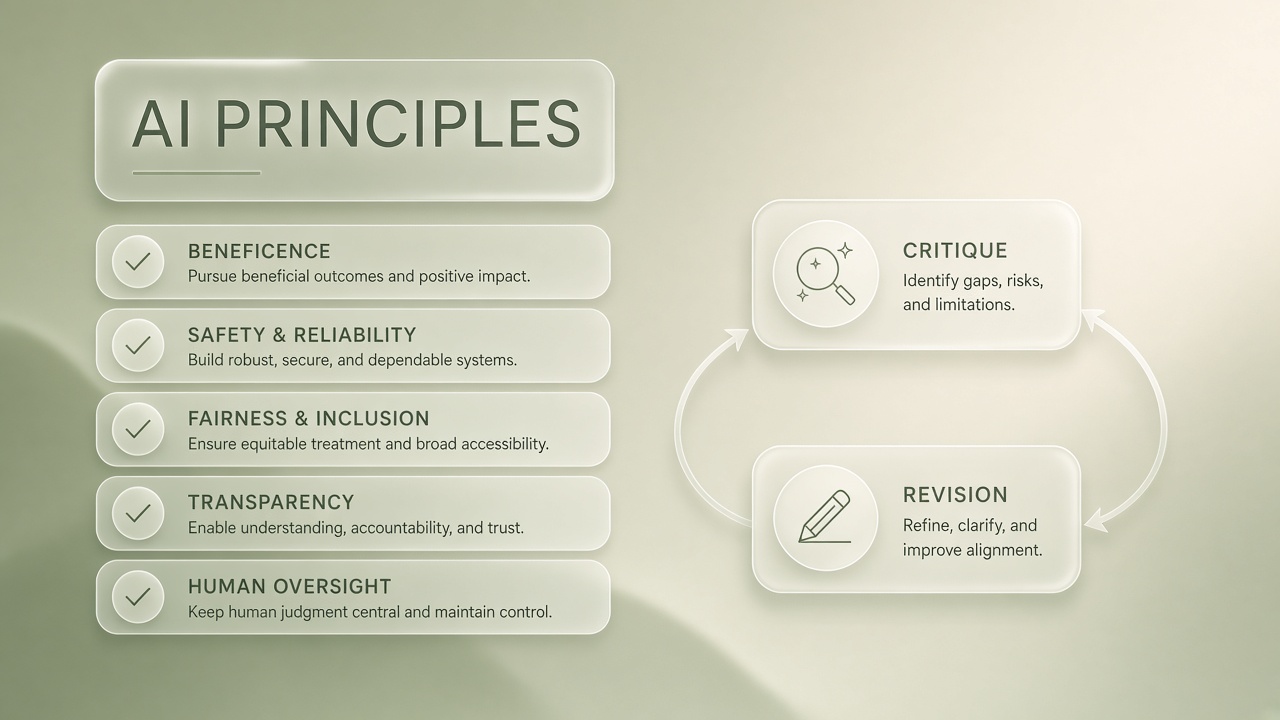
Reinforcement learning from human feedback (RLHF) scales alignment by paying labelers to rank model outputs. That works until you need consistent behavior across millions of edge cases labelers never saw. Constitutional AI (CAI), developed at Anthropic and described in Bai et al., offers a complementary path: write explicit principles, train the model to critique its own responses against those principles, and revise before showing results. The constitution becomes both training signal and behavioral guardrail.
Constitutional AI is an alignment method where language models learn to evaluate and revise their outputs against a set of written principles, reducing reliance on human labels for every harmful edge case. CAI combines supervised critique-revision loops with reinforcement learning guided by AI-generated preference labels derived from the constitution. This guide explains how CAI extends beyond RLHF, how the critique-revision loop works in practice, how principles shape refusals and tone, the limits including over-refusal, and the enterprise questions buyers should ask when evaluating AI code assistants and AI chatbot products marketed as safe or constitutionally aligned.
Beyond RLHF: Why Constitutional AI Exists
RLHF aligns models to human preferences but scales poorly when harmful outputs are rare, expensive to label, or culturally variable; CAI uses written principles to generate scalable self-supervision. Human labelers cannot anticipate every jailbreak, demographic stereotype, or dual-use science query. A constitution encodes norms explicitly: avoid discriminatory generalizations, refuse illicit instructions, acknowledge uncertainty, and prioritize harm reduction. The model learns to apply those norms through iterative self-critique rather than waiting for a human rater on each variant.
| Method | Primary signal | Scaling limit |
|---|---|---|
| RLHF | Human preference rankings | Labeler throughput and agreement |
| Constitutional AI | Written principles + model critiques | Principle quality and critique accuracy |
| RLAIF (AI feedback) | Another model judges outputs | Judge model biases propagate |
| Rule filters | Keyword and policy classifiers | Brittle on paraphrase and context |
The Critique-Revision Loop
CAI training often runs in two phases: supervised critique-revision on model-generated responses, followed by reinforcement learning where AI preference labels replace some human rankings. In the supervised phase, the model produces an initial answer, critiques that answer against constitutional principles, and rewrites a improved version. Thousands of such triples (response, critique, revision) teach the model internalized norms. In the RL phase, the model generates candidates, an AI critic scores them per the constitution, and preference optimization pushes the policy toward higher-scoring revisions.
- Generate: Model drafts a response to a prompt, including potentially harmful examples used only in controlled training.
- Critique: Model identifies violations of specific constitutional principles with referenced text spans.
- Revise: Model produces a new response addressing each cited violation.
- Preference optimize: RL prefers revised outputs the constitutional critic ranks higher.
At inference time, well-aligned models may perform implicit critique-revision internally before returning text, though vendors rarely expose intermediate drafts. Some products surface "thinking" or safety layers; most keep the loop hidden inside a single API response.
How Principles Shape Refusals
Constitutional principles translate into refusal behavior, hedging language, and alternative suggestions when requests conflict with encoded values. A principle like "choose the response that is least likely to cause harm" pushes the model toward declining weaponization instructions while still offering high-level educational context where policy allows. Principles about equality reduce stereotyping in persona descriptions. Principles about honesty increase explicit uncertainty statements on medical or legal questions.
Refusals are not binary blocks. Constitutional alignment encourages nuanced responses: explain why a request cannot be fulfilled, offer safer adjacent help, and avoid gratuitously moralizing lectures unless principles require transparency. Enterprise deployments sometimes layer a custom constitution on top of the base model vendor constitution, for example adding industry-specific compliance rules for finance or healthcare.
Example Principle Categories
| Category | Example principle | User-visible effect |
|---|---|---|
| Harm reduction | Refuse instructions for violent wrongdoing | Hard stops on illicit how-to content |
| Fairness | Avoid demeaning generalizations about groups | Careful handling of demographic queries |
| Epistemic humility | Acknowledge limits on specialized advice | Disclaimers on medical and legal topics |
| Privacy | Decline requests for private individual data | Blocks doxxing and stalking assistance |
Limits and Over-Refusal
Constitutional alignment can over-refuse legitimate requests when principles are vague, overly broad, or stacked without priority rules. Developers report blocked security research, creative fiction involving conflict, and benign medical education when safety layers err conservative. Over-refusal hurts productivity in AI coding workflows when vulnerability explanations or penetration testing documentation triggers policy filters meant for malicious abuse.
Mitigations vendors explore include principle hierarchies (free speech vs harm), context-aware classifiers, user role attestations in enterprise tiers, and adjustable safety presets. No preset eliminates tradeoffs. Stricter constitutions reduce headline safety incidents; looser constitutions improve utility for power users. Buyers should pilot on real prompts, not marketing demo scripts.
Enterprise Buyer Questions
Procurement teams should ask whether constitutional principles are published, customizable, versioned, and evaluated on domain-specific refusal and false-positive rates. Key questions:
- Can we read the base constitution or safety policy summary, not only marketing claims?
- Does the vendor support enterprise policy overlays without retraining the foundation model?
- How are principle changes communicated when model versions update?
- What false refusal rate was observed on internal benchmarks resembling our workflows?
- Are critique-revision steps logged for audit in regulated environments?
- How does constitutional alignment interact with retrieval grounding and tool use?
AI chatbot vendors targeting regulated industries increasingly ship "safe completion" modes branded around constitutional or policy-guided alignment. Treat these as configuration surfaces with measurable tradeoffs, not guarantees of zero risk.
RLAIF and Scaling AI Feedback
Reinforcement Learning from AI Feedback (RLAIF) extends CAI by using model-generated preference labels instead of human rankings for portions of the training pipeline. A constitutional critic compares two candidate responses and declares which better satisfies the written principles. That scales alignment data generation beyond human labeler throughput. The risk is compounding judge bias: if the critic model shares blind spots with the generator, both may reinforce the same subtle failures. Anthropic and other labs mitigate this with held-out human evals, adversarial red teaming, and periodic constitution updates.
Buyers should not treat "RLAIF" or "constitutional" labels as magic. Ask what percentage of preference data still comes from humans, what red team cadence runs before releases, and whether enterprise customers can submit failure cases that enter the improvement queue.
Published Constitution Examples
Anthropic's early constitutional AI research used principles drawn from sources like the UN Universal Declaration of Human Rights and Apple Terms of Service, reformulated as instructions the model applies during critique. Example principle patterns include: "Choose the response that is least discriminatory," "Choose the response that is most supportive of freedom of speech," and "Choose the response that is least intended to build personal rapport with the user." The exact constitution evolves between model generations and is not always fully public for competitive reasons.
Enterprises drafting overlay constitutions should write testable principles, not vague values. "Be ethical" is unenforceable. "Do not provide step-by-step instructions for synthesizing controlled substances" is testable in automated eval suites.
Measuring Constitutional Alignment
Vendors measure alignment with benchmark suites covering toxicity, bias, truthfulness, and refusal appropriateness; enterprises should add domain-specific evals reflecting their user base. Useful metrics include false refusal rate on benign professional prompts, false compliance rate on harmful prompts, and demographic parity on sensitive completion tasks. Run evals per model version because alignment can shift between releases even when capability benchmarks improve.
| Metric | What it measures | Why enterprises care |
|---|---|---|
| False refusal rate | Benign prompts incorrectly blocked | Productivity loss, user frustration |
| Harmful compliance rate | Unsafe prompts incorrectly answered | Legal and reputational risk |
| Stereotype bias score | Demographic generalizations in outputs | HR and customer-facing brand risk |
| Principle consistency | Same policy across paraphrased prompts | Predictable support and audit defense |
Constitutional AI vs Other Safety Layers
| Layer | When applied | Strength |
|---|---|---|
| Constitutional training | Pre-deployment weight updates | Broad norm internalization |
| Inference guardrails | Input/output filtering at API | Fast block on known patterns |
| System prompts | Per-application instructions | Context-specific policy |
| Human review queues | High-risk transactions | Highest accuracy, lowest scale |
Production systems stack layers. Constitutional AI shapes the base model's tendencies; guardrails catch residual failures; human review handles high-stakes exceptions. Relying on only one layer creates predictable gaps.
Frequently Asked Questions
Is Constitutional AI only used by Anthropic?
Anthropic pioneered and published Constitutional AI research; other labs use similar principle-guided self-critique and AI-feedback methods under different names. Ask any vendor how supervised critique, preference optimization, and policy documents interact regardless of branding.
Can enterprises write their own constitution?
Some platforms allow custom policy documents, system-level rules, or fine-tuning on company-specific critique data; full constitutional retraining of foundation weights remains vendor-controlled. Realistic enterprise control lives in overlays, not replacing the base model's entire alignment stack.
Does CAI prevent jailbreaks?
No alignment method fully prevents jailbreaks; CAI reduces certain failure modes but adversarial prompts evolve continuously. Combine constitutional training with monitoring, rate limits, and incident response processes.
Will the model show its constitutional critique to users?
Most consumer products hide internal critique steps; some enterprise or research interfaces expose chain-of-thought or safety reasoning for debugging. Hidden critique improves readability but reduces audit transparency unless vendors offer logging APIs.
How does CAI relate to EU AI Act or other regulations?
Regulations require risk management and documentation; constitutional principles can inform policy artifacts but do not by themselves satisfy legal conformity assessment. Map vendor safety docs to your regulatory obligations explicitly.
Do open-weight models use Constitutional AI?
Many open models use RLHF or DPO with varying safety investment; constitutional self-critique training is less common in smaller community releases. Self-hosting teams often add guardrails, system prompts, and fine-tunes to approximate vendor safety postures.
Does constitutional alignment work across languages?
Multilingual alignment quality varies; principles trained primarily on English data may not transfer equally to refusals and tone in other languages. Test safety behavior in every language your product ships.
Constitutional AI in the Open-Source Ecosystem
Open-weight model releases often ship with varying alignment investments: some include RLHF or DPO safety tuning, others publish base checkpoints with minimal refusal behavior. Community fine-tunes may strip safety layers for uncensored variants. Self-hosting teams cannot assume constitutional alignment exists unless the model card documents critique-revision training or equivalent preference optimization. Layer your own guardrails, content filters, and usage policies when deploying open models in customer-facing products.
Alignment tax is real: safer models refuse more and hedge more, which some users perceive as "dumber" responses. Product managers should communicate tradeoffs honestly rather than marketing "unlimited" assistants that hit safety walls on legitimate professional tasks.
Integrating CAI With Tool Use and Agents
Constitutional principles must extend to tool calls, not only final natural language answers: an aligned model should refuse to execute API actions that violate policy even when the user request sounds benign in chat. Agent frameworks need constitutional checks on proposed tool parameters (SQL queries, email sends, file deletions) before execution. A model that writes a safe refusal but still runs a harmful tool call through a separate code path fails alignment in practice.
User Expectations in 2026
End users should expect constitutionally aligned assistants to refuse clearly harmful requests, hedge on specialized advice, and maintain more consistent tone than base pretrained models, but not to eliminate all offensive or incorrect outputs. Alignment reduces tail-risk failures; it does not guarantee truth on factual questions or unbiased treatment of every edge-case prompt. Pair constitutional training with retrieval grounding for knowledge work and human review for high-stakes decisions.
Developers building on aligned APIs should document which safety preset they use, how overrides work in enterprise tiers, and what logging is available when a refusal blocks a legitimate workflow. Support teams need runbooks for escalating false refusals with reproducible prompt examples vendors can feed into improvement cycles.
Conclusion
Constitutional AI explained: models learn to critique and revise their own outputs against written principles, scaling alignment beyond what human labelers alone can cover. The critique-revision loop shapes refusals, tone, and harm reduction behavior users experience in modern assistants. Limits remain, especially over-refusal on legitimate professional tasks. Enterprise buyers evaluating chatbots and code tools should demand transparency on principles, measure false refusals on real workflows, and treat constitutional alignment as one layer in a broader safety program.