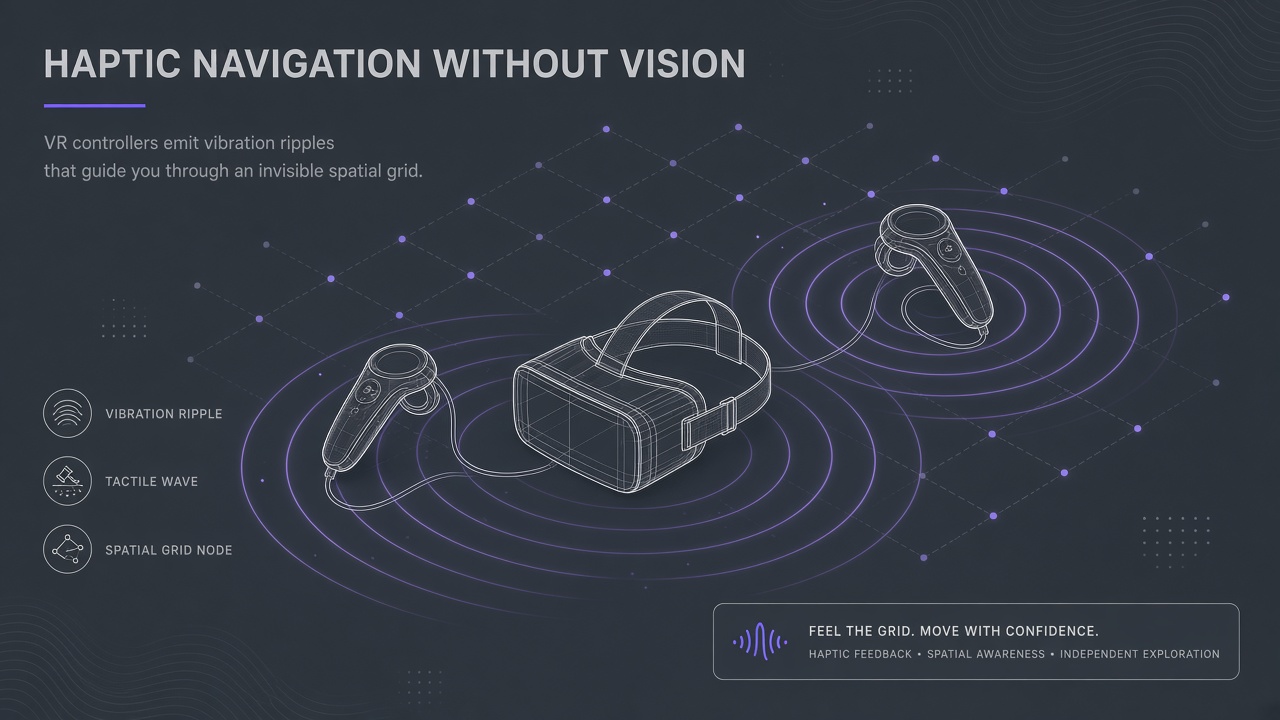
Virtual reality defaults to visual-first design: headsets render stereoscopic worlds, hand controllers trace invisible rays, and menus float in space. Blind and low-vision (BLV) users gain little from photorealistic shaders they cannot see. Screen readers transformed two-dimensional interfaces, but three-dimensional spatial content lacks a systematic way to deliver object layout, distance, and affordances through non-visual channels. Researchers now combine vision language models (VLMs), spatial audio, and AI-driven haptic feedback to translate scene geometry into vibration patterns on consumer controllers. EnVisionVR, described in arXiv:2502.03564, reported a 41.7 percentage point improvement in object localization success (from 50% to 91.7%) and a 33.3% increase in interaction success among twelve BLV participants. Readers interested in creative AI tools or popular AI tools for accessibility should understand sensory substitution limits, Quest hardware constraints, and why co-design with blind gamers precedes product claims.
Why VR Defaults to Visual-Only UX
Mainstream VR applications assume players can see reticles, color-coded objectives, and peripheral motion cues that BLV users cannot access without alternative feedback channels. Porting flat accessibility features such as high contrast or text scaling does not solve spatial navigation: knowing that a button exists on a panel differs from knowing it sits 1.2 meters to your left at knee height. Game engines expose collision meshes and depth buffers internally, but those data structures rarely surface as structured non-visual output. Social VR platforms compound the problem when avatar gestures and emoji reactions carry meaning visually alone.
Legal accessibility mandates for web content do not yet bind immersive 3D experiences uniformly across jurisdictions. Voluntary guidelines from disability advocates emphasize equivalent participation, yet shipping titles still treat audio descriptions as optional mods. The gap creates demand for AI middleware that interprets rendered frames or engine state and emits accessible cues in real time.
Sensory Substitution and Haptic Languages
Sensory substitution maps one modality into another: spatial structure becomes vibration rhythms, pitch shifts, or skin-stretch patterns that users learn as a haptic language. Early VR accessibility work used fixed pulse codes for walls versus collectibles. Learnability matters: overly complex alphabets fatigue users within minutes. Successful systems keep a small vocabulary of distance-dependent beeps, directional stereo panning, and controller rumble intensity tied to proximity.
Research compares vibrotactile motors in Meta Quest controllers against experimental skin-stretch displays on research hardware. Vibrotactile feedback is coarse but ships at scale. Skin-stretch arrays on wrists or vests offer finer directional cues in lab studies yet remain absent from consumer headsets. EnVisionVR uses Quest controller haptics alongside speech and tonal spatial audio, prioritizing deployability over laboratory accuracy.
ML Mapping Scene Geometry to Vibration
Modern pipelines feed RGB or depth frames to VLMs that describe objects, then align descriptions with engine collision data to drive haptic pulses toward targets. EnVisionVR supports voice commands such as "Where am I?", "What is near me?", and "Where is the object?" A VLM generates scene summaries; distance-dependent beeps and controller vibration guide turning and reaching. GPT-4o integrations in research prototypes pair Unreal Engine collision events with generated haptic scripts, letting designers prototype accessible feedback without hand-coding every mesh.
| System | Non-visual channels | Reported outcome |
|---|---|---|
| EnVisionVR | VLM speech, spatial audio, Quest haptics | 41.7 point localization gain (12 BLV users) |
| VRSight | AI detection, depth tones in Rec Room | Developer-independent 3D screen reader pattern |
| GPT-4o + Unreal prototypes | Collision-triggered haptic scripts | Rapid authoring, not validated at scale |
VRSight demonstrates a complementary approach: treat social VR worlds as navigable spaces with tone-based spatial audio akin to a three-dimensional screen reader. Combining VRSight-style continuous scanning with EnVisionVR-style object queries may cover exploration and task-focused interaction better than either alone. Latency remains a bottleneck: VLM inference measured in hundreds of milliseconds can desync fast-paced games unless predictions cache on static geometry.
Research Prototypes vs Consumer Headsets
Meta Quest hardware limits haptic expressiveness to bilateral controller motors with no palm, finger, or torso actuators in the stock configuration. Battery life, thermal throttling, and guardian boundaries further constrain always-on AI accessibility layers. PCVR headsets offload compute to GPUs but exclude many BLV users who depend on standalone devices for portability. Research vests with dozens of tactors show higher localization accuracy in controlled trials yet cost thousands of dollars and require calibration per user.
Nausea risk rises when audio and haptic cues disagree with vestibular signals during artificial locomotion. Accessible locomotion options such as teleportation, snap turning, and seated play reduce discomfort but must be exposed through non-visual menus. AI assistants that describe comfort settings verbally shorten the trial-and-error cycle that sighted players solve visually in seconds.
Co-Design With Blind Gamers
BLV co-designers reject one-size-fits-all haptic alphabets and prioritize configurable cue density, mute options, and compatibility with existing screen reader habits. EnVisionVR authors conducted studies with participants who regularly use assistive technology and those who do not, finding subgroup differences in localization gains. Assistive technology veterans adapted faster, suggesting training modules should ship with accessible VR titles rather than assuming instant mastery.
Community feedback channels on Discord and specialized forums surface failure modes academic papers miss: crowded social spaces where multiple speakers overlap, or games where haptic rumble indicates damage and accessibility pulses simultaneously. Designers need mixer priorities that preserve combat feedback without drowning navigation cues. Open-source middleware could standardize haptic event schemas similar to WAI-ARIA roles for flat web.
Frequently Asked Questions
Does Quest support accessible haptics out of the box?
Quest provides generic controller vibration for games but no system-level AI scene interpreter. EnVisionVR and similar tools are research or third-party layers, not native Meta features as of 2026.
Is PCVR better for accessibility AI?
PCVR allows heavier VLM models and experimental peripherals, but cost and setup complexity exclude many BLV users. Standalone Quest solutions remain the equitable target for mass adoption.
Can haptics replace spatial audio?
No. Audio carries semantic labels; haptics convey proximity and direction. EnVisionVR combines both because either channel alone leaves gaps in scene understanding.
Do these tools cause motion sickness?
Mismatched locomotion cues can increase nausea. Accessible titles should default to comfort locomotion and let users tune cue intensity. More research is needed on long-session effects.
Are there open standards?
Immersive accessibility lacks a single haptic API standard. Engine plugins and research prototypes use ad hoc event buses. Industry alignment would help assistive tech vendors integrate consistently.
What about cost?
Consumer Quest controllers add no marginal hardware cost. Research skin-stretch devices remain expensive. Cloud VLM inference may introduce subscription costs if accessibility layers phone home to APIs.
AI haptic feedback for accessible VR is crossing from lab demos toward integrable middleware, but hardware gaps on Quest-class devices cap fidelity. The 41.7% localization improvement in EnVisionVR proves concept viability; shipping products still need co-designed haptic languages, latency budgets, and policies that treat BLV gamers as core players rather than compliance checkboxes. Expect hybrid stacks: engine collision data for fast pulses, VLMs for semantic "what is near me" queries, and spatial audio as the backbone every prototype shares.
Developers evaluating GPT-4o plus Unreal collision haptics should prototype on static training levels before open-world titles where dynamic objects outpace inference budgets. Caching mesh summaries per room reduces repeated VLM calls when players revisit hubs. For social VR, moderation and privacy intersect with accessibility: scene description models must filter sensitive avatar appearances before speaking descriptions aloud in public spaces.
Skin-stretch versus vibrotactile accuracy tradeoffs will persist until headset makers embed denser actuator grids. Until then, AI mapping from scene geometry to vibration patterns on stock controllers is the realistic path for blind users who want parity in mainstream VR rather than segregated accessible-only experiences on parallel hardware.
Audio spatialization quality depends on HRTF personalization. EnVisionVR distance-dependent beeps assume stereo headphones with reasonable head-related transfer function defaults. Users with asymmetric hearing loss may need adjustable frequency bands for proximity tones separate from vibrotactile pulses. AI accessibility layers should expose per-channel gain sliders reachable through voice menus, not buried in visual settings panels.
Competitive multiplayer titles pose collision-heavy scenarios where ten simultaneous haptic events create noise. Machine learning classifiers can prioritize the nearest threat or objective-bearing object when more than three cues compete. Unreal Engine collision events feeding GPT-4o generated scripts allow designers to prototype priority rules in natural language before engineers harden them into C++ handlers. Production builds should fall back to deterministic rules if API latency exceeds frame budgets.
Privacy intersects accessibility when VLMs describe other players avatars aloud. EnVisionVR style scene narration must filter appearance descriptions that could enable harassment or reveal identity attributes users wish to keep private. Blind gamers in qualitative interviews request opt-in description depth levels: minimal for competitive lobbies, verbose for narrative single-player campaigns. Co-design sessions documented in CHI and ASSETS proceedings emphasize configurable verbosity over maximal automation.
Enterprise training simulators in manufacturing and healthcare explore haptic accessibility for blind technicians maintaining equipment in VR twins. Regulatory training may eventually require non-visual parity where sighted trainees already use immersive modules. AI haptic feedback accessible VR stacks that pass WCAG-adjacent immersive guidelines could become procurement requirements before consumer game studios adopt them widely.
Battery thermal limits on Quest 3 class hardware throttle simultaneous haptics, wireless streaming, and on-device VLM inference. Edge architectures that preprocess static environment meshes on PC hosts while streaming lightweight pulse commands to standalone headsets may balance cost and performance. Until Meta or competitors ship accessibility SDKs with documented haptic schemas, researchers should publish open middleware libraries so indie studios integrate BLV features without replicating EnVisionVR experiments from scratch.
Standards bodies within Khronos and IEEE immersive working groups have begun discussing accessibility extension layers for OpenXR, though haptic event schemas remain immature compared to audio APIs. Developers porting EnVisionVR concepts to OpenXR runtimes should contribute feedback so future headset firmware exposes semantic haptic events rather than raw motor amplitudes alone. Blind beta testers recruited through National Federation of the Blind chapters and similar organizations consistently outperform sighted engineers at identifying confusing cue collisions during playtests.
Educational VR for astronomy and history museums could adopt AI haptic maps of virtual exhibits, letting blind visitors feel constellation layouts or artifact contours while audio narration describes provenance. Funding for accessible cultural institutions lags gaming budgets, but grant programs increasingly cite Section 508 and European Accessibility Act obligations for publicly funded digital experiences. Proof-of-concept demos with EnVisionVR metrics provide evidence for grant applications seeking hardware loans and researcher time.
Longitudinal studies tracking blind gamers across months of VR adoption will clarify whether learned haptic vocabularies transfer between titles or require retraining per game, a question EnVisionVR twelve-participant study could not answer alone. Funding agencies should prioritize multi-month field studies over one-hour lab demos when evaluating claims about inclusive VR.