AI horse lameness detection uses markerless computer vision on smartphone trot videos to quantify gait asymmetry through head nod, pelvic hike, and stride-level vertical displacement metrics that equine veterinarians combine with clinical exams, nerve blocks, and imaging. Validated systems such as Sleip and RealHorse report mean differences below 2.2 mm compared with multi-camera motion capture on straight-line trots, though lunging and prepurchase settings introduce higher error. This guide covers lameness economics, optical flow and pose metrics, smartphone capture practices, clinic integration, diagnostic limits, and consumer versus clinical boundaries for teams evaluating AI healthcare vision tools and popular AI tools for field deployment.
How AI Horse Lameness Detection Works
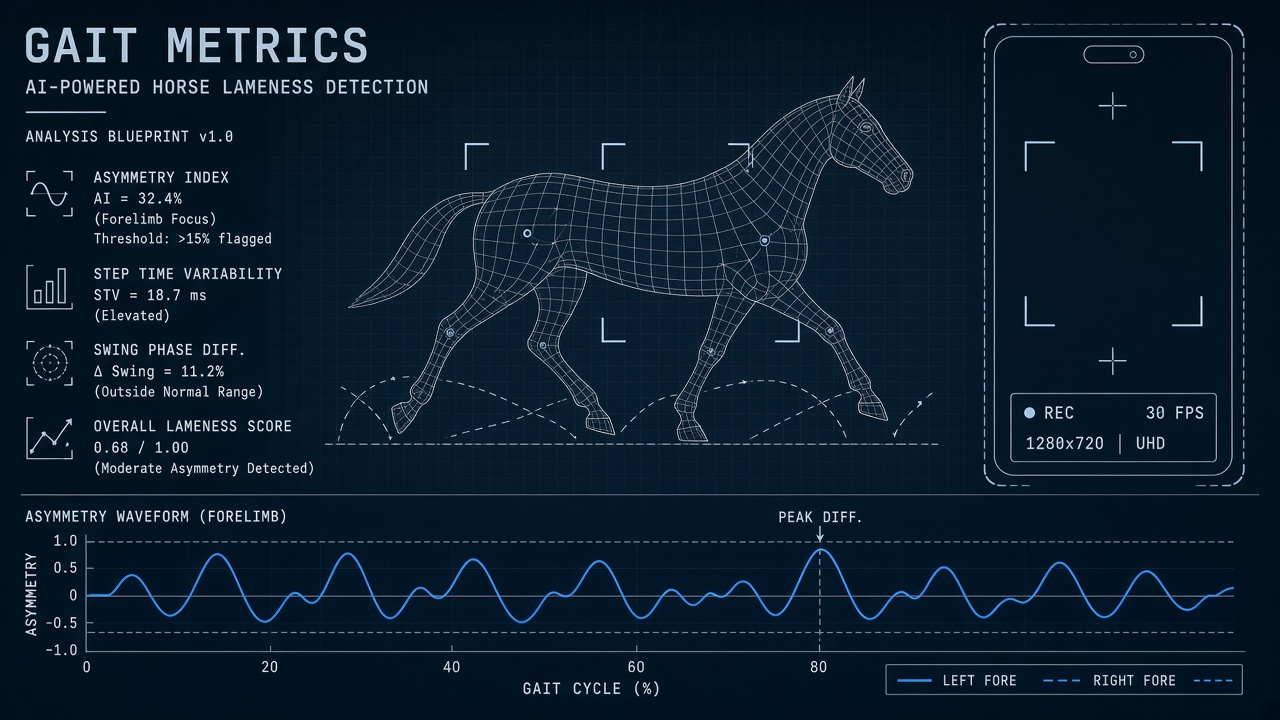
Markerless computer vision models detect anatomical keypoints on each video frame, reconstruct vertical displacement curves for head and pelvis during trot strides, and compute asymmetry metrics (Maxdiff, Mindiff) that correlate with forelimb and hindlimb lameness when capture conditions stay consistent. No reflective markers attach to the horse; a smartphone or stabilized camera records straight-line or lunge trots for upload to validated platforms such as Sleip or RealHorse. Outputs supplement but do not replace nerve blocks, imaging, or licensed veterinary judgment.
Lameness Economics in Equine Sports
Lameness drives insurance claims, lost competition seasons, prepurchase deal failures, and early retirement in sport horses, making objective gait screening valuable at sales, racetrack inspections, and routine wellness visits. Subjective AAEP lameness grading (0 to 5 scale) varies between clinicians and fatigue levels. A horse graded 2/5 on Monday may present as 1/5 after rest. Objective asymmetry scores create timestamped baselines that buyers, trainers, and insurers can compare across visits when methodology stays consistent.
Prepurchase exams often occur at seller barns with uneven footing and limited straight-line distance. Smartphone tools lower friction: one handler trots the horse while a vet records 30 meters on an iPhone without attaching reflective markers. Economics favor screening many horses quickly, then investing nerve-block time only on animals that show quantified asymmetry.
Optical Flow and Pose Asymmetry Metrics
Markerless systems track anatomical keypoints (eye, withers, croup, limbs) frame by frame, estimate a dynamic ground line, and compute stride-level Maxdiff and Mindiff vertical displacement differences that correlate with forelimb and hindlimb lameness. Forelimb lameness often appears as head nod asymmetry: the head rises less on the lame side during weight bearing. Hindlimb lameness shifts pelvic vertical motion. Deep learning models trained on large equine motion datasets detect these patterns without skin markers, though withers keypoints show higher error (around 5 to 12 mm frame-level) than eye or croup points in field validation studies.
| Metric | Anatomical focus | Typical lameness signal |
|---|---|---|
| Head Maxdiff / Mindiff | Eye vertical displacement | Forelimb asymmetry |
| Pelvic hike | Croup vertical motion | Hindlimb asymmetry |
| Stride consistency | Full gait cycle | Intermittent vs consistent lameness |
| Trial-level averages | Aggregated strides | Lower noise than single strides |
Comparison studies between smartphone single-camera systems and 13-camera optical motion capture found trial mean differences below 2.2 mm for head and pelvic lameness metrics across hundreds of matched strides. RealHorse validation on 59 horses reported trial-level mean absolute errors of 1.1 to 1.4 mm on straight lines and 1.8 to 3.3 mm on circles, supporting clinical screening though not replacing imaging.
Smartphone Capture Best Practices
Consistent camera position, adequate straight-line length (25 to 30 meters), trotting speed, and lighting produce reproducible asymmetry scores; handheld stabilizers and operator training reduce frame dropout. Sleip documentation recommends standing approximately 3 meters behind the start of a straight track for away-and-toward trots, and 10 meters outside a 12 to 15 meter lunge circle for circular evaluations. Keep the entire horse in frame throughout the pass. Avoid filming through fence rails that occlude limbs.
Surface matters. Deep sand masks subtle asymmetry; concrete can exaggerate head bob. Document footing in the medical record alongside AI output. Wind, rider weight, and tack changes between visits invalidate direct comparison unless controlled.
Integration With Vet Clinic Records
Export PDF reports with stride graphs, color-coded limb indicators, and trial metadata into practice management systems so asymmetry trends appear next to radiograph and ultrasound findings. Field studies at traditional racehorse pre-race inspections combined simultaneous AAEP grading with offline Sleip uploads, demonstrating feasibility without disrupting clinical workflow. Best practice stores raw video plus processed metrics for medicolegal traceability when prepurchase disputes arise.
Teams exploring AI healthcare deployments should define who may interpret scores (licensed veterinarians only in most jurisdictions) and how consumer app outputs differ from clinic-grade reports.
Prepurchase Exam Workflow
Prepurchase exams combine seller history, palpation, flexion tests, AI gait screening, radiographs, and endoscopy depending on price tier and buyer risk tolerance. Record baseline AI asymmetry scores before and after flexion to detect subtle changes that static observation misses. Buyers should receive raw video plus PDF metrics so independent vets can reprocess if the selling barn changes software vendors between preview and closing.
Sellers sometimes trot horses on firm footing toward the camera and soft footing away to mask asymmetry. Require bidirectional passes on consistent surface and note shoeing differences between forelimbs. AI cannot detect medicated pain masking without chemical testing; disclose recent anti-inflammatory administration in the record.
Limits vs In-Person Nerve Blocks
AI gait analysis localizes asymmetry to a limb region but cannot identify whether pain originates in the foot, fetlock, suspensory, or stifle; diagnostic analgesia, imaging, and physical exam remain essential. Bilateral lameness, mild grade 1/5 subtlety, and neurologic gait abnormalities challenge vision systems trained on classic orthopedic asymmetry. False positives appear when horses shorten stride from rider error or slippery footing rather than pain.
Consumer smartphone apps marketed to owners risk over-interpretation. Regulatory boundaries treat veterinary diagnosis as a licensed activity. Apps should label outputs as screening aids requiring professional follow-up, not definitive diagnoses for insurance claims without vet sign-off.
Regulatory and Telemedicine Boundaries
Veterinary practice acts in many jurisdictions restrict diagnosis and treatment recommendations to licensed professionals; equine telemedicine rules vary on whether video gait analysis constitutes a veterinary service. Clinics should document that AI reports are generated under veterinarian supervision. Owners uploading barn videos to consumer apps without vet relationship may receive actionable-sounding limb labels that create liability if they self-treat with rest or NSAIDs incorrectly. Clear disclaimers and referral pathways protect both app vendors and horses.
Dressage trainers use repeated screening to detect subtle hindlimb stiffness that appears only after collected work, though standard protocols still emphasize straight-line trot. Racing stables may screen entire strings weekly during meet season; threshold alerts trigger palpation before starts. Farriers should be notified when AI scores shift after shoeing changes because asymmetric trimming mimics lameness signals in vision models.
Integration with radiograph and ultrasound PACS systems lets clinicians pull gait trend lines beside imaging dates. A horse with rising pelvic asymmetry and new suspensory changes on ultrasound warrants modified training plans even when the owner reports no visible head bob. Research continues on combining inertial sensors with video for canter work, but trot remains the validated screening gait for most commercial tools in 2026.
Warm-up protocol standardization improves repeatability: allow five minutes of walking before trot capture so horses settle from trailer unloading or arena arrival excitement. Block placement after flexion tests should wait the same interval your clinic defines before re-filming, because transient asymmetry from flexion can mimic lameness in vision models. For insurance documentation, store metadata on handler identity, surface type, shoeing date, and recent medications alongside AI PDF exports so adjusters can audit whether screening conditions matched prior visits.
Equine sports medicine conferences in 2025 and 2026 increasingly feature hands-on workshops comparing markerless apps to inertial sensor belts. Belts capture limb timing with high temporal resolution but require equipment placement expertise; video apps win on accessibility at remote barns. Hybrid workflows film trot passes for asymmetry screening, then apply sensors when clinicians need phase-level detail before joint injections. Owners comparing consumer app subscriptions to single vet visit fees should weigh that apps do not include physical exam, hoof tester evaluation, or professional liability coverage. Clinics charging for AI gait screening as a line item should document informed consent explaining screening limits and recommended follow-up when scores exceed clinic-defined thresholds.
Frequently Asked Questions
Does AI work for dressage and sport horses?
Straight-line and lunge trots remain the standard capture protocol across disciplines. Collection and lateral work are not typical screening contexts. Baseline trots before competition season help track changes.
How do racetracks use lameness AI?
Pre-race inspections increasingly trial markerless systems alongside traditional vet exams. Objective scores support stewards when subjective opinions split, but jurisdiction rules vary on admissibility.
What causes false positives?
Poor video quality, uneven surfaces, inexperienced handlers, and asymmetric trimming or shoeing. Re-record before escalating to nerve blocks when scores border threshold values.
Can owners submit app reports for insurance?
Carriers generally require licensed veterinary diagnosis. AI reports may supplement claims as objective evidence when a vet attests to findings. Check policy language before relying on consumer app PDFs.
How do Sleip and RealHorse compare?
Both use markerless smartphone video with published validation against motion capture. Feature sets, pricing, and circle-trot accuracy differ; trial both on your caseload before standardizing clinic workflow.
Where should clinics explore tools?
Browse popular AI tools for emerging equine vision startups, but prioritize peer-reviewed validation and integration with your records system over marketing accuracy claims.
How often should trainers re-screen?
Monthly baselines during competition season catch gradual changes before they become career-ending injuries. Compare trial-level aggregates, not single strides, when deciding whether asymmetry crossed clinical significance thresholds your practice defines.
Does rider weight affect AI scores?
Heavy or unbalanced riders introduce asymmetry unrelated to lameness. Standardize handler and rider when comparing visits. In-hand trots reduce rider confounding for prepurchase work.
How do AI scores correlate with AAEP grades?
Field studies show correlation with subjective grades but not one-to-one mapping. A horse graded 1/5 may show measurable asymmetry while a 2/5 horse on soft footing may score below threshold. Use AI as a quantified input, not a replacement grade.
Can AI detect bilateral lameness?
Bilateral or very mild asymmetry is harder because both sides compensate. Clinical exam and flexion tests remain essential when scores sit near noise floor across multiple visits.
How many strides should each recording include?
Validated studies aggregate multiple strides per trial; aim for at least eight to ten clean trot strides per direction when possible. Short clips increase variance and may trigger false stability when a single outlier stride dominates the average.
Do weather conditions affect capture?
Strong wind moves mane and tail, occasionally confusing keypoint trackers. Rain darkens coat contrast against footing. Schedule screening in consistent conditions when comparing serial visits for the same horse. Snow and ice alter stride length and should be avoided for baseline screening protocols.