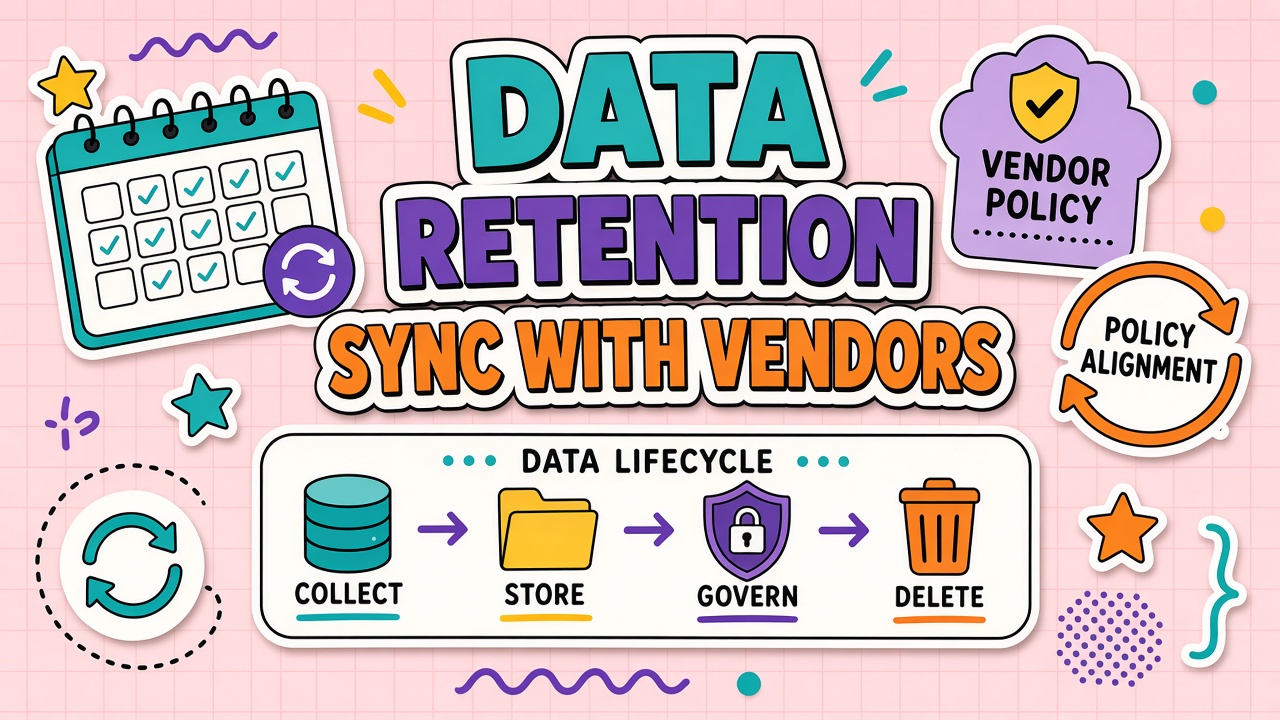
Your privacy policy promises customer data deletion after account closure. Your CRM honors that in 30 days. The AI vendor keeps prompts for 90 days, embeddings for 180, and backups for a year. Misaligned retention creates compliance debt and angry enterprise buyers. AI vendor retention alignment maps your schedules to vendor reality and automates deletion where possible.
Apply this guide when operating AI automation pipelines and AI research platforms that index customer documents for retrieval.
Inventory Retention Periods by System
Build a retention matrix listing every system that stores customer personal data, including AI-specific stores often missed:
- Prompt and completion logs
- Vector embeddings and chunk metadata
- Fine-tuning datasets and evaluation sets
- Moderation and safety review queues
- Analytics aggregates derived from usage
- Support tickets with vendors about customer incidents
For each row, record legal retention minimum/maximum, contractual promise to customers, and actual vendor SLA. Highlight gaps in red for remediation.
Vendor Deletion SLAs and Proof
Contracts should specify deletion timelines after account termination or data subject request. Operationalize:
- Trigger deletion via API or ticket with customer identifier
- Vendor confirms completion date and scope (logs, embeddings, backups)
- Store confirmation certificate or API response hash in compliance archive
- Re-query or spot-check after SLA plus backup window
Some automation vendors offer "delete workspace" that does not purge shared model evaluation sets. Ask explicitly.
| Store type | Typical vendor SLA | Verification |
|---|---|---|
| Prompt logs | 0–90 days | API audit or vendor attestation |
| Embeddings | 30–180 days | Re-retrieval test returns empty |
| Backups | Up to 35–90 days rolling | Contract backup retention clause |
Backup and Log Retention Gaps
Primary database deletion does not guarantee backup expungement. Clarify whether backups are overwritten in place or restorable after customer deletion. Security logs may have longer retention for fraud investigation; segregate identifiers so deleted users are not re-identifiable in aggregated logs where possible.
Internal research notebooks exporting customer samples need the same deletion hooks as production RAG indexes.
Automating Deletion Workflows
Manual vendor tickets do not scale. Automate:
- Account closure webhook fires deletion jobs to all integrated AI vendors
- Data subject request portal queues vendor API calls with status dashboard
- Retry and alert on failure; escalate before statutory deadline
- Versioned runbooks when vendor APIs change
Test automation quarterly with synthetic accounts. Document dependencies: deleting CRM contact should cascade to AI personalization profiles linked by ID.
Retention Mapping Worksheet in Practice
Start the worksheet with customer ID as row key and columns for each store: application DB, object storage, AI prompt logs, embedding index, analytics warehouse, backup snapshots, vendor A, vendor B. Fill retention days and deletion method per cell. Highlight cells where vendor retention exceeds your public promise in red for immediate remediation or notice update.
Deletion verification steps include API call confirmation, search for customer identifier in indexes after deletion job, and vendor attestation email for subprocessors. Schedule reverification annually or after vendor infrastructure changes. Screenshots of empty search results are weak evidence; prefer vendor deletion IDs and timestamps in ticket system.
Backup retention gaps cause the most audit surprises. Production row deleted while backup tape retains copy may still be lawful with documented backup policy, but only if restores are rare and backups are encrypted with restricted access. AI-specific abuse logs may retain prompts longer than product data; align or disclose.
Automate deletion workflows triggered from CRM account closure or privacy request queue. Manual deletion tickets backlog and fail during vacations. Idempotent jobs retry vendor API failures with alerting. Block "account deleted" UI state until all green checks pass or documented legal hold exception exists.
Legal holds pause deletion for named customers without freezing entire queues. Tag held records in worksheet and resume deletion on release. Litigation hold notices should flow to AI vendors if their logs contain held customer content.
Retention Mapping Worksheet
Columns: data category, source system, your policy retention, vendor contractual retention, vendor actual (from test), backup retention, legal hold flag, deletion method, proof artifact. Review quarterly in privacy steering meeting.
Mismatches where vendor retention exceeds your promise require either contract negotiation or customer notice amendment. Silence is not compliance.
DSAR orchestration
Data subject access requests must include AI stores: prompts mentioning the individual, generated content, embeddings retrievable by search. Orchestration platform tracks per-system status until complete.
Automation testing calendar
Quarterly synthetic user lifecycle: create, use automation features, delete, verify empty after SLA. Document failures as vendor tickets with severity tied to compliance risk.
Research notebook cleanup
Research teams export CSVs to notebooks; schedule monthly sweeps for customer samples past retention. Git history may retain data; use BFG or repo retirement policies.
Deletion Automation and Litigation
Webhook-driven deletion from your master privacy request system beats manual tickets. When user requests erasure, enqueue jobs for each vendor with retry and alerting. Surface status in customer portal: received, in progress, completed, blocked by legal hold.
Litigation holds must propagate to AI vendors via formal notice with customer identifiers or date ranges affected. Confirm vendor acknowledges hold and suspends automated deletion jobs for scoped data. Release hold should trigger catch-up deletion queue.
Embedding deletion is non-trivial: removing vectors for one customer may require re-indexing shared corpus if chunks mixed. Architect indexes with tenant isolation upfront to avoid expensive rebuilds. Contract with vendors for tenant-scoped indexes where available.
Sync retention schedules with customer contracts: if enterprise customer contract promises 30-day deletion, your vendor chain must meet 30 days or you disclose longer subprocessors retention in amendment. Misalignment causes renewal losses and regulatory complaints.
Proving Deletion to Auditors
Audit evidence package includes retention matrix, sample deletion tickets with API responses, vendor attestations, and policy version history. Annual sample: pick ten closed accounts, demonstrate all stores empty or anonymized per policy. Failed sample triggers remediation project, not spreadsheet excuse.
Cross-Functional Retention Cadence
Quarterly retention review meeting includes legal, privacy, engineering, and customer success. Compare public policy, DPA commitments, vendor reality, and engineering implementation. Action items assign owners with due dates. Stale matrix older than ninety days without review is an audit finding waiting to happen.
Customer success should know retention limits when promising custom deletion in sales calls. Enablement deck with "what we can delete how fast" prevents impossible commitments that engineering cannot honor without vendor escalation.
When customers ask "prove you deleted my data," respond with deletion certificate listing systems, timestamps, and any legal hold exceptions. Templates speed responses and reduce legal review load. Certificates should match retention matrix rows, not generic marketing language about caring about privacy.
Run an annual "retention fire drill": pick a fictional customer ID and execute deletion end to end in staging, measuring elapsed time per system. Gaps discovered in staging are cheaper than gaps discovered during a regulator inquiry or enterprise renewal audit.
Treat retention sync as a product feature with owners, not a one-time legal project. When engineering ships a new AI connector, the retention matrix row is mandatory before merge, same as unit tests for authentication.
Frequently Asked Questions
Legal hold vs deletion request?
Suspend automated deletion for affected records under hold. Track scope narrowly. Release and purge when hold lifts. AI vendors need hold flags in API if supported.
Litigation preservation?
Coordinate with legal before deleting data relevant to active cases. Policy should define who approves exceptions.
Keep anonymized aggregates?
True anonymization may be retainable; document analysis. Aggregates that re-identify small cohorts may still be personal data.
Customer data across five AI vendors?
Orchestration layer tracks per-vendor deletion status. Customer-facing confirmation only when all complete or exceptions disclosed.
Prove deletion to enterprise customers?
Provide summary letter, vendor certificates, and internal ticket IDs. Some vendors offer customer-facing deletion reports in trust portals.
The Bottom Line
Syncing customer data retention with AI vendor policies starts with a complete inventory, contractual deletion SLAs, backup gap analysis, and automated workflows. Teams running AI automation and research indexes should verify embeddings and logs, not only primary app databases, before telling customers their data is gone.
Vendor Scorecard for Retention Compliance
Score vendors quarterly on deletion SLA adherence, proof quality, and API reliability. Low scores trigger executive escalation before renewal. Prefer vendors with customer-visible deletion status APIs over email-only attestation.
When your policy shortens retention (customer trust initiative), renegotiate vendor configs in batch. Partial vendor compliance forces honest customer communication about longest remaining window.