AI referee assist in sports combines camera tracking, sensor-equipped balls, and challenge workflows to reduce measurable officiating error on offsides, strike zones, and line calls, while human referees retain final authority on subjective judgments and fans still debate close margins. FIFA's 2026 World Cup upgrades semi-automated offside technology to pipe clear positional alerts directly to assistant referees. Major League Baseball's 2026 Automated Ball-Strike challenge system uses Hawk-Eye cameras without replacing plate umpires. This guide explains why fans distrust automation, how soccer and baseball deploy assist tech, latency and stadium UX, governance rules, and limits for teams comparing AI chatbot rulebook parsers with popular AI tools in sports analytics.
What AI Referee Assist Means in Sports
AI referee assist combines multi-camera tracking, sensor-equipped balls, and league-defined challenge workflows to support human officials on offsides, strike zones, and line calls without granting algorithms sole authority over subjective fouls, intent, or interference judgments. FIFA advanced semi-automated offside, MLB Automated Ball-Strike challenges, tennis Hawk-Eye, and cricket DRS each embed different governance rules about who may initiate review and what margins trigger automation versus human discretion.
Why Fans Distrust Automated Calls
Fans distrust automated officiating when technology changes how rules are applied, when reviews slow emotional momentum, when graphics disagree with broadcast intuition, and when accountability for final decisions remains opaque. Research on MLB's ABS notes a bidirectional relationship: enforcement tech does not merely apply existing rules but reshapes them, such as translating a three-dimensional strike zone into a two-dimensional plane at the front of home plate for camera evaluation and fan graphics.
Controversy also stems from delayed offside flags in soccer, where attackers score before assistants raise flags, and from tennis Hawk-Eye challenges that interrupt rhythm. Even accurate calls feel wrong when the human umpire becomes a ceremonial figure while a graphic overrules them on stadium boards. Governance transparency (who initiated review, what threshold triggered alert) moderates backlash more than marginal accuracy gains alone.
Soccer VAR and Semi-Automated Offside
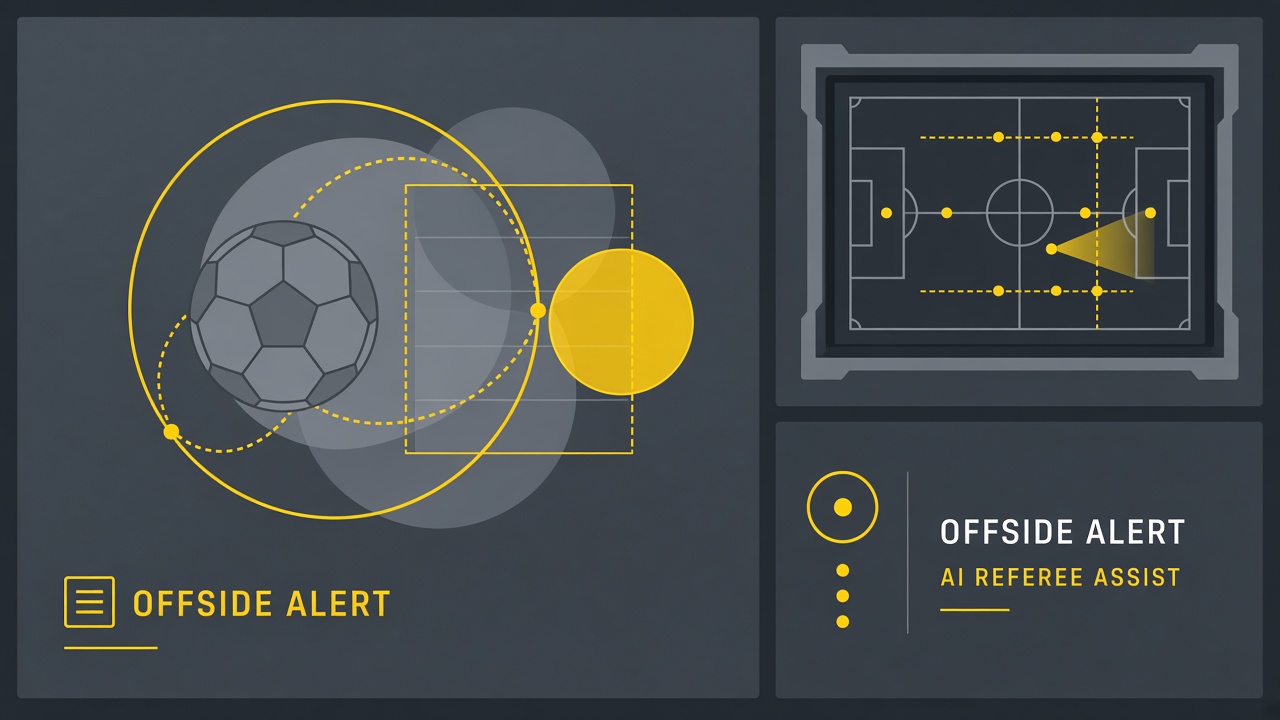
Video Assistant Referees review clear errors on goals, penalties, red cards, and mistaken identity, while semi-automated offside technology (SAOT) uses multi-camera tracking and ball sensors to model player skeletons and determine whether attackers were ahead of the second-last defender at the moment of the pass. FIFA deployed SAOT at the 2022 World Cup with 3D animations shown in stadiums. The 2026 tournament introduces advanced SAOT that sends real-time audio alerts to assistant referees for clear positional offsides above roughly 10 centimeters, tightened from earlier 50 centimeter thresholds tested at club events.
SAOT handles positional offside only. It does not decide whether an offside player interfered with play, blocked a goalkeeper's view, or gained an advantage from a deflection. Those subjective calls remain with on-field officials and VAR. Technology also struggles when players are grounded, clustered, or separated by less than the alert threshold.
| Technology | Sport | Automated scope | Human retains |
|---|---|---|---|
| Advanced SAOT | Soccer | Clear positional offside alerts | Interference, fouls, final flag |
| VAR booth | Soccer | Replay review on defined incidents | Subjective interpretation |
| Hawk-Eye ABS | Baseball | Ball-strike on challenge | Live ball-strike calls |
| Hawk-Eye line review | Tennis | In/out on player challenge | Foot faults, conduct |
Tennis Hawk-Eye and Baseball Strike Zones
Tennis Hawk-Eye reconstructs ball trajectory for challenged line calls; MLB's ABS uses 12 stadium cameras to locate pitches within a batter-height-adjusted strike zone when pitchers, catchers, or batters tap their helmet to challenge. Each MLB team receives two challenges per game, retaining a challenge on successful overturns. Early 2026 season data reported roughly 55 percent of challenges overturned, with pitchers and catchers succeeding more often than batters. Reviews target about 15 seconds with graphics on outfield boards.
ABS accuracy studies cited by MLB locate 95 percent of pitches within 0.39 inches of true position, yet humans still call live strikes until challenged. Personalized zone height (top at 53.5 percent of batter height, bottom at 27 percent) differs from traditional umpire zones, fueling debate about whether automation enforces the rulebook or a new standard.
Latency and Stadium UX
Officiating assist succeeds when review latency stays below fan attention thresholds and stadium graphics explain decisions in plain language without jargon-heavy skeletal models. FIFA's direct-to-assistant audio alerts aim to raise flags before goals develop, reducing injury risk and controversy from delayed whistles. Baseball optimizes for sub-20-second challenge cycles. Tennis players receive limited challenges per set, disciplining use.
Broadcast overlays must match in-stadium displays to prevent parallel realities for attendees versus TV viewers. Referee body cameras debuting at the 2026 World Cup add transparency footage but also new privacy and editorial policies for how clips air.
Cricket DRS and Rugby TMO
Cricket's Decision Review System combines ball-tracking, edge detection, and replay for lbw, catches, and run-outs, with umpire's call retaining some on-field decisions inside impact margins. Teams receive limited reviews per innings; unsuccessful reviews are lost. Hawk-Eye predicts ball path after pad impact, a physics problem distinct from soccer skeletal tracking. Fans debate umpire's call when impact is 50 percent on stump line but original out decision stands.
Rugby's Television Match Official reviews try grounding and forward passes under strict communication protocols with the on-field referee. The TMO cannot initiate all reviews; captain requests and referee discretion gate access. Latency is less visible to stadium fans because many reviews occur during stoppages already, but flow complaints persist when TMO sequences exceed two minutes.
Governance: Who Can Overturn
Leagues define which roles may initiate technology review, how many challenges exist, and whether on-field officials can override sensor output when they suspect malfunction. FIFA instructs assistant referees that they may keep flags down if they believe SAOT erred. MLB plate umpires still announce outcomes after ABS review, becoming the public face of overturned calls. Cricket's Decision Review System limits player-initiated reviews per innings with umpire's call margins on impact and pitching.
LLM rulebook assistants can help broadcasters and journalists summarize laws quickly, but they are not authorized decision makers. Feeding outdated rule PDFs into AI chatbot tools risks hallucinated interpretations; official league APIs and human referee supervisors remain the source of truth.
Broadcast and Betting Integrity
Sportsbooks and fantasy platforms consume officiating data feeds; delayed or corrected calls after goals stand create integrity incidents when bets settled on incomplete information. Leagues coordinate VAR announcements with betting partners on protocol delays. Hawk-Eye pitch graphics shown on TV influence public perception even when live calls stand until challenged. Transparent timestamps on when technology input became available help analysts separate officiating error from product design choices.
Tennis continues to refine Hawk-Eye live line calling at select tournaments, reducing player challenges but changing the drama of human overrules. NBA replay centers in Secaucus review last-two-minute scenarios with multiple camera angles; subjective foul judgment stays local. NFL uses coach challenges with automatic reviews in final minutes, a hybrid governance model soccer debates when VAR checks every goal sequence.
Fan forums train large language models on passionate but inaccurate rule interpretations. Media outlets using AI chatbot assistants for explainer articles must cite official league rulebooks and post-match referee audio where published. Semi-automated offside will not end debates on handball arm position or goalkeeper obstruction; those judgments require human interpretation under IFAB guidance that technology vendors cannot encode without controversy.
Stadium UX designers now storyboard challenge moments: helmet tap gesture, review clock, graphic reveal, and umpire or referee announcement order. MLB players report strategic challenge hoarding late in games when a single borderline strike could change leverage counts. Soccer assistants trained on 2026 audio alerts must practice ignoring false positives when the system misidentifies tight overlaps, preserving the IFAB principle that technology informs but does not command the flag. Youth leagues adopting simplified VAR-lite should not copy professional thresholds without calibrating for slower play and fewer cameras.
Hawk-Eye tennis line calling at Grand Slam events set precedent for invisible automation: players lost the drama of human overrules but gained consistency on baseline rallies. Baseball chose the opposite philosophy in 2026 by keeping human ball-strike calls live and limiting ABS to challenges, preserving umpire personality while adding accountability. Soccer's 2026 innovation routes only clear positional offsides to assistant earpieces, a middle path between full VAR delay and silent automation. Each sport's governance body weighs tradition, broadcast product, and player union input differently; no single AI referee model fits all rulebooks. Fans attending matches in person deserve the same graphical explanations shown on broadcasts when challenges occur, or stadium trust erodes even when calls are technically correct.
Frequently Asked Questions
How does cricket DRS compare?
DRS combines ball-tracking, UltraEdge audio, and replay for lbw, catches, and run-outs. Umpire's call retains some original decisions inside margin thresholds. Player reviews are capped per innings unlike unlimited VAR checks in some soccer leagues.
Will the NBA adopt full robot officiating?
The NBA uses replay centers for last-two-minute reviews and goaltending automation in some contexts, but foul judgment (charge vs block) remains human. Full automation of contact fouls is not imminent given subjective intent rules.
Can camera placement bias tracking?
Calibration errors and occluded limbs skew skeletal models. Leagues run pre-match calibration and fail-safe protocols. Independent audits matter when single vendors supply multiple competitions.
Are robot umpires replacing humans?
MLB ABS and FIFA SAOT augment rather than replace on-field officials in 2026 deployments. Labor relations, fan tradition, and subjective rule categories slow full automation.
What improves fan acceptance?
Faster reviews, consistent stadium graphics, published challenge success rates, and clear explanation when technology cannot decide (too close to call). Hiding sensor uncertainty breeds conspiracy theories.
Where should analysts explore tools?
Broadcast tech and team performance analytics overlap with officiating data. Browse popular AI tools for video analysis, but separate league-certified officiating stacks from consumer highlight apps.
What ball technology debuts at World Cup 2026?
The adidas Trionda match ball includes a 500 Hz sensor aiding kick-off detection and last-touch identification for corner and goal-line reviews. Ball tracking complements SAOT but does not replace human judgment on interference calls.
How does ABS affect umpire morale?
Early 2026 reports note umpires face stadium scrutiny when ABS overturns their calls on videoboards. Leagues should provide psychological support and clarify that challenge success rates reflect tight margins, not incompetence.
Why did FIFA tighten the offside alert threshold?
Earlier SAOT tests at 50 centimeters let marginal offsides play on before VAR review, increasing injury risk and fan frustration. The 2026 roughly 10 centimeter audio alert threshold flags clearer positional violations earlier while leaving borderline calls to humans.
Will LLMs ever officiate matches?
Rulebook LLMs may assist training and media explainer workflows, but real-time foul judgment requires contextual intent reading that current leagues do not delegate to language models. Governance bodies treat LLM output as advisory text only.