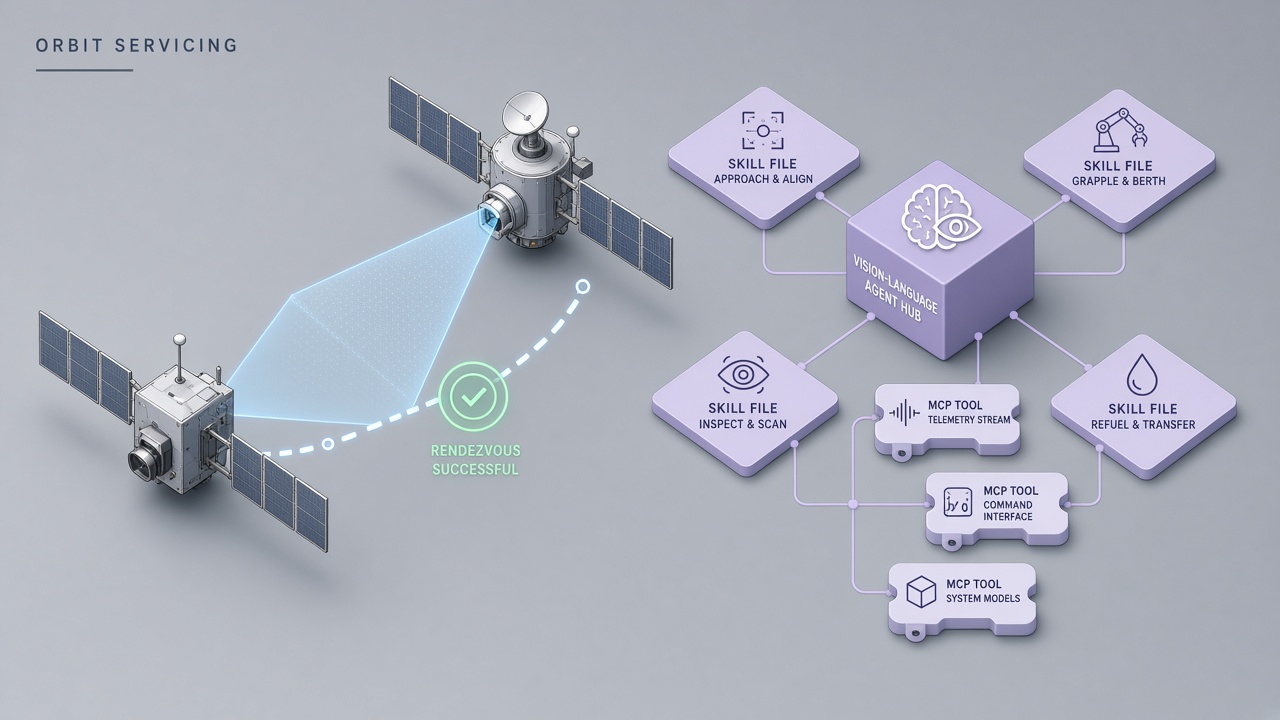
Servicing a satellite in orbit is not a single maneuver. A servicer spacecraft must approach safely, match attitude, inspect damage, possibly grasp or refuel a client, and retreat without creating debris. Each phase spans minutes to hours with delayed telemetry, partial observability, and no opportunity to reboot if the controller fails mid-task. Traditional autonomy stacks hard-code state machines for each mission. New research treats the servicer as an embodied agent that sees through cameras, reasons in natural language, and invokes tools for motion control. SpaceMind on-orbit servicing AI is a modular vision-language agent framework (arXiv 2604.14399) that decomposes knowledge into skill files, exposes hardware through the Model Context Protocol (MCP), and accumulates experience via self-evolution without fine-tuning model weights.
On-orbit servicing, assembly, and manufacturing (OSAM) missions are moving from demonstration to commercial contracts. Northrop Grumman's MEV missions docked with Intelsat satellites; future servicers will need more flexible autonomy when clients vary and tasks are not fully scripted. Teams evaluating AI chatbot products for mission operations should understand that VLM agents differ from conversational chatbots: they close perception-action loops under safety constraints. For broader context on research explainers, browse the EliteAI.tools blog index.
What SpaceMind On-Orbit Servicing AI Means in Plain Language
SpaceMind on-orbit servicing AI is a vision-language model agent framework where a VLM perceives camera images, selects skill modules, calls MCP-configured control tools, and issues motion commands to execute multi-phase satellite servicing tasks. Unlike a chatbot that outputs text, SpaceMind closes the loop: images enter the VLM, the agent chooses actions (translate, rotate, activate sensor), the environment updates, and the cycle repeats until the task completes or aborts.
The framework separates three extensible dimensions. Skill modules package domain knowledge (rendezvous procedures, inspection checklists) with LLM-based dynamic routing to pick the right skill per situation. MCP tools expose thruster commands, camera settings, and simulation hooks through configurable profiles. Reasoning modes (Standard, ReAct, Prospective) switch how the agent plans: direct action, iterative thought-action-observation loops, or multi-candidate prediction with selection. A Redis message bus decouples the agent from the backend so the same code runs in Unreal Engine 5 simulation and physical laboratory hardware.
| OSAM task phase | Agent responsibility | Sensor inputs |
|---|---|---|
| Far-range approach | Coarse navigation toward client orbit | Wide-field camera, GNSS, ground updates |
| Proximity operations | Relative pose estimation, hold points | Stereo vision, LiDAR, fiducial markers |
| Inspection | Traverse client surface, detect anomalies | High-resolution imagers, lighting control |
| Capture / servicing | Grasp, refuel, or module swap | Force-torque, contact sensors, arm cameras |
Why OSAM missions need agent architectures
OSAM missions face heterogeneous clients, degraded sensors, and task variations that break fixed scripts; agent frameworks adapt by routing skills and evolving learned files from prior episodes. A servicer approaching an unknown client may encounter sun glare, missing fiducials, or attitude drift. Hard-coded trees require engineer updates for each scenario. SpaceMind's Prospective reasoning mode predicts multiple action candidates and selects among them, which the authors show succeeds on search-and-approach tasks under degradation where Standard and ReAct modes fail.
How the Underlying AI Pipeline Works
SpaceMind runs a closed perception-reasoning-action loop: cameras capture frames, the VLM receives images plus hierarchical memory context, dynamic routing selects a skill module, MCP tools execute low-level commands, and observations return through Redis to the agent. Skill Self-Evolution reflects on completed episodes, writes structured learned skill files, and injects them into future runs so operational knowledge accumulates without gradient updates to the VLM.
Skill modules and MCP tool profiles
Skill modules are declarative packages: instructions, constraints, and tool bindings for a mission phase. An LLM router reads the current observation summary and picks the active skill. MCP standardizes how tools appear to the agent (thruster burn, camera exposure, hold position). Configurable tool profiles limit which commands are available per phase, preventing dangerous actions during far-range approach. This mirrors terrestrial robotics stacks that gate high-power actuators behind state guards, but the gates are expressed as agent configuration rather than C code branches.
Standard, ReAct, and Prospective reasoning
Standard mode issues direct decisions from the VLM; ReAct iterates explicit thought-action-observation steps; Prospective mode generates multiple candidate action sequences and scores them before execution. Under nominal conditions all three modes achieved 90 to 100% navigation success across SpaceMind experiments. Under deliberate degradation (sensor noise, occlusions, initial pose error), Prospective mode uniquely completed search-and-approach tasks where other modes failed. ReAct helps when intermediate reasoning must be auditable for mission review boards.
Skill Self-Evolution reflects on completed episodes
After each episode the agent reflects on success or failure, distills lessons into JSON-like learned skill files, and loads them on subsequent runs. In the paper's self-evolution study, four of six experimental groups recovered from a single failed episode, including one group rising from 0% to 100% success and inspection scores improving from 12 to 59 out of 100. Knowledge persists in auditable files rather than opaque weight changes, which matters for space certification where engineers must trace why the agent behaved a certain way.
Simulation-to-orbit transfer via MCP-Redis
The MCP-Redis abstraction layer lets SpaceMind send the same command messages whether the backend is a UE5 high-fidelity simulator or a physical laboratory robot testbed. Authors report zero code modification for sim-to-real transfer on rendezvous tasks, with 100% rendezvous success in physical validation. The sim-to-orbit gap remains wider than sim-to-lab: radiation, communication delay, and propellant uncertainty are not fully modeled in UE5. The architecture reduces software friction; environmental fidelity still demands mission-specific validation.
| Component | Function | Extension path |
|---|---|---|
| VLM decision hub | Perceive images, plan actions | Swap backbone model via config |
| Skill router | Select mission-phase module | Add new skill YAML or JSON files |
| MCP tool layer | Execute motion and sensor commands | Register new tools with profiles |
| Hierarchical memory | Recent steps plus compressed history | Tune window and summary policy |
| Learned skill files | Persist episode reflections | Curate or prune via ground review |
Typical workflow steps
- Define mission skill modules (approach, inspect, capture) and MCP tool profiles with safety limits.
- Configure reasoning mode (Standard for nominal ops, Prospective for degraded search).
- Run closed-loop episodes in UE5 simulation across satellite models and initial conditions.
- Enable Skill Self-Evolution; review generated learned skill files before flight adoption.
- Transfer same agent binary to hardware-in-the-loop lab via Redis backend swap.
- Conduct phased on-orbit demonstration with ground operator veto and telemetry logging.
Real Deployments and Published Evidence
SpaceMind is published on arXiv (2604.14399) with open-source code at github.com/wuaodi/SpaceMind, reporting 192 closed-loop runs across five satellite models, three task types, three reasoning modes, three initial conditions, and two environments. Experiments used a high-fidelity UE5 simulation and a physical laboratory testbed. The work was presented at the IAA Conference on AI in and for Space (SPAICE 2025) and is under review at Acta Astronautica.
Nominal navigation success rates reached 90 to 100% across reasoning modes. Degraded-condition tests showed Prospective reasoning's advantage on search-and-approach. Self-evolution recovered performance in four of six groups from a single failure. Physical rendezvous validation achieved 100% success without code changes between simulation and hardware backends. These results are laboratory-scale evidence, not flight heritage on operational servicers, but they establish a reproducible benchmark for VLM-agent OSAM research.
Commercial OSAM programs (MEV, future refueling demonstrators, debris removal concepts) still rely heavily on human-supervised autonomy and pre-approved maneuver blocks. SpaceMind represents a research path toward more adaptive servicing when client diversity and partial failures exceed scripted coverage. Integration with existing flight software frameworks (cFS, ROS2 space ports) remains an engineering task beyond the published MCP-Redis prototype.
Comparison with traditional autonomy stacks
Classical GNC (guidance, navigation, control) uses Kalman filters, model-predictive control, and verified state machines with formal hazard analysis. VLM agents add semantic reasoning over visual scenes (identify docking port, read damage labels) that geometric pipelines handle poorly. The risk is nondeterminism: VLMs can hallucinate actions. SpaceMind mitigates through tool gating, skill boundaries, and auditable learned files, but flight certifiers will demand deterministic fallbacks and operator override at every critical hold point.
Limits, Risks, and Ethical Guardrails
SpaceMind on-orbit servicing AI has not flown on operational missions; VLM latency, hallucination, and sim-to-orbit environmental gaps remain open risks before autonomous capture or refueling without human approval. Laboratory rendezvous success does not prove robustness to space radiation effects on compute, solar glare on cameras, or multi-second communication delays with ground veto.
- Hallucinated commands: VLMs may propose physically impossible or unsafe maneuvers; MCP profiles must hard-limit thrust and envelope.
- Debris creation: Failed grasp or collision generates trackable debris; autonomy errors have orbital consequences unlike terrestrial robots.
- Dual-use concerns: Proximity operations technology applies to inspection and to anti-satellite approaches; export control applies.
- Certification gap: Learned skill files evolve at runtime; regulators may require frozen configurations for licensed missions.
Ethical guardrails include human-on-the-loop approval for client contact, transparent logging of VLM reasoning traces, international coordination on servicing standards (CONFERS industry forum), and debris mitigation plans for every autonomous maneuver. Servicing extends satellite life and can reduce launch demand, but it also enables persistence of legacy assets in crowded orbits.
Who Should Use This and Who Should Wait
OSAM research labs, university space robotics groups, and mission autonomy teams prototyping in simulation should evaluate SpaceMind now for skill-modular VLM control architectures. Commercial operators planning revenue servicing flights should wait for flight-qualified GNC with formal verification, using SpaceMind concepts as R&D input rather than flight software.
| Audience | Recommendation | Caveat |
|---|---|---|
| University OSAM lab | Clone SpaceMind; test Prospective mode under sensor degradation | UE5 physics differs from orbital dynamics |
| Servicing startup (pre-flight) | Prototype skill files and MCP tool boundaries in sim | Plan deterministic fallback GNC for certification |
| Satellite operator client | Require human-supervised demo before contract autonomy | Insist on debris and liability clauses |
| Conversational AI vendor | Wait; embodied space agents differ from chatbots | Safety case requires aerospace partnership |
Frequently Asked Questions
Is SpaceMind flight-ready for on-orbit servicing?
No. SpaceMind is a research framework validated in UE5 simulation and laboratory hardware; it has not been demonstrated on orbit. Flight adoption requires radiation-hardened compute qualification, communication delay handling, and regulatory approval beyond published results.
Is Skill Self-Evolution safe for space missions?
Self-evolution improves task scores in experiments but modifies runtime behavior through learned skill files; mission operators should gate automatic injection behind ground review until certification paths exist. Auditable files help traceability, yet evolving autonomy conflicts with frozen flight software baselines common in launch licensing.
When should operators use Prospective reasoning over ReAct?
Use Prospective mode when degraded sensing or search-and-approach uncertainty requires comparing multiple action candidates; use ReAct when auditable step-by-step reasoning is needed; use Standard for nominal phases with clear observations. Published results show Prospective uniquely succeeding on degraded search tasks where other modes failed.
What does the MCP-Redis layer do?
MCP exposes tools to the VLM in a standard protocol; Redis message bus decouples the agent from simulation or hardware backends so identical agent code runs in UE5 and the physical lab without modification. This addresses software sim-to-real transfer, not full orbital environmental fidelity.
Which vision-language model does SpaceMind use?
The framework is model-agnostic via configuration; experiments in the paper use VLM backbones suitable for embodied control, swappable without rewriting skill modules. Production missions would evaluate latency, power draw, and radiation tolerance per avionics stack.
How does SpaceMind compare to traditional OSAM GNC software?
Traditional stacks offer verified deterministic control; SpaceMind adds semantic visual reasoning and modular skill evolution at the cost of nondeterminism and immature certification status. Hybrid architectures that wrap VLM planning around verified low-level controllers are a plausible near-term path.
Is SpaceMind open source?
Yes. Code is available at github.com/wuaodi/SpaceMind with paper details at arXiv:2604.14399. Reproduce the 192-run benchmark before adapting to proprietary servicer avionics.
Conclusion
SpaceMind on-orbit servicing AI frames autonomous satellite servicing as a modular vision-language agent problem: skill modules with dynamic routing, MCP tool profiles, injectable reasoning modes, hierarchical memory, and Skill Self-Evolution that distills episode experience into persistent files. Published experiments across simulation and laboratory hardware show strong nominal navigation, Prospective reasoning under degradation, and sim-to-lab transfer without code changes. OSAM missions still demand flight-qualified GNC, debris mitigation, and human oversight before commercial autonomous capture. Teams exploring this space should treat SpaceMind as an architectural reference for embodied space agents, validate every learned skill file on the ground, and plan deterministic fallbacks for any maneuver that risks client contact or orbital debris.