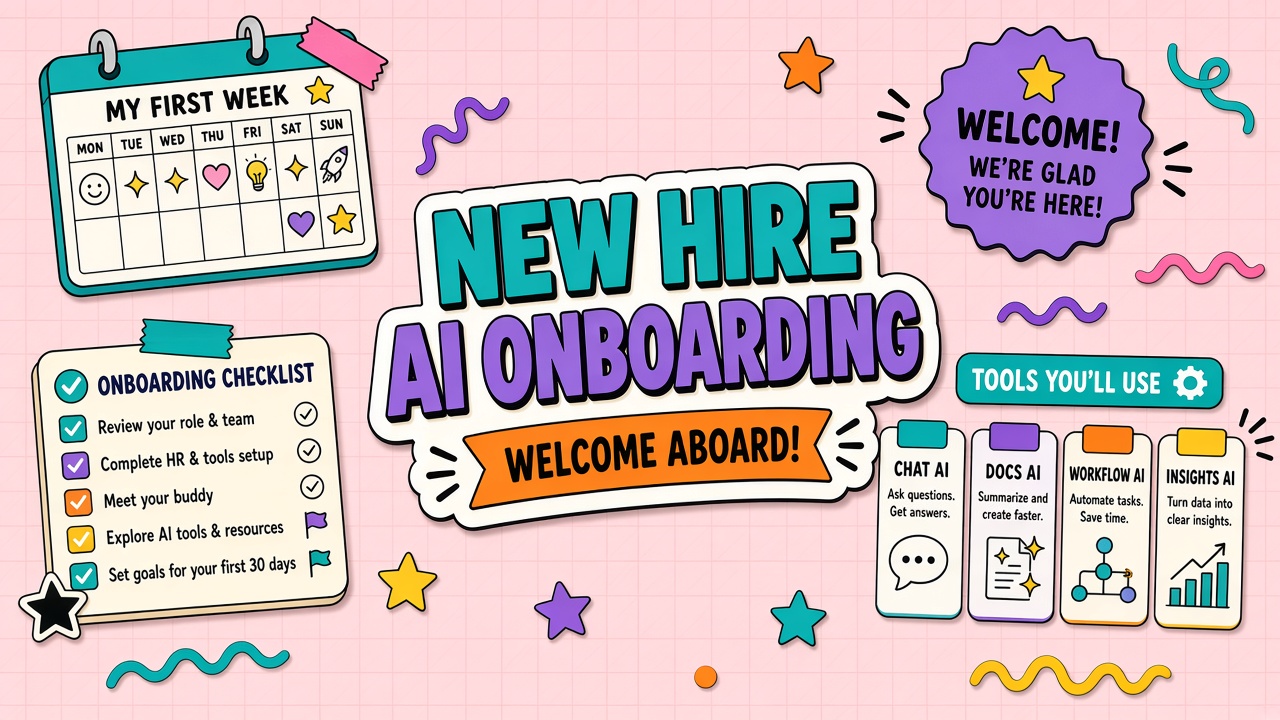
New hires learn your Slack channels and expense policy in week one. If AI rules arrive as a vague "be careful" aside, they will paste client data into the wrong tab before HR finishes desk setup. A structured new hire AI onboarding sequence spreads policy, tool access, shadowing, and supervised practice across five days so competency is observable, not assumed.
This day-by-day plan fits teams standardizing on AI productivity tools and AI chatbot workflows. Adjust timings for part-time or remote cohorts; keep checkpoint order intact.
Day 1: Policy and Accounts
Before any generation, new hires read policy and receive only approved accounts. Day 1 checklist for manager and IT:
- Assign AI policy module in LMS with completion due end of day
- Provision approved tool accounts; block personal vendor signup on corporate email
- Walk through risk tiers: public, internal, client, regulated with team examples
- Share team charter link with pre-approved and ask-first task lists
- Introduce security contact and how to report mistaken paste incidents without punishment for honest mistakes
Manager holds a fifteen-minute live Q&A after the module. Document questions that reveal policy gaps; update charter same week if the same confusion appears twice.
Day 2: Shadow an Approved Workflow
Shadowing connects abstract policy to real clicks. Pair the new hire with a certified buddy for two workflow runs:
- Watch buddy execute workflow start to finish narrating checkpoints
- Review prompt source in governed library, not buddy's private notes
- See where output lands (CRM, wiki, customer email draft queue)
- Discuss one near miss or quality fix from recent weeks
Prefer workflows using productivity integrations the hire will use daily. Avoid rare edge workflows on day two unless role-specific.
Day 3: Supervised First Task
New hire executes one low-risk production task with buddy co-piloting. Task criteria:
- Internal or low-risk tier only
- Single workflow with checklist visible
- Real input, not synthetic toy data, so mistakes teach real handling
- Buddy signs QA form: pass with edits, retry required, or escalate to manager
Debrief five minutes: what felt unclear, which policy line helped, where they wanted to shortcut. Shortcuts often reveal UX friction in your tool setup, not laziness.
Day 4-5: Feedback and Certification Quiz
Days four and five add solo practice with review and a lightweight certification.
Day 4:
- New hire runs two tasks solo; buddy async review within four hours
- Manager feedback on communication and policy adherence, not only output quality
- Optional intro to chatbot tools if role requires, still internal tier
Day 5:
- Ten-question certification quiz: data tiers, approved tools, escalation paths, where prompts live
- Practical scenario: "Customer spreadsheet attached; what do you do?" with multiple choice and one short answer
- Pass threshold defined in advance (commonly eighty percent plus manager sign-off on scenario answer)
- Record certification date in HR or ops tracker; set refresher at six months or on major policy change
| Day | Focus | Exit checkpoint |
|---|---|---|
| 1 | Policy and accounts | LMS complete, accounts live |
| 2 | Shadow workflow | Buddy sign-off on observation |
| 3 | Supervised task | QA form pass with edits allowed |
| 4-5 | Solo plus cert | Quiz pass and manager approval |
Manager Responsibilities Each Day
Managers anchor week-one AI onboarding; buddies execute tasks. Day 1 manager confirms LMS completion and accounts. Day 2 manager confirms shadow pairing scheduled. Day 3 manager reviews QA form within twenty-four hours. Day 4 manager gives behavioral feedback, not only output critique. Day 5 manager signs certification or schedules remediation with clear date. Manager absence is the top reason onboarding compresses to "here is the tool, good luck."
Extending the Sequence for Specialist Roles
Engineering, support, and marketing hires need different day-four tasks but the same policy foundation. Add one role-specific supervised workflow in week two after certification: engineers on code-assist policy, support on macro tiers, marketing on brand review chain. Do not overload week one with every tool in the stack; depth on two workflows beats shallow tours of six products.
Feedback Loop to Policy Owners
Week-one confusion signals policy debt. Collect new hire FAQ list at day five; send to security and ops owners weekly during hiring seasons. Repeated questions about the same tier or tool mean charter or LMS module needs rewrite, not another verbal explanation in the next cohort.
Successful onboarding programs version like software: v1.3 after Q2 hires clarified chatbot tier examples.
Buddy Selection and Training
Buddies need certification plus coaching skill, not only seniority. Pick buddies who follow charter reliably and can explain why a step exists. Brief buddies on feedback tone: specific, kind, tied to policy. Buddy checklist covers shadow session, supervised task QA form, day-four async review SLA, and escalation to manager if new hire attempts client-tier work early.
Remote and Hybrid Cohorts
Remote onboarding requires explicit screen-share protocols. Record shadow sessions with consent for async replay in other time zones. Use shared checklist doc ticked live during supervised task. Certification quiz remains closed-book on policy; practical scenario may be live video explain-back to manager instead of multiple choice when role is high-touch client facing.
Ship hardware tokens or SSO test accounts before day one so day one is not IT ticket purgatory while policy module waits.
Program Setup for HR and Managers
Before cohort starts: LMS module updated, accounts provisioned, buddy roster staffed, certification quiz current, QA forms templated, manager calendar holds daily five-minute check-ins week one. HR triggers day one module assignment automatically on start date. IT validates SSO and tool access ticket closed before day one standup. Managers receive buddy checklist and escalation contacts single pager.
After cohort: aggregate day five FAQ to policy owners; track certification pass rate and remediation rate; update program version when pass rate drops below target two cohorts running. Onboarding program is production software serving human releases; maintain it with same seriousness as customer-facing features.
Certification Remediation Path
First fail: buddy remediation session same week covering missed policy areas, retake within two business days. Second fail: manager conversation on role requirements and extended shadowing. Third fail: role placement review with HR. Remediation materials version when quiz changes; do not retest on stale modules.
Scaling for Hiring Cohorts
When five or more hires start same week, assign one lead buddy plus floater buddy for overflow, stagger supervised tasks across days to avoid buddy bottleneck, run one group policy Q&A with manager, and batch certification quiz grading same day to unblock week two work. Cohort scale fails when every buddy duplicates the same shadow session five times live; record once, require watch plus quiz for cohort members before supervised task.
Tooling Checklist for IT Before Day One
IT completes before start date: SSO group membership for approved AI tools, block list for consumer signup on corporate email domain, MFA enforced, laptop policy scan for unauthorized extensions, and test login from hire equipment. Manager verifies checklist ticket closed in morning standup day one. Day one policy module before first generation is non-negotiable sequence.
Hires who generate client-adjacent content before accounts provisioned correctly often paste into personal tools creating incidents IT could have prevented with checklist discipline.
Measuring Onboarding Effectiveness
Track certification pass rate first attempt, time to first solo approved task, incident rate in first ninety days compared to tenured peers, and new hire confidence survey score on policy clarity. Low confidence with zero incidents still signals future risk when pressure rises. Program owners review metrics quarterly and version LMS content when pass rate drops two cohorts in a row.
Manager Sign-Off Criteria After Week One
Manager signs week-one completion when LMS done, certification passed, supervised task QA passed, buddy confirms no policy red flags, and hire can articulate three ask-first examples from memory. Sign-off recorded in HRIS or ops tracker. Week two assigns first low-risk recurring task with async review only if sign-off complete.
Contractor Compressed Track
Contractors complete day one policy, day two recorded shadow, day three supervised task, day four cert quiz same week. Skip only content irrelevant to SOW scope documented in writing. Compressed track still requires pass; no waiver for "short contract" on client-tier rules.
Refresh for Tenured Transfers
Internal transfers new to team complete days one through three even if tenured at company: team charter, shadow, supervised task. Skip only company-wide LMS if current within twelve months. Team-specific AI rules differ across departments more than HR assumes.
LMS Content Refresh Triggers
Refresh LMS module when charter version increments, new approved vendor added, or incident tied to onboarding gap. Version number visible on completion certificate so managers know hire trained on current rules not outdated module from prior year.
Welcome email from manager includes AI charter link and buddy name before day one so hire reads policy expectations before first login temptation to test random tools.
Frequently Asked Questions
Do contractors follow the same week-one sequence?
Same policy and certification before client-tier work. Compress days if contract length is short but do not skip supervised task or quiz.
International hires in different time zones?
Async LMS and recorded shadow session day two; live supervised task when overlap hours exist. Certification quiz can be async with proctoring honor code or live video.
Experienced hire already knows AI tools. Skip onboarding?
Skip vendor tutorials, not policy or your library locations. They still need certification on your tiers, approved stack, and escalation paths.
What if they fail certification?
Remediation day with buddy, retake within two business days. Repeated failure triggers manager conversation on role fit or additional training, not silent waiver.
The Bottom Line
Onboard new hires to AI tools across five days: policy and accounts, shadowing, supervised execution, solo practice, and certification. Observable checkpoints beat assuming smart people will infer your rules from context.