GPU clusters crossed a thermal threshold in 2026. Single AI racks routinely draw more than 100 kW, with Nvidia's Vera Rubin NVL72 roadmap targeting 300 kW per rack and Google publicly discussing 1 MW rack designs. Liquid cooling for AI data centers is no longer an optional upgrade for frontier training sites. It is the default specification for any facility hosting Blackwell-class and next-generation accelerators.
This analysis explains why air cooling hit physical limits, maps the direct liquid cooling (DLC) vendor landscape, breaks down retrofit cost factors for brownfield sites, and offers an operator planning checklist for teams building on AI code and AI infrastructure.
Why Air Cooling Hit Its Thermal Ceiling
Conventional air cooling cannot reliably remove heat from AI racks above roughly 40 to 50 kW without excessive fan power, hot spots, and throttled GPU performance. Dell'Oro Group reported the liquid cooling market nearly doubled in 2025, approaching $3 billion, with forecasts reaching $7 billion by 2029. S&P Global Market Intelligence 451 Research found only 45% of data centers ran purely on air cooling in late 2025, down from 48% in 2024, while 59% planned liquid cooling within five years.
Nvidia's density roadmap illustrates the gap. Blackwell GB300 racks peak near 163 kW. Vera Rubin NVL72 targets 300 kW per rack in 2026 with warm-water direct liquid cooling at 45 degrees Celsius, allowing dry coolers to reject heat without mechanical chillers. Rubin Ultra NVL576 may exceed 600 kW per rack by 2027. Legacy A100-era air-cooled designs assumed roughly 10 to 15 kW per rack. The four-decade air cooling paradigm served general enterprise servers well but cannot scale linearly with tensor-core power draw.
Fan energy compounds the problem. As rack density rises, airflow management requires larger CRAC units, higher static pressure, and more aisle containment. Operators report fan power consuming 15 to 25% of total facility energy at high-density air sites, eroding the TCO advantage of cheaper upfront cooling capex. Liquid systems move heat at the source, reducing the volume of air that must circulate through the white space.
| Cooling method | Typical rack density | 2026 AI fit |
|---|---|---|
| Conventional air | 5 to 15 kW | Legacy inference, general compute |
| Rear-door heat exchanger | 30 to 60 kW | Bridge retrofit, partial density uplift |
| Direct-to-chip (DLC) | 100 to 300+ kW | Frontier GPU training clusters |
| Immersion | Very high density | Specialized HPC, greenfield pods |
DLC Vendor Landscape in 2026
Direct-to-chip liquid cooling holds roughly 47% of the AI data center liquid cooling segment in 2026, with cold plates mounted on GPUs and CPUs routing coolant through coolant distribution units (CDUs) to facility loops. Future Market Insights valued the AI datacenter liquid cooling market at $3.2 billion in 2025, projecting $3.7 billion by end of 2026 and $17.8 billion by 2036 at a 16.9% CAGR.
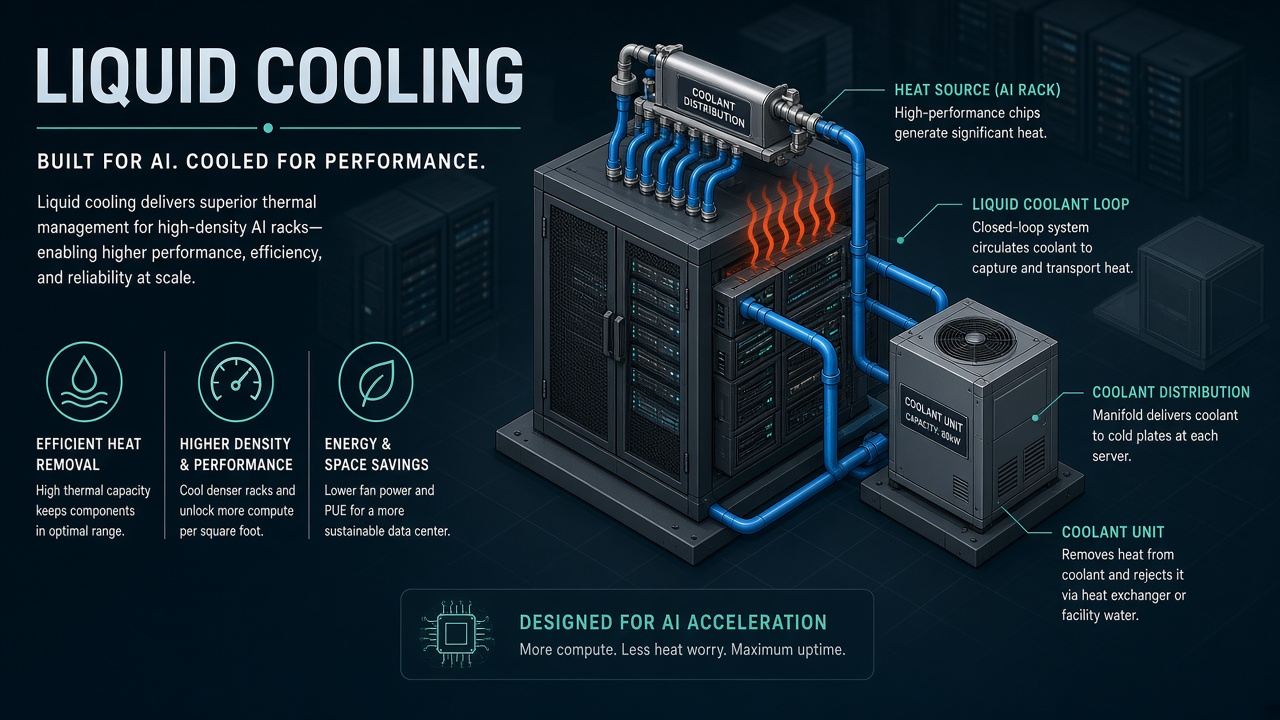
The vendor stack spans three layers. Server OEMs (Dell, HPE, Supermicro, Lenovo) ship DLC-ready GPU servers with factory-installed cold plates and leak detection. CDU manufacturers (CoolIT, Boyd, Motivair, GRC) provide rack-level or row-level distribution with redundant pumps and filtration. Facility integrators (Vertiv, Schneider Electric, Stulz) connect CDU loops to chillers, dry coolers, or warm-water rejection systems. Nvidia specifies direct liquid cooling for GB200 and Rubin compute nodes, effectively mandating DLC for buyers on its reference architectures.
Hyperscaler deployments set the pace. Meta committed $800 million to a liquid-cooled AI data center in Indiana and demonstrated a 140 kW liquid-cooled rack at OCP Global Summit 2024. Colocation operators including Equinix and Digital Realty market "liquid-ready" campuses with pre-provisioned CDU capacity and higher per-rack power feeds. Greenfield AI campuses in Virginia, Ohio, and Nordic regions increasingly specify warm-water DLC from day one to avoid retrofitting within two product cycles.
Retrofit Cost Factors for Brownfield Sites
Retrofitting legacy air-cooled facilities for AI density requires phased pod upgrades, not wholesale building replacement, but costs vary widely based on power headroom, floor loading, and coolant loop isolation. Build Inc's 2026 retrofit analysis identifies three zones: air-cooled areas that remain unchanged, hybrid zones with rear-door heat exchangers, and liquid-ready zones requiring full DLC with revised operations procedures.
Major cost drivers include electrical upgrades (dual 60A or 80A feeds per rack), CDU floor space and weight loading, coolant chemistry monitoring, leak containment trays, and operator training for two-phase versus single-phase systems. Rear-door heat exchangers extend useful life of existing halls but do not satisfy 100 kW+ GPU requirements. Direct-to-chip remains the practical path for serious AI density when the building has sufficient power and heat rejection capacity.
TCO comparisons should include capex (cold plates, CDUs, piping, commissioning), opex (coolant maintenance, pump energy, technician certifications), and opportunity cost of stranded air-cooled capacity. Operators who defer liquid upgrades risk being unable to host next-generation GPU SKUs, effectively writing down white space value within three to five years. Colocation contracts now specify liquid-ready SLAs and density tiers priced per kW rather than per square foot.
| Cost category | Typical range | Planning note |
|---|---|---|
| Per-rack DLC hardware | $8,000 to $25,000 | Often bundled with GPU server purchase |
| CDU (row-level) | $50,000 to $200,000 | Serves multiple racks; redundancy adds cost |
| Facility loop tie-in | $100,000 to $1M+ per pod | Depends on chiller vs dry cooler path |
| Power upgrade | Highly site-specific | Often the binding constraint, not cooling hardware |
Operator Planning Checklist
Data center operators evaluating liquid cooling for AI racks should audit power capacity, heat rejection, floor loading, and operations readiness before signing GPU cluster contracts. Use this checklist as a starting framework for facility and procurement teams.
- Power audit: Confirm available kW per rack and per row against target GPU SKU TDP plus CDU overhead.
- Heat rejection path: Model warm-water DLC at 45C supply versus chilled water requirements for legacy halls.
- Coolant isolation: Ensure IT-side loops are isolated from facility water to protect servers from contamination.
- Leak response: Document shutoff procedures, containment trays, and sensor alerting per rack.
- OEM alignment: Match cold plate specifications to server vendor and GPU generation roadmaps.
- Phased rollout: Plan pod-by-pod deployment to avoid stranding adjacent air-cooled tenants.
- Operator training: Certify facilities staff on coolant chemistry, pump maintenance, and emergency protocols.
- Contract language: Include density tiers, liquid-ready SLAs, and upgrade timelines in colocation agreements.
Teams deploying AI training workloads should coordinate cooling specifications with GPU procurement timelines. A six-month delay in CDU installation can block Rubin-class deployments even when servers are available. Facility operators who map upgrade paths now avoid competing for limited CDU supply when hyperscaler demand peaks each product cycle.
Frequently Asked Questions
What rack density requires liquid cooling for AI?
Industry analysts generally cite 40 to 50 kW as the practical air cooling ceiling. Nvidia's 2026 reference architectures for frontier GPUs assume 100 kW or more per rack, making direct liquid cooling the minimum specification for those workloads.
What is direct-to-chip liquid cooling?
Direct-to-chip (DLC) mounts cold plates on heat-generating components such as GPUs and CPUs. Coolant flows through the plates to a coolant distribution unit, which transfers heat to the facility water loop or dry coolers. DLC maintains compatibility with standard rack form factors.
Can existing data centers be retrofitted for liquid cooling?
Yes, through phased pod upgrades using rear-door heat exchangers for moderate density or full direct-to-chip for frontier GPU clusters. Success depends on available power, floor loading, heat rejection capacity, and operator training rather than building age alone.
How big is the liquid cooling market in 2026?
Future Market Insights estimated the AI datacenter liquid cooling market at $3.2 billion in 2025, projecting approximately $3.7 billion by end of 2026. Direct-to-chip systems hold about 47% of the cooling technology segment.
Does warm-water cooling reduce chiller dependency?
Nvidia's Vera Rubin specification uses 45C supply temperature, enabling heat rejection through dry coolers and ambient air in many climates. This reduces mechanical chiller energy compared to traditional chilled-water systems designed for lower supply temperatures.