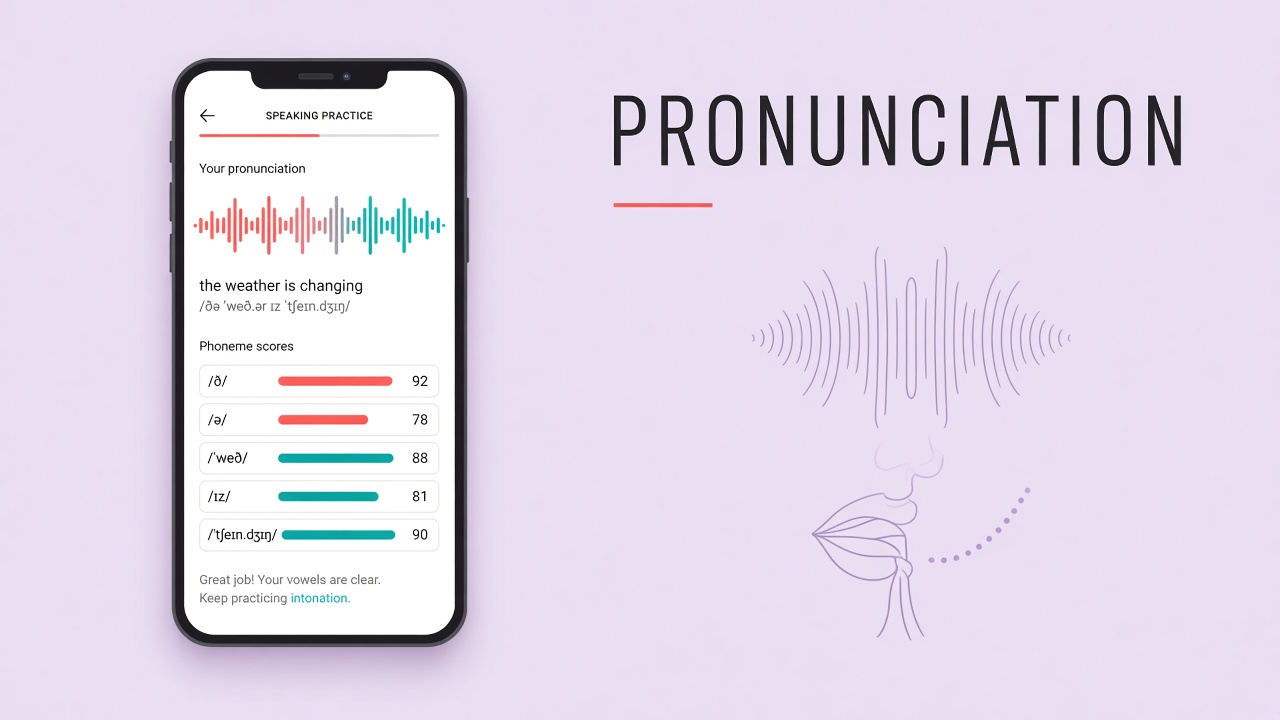
AI pronunciation feedback for language learning analyzes acoustic features such as phoneme alignment, pitch contours, stress patterns, and speaking rate, then returns visual and spoken guidance within seconds of each utterance. Consumer apps like ELSA Speak and Speechace, classroom platforms from Pearson and Oxford University Press, and embedded speech exercises in Duolingo now sit alongside human tutors. None replace discourse-level coaching or pragmatic judgment, but they lower the cost of high-volume drill practice. Educators evaluating AI chatbot tutors or comparing speech stacks should understand what acoustic scoring can and cannot measure before assigning homework that depends on automated grades.
Limits of Text-Only Language Apps
Reading and typing drills build vocabulary and grammar but leave pronunciation, prosody, and listening discrimination undertrained unless learners hear and produce speech repeatedly. Flashcard apps and grammar bots excel at spaced repetition of written forms. They fail silently on tone languages where a single syllable shape maps to multiple characters, or on English where stress shift changes word class (record as noun versus verb). Learners who only type answers may pass written tests yet remain unintelligible in conversation.
Duolingo addressed part of this gap with phonetic-based grading for Mandarin homophones (他, 她, 它 all pronounced tā), accepting any close phonetic match instead of forcing one character. Independent reviews still report weak tone instruction and inconsistent speech recognition on Android Mandarin builds tied to third-party ASR updates. Text-first apps remain useful on-ramp tools, but pronunciation-heavy goals need dedicated speech feedback layers.
Classroom time is scarce. A teacher with thirty students cannot listen to each learner pronounce every target sound daily. AI coaches scale unlimited repetitions with consistent rubrics, freeing instructors to focus on role-play, error interpretation, and motivation. Product teams building on AI research speech models should treat consumer apps as reference UX, not as ground truth for exam validity.
The 2025-2026 product cycle added publisher partnerships (Pearson, Oxford, HarperCollins on ELSA) and institutional speaking tests with retest reliability claims near 0.82 Pearson correlation on Speechace. Neither replaces conservatory IPA ear training, but both shrink the gap between homework apps and measurable speaking outcomes for working professionals and university EFL cohorts.
Acoustic Features for Pronunciation Scoring
Automated pronunciation assessment typically extracts mel-frequency cepstral coefficients, pitch tracks, energy envelopes, and phoneme posterior probabilities from the learner waveform, then compares them to reference native or near-native exemplars. ELSA Speak trains on voice data from non-native English speakers across accents, aiming to recognize learner patterns general ASR might mislabel. Speechace reports phoneme-level scores, fluency metrics, grammar and vocabulary proxies, and mappings to CEFR, IELTS, TOEFL, PTE, and TOEIC scales for institutional testing portals.
Tone languages add fundamental frequency contours per syllable. Mandarin carries four lexical tones plus neutral tone; mis-toning changes meaning entirely. Arabic emphasizes emphatic consonants and guttural articulation that Romanized prompts underrepresent. Japanese pitch accent is subtler than Mandarin tone but still affects comprehension. Good feedback UI overlays pitch curves, highlights mis-stressed syllables, and replays minimal pairs rather than showing a single percentage score.
Rhythm and connected speech matter for intelligibility. Learners may nail isolated words yet flatten phrase-level linking and reduction. Advanced systems score speaking rate stability, pause placement, and vowel reduction in function words. Research on Speechace in higher education found statistically higher post-test pronunciation scores versus control groups, with students praising immediate phoneme-specific pointers over waveform tools like Praat that require expert interpretation.
| Platform | Feedback depth | Typical use |
|---|---|---|
| ELSA Speak | Phoneme, stress, intonation, fluency | Consumer English, K-12 ELSA Schools |
| Speechace | Phoneme scores plus exam-aligned rubrics | Admissions, corporate L&D, API integrations |
| Duolingo speaking | Phrase-level pass/fail, phonetic grading on some courses | Casual habit building, not exam prep |
| HelloChinese / ChineseSkill | Tone visualization for Mandarin | Tone-focused supplement to general apps |
Feedback UX That Motivates Practice
Effective pronunciation UX combines low-latency scoring, replay of learner and model audio, color-coded mouth diagrams or spectrograms, and micro-goals that celebrate incremental gains instead of punishing accent. ELSA structures practice into short dialogues with streaks, role-plays, and publisher-backed lesson packs from HarperCollins, Pearson, and Oxford. Learners see which sounds failed (th versus s, short i versus long ee) and get targeted drills. Speechace emphasizes institutional dashboards: branded test portals, retest reliability near 0.82 Pearson correlation in vendor-reported studies, and instant PDF skill reports recruiters can verify.
Gamification helps volume but can mislead. Premature "correct" dings before a sentence finishes, reported on Duolingo Mandarin in 2025, erode trust. Product designers should gate celebration on stable phoneme confidence thresholds and offer a slow-practice mode for tone pairs. Confidence-building copy matters: frame feedback as intelligibility training, not accent elimination, especially for adult professionals who need clear business English rather than mimicry of a broadcast accent.
Pair AI drills with shadowing: learners repeat after a native clip, then compare waveforms. Some classrooms assign AI homework for mechanics and reserve live sessions for presentation skills and Q&A. That split respects what automated rubrics measure while preserving human judgment on content quality.
Classroom vs Consumer App Models
Consumer apps optimize daily engagement and subscription retention; classroom products add roster management, curriculum alignment, learning analytics, and data agreements suitable for schools. ELSA Schools targets K-12 with teacher dashboards, AI-generated lesson plans, and progress exports without adding prep workload. Speechace sells white-label speaking tests universities embed in admissions workflows. Duolingo for Schools offers class assignments but lighter pronunciation analytics than dedicated speech coaches.
Integration patterns include LMS plugins (Canvas, Moodle), SSO via Google Classroom, and API hooks that push scores into gradebooks. Institutions should pilot one cohort before district-wide rollout, comparing pre/post oral exam rubrics scored by humans blind to app assignment. Qualitative interviews often reveal learners value a nonjudgmental practice space yet still want teacher validation before high-stakes presentations.
BYOD consumer subscriptions let learners continue summer practice, but FERPA and GDPR obligations apply when schools mandate specific apps. Review data retention, voice storage location, and whether audio is used for model training. Many vendors offer enterprise tiers that disable training on student utterances.
Accent Bias and Inclusive Design
Speech models trained predominantly on one accent region may penalize intelligible variants from India, Nigeria, or the Philippines, conflating accent with error and discouraging diverse classrooms. ELSA explicitly markets training on non-native speech corpora to reduce false negatives for global English learners. Even so, no automated rubric captures sociolinguistic acceptability: a Nigerian English rhythm can be fully professional yet score low on a US-centric mel-cepstral distance metric. Inclusive design documents which reference accent a scoring lane uses, allows teacher override, and never labels accent as "wrong" when phoneme targets are met.
Bias audits should sample gender, age, and recording hardware (laptop mic versus phone in noisy dorms). Low-resource languages and Arabic dialects remain underserved relative to English and major European languages. Teams publishing AI chatbot voice features should disclose language coverage and confidence intervals rather than marketing universal pronunciation mastery.
Disability inclusion intersects here: deaf and hard-of-hearing learners may use speech practice differently; some rely on visual phonetics without aiming for spoken production. Apps should support adjustable scoring sensitivity and alternative mastery paths aligned with individual education programs.
Mandarin Tone and Prosody Coaching
Tone languages require feedback systems that visualize pitch contours across the syllable, not only consonant and vowel accuracy scored against a single reference waveform. Mandarin learners often plateau when apps treat tā (he, she, it) as interchangeable homophones without teaching tone pairs like mǎ (horse) versus mā (mother). HelloChinese and ChineseSkill overlay tone curves learners can match by ear; ELSA has expanded beyond English but remains strongest on Indo-European phoneme inventories. Arabic learners need feedback on emphatic consonants (ṣād, ḍād) that Romanized prompts flatten.
Prosody at phrase level separates classroom intelligibility from textbook correctness. English learners from tonal L1 backgrounds may apply flat pitch on questions; Japanese learners may underuse English stress-timed rhythm. Good coaches score linking ("want to" becoming "wanna" in casual speech only when appropriate) and flag over-articulation that sounds robotic in meetings.
Classroom pairing works well: assign five minutes of AI drill on target phonemes before pair conversation, then have partners score each other on communicative success while the teacher circulates. That structure respects what machines measure (articulation) and what humans judge (message received).
API and LMS Integration for Institutions
Speechace and similar vendors expose APIs and white-label portals so universities embed pronunciation modules inside existing LMS workflows without forcing students to a separate consumer app. Admissions teams use automated speaking screens with CEFR-aligned reports; corporate HR uses the same stack for call-center hiring in Philippines and India operations where intelligibility standards must be documented. Developers building custom AI research tutors can license speech scoring APIs rather than training proprietary acoustic models from scratch, though per-minute pricing and data residency clauses vary by vendor tier.
When integrating, validate latency under campus Wi-Fi: sub-500 ms feedback keeps drill loops fluid. Offline mode remains rare; plan for basement language labs with weak signal or cache reference audio locally while scoring uploads when connected.
Frequently Asked Questions
Does AI pronunciation feedback work for Japanese and Arabic?
English and Mandarin receive the deepest commercial investment. Japanese pitch-accent tools exist but are fewer; Arabic emphatic consonant feedback is limited outside specialized university projects. Verify language support before purchasing district licenses.
Is automated pronunciation coaching safe for kids?
Vendors like ELSA Schools offer child-oriented flows with COPPA-aligned policies when configured for institutions. Parental consent and minimal voice retention should be confirmed. Young learners still need teacher monitoring to prevent over-drilling without communicative context.
Can AI replace pronunciation teachers?
No for discourse, pragmatics, and motivational coaching. Yes for scalable drill volume between live sessions. Indonesian university interview studies found learners treat AI as complementary, not a substitute for human evaluation on presentations.
Are app scores valid for IELTS or TOEFL prep?
Speechace aligns rubrics to major exams but automated scores are practice indicators, not official results. Use them to prioritize weak phonemes, then validate with human mock examiners.
How should Mandarin learners handle weak tone feedback in general apps?
Supplement Duolingo or similar courses with HelloChinese or tutor-led tone drills. Do not assume green checkmarks mean tones are production-ready for real conversation.
What privacy risks come with voice recording?
Read whether audio is stored, for how long, and if it trains vendor models. Enterprise education contracts often provide deletion on request and regional data residency.
Should learners chase a 100 percent pronunciation score?
Intelligibility and confidence matter more than perfect spectral match. Plateau near 85 to 92 percent on many apps may still be conversation-ready; redirect effort to connected speech and vocabulary breadth.
How does ChatGPT Voice compare to ELSA?
Conversational voice modes prioritize dialogue fluency over phoneme-level scoring. Use them for role-play after mechanical drills, not as primary pronunciation rubrics.
Should learners combine apps with YouGlish or similar?
Hearing real speakers in context complements AI scoring. A strong weekly routine: AI drill on target phonemes, YouGlish clips for natural prosody, then classroom conversation for feedback on whether messages landed.