Security and compliance teams drown in repetitive attestations: SOC 2 bridge letters, ISO 27001 control narratives, vendor security questionnaires, and customer-specific security addenda. Each document restates evidence already sitting in GRC folders, ticket exports, and policy PDFs. Artificial intelligence can draft first-pass responses from structured evidence packs, but a hallucinated control description or outdated subprocessors list creates contractual liability. This AI compliance attestation workflow guide maps attestation types, evidence mapping, draft versus sign boundaries, audit trails, and hallucination risk, with links to AI writing tools and AI productivity patterns for GRC teams.
What Compliance Attestations Are
Compliance attestations are formal statements that an organization meets specified security, privacy, or operational control requirements, often backed by audit reports, certifications, or management assertions signed by authorized officers. They differ from marketing security pages: attestations become contractual exhibits, RFP responses, or regulator filings. Accuracy is legal, not cosmetic.
AI helps assemble language from evidence; AI does not replace the accountable human who signs. The productive frame is evidence-first drafting: every sentence in the output must link to a source artifact dated within policy freshness windows.
Attestation Types and Evidence Sources
Common attestation families include SOC 2 Type II bridge letters, ISO 27001 statement of applicability excerpts, SIG and CAIQ questionnaire answers, HIPAA BAAs, PCI DSS responsibility matrices, and customer-specific security schedules. Each type expects different evidence granularity.
| Attestation type | Primary evidence | Signatory |
|---|---|---|
| SOC 2 bridge letter | Latest auditor report, change log since period end | CISO or CFO |
| ISO 27001 SoA excerpt | Certified ISMS scope, control implementation status | ISMS manager |
| Vendor SIG / CAIQ | Policies, pen test, BCP test results | Security engineering lead |
| Customer security schedule | Negotiated control baseline, subprocessors | Legal + CISO |
| PCI responsibility matrix | SAQ or ROC, segmentation diagrams | Compliance officer |
Evidence Mapping Workflow
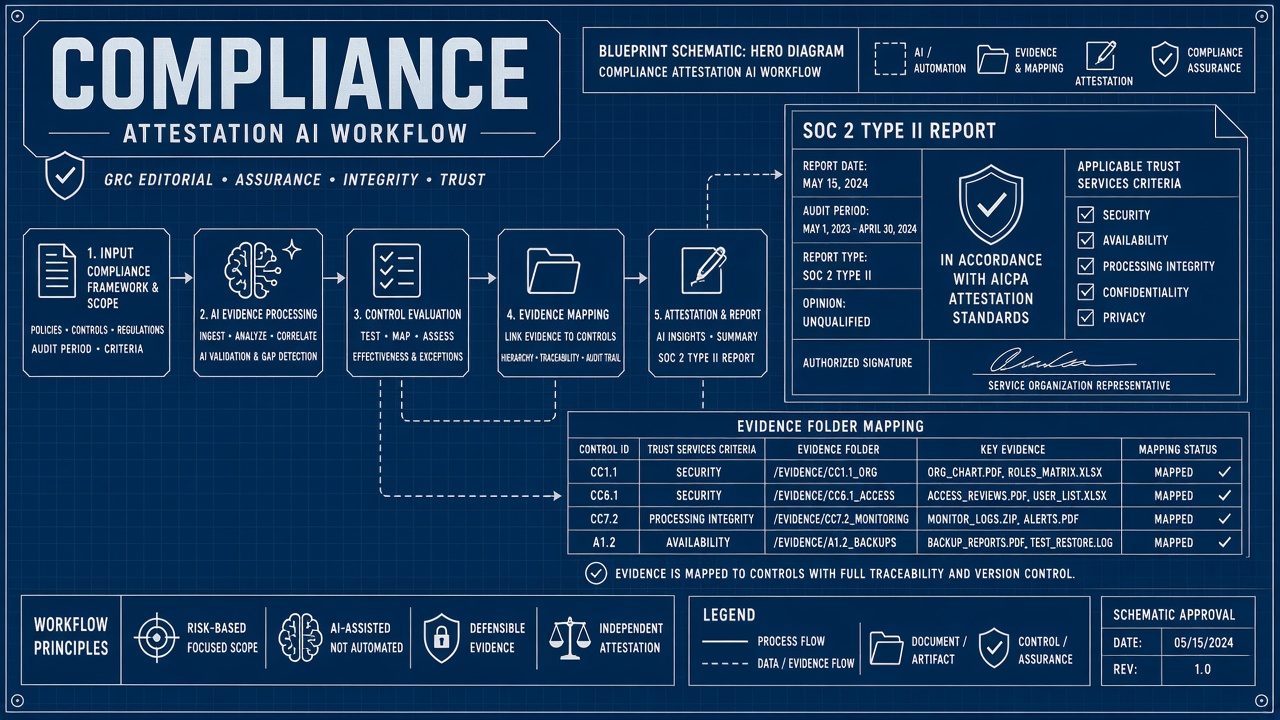
Evidence mapping links each control question or attestation clause to authoritative artifacts: policy version, screenshot hash, ticket ID, scan report date, and owner. Without mapping, LLM drafts read plausible but untethered. Build an evidence pack per attestation before invoking AI writing tools.
- Intake template: Import questionnaire or contract security exhibit as structured rows (control ID, question text, required evidence type).
- Retrieve evidence: Pull from GRC (Vanta, Drata, Secureframe), CMDB, IAM exports, and policy wiki with version pins.
- Gap flag: Mark rows with missing or stale evidence (pen test older than 12 months, subprocessors list not updated).
- Draft response: LLM generates answer text citing evidence IDs only from the pack, not from general knowledge.
- Human review: Control owner validates technical accuracy; legal reviews contractual language.
- Sign and archive: Authorized signatory approves; store signed PDF with evidence manifest.
Evidence Freshness Rules
Encode freshness rules in the workflow: vulnerability scans within 90 days, access reviews quarterly, BCP test annually. Stale evidence should block draft generation for that row and surface a remediation task instead of silent outdated claims.
Draft Versus Sign Boundaries
AI may draft narrative responses, tables, and responsibility matrices; humans must verify every claim, approve subprocessors lists, and execute formal signatures. No model output ships to customers without named reviewer initials in the workflow tool.
- AI drafts: control descriptions, procedure summaries, cross-references to policies
- Human only: scope boundaries, compensating controls for gaps, legal qualifiers, signature blocks
- Prohibited: AI inventing audit dates, certifying bodies, or control test results not in evidence pack
- Escalate to legal: unlimited liability language, audit rights, breach notification timelines
Bridge letters deserve extra caution: they extend SOC coverage across a gap period. AI must not imply controls unchanged since last audit unless change management records support that statement. List material changes explicitly or legal exposure follows.
Audit Trail Requirements
Audit trails capture evidence pack version, model prompt template, generated draft hash, reviewer edits, approver identity, and final signed document checksum. When a customer audits your attestation two years later, you must reconstruct what was true on the signature date.
Store diffs between AI draft and human-edited final. Reviewers who bulk-accept without reading should be visible in metrics; compliance leadership samples 5 to 10% monthly. Integrate with AI productivity platforms that log enterprise tenants, not consumer chat sessions without retention.
Version Control for Policies
Attestation answers reference policy titles and versions; when InfoSec updates the acceptable use policy, downstream attestations in flight must re-link or flag conflict. Automate policy version bumps triggering re-review queues for open questionnaires.
Hallucination Risk in Compliance Text
LLMs hallucinate compliance details convincingly: fake ISO clauses, nonexistent SOC criteria mappings, and subprocessors never contracted. Mitigations are procedural, not prompt-engineering alone.
- Constrain generation to retrieved evidence chunks (RAG with citation required per sentence)
- Reject outputs containing entities not in allowlists (subprocessor names, data center regions)
- Run deterministic validators: date formats, cert numbers against registrar APIs where available
- Second-pass critic model searches for unsupported superlatives ("always encrypted," "zero breaches")
- Human subject-matter expert sign-off on any numerical claim (RTO hours, retention days)
Treat hallucinated subprocessors as incident-class defects: notify legal, correct customer communications, update vendor registry. One wrong name in a SIG response can breach contract if customer relied on it for their own compliance filing.
Cross-Functional Review Cadence
Attestations touch security, legal, sales, and customer success; a recurring review cadence prevents bottlenecks when AI accelerates draft speed but humans remain the constraint. Weekly triage meetings assign owners to open questionnaire rows, stale evidence gaps, and legal redlines. Sales should not promise security controls in RFPs that GRC has not mapped to evidence. Customer success needs visibility into signed attestations before making implementation commitments that imply data residency or subprocessors not yet approved.
When a major customer sends a 400-row SIG due in ten days, AI drafting without cadence produces a pile of unreviewed text that signatories refuse to touch. Stage delivery: complete high-risk rows first, ship interim responses with explicit "pending evidence" flags rather than silent omissions. Customers respect honesty about gaps more than polished fiction.
Contractual Security Exhibits
Contract security exhibits become binding obligations; AI must never paraphrase exhibit language without legal diff review against the customer's template. Track exhibit version in CLM tools. When AI suggests merging two customer templates, legal merges, not the model alone.
Subprocessor and Data Residency Attestations
Subprocessor lists and data residency statements are high hallucination risk because they change frequently and appear in nearly every enterprise questionnaire. Maintain a canonical subprocessor registry with effective dates, data categories processed, and regions. AI drafts should pull only from that registry API, never from memory. When sales adds a new analytics vendor, GRC must update the registry before any attestation ships. Data residency answers require legal review when customers ask for country-specific storage guarantees your architecture does not support.
Incident Disclosure in Attestations
Active security incidents may require disclosure in bridge letters or customer-specific attestations; AI must not suppress incident status to complete a questionnaire faster. Incident response and GRC should share a single status flag that blocks attestation generation until communications strategy is set. Post-incident, update evidence packs with remediation artifacts before reusing prior answer libraries.
Vendor Questionnaire Automation at Scale
High-volume SIG and CAIQ cycles benefit from answer libraries synced to evidence mapping: approved answers for recurring controls, AI only filling novel customer-specific rows. Reuse reduces variance; customers comparing year-over-year responses appreciate consistency. Novel rows still need fresh evidence retrieval, not copy-paste from last year's library without verification.
| Risk level | AI autonomy | Reviewer |
|---|---|---|
| Low (library match) | Auto-insert approved text | Spot check sample |
| Medium (RAG draft) | Draft with citations | Control owner required |
| High (gap or legal) | No auto draft | Legal + CISO |
Frequently Asked Questions
Can AI sign an attestation?
No; electronic signatures require authorized human officers with legal authority. AI-generated signature blocks are for layout only until a person signs through approved e-sign tools.
Is AI safe for SOC bridge letters?
AI can assemble change summaries from ticket exports, but CISO must verify every material change and date range before signing. Bridge letters are high-liability documents.
What if customers audit our AI-drafted answers?
Produce the evidence manifest and reviewer logs; if answers were evidence-linked, audits proceed normally. If drafts were chat-generated without citations, audits fail and contracts may breach.
Should AI sit inside our GRC platform or external chat?
Prefer GRC-integrated drafting with retention and access controls over pasting SOC reports into public LLM UIs. Data leakage to model training is a separate compliance incident.
How does AI help ISO 27001 SoA maintenance?
AI suggests control applicability narratives when scope changes, but ISMS manager approves inclusion, exclusion, and compensating controls. Certification bodies expect human accountability.
Does AI drafting differ for SOC 2 Type I versus Type II?
Type I attestations describe point-in-time design; Type II adds operating effectiveness over a period, so evidence packs must include continuous monitoring logs, not only policy PDFs. AI should never imply Type II coverage from Type I artifacts alone.
How should pen test results appear in attestations?
Cite report date, scope, firm name, and remediation status for findings above severity threshold; never summarize "clean pen test" without linking the actual report artifact. AI often invents remediation dates; validators should check ticket closure timestamps.
How do we test for hallucination before go-live?
Red-team questionnaires with intentionally missing evidence; system must refuse or flag gaps, not invent pen test results. Run quarterly with updated adversarial prompts.
Customer Trust and Transparency
Enterprise customers increasingly ask whether vendors use AI to complete security questionnaires; disclose your governed drafting process and human review steps when asked. Transparency builds trust when backed by evidence manifests. Hiding AI use and delivering a hallucinated subprocessor list destroys trust faster than admitting AI assisted a draft that humans verified. Sales enablement should carry a standard answer aligned with legal and GRC, not improvised per deal.
Training GRC Staff on AI Drafting
GRC analysts need training on prompt boundaries, evidence citation requirements, and when to reject model output entirely. A one-hour workshop on "verify every subprocessor name against the registry" prevents more incidents than advanced prompt engineering. Include legal and sales in annual refreshers so customer-facing teams do not promise controls GRC cannot attest. Measure analyst time per questionnaire before and after governed AI drafting; savings should appear in cycle time, not only draft word count.
Conclusion
AI compliance attestation workflows compress drafting time when every sentence traces to dated evidence, humans own sign-offs, and audit trails survive customer scrutiny years later. Map SOC, ISO, and vendor questionnaire rows to artifacts, block stale evidence, separate draft from sign authority, and treat hallucinations as security incidents. Use governed AI writing inside GRC boundaries and AI productivity for coordination, not improvisation. Compliance automation earns trust when wrong answers are impossible to ship silently, not when they are rare. Start with one attestation family, prove the evidence mapping discipline, then expand to full questionnaire automation at scale.