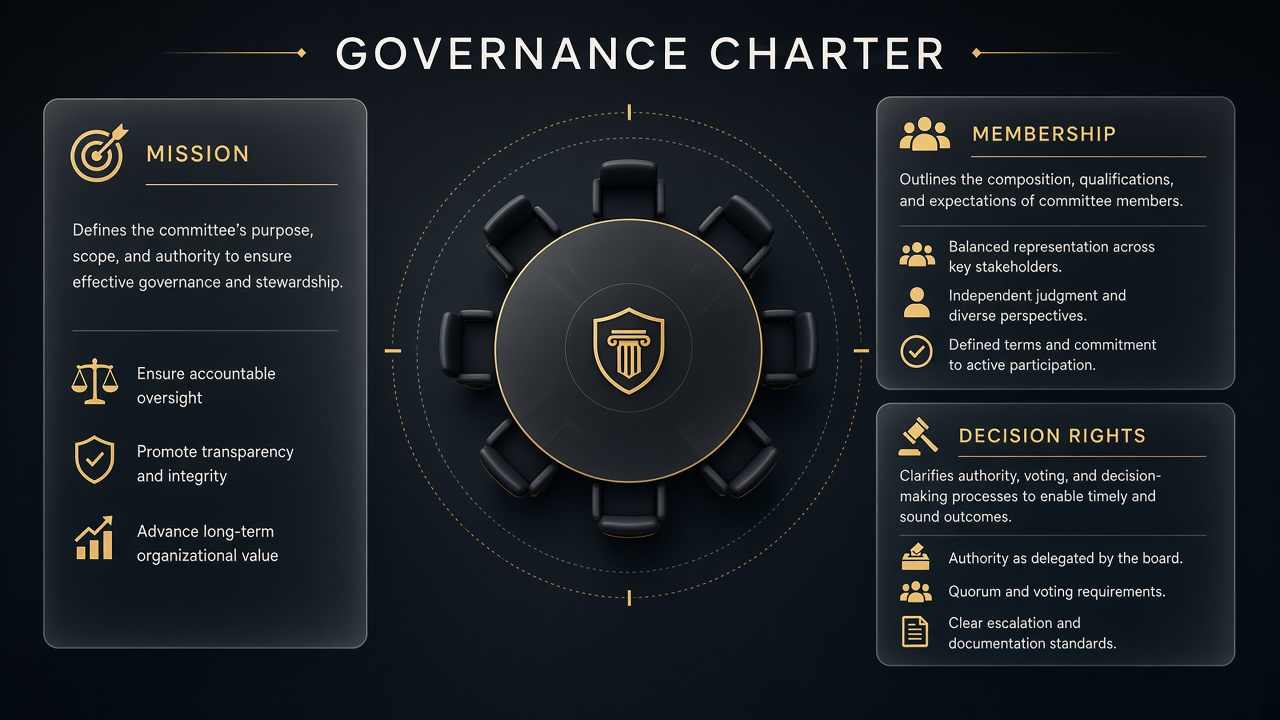
AI adoption outpaces policy when every team buys its own chat subscription and embeds models without a forum to resolve risk disputes. Security blocks a tool legal already approved; product launches a copilot nobody classified; the board asks who owns AI risk and receives five different answers. An AI governance committee without a charter is an advisory lunch group. A ratified charter turns cross-functional debate into enforceable decisions.
An AI governance committee charter is the founding document that establishes the committee's mission, scope boundaries, voting membership, quorum rules, decision rights, escalation paths, and reporting obligations to executive leadership. This template aligns with NIST AI RMF Govern function, ISO/IEC 42001 clause 5.3 organizational roles, and EU AI Act deployer obligations under Articles 9, 14, and 26. Use it when standing up oversight for AI automation platforms and AI research initiatives across the enterprise. The goal is authority auditors recognize, not another slide deck.
Mission and Scope Boundaries
The AI governance committee mission is enterprise oversight of AI strategy, risk classification, deployment approval, policy maintenance, and incident review, with explicit boundaries excluding day-to-day model engineering and operational security triage owned by other functions. Scope clarity prevents the committee from becoming a bottleneck for every prompt template change while ensuring high-impact systems receive structured review.
| In scope | Out of scope |
|---|---|
| Risk tier approval for new AI systems and material changes | Writing application code or tuning model hyperparameters |
| AI acceptable use and procurement policy updates | Real-time SOC alert response and malware containment |
| Exception approvals with time-bound conditions | Individual performance management of data scientists |
| Post-incident governance review and remediation direction | Replacing legal counsel on regulatory interpretation |
| Executive and board reporting on AI risk posture | Vendor contract negotiation owned by procurement |
Charter Mission Statement
Copy-ready mission language: "The AI Governance Committee provides cross-functional oversight of artificial intelligence deployment, risk classification, and compliance alignment across the organization, with authority to approve, condition, or suspend AI systems above defined risk thresholds." Customize thresholds to your industry. Healthcare deployers reference HIPAA-aligned oversight; financial services reference model risk management principles; EU deployers reference high-risk system categories in Annex III.
Scope Boundaries for Automation and Research
Production AI automation requires full committee review at medium risk and above; experimental AI research in sandbox environments may follow expedited review with mandatory promotion gate before production data. Define "production" as any system processing non-synthetic customer, employee, or financial data. Research exemptions expire automatically unless renewed at quarterly review.
Relationship to Board and Executive Sponsor
The committee reports to an executive sponsor (typically CTO, CRO, or Chief AI Officer) and escalates material risk appetite changes, serious incidents, and regulatory inquiries to the board audit or risk committee at least quarterly. The charter should name the reporting line, not leave it implicit. Board ratification of the charter itself signals top-down commitment expected under ISO 42001 leadership clauses.
Membership and Quorum Rules
Effective committees include six to eight voting members spanning technology, risk, legal, privacy, security, and business operations, with quorum set at four voting members including the chair or vice-chair and at least one control function representative (legal, risk, CISO, or DPO). Name roles, not individuals, so succession survives reorgs.
| Seat | Authority type | Typical responsibilities |
|---|---|---|
| Chair (CTO or Chief AI Officer) | Decision, agenda owner | Sets priorities, breaks ties, calls extraordinary sessions |
| Chief Risk Officer or delegate | Decision, veto on appetite breaches | Risk tier framework, exception conditions |
| General Counsel or senior legal designee | Decision, compliance veto | Regulatory mapping, contract alignment |
| CISO or security delegate | Decision, security veto | Data protection controls, vendor security baseline |
| Data Protection Officer | Advisory with privacy veto | DPIA review, GDPR and cross-border transfers |
| Business unit sponsor (rotating) | Decision | Use case context, operational impact |
| Internal audit (observer) | Advisory, no vote | Independent assurance, audit finding tracking |
Quorum and Voting Thresholds
Quorum requires four voting members present, including either the Chair or Vice Chair, and at least one member from legal, risk, or security; routine decisions pass by simple majority, while overrides of CISO or DPO denial require unanimous vote plus audit committee notification. Tie votes defer decision and escalate to the executive sponsor within five business days. Document dissenting opinions in minutes for audit trail completeness.
Term Lengths and Alternates
Assign two-year staggered terms for business unit seats; permanent seats for control functions; named alternates with full voting authority when principals are unavailable. Avoid quorum games by requiring alternates to pre-read materials. Rotate business representation quarterly when multiple divisions deploy AI so no single unit dominates agenda.
Meeting Cadence
Hold ordinary meetings monthly or quarterly depending on AI deployment velocity; convene extraordinary sessions within five business days of Severity 1 AI incidents (bias harm, data breach via AI tool, regulatory inquiry). Standing agenda items: new system approvals, exception renewals, policy revisions, metrics review, and open remediation items from prior incidents.
Decision Rights and Escalation
Decision rights split into committee-approved actions (high-risk deployment, policy changes, time-bound exceptions), committee recommendations to the board (risk appetite changes, major vendor commitments), and post-incident review directives with mandatory remediation owners. Publish a RACI matrix in the charter appendix so requesters know where to start.
| Decision | Committee authority | Escalation trigger |
|---|---|---|
| High-risk AI system deployment | Approve, reject, or approve with conditions | Prohibited use case to board and legal |
| Risk tier dispute between units | Final classification binding until review | Tier change affecting enterprise appetite |
| AI policy and standard updates | Approve material amendments | Board-level policy when mandated by regulation |
| Time-bound exception to policy | Grant up to 90 days with conditions | Extension beyond 90 days or repeat exception |
| System suspension after incident | Mandate shutdown or read-only mode | Customer notification or regulatory report |
| Material change to AI risk appetite | Recommend to board | Board vote required before implementation |
Escalation Path to Executive and Board
Escalate to the executive sponsor when committee cannot reach quorum, unanimous override is attempted, or business impact of rejection exceeds defined revenue or customer thresholds; escalate to the board audit or risk committee for serious incidents, regulatory investigations, unauthorized high-risk deployments, and risk appetite changes. Document escalation in writing with decision memo, dissent summary, and recommended options. EU AI Act Article 73 serious incident reporting may require parallel legal escalation outside committee voting timelines.
Human Oversight Alignment
Charter language should require human oversight procedures for high-risk systems per EU AI Act Article 14, assigned to business owners but reviewed by the committee at deployment and after material model changes. The committee approves oversight design; line managers execute daily review. Confusing the two creates either bureaucratic review of every output or absent governance at scale.
Exception Management
Exceptions require written business justification, compensating controls, expiry date, and named exception owner; the committee tracks open exceptions as a standing metric and rejects rolling renewals without new risk assessment. Shadow AI discovered outside the inventory enters through expedited review with default deny until classified.
Metrics Reported to Executives
Executive reporting packages should include ten to twelve KPIs updated each quarter: active AI systems by risk tier, approval cycle time, open exceptions, overdue reviews, incident count, shadow AI discoveries, training completion, and vendor concentration. Metrics prove the committee governs outcomes, not meeting attendance alone.
| Metric | Definition | Executive action trigger |
|---|---|---|
| Systems by risk tier | Count active entries in AI inventory register | High-risk count grows faster than review capacity |
| Mean approval cycle time | Days from submission to committee decision | Exceeds 30 days for standard requests |
| Open exceptions | Active policy deviations with expiry dates | Any exception past expiry without renewal vote |
| Shadow AI discoveries | Unapproved tools found per quarter | Trend increasing two quarters consecutively |
| Incident remediation SLA | Days to close committee-directed actions | Critical items open beyond 14 days |
| Governance training completion | Percent owners completing annual AI governance training | Below 90 percent before year-end |
Board Reporting Format
Quarterly board summaries fit on two pages: risk posture narrative, tier distribution chart, top three incidents, open high-risk approvals, regulatory horizon scan, and resource asks. Annual reports add trend analysis, framework alignment attestation (NIST AI RMF, ISO 42001, EU AI Act readiness), and charter effectiveness review recommending membership or scope adjustments.
Operational Dashboards
Maintain a live dashboard fed from the AI tool inventory, GRC ticketing, and identity logs so committee members review current data rather than static slide decks. Automate metric extraction where possible; manual compilation delays decisions and erodes trust in reported numbers.
Charter Template Sections to Include
A complete charter fits two pages plus RACI appendix: purpose and authority, scope, membership, quorum, meetings, decision rights, escalation, reporting, record keeping, and annual review clause. Auditors should read the charter in five minutes and understand who decides what.
- Purpose and authority granted by executive sponsor and board acknowledgment.
- Scope and explicit exclusions referencing security operations and engineering delivery.
- Membership table with roles, alternates, and observer seats.
- Quorum, voting, veto, and tie-break rules.
- Meeting ordinary and extraordinary cadence with notice periods.
- Decision rights matrix and exception policy.
- Escalation to executive sponsor and board committees.
- Metrics and reporting obligations.
- Document retention for minutes, decisions, and dissent records.
- Annual charter review date and amendment procedure.
Framework Crosswalk
Include a crosswalk table mapping charter sections to NIST AI RMF Govern, ISO 42001 clause 5.3, and EU AI Act Articles 9, 14, and 26 so regulatory reviewers trace committee functions to recognized frameworks. Framework alignment does not replace legal advice but accelerates customer and regulator questionnaires.
| Charter section | NIST AI RMF | EU AI Act |
|---|---|---|
| Mission and scope boundaries | GOVERN 1.1 policies and procedures | Article 9 risk management system |
| Membership and quorum rules | GOVERN 2.1 roles and responsibilities | Article 14 human oversight measures |
| Decision rights | GOVERN 1.2 accountability structures | Article 26 deployer obligations |
| Incident review | MANAGE 2.3 incident response | Article 73 serious incident reporting |
| Metrics and reporting | GOVERN 1.3 workforce diversity of input | Article 12 logging and record keeping |
Charter Amendment Process
Amend the charter through committee vote with two-thirds majority and executive sponsor approval; version each amendment with effective date and notify all stakeholders within ten business days. Material scope expansions (for example, adding authority over all third-party SaaS with embedded AI) require board acknowledgment. Store signed PDFs in the GRC repository with immutable version history.
Intake and Approval Workflow
Every AI system seeking production access submits a standardized intake form linking to the inventory register: use case description, data classes, proposed risk tier, human oversight design, vendor details, and business owner attestation. The committee reviews complete packages only; incomplete submissions return without agenda slot to discourage last-minute rush approvals before product launches.
- Intake triage within five business days by a designated committee secretary or GRC analyst.
- Control function pre-review (security, privacy, legal) before placement on the agenda.
- Decision recorded in minutes with conditions, expiry for pilot deployments, and re-review triggers.
- Rejected submissions receive written rationale and path to resubmission.
- Approved systems receive register ID mandatory for change management and CI/CD gates.
Pilot Versus Production Approval
Pilot approvals default to 90-day expiry with synthetic or de-identified data only; production promotion requires fresh committee vote when data classes, user population, or model version changes materially. This pattern supports fast experimentation in AI research sandboxes without granting indefinite production authority from a single pilot vote.
Standing Up the Committee in 90 Days
Days 1 to 30: draft charter and secure executive sponsor; days 31 to 60: ratify membership, publish RACI, integrate with AI inventory intake; days 61 to 90: hold first decisions on waiting queue, publish metrics baseline, schedule board briefing. Do not wait for perfect inventory data; classify known systems while discovery continues.
Frequently Asked Questions
What is the relationship between the AI governance committee and the security council?
The AI governance committee sets policy, risk tiers, and deployment approval for AI systems; the security council (or security committee) owns enterprise cybersecurity strategy, vulnerability management, and SOC operations, with overlapping membership on the CISO seat but distinct mandates and agendas. AI governance decides whether a copilot may process confidential code; security council decides network segmentation and endpoint controls enforcing that decision. Escalate conflicts where security baseline denial blocks approved AI use to executive sponsor mediation. Document MOU between committees to avoid duplicate review or dangerous gaps.
Do we need a committee if we have a Chief AI Officer?
A Chief AI Officer drives strategy and delivery; the committee provides independent cross-functional checks, veto voices from legal and risk, and audit evidence that decisions were not unilateral. The CAIO often chairs the committee but should not hold sole approval authority for high-risk systems. Regulators and enterprise customers expect governance structure beyond a single executive role.
Can a 200-person company use this charter template?
Scale membership down to five voting seats with combined legal and privacy representation, maintain quorum of three including chair, and meet quarterly unless incident-driven. Charter principles remain identical; only cadence and seat count shrink. Enterprise customers selling to regulated buyers still ask for documented governance regardless of headcount.
What records must the committee retain?
Retain meeting minutes, decision memos, vote counts, dissent notes, submitted risk assessments, and exception registers for at least the longest applicable regulatory period, commonly five to seven years for financial and health sectors. Minutes should capture decisions and conditions, not verbatim debate. Link minutes to inventory register entry IDs for traceability.
How does the committee govern AI automation platforms?
Automation platforms that chain models, APIs, and robotic process automation require committee review of the full workflow, not individual components, because risk compounds across steps. A low-risk summarization model feeding a high-risk decision workflow inherits the higher tier. Workflow owners present end-to-end data flow diagrams at intake. Committee conditions may mandate kill switches, human approval gates, and logging at each automation stage.
Ratified Charter, Enforceable Governance
An AI governance committee charter succeeds when mission and scope exclude operational noise but cover real risk decisions, membership and quorum guarantee control-function voice, decision rights and escalation paths are explicit, executives receive metrics that drive action, and the security council relationship is documented without overlap or gaps. Ratify the charter before the next production AI deployment, not after the first audit finding.