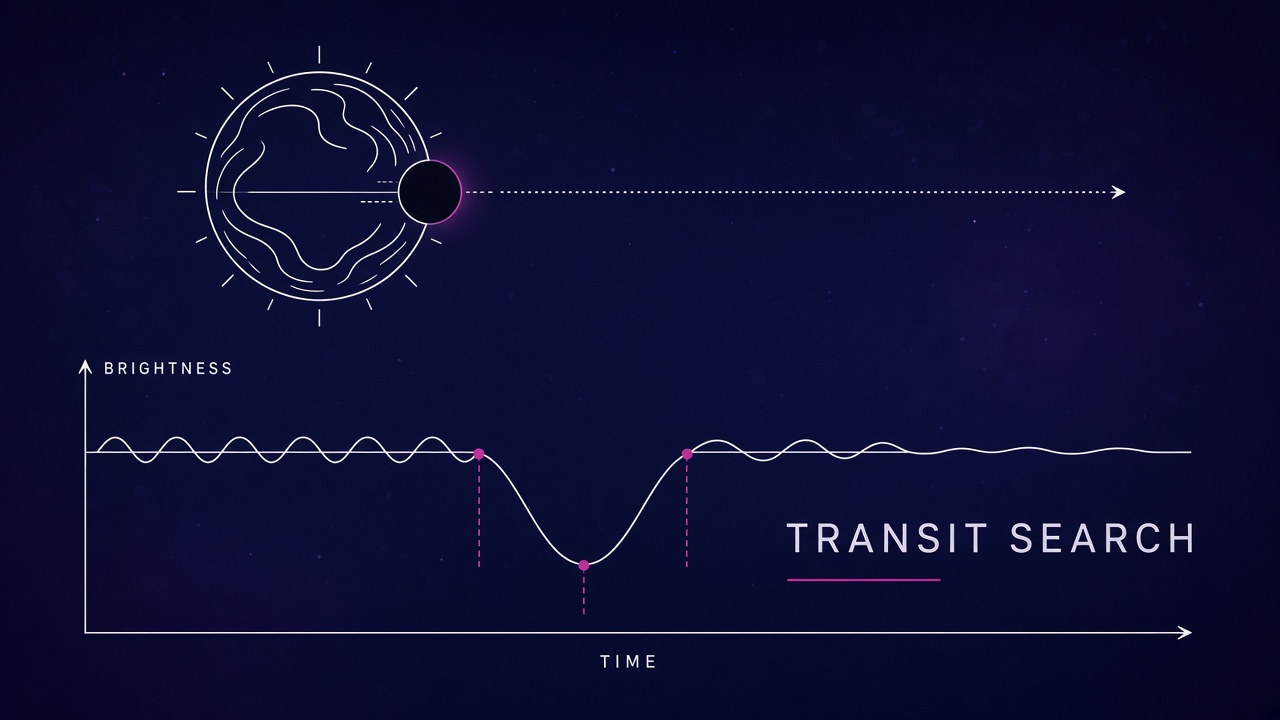
When a planet crosses in front of its star, the star dims slightly and repeatedly. NASA's Kepler and Transiting Exoplanet Survey Satellite (TESS) missions have recorded billions of such brightness measurements, producing millions of threshold crossing events (TCEs) that might be planets or might be eclipsing binaries, instrument glitches, and stellar variability. AI exoplanet transit detection automates search and vetting so human researchers focus on the hardest candidates. Convolutional networks, attention models, and transformers now classify light curves, rank TCEs, and even scan full-frame image time series without assuming periodicity. This workflow guide walks from pixels to confirmed worlds, citing ExoMiner++, transformer discovery papers, and citizen science pipelines. Astronomers and ML engineers exploring AI research or popular AI research topics will see where automation ends and radial velocity or JWST follow-up begins.
Transit Method in Plain Language
A transiting exoplanet blocks a tiny fraction of starlight, typically 0.01 to 1 percent depending on planet and star size, producing a periodic U-shaped dip in a light curve when orbital geometry aligns. Kepler stared at one field for years, maximizing sensitivity to Earth-size planets on year-long orbits. TESS surveys most of the sky in 27-day sectors, favoring bright nearby stars suitable for mass measurement via radial velocity. Neither mission "sees" the planet directly; they measure flux versus time. Stellar spots, companion stars, and spacecraft momentum dumps mimic transits, which is why vetting dominates compute time.
The NASA Exoplanet Archive lists thousands of confirmed planets, but orders of magnitude more TCEs await disposition. Machine learning reduces the backlog by scoring how planet-like a signal looks given folded light curves, centroid shifts, difference images, and periodograms that human vetters historically inspected by eye.
Training on Labeled TESS Cutouts
Supervised models train on Kepler and TESS TCEs labeled planet candidate or false positive by mission teams and follow-up campaigns, often augmenting scarce positive examples with synthetic transits injected into real noise. ExoMiner, first published in 2022, validated 370 new Kepler planets using deep learning on diagnostic tests. ExoMiner++, described in the Astronomical Journal (October 27, 2025, Vol. 170, No. 5), retrains on combined Kepler and TESS labels and adds difference images, flux trends, flux periodograms, and momentum dump flags as inputs for the first time at scale. Among 147,568 previously unlabeled TESS TCEs, ExoMiner++ classified 7,330 as planet candidates, including 50 new community TESS objects of interest introduced in the catalog.
Alternative architectures explore efficiency and interpretability. DART-Vetter uses a compact CNN on folded light curves alone, achieving about 91 percent recall on combined Kepler and TESS ensembles while staying easy to replicate (Astrophysical Journal 2025). Research in Research in Astronomy and Astrophysics (2025) reports channel-attention CNNs with 99.9 percent accuracy and 99.5 percent F1 on TESS test splits, training in 0.3 to 0.6 hours. Hybrid pipelines combine VGG19 feature extraction, t-SNE dimensionality reduction, and XGBoost with conditional flow matching, reporting 98 to 100 percent F1 on selected Kepler and TESS sets (Electronics, 2025). Metrics depend heavily on class balance and label quality; headline F1 scores are not interchangeable across papers.
| Stage | Input | Typical ML role |
|---|---|---|
| Detrend and search | Raw flux, cotrending basis vectors | Box-least-squares; emerging transformer search |
| TCE generation | Period, depth, duration parameters | Mission pipelines (Kepler, TESS SPOC) |
| Automated vetting | Folded curves, diagnostics, difference images | ExoMiner++, DART-Vetter, attention CNNs |
| Human review | Top-ranked candidates | Citizen science (Planet Hunters); expert teams |
| Confirmation | Radial velocity, transit timing, imaging | Physics validation; JWST atmospheric follow-up |
Automated Vetting vs Human Follow-Up
Vetting models shrink the search space; confirmation still requires independent evidence that a dimming signal is planetary and bound to the target star. ExoMiner++ publishes confidence scores per TCE on Zenodo with an interactive catalog hosted for community review. NASA Ames project lead Hamed Valizadegan notes the team initially flagged about 7,000 TESS targets as candidates in an early run discussed on NASA Science open-science pages, emphasizing efficient returns from modest compute when diagnostics are engineered well.
Human vetters remain essential for long-period planets, crowded fields, and signals with only one visible transit. Transformer work on TESS full-frame image light curves (2025 preprint) identified 214 new candidate systems from sectors 1 through 26 without phase folding, including 88 single-transit events and 4 multi-planet systems with radius greater than 0.27 Jupiter radii. Single-transit discoveries are nearly impossible for classifiers that assume periodic folding upfront, illustrating why search-stage ML differs from vetting-stage ML.
Citizen Science and ML Together
Planet Hunters and similar platforms route human classifiers toward borderline TCEs that algorithms score near decision thresholds, combining recall from machines with contextual judgment from volunteers. Humans excel at spotting odd centroid shifts or Doppler beaming hints that CNNs trained only on folded flux miss. ML excels at processing hundreds of thousands of uniform TCEs overnight. Production teams increasingly publish model scores alongside light curves so citizen scientists prioritize high-recall frontiers rather than re-vetting obvious eclipsing binaries.
ExoMiner++'s open GitHub repository and Podman pipeline lower the barrier for graduate programs to reproduce vetting on custom TIC lists without rebuilding Kepler-era preprocessing. Teaching workflows benefit: students learn astrophysics false positive modes while inspecting difference images the model flagged uncertain.
Novel Candidate Discovery Stories
Each confirmed exoplanet from ML pipelines combines algorithmic ranking with telescope time for radial velocity or high-resolution imaging to rule out background eclipsing binaries. Kepler's 370 ExoMiner-validated worlds demonstrated that neural networks could clear years of backlog. TESS ExoMiner++ adds momentum dump awareness because spacecraft attitude tweaks inject glitches that mimic transits. Community TOIs enter public forums where amateur astronomers contribute ground-based photometry.
Citizen science projects like Planet Hunters TESS enlist volunteers to classify light curves; ML pre-filters or prioritizes uploads so humans see borderline cases. The hybrid model respects that false positives have real costs: wasted Keck nights and JWST director's discretionary time are scarcer than GPU hours.
Limits for Earth-Size Habitable Zone Planets
Detecting Earth analogs around Sun-like stars requires photometric precision, multi-year baselines, and stellar noise mitigation that TESS's wide-field cadence cannot always deliver alone. TESS excels at bright M-dwarf rocky planet searches where transit depth reaches detectable percent levels. Sun-like habitable zone Earths remain Kepler-era statistical discoveries or future mission targets (PLATO, Roman). ML helps rank marginal signals but cannot overcome fundamental photon noise when depth approaches tens of parts per million.
Radio frequency interference and systematic drifts in full-frame data challenge transformer search models; background subtraction and cotrending vectors must precede neural attention. JWST follow-up characterizes atmospheres of already confirmed planets; it does not replace ground-based vetting for false positive rejection at discovery stage.
Frequently Asked Questions
What is a TCE?
A threshold crossing event is a periodic dimming signature flagged by mission pipelines. TCEs become planet candidates after vetting, and confirmed planets only after independent validation.
How does ExoMiner++ differ from ExoMiner?
ExoMiner++ extends the architecture to TESS 2-minute data, adds four diagnostic data products used by human vetters, and publishes a scored catalog for 147,568 TCEs. Training blends Kepler quality labels to compensate for noisier TESS disposition histories.
Can I run the pipeline locally?
NASA open-sources ExoMiner on GitHub with a Podman container pipeline from TIC IDs to prediction scores, downloading SPOC products from MAST. GPU helps but containerization reduces dependency friction.
What are common false positives?
Eclipsing binaries, stellar pulsations, spot modulation, instrumental systematics, and centroid shifts indicating a background blend. Difference imaging and centroid tests discriminate many of these when included as model inputs.
Will ML find an Earth twin soon?
ML accelerates candidate lists, but Earth-Sun analogs need missions and baselines beyond current TESS sectors. Expect progress on rocky worlds around small stars first, with atmospheric characterization on JWST for favorable targets.
What is ExoFOP?
ExoFOP (Exoplanet Follow-up Observing Program) coordinates community follow-up for TESS objects of interest. ExoMiner++ comparisons reference ExoFOP planet candidate labels when measuring agreement rates on previously vetted TOIs, helping teams see where automated scores align or diverge from human consensus.
How does JWST fit the workflow?
JWST conducts transmission spectroscopy and eclipse mapping on confirmed planets, not bulk TCE vetting. Discovery workflows end at robust planet candidate status; JWST science begins after confirmation and target selection committees allocate time.
Noise, RFI, and Systematics
TESS full-frame image light curves include spacecraft jitter, scattered light from Earth and Moon, and variable crowding in galactic plane fields. Transformer search models must ingest background and centroid time series alongside flux to reject blends. Momentum dumps from reaction wheel desaturation create glitches that ExoMiner++ explicitly models because human vetters learned to flag them by eye. Radio frequency interference is less dominant than in radio astronomy, but electronic systematics from detector temperature drifts still masquerade as shallow transits until periodograms reveal non-Keplerian harmonics.
Upcoming ESA PLATO and future Roman Space Telescope surveys will multiply data volumes. Pipelines proven on Kepler and TESS TCE formats become templates: diagnostic-rich vetting, open catalogs with confidence scores, and human review on the long tail. Earth-size habitable zone planets around Sun-like stars remain statistically rare in single-sector TESS data; multi-year stacking and space-based follow-up still define the discovery frontier ML cannot shortcut. Additive attention LSTM architectures published in the Astronomical Journal (2025) show that interpretable attention weights over transit epochs help reviewers understand which dips convinced the network, bridging the gap between black-box scores and pedagogical vetting sessions for new graduate students. Conditional flow matching hybrids that pair VGG19 embeddings with XGBoost classifiers illustrate how teams can trade marginal F1 gains for orders-of-magnitude lower inference cost when scoring millions of Kepler-era TCE archives offline.
AI exoplanet transit detection is a pipeline discipline: search, vet, confirm. ExoMiner++ and compact vetters like DART-Vetter industrialize TESS 2-minute data review, while transformers probe single-transit territory in full-frame archives. No model skips the physics of blended binaries or the telescope time required to weigh a world. Continue with planetary and space AI topics in AI research and popular AI research coverage. When you publish candidate lists from custom ML runs, include diagnostic plots difference imagers expect so follow-up observers can reproduce your triage decision without retraining the network from scratch. The 214-candidate transformer search from TESS sectors 1 through 26 demonstrates that models skipping phase fold assumptions can surface single-transit events traditional box-least-squares pipelines delay, expanding the discovery surface area when human follow-up capacity allows. DART-Vetter's 91 percent recall on combined Kepler and TESS ensembles shows compact CNNs still earn a place beside heavier diagnostic stacks when teams need fast, reproducible triage on folded light curves alone. ExoMiner++ identified 7,330 planet candidates among 147,568 unlabeled TESS TCEs in its published catalog, including 50 new community TOIs for follow-up. The original 2021 ExoMiner release validated 370 new Kepler worlds, establishing the template ExoMiner++ extended to TESS 2-minute diagnostics in the Astronomical Journal (October 27, 2025).