Article 50 of the EU AI Act requires providers to mark synthetic audio, image, video, and text in machine-readable formats, while deployers face labeling duties for deepfakes and certain AI-generated publications. Detection APIs that verify C2PA Content Credentials, SynthID watermarks, and IPTC metadata are moving from vendor pilots to daily newsroom infrastructure. This article explains how the eu watermark api newsrooms workflow changes CMS design, editorial policy, and compliance operations for publishers operating in Europe.
A companion piece covers detection API inputs, outputs, and accuracy limits at the platform level. Here the focus is publisher operations: where to call detection in the CMS, how editors handle flags, and how to reduce false positive harm. Teams using AI writing tools and AI detection stacks should align both generation and verification policies before national enforcement accelerates.
Detection API Role for Newsroom Publishers
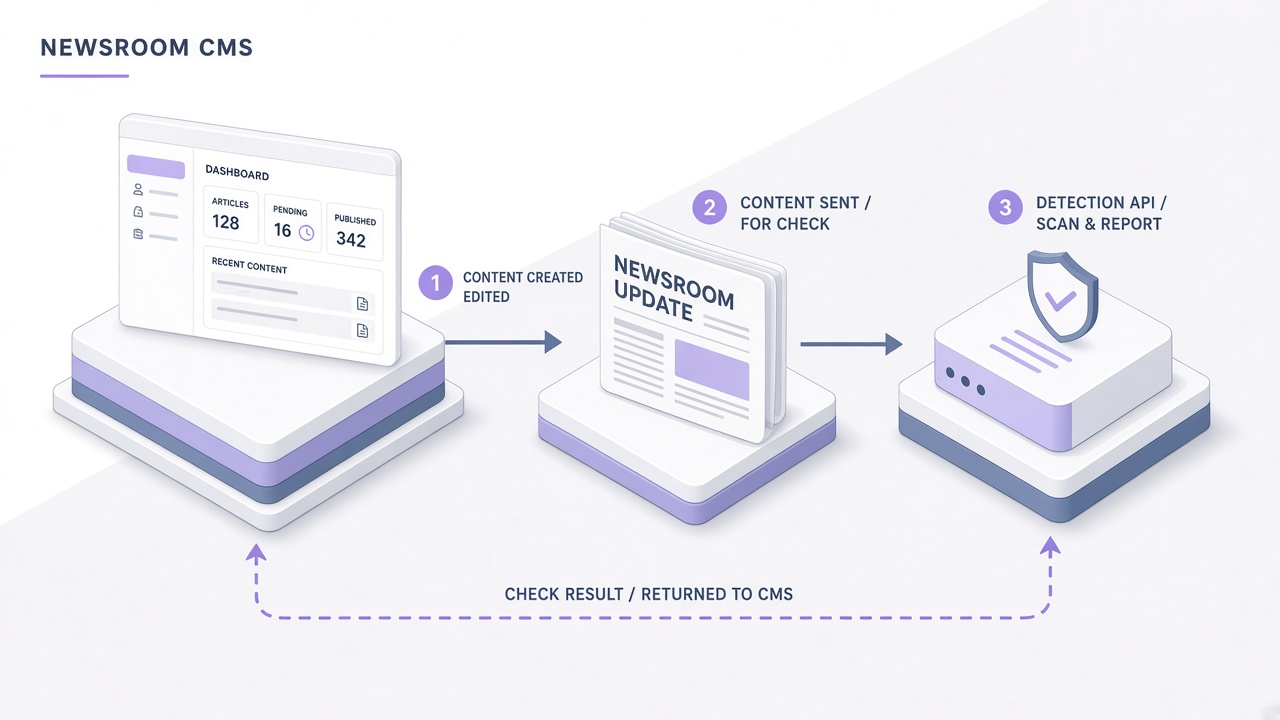
Publishers use watermark and provenance detection APIs at asset ingest to verify whether submitted media carries machine-readable synthetic signals before stories reach the homepage. Unlike statistical AI detectors that guess from pixel patterns, provenance APIs confirm whether known credentials or watermarks are present and intact.
The detection layer sits between user upload and editorial review. When a freelance photographer submits images, the CMS calls the API, stores structured results alongside the asset, and routes ambiguous cases to a photo desk editor. Audio and video workflows mirror image checks, with separate endpoints for SynthID-compatible audio and C2PA-signed video manifests.
| Workflow stage | API action | Editorial outcome |
|---|---|---|
| Ingest | Run detection on upload | Auto-flag missing credentials |
| Edit | Re-verify after crop or re-encode | Re-sign C2PA if credentials stripped |
| Publish | Attach labels to page metadata | Display deployer duties for deepfakes |
| Archive | Store API JSON with asset GUID | Audit trail for regulators |
Wire services and agency partners should publish which signals their feeds include so newsrooms do not double-pay for detection on already-certified content. Build adapter modules per vendor (OpenAI Content Provenance API, Google AI Content Detection API, open C2PA validators) behind a single internal interface.
CMS Integration Patterns for Synthetic Media
Modern newsroom CMS integrations use asynchronous job queues for detection, webhook callbacks for results, and immutable audit logs keyed to asset versions. Synchronous API calls during save events block editors; queue workers handle verification within seconds while writers continue drafting.
Recommended integration architecture:
- Asset upload triggers a `provenance_check` job with file hash and MIME type.
- Worker calls vendor API; persists JSON response in a `media_provenance` table.
- CMS UI shows badges: verified synthetic, verified human capture, unknown, or failed check.
- Publish pipeline embeds IPTC Digital Source Type fields in outgoing feeds.
- CDN cache keys include provenance version to avoid serving stale labels.
Headless CMS vendors should expose provenance fields in GraphQL and REST schemas so front-end apps and syndication partners inherit labels. For synthetic media cms rollouts, pilot on the photo desk before enabling automated quarantine rules on the entire archive.
Editorial Policy Updates for AI-Generated Content
Editorial policies must define when staff may use generative tools, how AI-assisted articles are labeled, and what happens when detection APIs return inconclusive results. The EU Code of Practice on Transparency of AI-generated Content gives deployers labeling rules for deepfakes and public-interest text; internal policy should operationalize those duties before legal teams finalize wording.
Policy elements to publish internally:
- Permitted use cases for image, audio, video, and text generation in news production.
- Mandatory disclosure strings for AI-assisted investigative pieces and illustrated explainers.
- Prohibition on passing synthetic media as eyewitness documentation without deepfake labeling.
- Escalation path when detection conflicts with journalist attestation of human capture.
- Retention period for API responses supporting regulatory audits.
Train editors on the difference between "detected synthetic" and "suspected synthetic." APIs return signal-specific verdicts; conflating them in headlines creates legal and reputational risk. Legal should review policy updates alongside ai generated news labeling obligations in each EU member state implementation timeline.
False Positive Handling in Publishing Pipelines
False positives occur when detection APIs misread heavily compressed photos, film grain, or re-encoded agency feeds as synthetic, while false negatives happen when watermarks are stripped or generators lack marking. Newsrooms need human override workflows with accountability, not blind automation.
Tiered response model:
- High confidence provenance hit: Auto-apply label, notify editor, allow publish with disclosure.
- Low confidence statistical flag: Hold for photo desk review, do not auto-reject.
- Negative on stripped metadata: Request original file from contributor; log gap for compliance.
- Journalist override: Senior editor attestation with stored rationale and optional re-shoot.
Track false positive rate by source (freelance, wire, social embed) monthly. Adjust thresholds when legitimate photojournalism gets quarantined during major events. Document residual risk for regulators: Article 50 demands feasible methods, not perfection. Pair watermark detection publishing checks with source reputation scoring and EXIF consistency tests to reduce single-vendor dependence.
Appeals matter for trust. Contributors wrongly flagged should receive clear remediation steps (submit RAW files, provide chain-of-custody). Public corrections policies should cover mislabeled AI content discovered post-publish, including updated detection runs on archived URLs.
Frequently Asked Questions
Must our CMS vendor build detection natively?
Not necessarily. Middleware or DAM plugins can call detection APIs if they write results back to the CMS asset record. Require vendors to preserve C2PA manifests through common edit operations.
Do non-EU newsrooms need these workflows?
If you publish to EU audiences or syndicate to EU partners, deployer duties may still apply. Many global publishers adopt EU-grade labeling as a single standard to simplify operations.
Does Article 50 cover AI-written articles?
Deployers face labeling duties for certain AI-generated text publications of public interest. Detection APIs for text differ from image provenance; policy should address text disclosure separately from media watermark checks.
Should we rely on one detection vendor?
No. Use a primary API plus open C2PA validators as fallback. Document which signals each vendor verifies and plan for vendor API outages during breaking news.