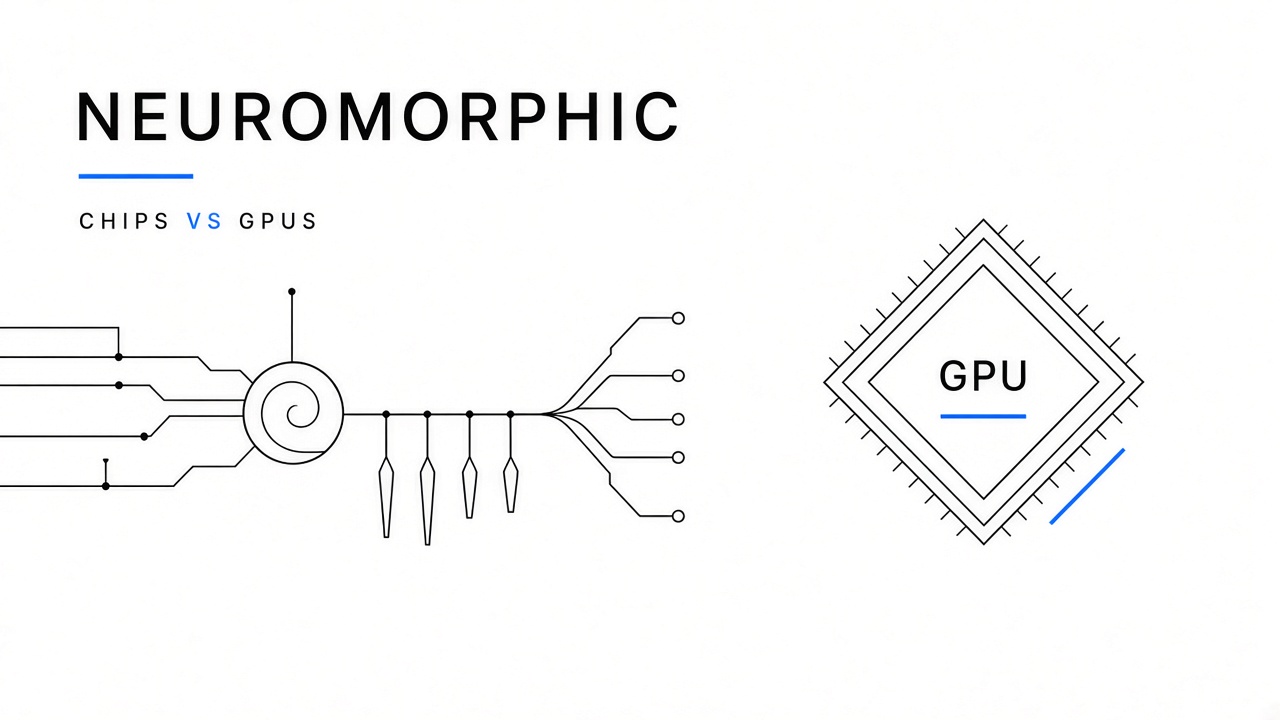
GPUs won the training war. Neuromorphic chips argue for a different front: always-on inference where milliwatts matter more than teraflops. Brain-inspired hardware processes spikes and sparse events instead of dense floating-point matmuls every clock cycle. Intel Loihi 2, the legacy IBM TrueNorth line, and the SpiNNaker neuromorphic platform represent two decades of research now edging toward industrial pilots. This guide explains what neuromorphic chips vs GPUs for AI actually means for buyers, where event-driven silicon beats NVIDIA-class accelerators, and why GPUs still dominate model training in 2026. Teams evaluating AI API endpoints alongside edge stacks should read both sides before committing silicon budgets to AI automation at the sensor layer.
What Is Neuromorphic Computing?
Neuromorphic computing builds processors whose architecture mimics biological neurons: local memory, asynchronous spikes, and sparse connectivity instead of a single global memory hierarchy feeding SIMD cores. Traditional GPUs excel at synchronized matrix multiply across thousands of identical cores. Neuromorphic chips excel when input arrives as irregular events (microphone clicks, lidar returns, pixel changes) and most neurons stay silent most of the time.
The term covers multiple engineering paths. Some chips implement explicit spiking neural networks (SNNs) with programmable synaptic weights. Others use event-based digital logic that approximates spike timing without full biophysical fidelity. All share a design goal: compute only when data changes, not on a fixed frame rate.
Event-Driven Spiking vs Frame-Based GPUs
GPUs process fixed tensors on a schedule; neuromorphic chips propagate spikes only when presynaptic activity crosses a threshold, which can reduce energy when inputs are sparse. A security camera running 30 frames per second through a ResNet on a GPU burns power decoding full images even when nothing moves. An event camera paired with a spiking network may fire thousands of times less often during idle scenes.
| Dimension | GPU (inference) | Neuromorphic chip |
|---|---|---|
| Compute model | Dense matmul, SIMD parallelism | Sparse spikes, local state |
| Idle power | Higher baseline for memory and clocks | Lower when no events arrive |
| Latency profile | Batch-friendly, frame latency | Sub-millisecond reaction to single events |
| Software stack | PyTorch, TensorRT, ONNX mature | Lava, Nengo, vendor SDKs narrower |
| Training fit | Dominant for backprop at scale | Research and conversion from ANNs |
Power and Latency Tradeoffs
Neuromorphic wins appear on ultra-low-power always-on workloads; GPUs win on throughput-heavy batch inference and any workload requiring large transformer layers. Published Loihi 2 demos report order-of-magnitude energy reductions on specific spiking workloads versus CPU baselines, not versus a tuned INT8 GPU kernel on identical tasks. Apples-to-oranges comparisons flood marketing decks; buyers should demand benchmark task names, input sparsity, and accuracy parity.
When Milliwatts Dominate
- Always-listening audio keyword spotting on battery-powered wearables where duty cycle is 24/7 but speech is rare.
- Industrial vibration monitoring where spikes indicate bearing failure and continuous FFT on a GPU is wasteful.
- Robotics reflex loops needing microsecond-scale reactions to contact events, not batch vision classification.
- Neuromorphic sensors such as event cameras (DVS) that natively output spikes rather than RGB frames.
When GPUs Still Win at Inference
- Large language model decoding requires massive weight matrices ill-suited to sparse spike routing.
- High-resolution image segmentation at video rate where dense convolutions are optimized in TensorRT.
- Multi-model serving in data centers where batching amortizes memory bandwidth.
Current Products vs Research Platforms
Intel Loihi 2 is the most visible commercial neuromorphic research chip; IBM TrueNorth is legacy but still cited; SpiNNaker remains an academic scale-out platform for brain simulation. None ship inside consumer laptops the way NPUs do. Expect dev kits, cloud access, and partner integrations rather than retail PCIe cards competing with NVIDIA RTX lines.
Intel Loihi 2
Loihi 2 improves neuron model flexibility and on-chip learning rules versus the first Loihi generation. Intel distributes boards through neuromorphic research communities and documents the Lava software framework for mapping SNNs. Production inference at Fortune 500 scale is rare; automotive and industrial partners run targeted pilots on sensor fusion and anomaly detection.
IBM TrueNorth (Legacy)
TrueNorth demonstrated million-neuron scale at roughly 70 milliwatts in IBM's 2014-era publicity, catalyzing the field. IBM shifted emphasis to digital AI accelerators and cloud AI services; TrueNorth hardware is not a 2026 procurement path but remains a reference for energy-per-spike claims and DARPA-era neuromorphic history.
SpiNNaker Platform
The SpiNNaker machine at the University of Manchester connects thousands of ARM cores optimized for real-time spiking simulation. SpiNNaker targets computational neuroscience and large-scale brain models more than shipping product inference. Lessons from SpiNNaker routing inform how event packets move on newer chips.
Why GPUs Still Dominate Training
Backpropagation through deep networks requires dense gradient updates across billions of weights; neuromorphic on-chip learning rules do not yet replace data-center GPU clusters for foundation model training. Research on surrogate gradients and ANN-to-SNN conversion lets teams train in PyTorch then deploy converted networks on Loihi-class hardware, but conversion loss and tooling gaps block mainstream adoption. Cloud AI API providers train exclusively on GPUs and TPUs; neuromorphic silicon sits downstream of that pipeline if at all.
Organizations should separate training infrastructure from edge deployment decisions. A fleet of H100 GPUs training vision models does not preclude neuromorphic inference on a factory floor if latency and power targets align and accuracy after conversion meets safety thresholds.
Use-Case Fit: A Decision Guide
Choose neuromorphic hardware when inputs are naturally sparse, power budgets sit below one watt, and sub-10 millisecond reaction times matter more than ImageNet-scale accuracy margins. Choose GPUs when models are transformers, convnets at HD resolution, or anything served through standard ONNX runtimes your MLOps team already operates.
- Characterize input sparsity: Log event rates on representative data before comparing chip spec sheets.
- Prototype on GPU first: Establish accuracy ceiling with familiar tools, then attempt SNN conversion if power targets fail.
- Validate vendor SDK maturity: Loihi requires Lava expertise; budget engineer training.
- Plan hybrid architectures: GPU handles heavy perception; neuromorphic chip handles reflex and wake-word layers.
- Document fallback: If neuromorphic supply is research-only, keep DSP or NPU path for production continuity.
AI automation pipelines orchestrating factory robots may combine cloud GPU analytics with edge neuromorphic reflexes. The orchestration layer should not assume a single silicon type end to end.
Software Ecosystem and Tooling Gaps
Neuromorphic deployment software lags CUDA by a decade: fewer pretrained SNN checkpoints, smaller communities, and limited ONNX export paths constrain teams used to PyTorch two-click inference. Intel Lava, INRC tutorials, and academic frameworks (Nengo, Brian) cover research workflows. Production MLOps teams expect Kubernetes device plugins, Prometheus metrics, and canary rollbacks. Neuromorphic stacks rarely offer that bundle in 2026. Budget six to twelve months of toolchain integration before promising edge neuromorphic SLAs to customers.
ANN-to-SNN Conversion Pipeline
Most teams train familiar convolutional or transformer blocks in PyTorch, then convert to spiking equivalents using rate coding or temporal coding schemes. Conversion introduces accuracy drops of one to five percentage points on vision benchmarks unless quantization-aware SNN training follows. Document both float baseline and SNN accuracy in validation reports regulators and safety teams may review. Robotics applications should test converted models on hardware-in-the-loop benches, not only desktop simulators that idealize spike timing.
Benchmarking Methodology That Survives Procurement
Valid neuromorphic benchmarks report task name, input event rate, energy per inference including idle window, and accuracy parity versus a GPU INT8 baseline on the same sensor stream. Reject energy claims that measure only active spikes while ignoring memory refresh on the GPU comparison host. Reject latency claims that skip host-to-device setup when the neuromorphic chip integrates closer to the sensor. Independent labs and IEEE literature provide templates; vendor slides rarely suffice alone.
Hybrid Architectures in Practice
Industrial robots illustrate hybrid design: a GPU or NPU runs periodic scene understanding at five hertz while a Loihi-class chip handles collision reflexes at kilohertz event rates. Drone fleets may wake a neuromorphic layer on accelerometer anomalies before spinning a GPU for visual confirmation. Smart building sensors use spiking layers for always-on acoustic classifiers and escalate to cloud API transcription only when keywords fire. Hybrid maps cleanly onto automation orchestrators if each tier exposes health metrics and fallback paths when the research chip resets.
Frequently Asked Questions
| Question | Short answer |
|---|---|
| Can neuromorphic chips train GPT-class models? | No at production scale; GPUs and TPUs train large models; neuromorphic targets specialized edge inference. |
| Is Loihi 2 available to buy? | Research and partner programs; not a general retail GPU replacement. |
| What is a spiking neural network? | A network where neurons communicate via timed spikes, enabling event-driven computation. |
| Do neuromorphic chips replace NPUs in phones? | Not in 2026 flagships; Apple Neural Engine and Qualcomm Hexagon use conventional accelerators. |
| When will neuromorphic go mainstream? | Niche edge wins first; broad replacement of GPUs for inference remains unlikely this decade. |
| How do I convert PyTorch models to SNNs? | Use conversion toolchains (Lava, snnTorch) and validate accuracy loss on hold-out sets. |
Will neuromorphic chips replace data center GPUs?
Not for general AI serving. Hyperscalers optimize GPUs and custom ASICs for transformer throughput. Neuromorphic may appear in specialized co-processors for sensor ingest, not rack-scale LLM hosting.
Do I need an event camera for neuromorphic AI?
Event cameras maximize neuromorphic advantages but are not mandatory. Standard sensors can feed SNNs after preprocessing, though efficiency gains shrink when converting dense frames to spikes artificially.
Key Takeaways for Procurement Teams
Neuromorphic silicon is a specialized co-processor class, not a GPU replacement in 2026 catalogs. Fund GPU training and standard inference first; fund neuromorphic pilots only when measured idle power on GPU baselines blocks product requirements and spike-friendly sensors are already selected. Require vendor roadmaps in writing with SDK release dates and reference designs that match your BOM. If a startup pitches neuromorphic for LLM hosting, redirect the conversation to API economics unless they show layer-level benchmarks on static graphs your product actually runs.
How does SpiNNaker differ from Loihi for engineers?
SpiNNaker optimizes massive spiking simulation for neuroscience research; Loihi targets programmable neuromorphic inference with Intel-supported SDKs. Choose SpiNNaker for brain modeling papers; choose Loihi for edge inference pilots with Intel partner access.
Can neuromorphic chips fuse lidar and IMU data?
Event-driven fusion is a natural fit when each sensor produces sparse timestamps; integration still requires custom routing logic and calibration unlike ROS packages on Linux plus GPU. Prototype fusion on GPU first, then port spike encoders once algorithms stabilize.
Conclusion
Neuromorphic chips vs GPUs is not a winner-take-all contest. GPUs dominate training and dense inference; neuromorphic silicon targets sparse, low-power, low-latency edge reflexes where event-driven spiking beats idle GPU waste. Intel Loihi 2, legacy IBM TrueNorth, and SpiNNaker map the research-to-product spectrum. Evaluate neuromorphic only after characterizing sparsity, proving converted-model accuracy, and accepting immature tooling relative to TensorRT ecosystems. Pair cloud AI API training with edge automation architectures that assign each workload to the silicon class it actually fits.