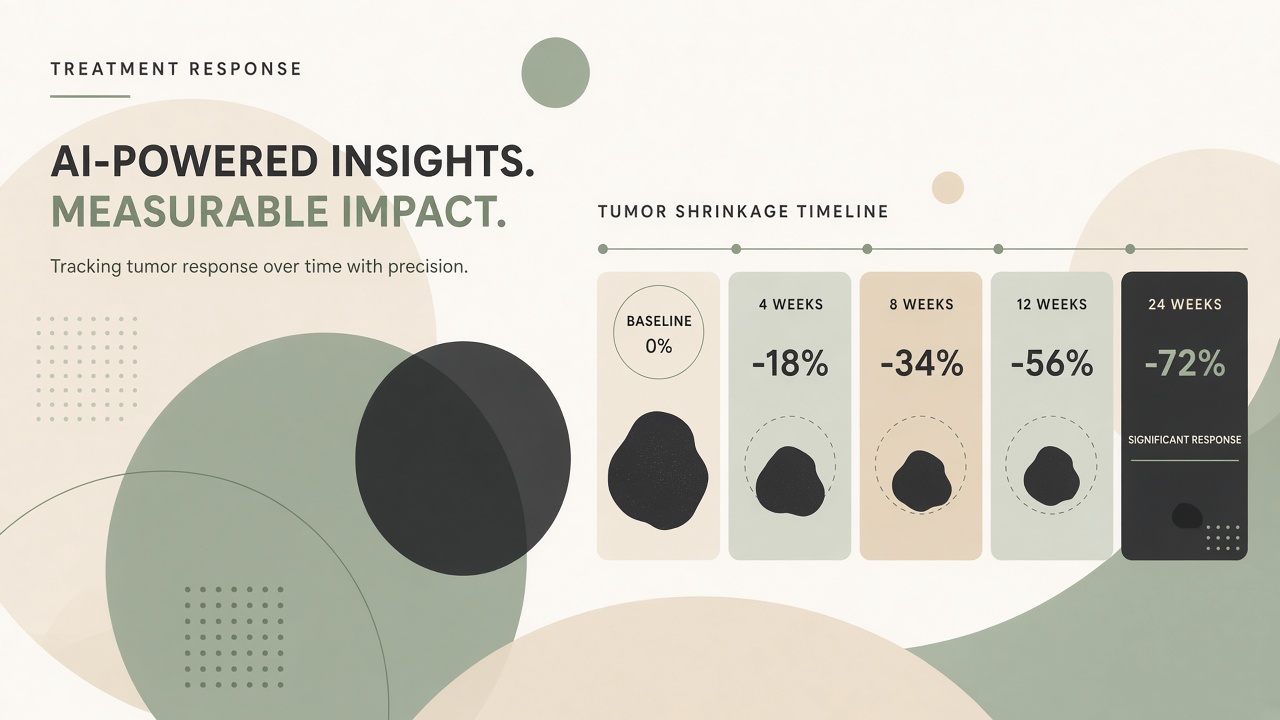
An oncologist must choose between immune checkpoint inhibitors costing six figures per year and cytotoxic chemotherapy with familiar toxicity profiles. Tumor mutational burden and PD-L1 immunohistochemistry help, yet many patients with high scores still progress while some low-score patients achieve durable remission. Oncology treatment response AI models predict whether a specific regimen will shrink or stabilize a patient's cancer using molecular profiles, pathology slides, imaging radiomics, and clinical labs gathered before treatment starts. The objective is precision allocation: give responders the therapy most likely to work and spare non-responders months of ineffective toxicity.
Tumor boards evaluating decision support should scrutinize training cohort diversity, prospective validation status, and whether predictions change actionable choices beyond existing guidelines. General AI chatbot tools must not substitute for molecular tumor boards interpreting assay results. Additional oncology AI explainers appear on the EliteAI.tools blog index.
What Oncology Treatment Response AI Means in Plain Language
Oncology treatment response AI refers to computational models that estimate the probability a given patient will achieve objective response, pathological complete response, progression-free survival, or overall survival on a specified cancer therapy, using pre-treatment data. Unlike static biomarker cutoffs (HER2 positive, EGFR mutation), machine learning can combine dozens of weak signals: albumin level, neutrophil-to-lymphocyte ratio, tumor infiltrating lymphocyte density on H&E slides, and single-cell RNA expression heterogeneity. Outputs are risk scores or responder probabilities that clinicians weigh alongside National Comprehensive Cancer Network (NCCN) guidelines and patient preferences.
Response prediction differs from treatment recommendation engines that suggest drugs directly. Prediction quantifies likelihood of benefit; recommendation applies business rules and formulary constraints. Regulatory bodies treat some outputs as laboratory-developed tests or in vitro diagnostic multivariate index assays requiring analytical and clinical validity studies before reimbursement.
| Data modality | Examples | Predictive signal |
|---|---|---|
| Single-cell transcriptomics | scRNA-seq from tumor biopsy | Clonal resistance before therapy |
| Digital pathology | H&E whole-slide images | TIL density, tumor grade features |
| Routine clinical labs | Albumin, NLR, prior therapy lines | Host inflammation and frailty |
| Genomic panels | TMB, MSI status, driver mutations | Target and immunotherapy eligibility |
How Prediction Pipelines Work
Modern oncology response pipelines use transfer learning: pretrain on large public cell-line drug screens or bulk cohorts, then fine-tune on patient-level single-cell or multimodal data from clinical trials. Feature extractors reduce high-dimensional inputs to embeddings; calibrated classifiers output responder probability with confidence intervals for tumor board discussion.
PERCEPTION and single-cell transfer learning
PERCEPTION (PERsonalized Single-Cell Expression-Based Planning for Treatments In ONcology), published in Nature Cancer in April 2024 (doi:10.1038/s43018-024-00756-7), builds treatment response models by aligning bulk and single-cell expression profiles from large-scale cell-line drug screens with patient tumor scRNA-seq. Transfer learning trains initial models on abundant cell-line data, then fine-tunes on sparse patient single-cell samples from trials. In multiple myeloma and breast cancer cohorts, PERCEPTION predicted combination therapy response and identified resistance emergence in non-small cell lung cancer patients on tyrosine kinase inhibitors. A single resistant clone can veto combination therapy response: if one subpopulation harbors resistance mutations, the patient may fail even when most clones appear sensitive, a finding the NCI highlighted in its 2024 press release on the work.
LORIS six-feature immunotherapy score
LORIS (logistic regression-based immunotherapy-response score), published in Nature Cancer June 2024 (doi:10.1038/s43018-024-00772-7), uses six routinely collected features: age, cancer type, prior systemic therapy, blood albumin, neutrophil-to-lymphocyte ratio, and tumor mutational burden from sequencing panels. Trained on 2,881 immune checkpoint blockade-treated patients across 18 solid tumor types, LORIS outperformed prior signatures for predicting objective response and survival, including in patients with low PD-L1 or low TMB where guidelines offer ambiguous guidance. The public web tool at loris.ccr.cancer.gov returns interpretable probabilities, supporting shared decision-making without requiring proprietary assay kits beyond standard panel sequencing.
Digital pathology multimodal models
Ataraxis and similar vendors fuse H&E whole-slide image features with clinical variables to predict pathological complete response (pCR) to neoadjuvant chemotherapy in breast cancer. A prospective validation trial (NCT07327970) is evaluating real-world workflow integration: Stage 1 enrolls 30 patients with blinded AI analysis during treatment; Stage 2 expands to 70 to 120 patients comparing AI-predicted pCR to surgical outcomes. Prior retrospective work claimed accuracy comparable to commercial genomic assays such as Oncotype DX, potentially lowering cost if prospective AUC holds. AI results remain reference-only in the trial design so physicians cannot be influenced until surgical pCR is assessed, preserving scientific rigor rare in early AI oncology deployments.
Adaptive dosing and longitudinal response
CURATE.AI and related platforms extend prediction from pre-treatment stratification to dynamic dose adjustment using circulating tumor DNA and toxicity signals during therapy. These closed-loop systems require serial measurements and pharmacology models distinct from one-shot response classifiers, but they share machine learning infrastructure and regulatory scrutiny. Tumor boards should not conflate static LORIS-style scores with adaptive dosing engines when evaluating vendor proposals.
FELINE trial and neoadjuvant breast combinations
PERCEPTION validation included the FELINE adaptive platform trial comparing multiple neoadjuvant combination arms in breast cancer. Single-cell viability scores differentiated responders from non-responders within combination arms, supporting the biological premise that bulk tumor averages mask clonal drug sensitivity. Readers evaluating vendor claims should ask whether performance metrics come from adaptive trial substudies with enriched molecular profiling or from convenience retrospective cohorts with missing treatment adherence data.
Tumor board integration and documentation
Molecular tumor boards should display LORIS or PERCEPTION scores alongside FDA-cleared companion diagnostics, with explicit notation of evidence grade (retrospective cohort versus prospective trial). Documenting when a score changes the recommended regimen creates medicolegal clarity and feeds learning health system registries. When boards override low scores based on patient preference for immunotherapy trial access, capture rationale so payers and auditors understand the decision was informed dissent, not ignorance of the model. Nursing navigators need plain-language summaries because patients increasingly ask about "the AI number" after reading portal notes.
Real Deployments and Published Evidence
2024 brought two high-profile Nature Cancer publications from NCI and Memorial Sloan Kettering, a public LORIS calculator, open-source PERCEPTION code, and prospective digital pathology trials entering clinic. Reimbursement pathways for AI-only scores without companion diagnostics remain unsettled; many deployments occur inside research protocols or academic tumor boards.
FDA-cleared genomic assays (FoundationOne CDx, Guardant360) already influence immunotherapy eligibility; LORIS complements rather than replaces these by integrating inexpensive blood markers. Cooperative groups such as ECOG-ACRIN and SWOG increasingly embed biorepository and single-cell collection into trial designs so PERCEPTION-style models can validate on prospective specimens rather than retrospective biobanks alone. Pharmaceutical sponsors use response predictors for enrichment strategies in phase 2 trials, reducing sample size when only predicted responders are randomized.
| Model | Therapy context | Evidence status |
|---|---|---|
| PERCEPTION | Targeted combos, myeloma, breast, NSCLC TKI | Retrospective trial cohorts; open source |
| LORIS | Immune checkpoint blockade, 18 tumor types | Multi-cohort validation; public web tool |
| Ataraxis breast AI | Neoadjuvant chemotherapy pCR | Prospective trial NCT07327970 ongoing |
| Commercial genomic assays | Chemo benefit, PARP eligibility | FDA cleared; distinct from ML scores above |
Limits, Risks, and Ethical Guardrails
Response predictors trained on trial populations enriched for fit patients may deny therapy to real-world patients with comorbidities who could still benefit, especially when scores gate access to immunotherapy in payer policies. Single-cell assays remain expensive and technically fragile; biopsy undersampling misses resistant subclones entirely. Digital pathology models drift across scanners and staining protocols, requiring periodic recalibration per CLIA laboratory standards.
- False negatives: Denying effective immunotherapy based on low LORIS score when tumor biology was mis-sampled.
- False positives: Exposing patients to toxicity when prediction optimism reflects batch effects in training data.
- Equity: Underrepresentation of racial and ethnic minorities in training trials skews scores.
- Explainability: Black-box deep models hinder tumor board trust compared with logistic LORIS coefficients.
- Indication creep: Using breast pCR models to infer adjuvant chemo benefit without label expansion.
Ethical deployment requires documenting when predictions are advisory versus binding, capturing override reasons in the EMR, and publishing model cards with intended populations and known failure modes. Patients should receive plain-language explanations that AI scores estimate group-level probabilities, not individual certainty.
Who Should Use This and Who Should Wait
Academic oncology programs with molecular tumor boards, biorepository access, and clinical trial infrastructure should pilot LORIS and PERCEPTION-class tools within protocols that track decision changes and outcomes. Community practices without sequencing panels should not deploy single-cell predictors requiring fresh biopsy logistics. Payers should wait for prospective utility studies showing cost neutrality or improvement before denying coverage based on AI scores alone.
| Setting | Appropriate use now | Defer until |
|---|---|---|
| NCI-designated cancer center | LORIS for ICB ambiguity; PERCEPTION research biopsies | Replacing PD-L1 ordering without study |
| Community oncology | LORIS web tool as second opinion with labs available | Single-cell assays without logistics support |
| Pharma trial sponsor | Enrichment biomarker exploratory endpoints | Primary registration endpoint without FDA agreement |
| Health insurer | Coverage with evidence development programs | Automatic denial rules on retrospective AUC only |
Frequently Asked Questions
How does LORIS differ from PD-L1 testing?
PD-L1 immunohistochemistry measures one protein on tumor or immune cells; LORIS integrates six clinical and genomic features to predict checkpoint inhibitor benefit. LORIS can stratify patients with low PD-L1 who still respond.
What data does PERCEPTION require?
PERCEPTION needs single-cell RNA sequencing from tumor biopsies, which is not yet routine outside research centers. Bulk RNA fallback exists but with reduced performance in published benchmarks.
Can one resistant clone override prediction?
Yes. NCI researchers showed that a single resistant subpopulation can cause clinical failure despite majority-sensitive clones. Biopsy sampling must capture heterogeneity for predictions to hold.
Are these models FDA-cleared?
LORIS and PERCEPTION are research tools and publications, not cleared in vitro diagnostics as of 2024. Digital pathology commercial tests pursue separate regulatory paths with prospective trials.
Can community oncologists use LORIS today?
The public calculator accepts routine labs and sequencing panel TMB, making it accessible without proprietary kits. Results should supplement, not replace, guideline-based recommendations and shared decision-making.
Radiomics and imaging-based predictors
Beyond pathology and labs, radiomics extracts quantitative texture features from baseline CT or PET scans to predict immunotherapy response in lung cancer and melanoma cohorts. These models face scanner harmonization challenges similar to digital pathology drift. Tumor boards should request vendor documentation on multi-site harmonization before trusting radiomics scores that looked excellent in single-institution retrospective studies.
Combination therapy and multi-drug response
PERCEPTION explicitly models combination regimens in myeloma and breast cancer trials where single-agent predictors fail. Interaction terms between drugs are learned from cell-line screens where all pairwise combinations were tested, then transferred to patient scRNA-seq. Clinicians should verify whether a vendor score trained on monotherapy data is being applied to triplet combinations off-label, a common indication creep risk in community oncology. NCCN guideline concordance remains the default when combination-specific validation is absent.
Do response predictors save money?
Economic evidence is preliminary; avoiding one year of ineffective immunotherapy is plausible but unproven at population scale. Prospective utility trials with payer participation are needed.
Liquid biopsy and longitudinal response monitoring
Circulating tumor DNA fraction and variant allele frequency trajectories during therapy provide response signals complementary to pre-treatment static scores. Models that fuse baseline LORIS inputs with week-four ctDNA clearance may outperform either alone in immunotherapy cohorts, though prospective validation is ongoing. Tumor boards should not conflate baseline non-response prediction with early progression detection; vendors marketing unified platforms should disclose which endpoint each module optimizes.
Biobank consent for future model training
Patients enrolling in trials with single-cell collection should receive clear consent language on whether de-identified omics data will train commercial prediction models sold to other health systems. Transparent governance builds trust and satisfies emerging NIH and EU data sharing expectations for federally funded oncology research.
Conclusion
Oncology treatment response AI matured in 2024 with PERCEPTION's single-cell transfer learning, LORIS's six-feature immunotherapy score, and prospective digital pathology trials for breast cancer pCR. The science reinforces a humbling theme: intratumoral heterogeneity means one resistant clone can veto combination therapy response, so predictions are probabilistic guides for tumor boards, not oracle verdicts. Centers with molecular infrastructure should pilot validated tools inside studies; community practices can experiment with interpretable scores like LORIS while awaiting reimbursement clarity and prospective outcome data.