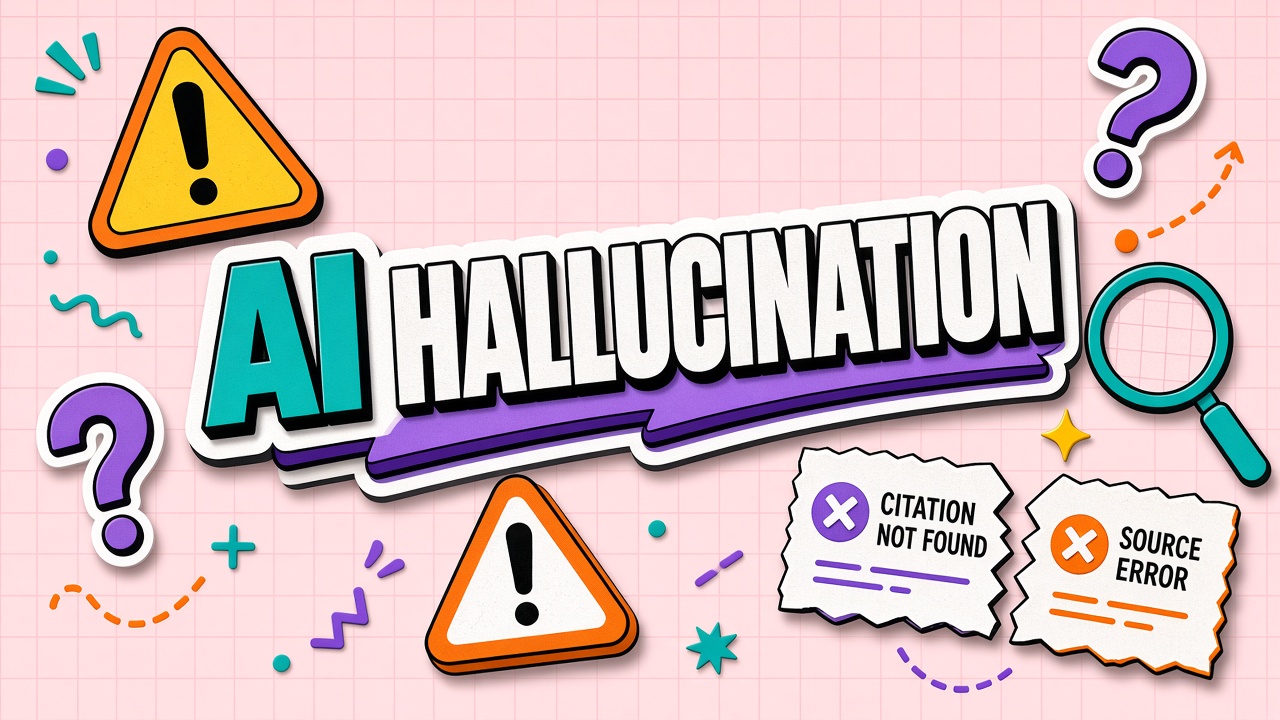
The chatbot cites a court case that does not exist. The research assistant attributes a quote to the wrong author. The coding helper invents a library function that compiles nowhere. Each output reads confidently, uses correct grammar, and fails only when you verify against reality. That failure mode has a name: hallucination.
AI hallucination is when a language model generates plausible-sounding content that is factually incorrect, unsupported, or fabricated. It is not a random glitch or a temporary bug. It emerges from how models predict tokens from patterns in training data combined with pressure to produce complete answers. This guide defines hallucination with concrete examples, explains why models hallucinate, covers detection techniques, lists tool features that help, and outlines workflow habits that reduce harm. Teams using AI chatbots for customer-facing or compliance-sensitive work should treat hallucination as a design constraint, not an occasional annoyance.
What Is AI Hallucination?
Hallucination means the model states something as fact without reliable grounding. The output may be syntactically perfect and tonally appropriate while being wrong about names, dates, statistics, citations, API methods, or logical conclusions. Users often trust fluent prose, which makes hallucinations more dangerous than obvious errors.
Named subtypes you will encounter
| Subtype | What goes wrong | Example |
|---|---|---|
| Factual fabrication | Invents statistics, events, or entities | "A 2023 MIT study found 94% adoption" with no such study |
| Citation hallucination | Creates fake papers, URLs, or case law references | DOI links that resolve to unrelated articles |
| Attribution error | Misassigns quotes or findings to wrong sources | Correct fact paired with incorrect author or year |
| Logical hallucination | Derives conclusions not supported by premises | Valid-sounding financial analysis from incomplete inputs |
| Tool or API hallucination | Invents functions, endpoints, or CLI flags | Code calling methods that never existed in the SDK |
Why Models Hallucinate: Training Gaps and Pressure to Answer
Language models optimize for plausible continuation, not truth verification. They lack persistent access to a live fact database unless you provide retrieval, browsing, or tools. When asked a question whose answer was weakly represented in training data, the model still produces tokens because empty or "I don't know" responses are underrepresented in fine-tuning targets.
- Parametric knowledge limits: Training cutoffs and sparse coverage of niche domains.
- Conflicting signals: Retrieved context may disagree with memorized patterns; models sometimes favor memory.
- Compression loss: Summarization and long-context use can drop critical qualifiers.
- Instruction tension: "Be helpful" and "Be concise" can override "Be accurate" without explicit priority.
- Stochastic sampling: Temperature above zero increases creative but risky completions.
Research on retrieval-augmented generation shows hallucinations persist even when correct documents are retrieved, because models may over-rely on internal parametric knowledge instead of copying retrieved evidence. RAG reduces but does not eliminate the problem.
Detection Techniques: Grounding, Citations, and Cross-Checks
You cannot prevent all hallucinations at generation time. Production systems combine automated signals with human verification for high-stakes outputs.
Practical detection checklist
- Require citations: Force the model to quote source passages; verify each quote exists in retrieved text.
- Cross-model check: Run the same question on a second model; flag disagreements on key facts.
- Structured output validation: Parse JSON fields and validate against schemas and allowed enums.
- External lookup: Resolve URLs, DOIs, product SKUs, and API names against live registries.
- Confidence heuristics: Flag answers when retrieval score is low or no source chunk supports claims.
- Human spot audit: Sample 5 to 10 percent of outputs weekly in customer-facing workflows.
Tool Features That Help: RAG, Browsing, and Structured Output
Commercial AI products bundle features that reduce hallucination risk when configured correctly. None are foolproof alone.
| Feature | How it reduces hallucination | Limitation |
|---|---|---|
| RAG over your documents | Grounds answers in retrieved chunks you control | Bad retrieval or stale indexes still produce wrong answers |
| Web browsing / search | Accesses current public information at query time | Search snippets can be misleading; model may misread results |
| Structured output mode | Constrains format; easier to validate programmatically | Schema compliance does not guarantee factual accuracy |
| Citation UI | Shows source passages for user verification | Citations can be fabricated if not tied to retrieval IDs |
| Lower temperature | Reduces creative drift on factual tasks | Does not fix knowledge gaps; can feel repetitive |
Research teams using AI research tools should verify every citation manually until the product proves retrieval-linked references in your pilot data.
Workflow Habits That Reduce Harm
Process design matters as much as model choice. Teams that treat AI output as a first draft, not a final deliverable, catch hallucinations before they reach customers or regulators.
- Scope AI to tasks where errors are cheap to fix (brainstorming, outlines) before expanding to production.
- Separate "generate" and "publish" roles so no single person approves unchecked AI text.
- Keep a golden question set; rerun monthly after model upgrades and measure factual accuracy drift.
- Document which sources are authoritative; instruct models to say "not found" when retrieval returns nothing relevant.
- Add disclaimers only where legally required; disclaimers do not replace verification.
Frequently Asked Questions
Is hallucination the same as creativity?
No. Creative writing intentionally invents fiction within agreed boundaries. Hallucination presents invention as fact in contexts where accuracy is expected. The same model capability produces both; intent and workflow determine whether the output helps or harms.
Can hallucinations create legal risk?
Yes. Fabricated citations in legal filings, false product claims in marketing, and incorrect medical or financial advice can trigger liability, regulatory action, or professional sanctions. Treat unverified AI output as untrusted third-party content.
Does RAG eliminate hallucination?
No. RAG reduces reliance on stale parametric knowledge but models can still ignore retrieved text, misquote it, or combine chunks incorrectly. Evaluate both retrieval quality and answer faithfulness separately.
Do newer models hallucinate less?
Frontier models generally improve on benchmarks, but hallucination rates vary by domain and task. A model strong at coding may still fabricate citations in legal research. Test on your data, not on vendor marketing averages.
Can you detect hallucination automatically?
Partially. Retrieval overlap scores, entailment models, and cross-checks catch many errors but miss subtle logical mistakes. High-stakes workflows still need human review or domain-specific validators.
The Bottom Line
AI hallucination is confident incorrect output, not random failure. Models hallucinate because they predict plausible text without built-in fact checking. Reduce harm with retrieval grounding, citation verification, structured validation, and human review on consequential outputs. Evaluate AI chatbot and AI research tools on EliteAI.tools by how they surface sources, not by fluency alone.