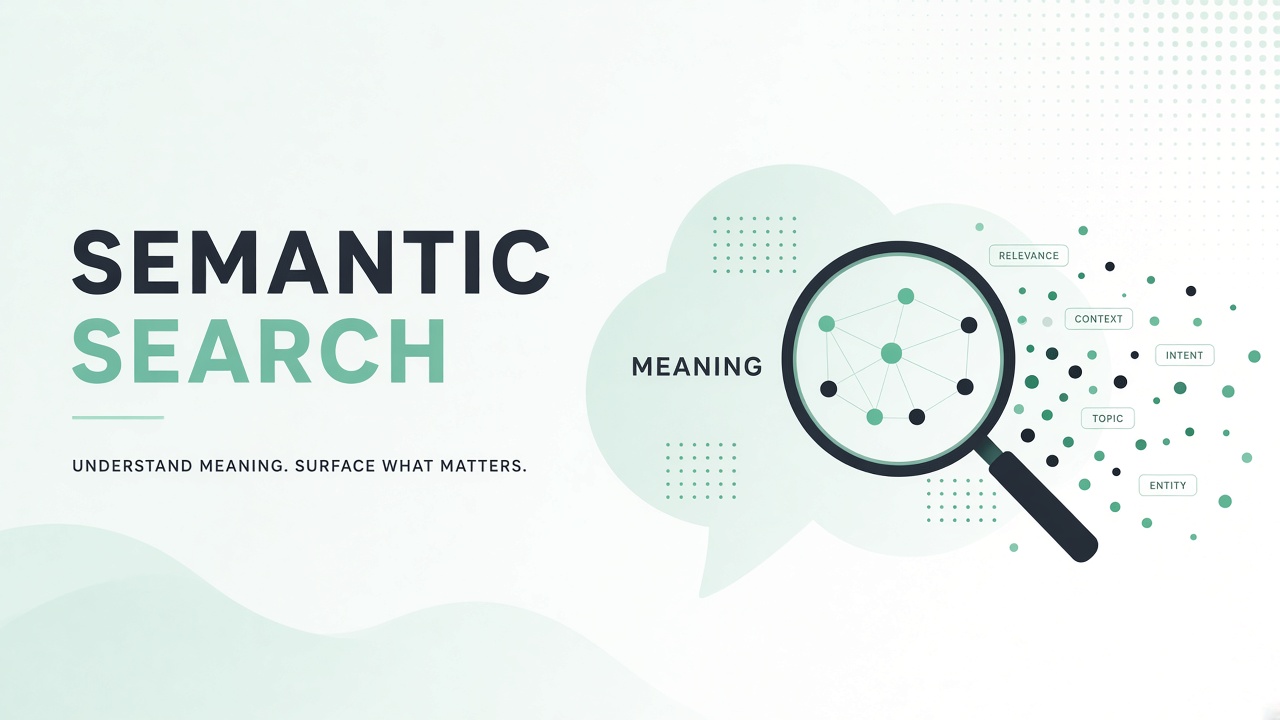
A developer searches the internal wiki for "how we handle GDPR deletion requests" but the official page title says "data subject erasure workflow." Keyword search returns nothing useful. Semantic search embeds both the query and the documents into vectors, then ranks by meaning similarity so paraphrases still match. Semantic search explained for product teams: retrieval that understands intent and synonyms, not just character overlap. The technique powers RAG assistants, enterprise search bars, and recommendation layers inside AI code tools that find relevant functions by description, plus private AI chatbot deployments that must search policy libraries users describe in everyday language.
Keyword, Semantic, and Hybrid Search
Keyword search (BM25, inverted indexes) excels at exact tokens, SKUs, and error codes; semantic search excels at paraphrases and conceptual questions; hybrid systems combine both scores for production recall. Pure keyword misses vocabulary mismatch. Pure semantic can rank vaguely related fluff above a document that contains the precise statute number the user pasted. Hybrid retrieval runs both paths, then merges rankings with weighted fusion or a cross-encoder reranker that reads query and candidate together.
| Approach | Strength | Weakness |
|---|---|---|
| Keyword (BM25) | Exact IDs, rare terms | Synonym and paraphrase gaps |
| Semantic (vectors) | Natural language questions | Precise token mismatches |
| Hybrid | Balanced enterprise recall | More infrastructure to tune |
| Reranked hybrid | Best precision at top-k | Extra latency and cost |
Query type routing helps: detect UUID patterns and route to keyword-first; detect conversational questions and boost semantic weight. Logs of click-through and thumbs-down on results reveal when fusion weights need adjustment per tenant or product line.
Building a Semantic Search Index
Building semantic search means chunking source content, embedding each chunk with a chosen model, storing vectors in a database that supports approximate nearest neighbor search, and attaching metadata for filtering. Chunk sizes between 300 and 800 tokens are common starting points; structure-aware chunkers split on headings in wikis and on functions in code. Embedding model choice should match domain (general, legal, multilingual, code) and query language distribution.
Ingest pipelines deduplicate near-identical pages, strip boilerplate navigation text, and preserve source URLs or file paths as metadata. Reindex jobs run on schedules or change-data-capture hooks from CMS and git repositories. Version embedding models explicitly: swapping models without re-embedding the corpus breaks comparability until reindex completes.
Vector database selection
Vector stores range from dedicated engines (Pinecone, Weaviate, Qdrant) to pgvector inside PostgreSQL and OpenSearch k-NN plugins. Choose based on filter complexity, ops maturity, and latency SLOs. Metadata-heavy enterprise search often needs pre-filtering by department before vector similarity runs, which favors databases with strong boolean filter performance.
Re-Ranking, Freshness, and Recency
First-stage vector search optimizes recall across millions of chunks; rerankers reorder the top fifty candidates for precision using cross-attention between query and passage text. Without reranking, users see "sort of related" documents at position one. Cross-encoder models add tens to hundreds of milliseconds; cache rerank results for popular queries when acceptable.
Freshness signals boost recently updated policies, tickets, or release notes. Semantic similarity alone may surface a deprecated 2022 doc that reads similarly to the 2026 policy. Combine `effective_date` metadata, version tags, and decay functions on `last_modified`. For news-heavy corpora, time-window filters prevent ancient articles from dominating topical queries.
Access Control Filters and Tenant Isolation
Enterprise semantic search must enforce permissions before similarity scoring, not after, so users never see snippets from documents they cannot open in the source system. Sync ACL bitmaps or group IDs into chunk metadata during ingest. At query time, apply filters: `department IN user.groups AND classification <= user.clearance`. Post-filtering top-k results leaks titles in logs and UI flash; pre-filtering is mandatory for regulated data.
Multi-tenant SaaS products isolate by `tenant_id` on every vector and reject cross-tenant queries at the API layer. Penetration tests should attempt prompt injection that asks the bot to "search all customers." Audit retrieval logs with user ID, filter set, and returned chunk IDs for compliance reviews. Private AI chatbot deployments on SharePoint or Google Drive inherit the connector's permission model; verify connector lag does not expose revoked access.
Metrics That Matter for Semantic Search
Track recall@k on labeled question sets, mean reciprocal rank, click-through rate on results, zero-result rate, and downstream answer quality when search feeds RAG generation. Offline benchmarks use human curators or LLM judges with caution; production click logs ground truth in real behavior. Separate metrics for retrieval and generation when diagnosing RAG: a perfect answer with wrong retrieval is luck, not system quality.
| Metric | What it tells you | Action if poor |
|---|---|---|
| Recall@10 | Right doc in top ten? | Tune chunking, hybrid weights, embeddings |
| MRR | How high correct doc ranks | Add reranker, freshness boosts |
| Zero-result rate | Queries returning nothing | Expand corpus, relax filters |
| p95 latency | User-perceived speed | Shrink candidate pool, cache embeddings |
Semantic Search for Code and Technical Docs
Code search benefits from embeddings trained on code-doc pairs plus symbol-aware chunking that keeps function bodies intact. Hybrid keyword on symbol names (`UserService.refund`) plus semantic on natural language questions ("where do we validate coupons") outperforms either alone. IDE integrations in AI code products index open files and repository history; freshness hooks re-embed on merge to main.
Query Understanding and Expansion
Pre-retrieval query processing rewrites vague questions, expands acronyms, and detects language before embedding to improve match quality. HyDE generates a hypothetical answer document, embeds it, and retrieves against that vector. Multi-query expansion asks the model for three paraphrases and unions results. Step-back prompting retrieves broader context first, then narrows. Each technique adds latency; A/B test on your query distribution rather than enabling all tricks at once.
Spell correction and entity linking connect user mentions to canonical IDs in metadata (`product_sku: AX-99`) so filters apply even when the user typoed the name. For multilingual corpora, either embed in a multilingual model or translate queries to the dominant document language with confidence thresholds on detection.
Operating Semantic Search in Production
Runbooks should cover embedding API outages (fallback to keyword-only), partial reindex failures, and emergency disable of semantic weight when a bad deploy poisons rankings. Blue-green index versions let you roll back vector indexes without touching the keyword index. Monitor embedding queue depth during bulk wiki imports. Capacity plan for query embedding QPS separately from ingest QPS; search spikes during incidents may dwarf steady-state ingest.
Developer experience matters: expose a debug mode for internal users showing scores, fusion weights, and chunk metadata to speed tuning. Product analytics on "no good result" queries feed backlog for new documents or improved chunk boundaries.
Common Failure Modes
Semantic search fails visibly when corpora are stale, chunks split mid-table, embedding models mismatch query language, or toxic duplicate pages pollute top results. Mitigations include golden query regression suites, deduplication hashes, human review queues for low-confidence retrievals, and abstention in downstream LLMs when max similarity score falls below a calibrated threshold.
Semantic Search Buyer Questions
Procurement should ask vendors about hybrid support, ACL filter placement, reindex SLAs, embedding model portability, and whether rerankers run in your VPC. Request benchmarks on your acronym-heavy corpus, not generic MS MARCO scores. Clarify whether "semantic search" means vectors only or includes keyword fusion and reranking in the quoted price.
Frequently Asked Questions
Do I still need keyword search?
Most production systems use hybrid retrieval because semantic alone misses exact identifiers keyword search finds instantly. Budget for both indexes or a platform that fuses them natively.
How expensive is embedding a large corpus?
Initial ingest cost scales with token count; steady-state cost depends on how often documents change. Incremental updates embed only changed chunks. Open embedding models reduce API spend at some quality tradeoff.
Does semantic search send my data to third parties?
Cloud embedding APIs process text you submit unless you self-host embedding models on your infrastructure. Review vendor data processing terms for confidential corpora.
Is semantic search the same as RAG?
Semantic search is typically the retrieval step inside RAG; RAG adds generation and citation on top of retrieved chunks. You can deploy semantic search without an LLM answer layer as a standalone enterprise search bar.
What chunk size should we start with?
Begin near 512 tokens with heading-aware splits, then tune using recall@k on fifty labeled internal questions. Increase size if answers lack context; decrease if retrieval returns irrelevant paragraphs.
Embedding Cache and Cost Control
Cache query embeddings for repeated searches, batch embed documents during off-peak hours, and deduplicate identical chunks across tenants when content is shared. Quantized embedding models reduce storage with small recall tradeoffs testable on your golden set. Monitor dollars per thousand queries including reranker fees; semantic search at scale is not negligible OpEx even when generation is disabled.
Semantic Search Maturity Model
Level 1 uploads PDFs to a single vector index; Level 2 adds ACL metadata and scheduled reindex; Level 3 runs hybrid plus reranker with golden-set regression; Level 4 closes the loop from user feedback into chunking and fusion tuning. Most vendors sell Level 1 as "enterprise semantic search." Buyers should map product roadmaps to this ladder and contract SLAs for Level 2 capabilities before promising compliance officers permission-safe search.
Semantic Search for Support Tickets
Support teams search past tickets with phrasing customers never used in the subject line; semantic retrieval surfaces resolved cases where the agent wrote "password reset loop" while the user asked about "cannot log in after MFA." Index ticket bodies, agent resolutions, and linked KB articles with `product` and `plan` metadata. Close the loop by suggesting draft replies from top matches, but require agents to verify before send because similar tickets may have different root causes.
Multilingual Semantic Search
Multilingual embedding models let one index serve queries in Spanish and documents in English when business rules allow cross-language retrieval. Otherwise detect query language and filter documents by `lang` metadata before similarity runs. Translate-query-retrieve-in-English is a fallback when high-quality monolingual embeddings exist only for English corpora. Evaluate cross-language recall separately in golden sets; do not assume multilingual models perform equally in all language pairs.
Conclusion
Semantic search explained: embed content and queries, rank by meaning, blend with keyword retrieval when needed, rerank for precision, enforce ACL filters before scoring, and measure recall plus latency continuously. It is the retrieval backbone behind grounded AI assistants and serious enterprise search. Invest in chunking, hybrid fusion, and permission-aware metadata before promising "AI that understands our docs" to users.
Start with a labeled evaluation set from real employee questions, not generic benchmarks. Tune one variable at a time: chunk size, then hybrid weights, then reranker depth. Document baseline keyword-only metrics so stakeholders see measurable lift when semantic layers ship. Retrieval quality caps every downstream RAG or copilot feature; fixing generation prompts cannot compensate for indexes that never return the right paragraph.