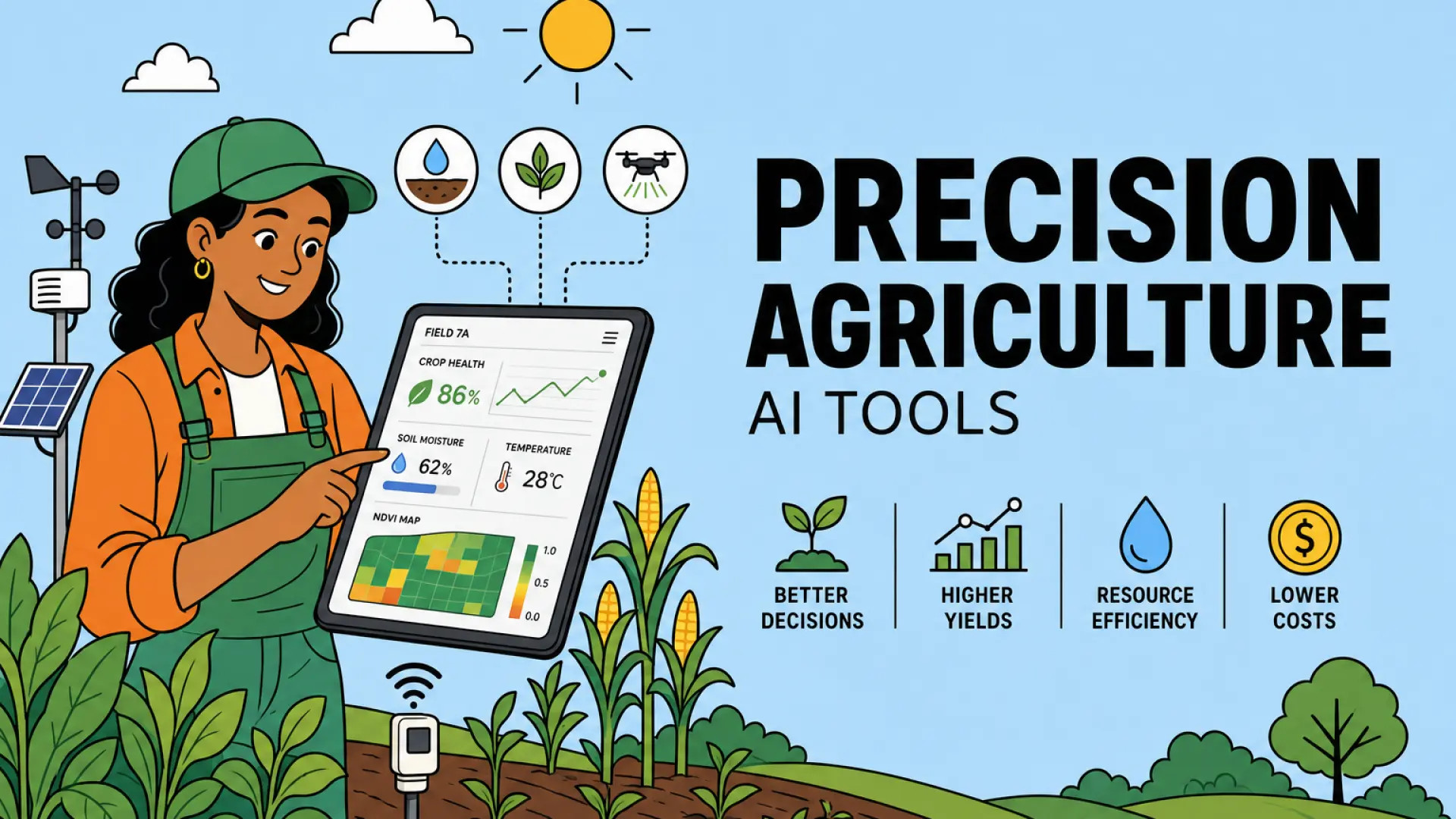
Variable-rate planting and targeted spraying promise higher yields with fewer inputs, but only when data layers agree on what the field actually needs. AI precision agriculture tools fuse satellite imagery, soil samples, and weather forecasts into recommendations operators must validate before equipment rolls. A wrong zone map wastes seed, chemical, and trust faster than traditional scouting catches.
This guide covers data fusion, equipment and drone integrations, regulatory documentation, and farmer adoption. Agronomists drafting extension content may use AI writing tools for newsletters; prescription maps must come from validated agronomic platforms. Visualization teams compare AI design tools for map styling separate from agronomic models.
Imagery, Soil, and Weather Data Fusion
Combine multispectral imagery, soil electrical conductivity, yield history, and hyperlocal weather to build management zones; no single layer is sufficient alone. Cloud cover gaps imagery timelines. Soil tests lag seasons. Weather models shift daily. Fusion algorithms weight sources by crop stage and historical accuracy on your farm.
| Data layer | Typical resolution | Validation need |
|---|---|---|
| Satellite NDVI | 3 to 10 m, multi-day revisit | Ground-truth stress vs moisture |
| Soil sampling | Point, interpolated zones | Retest every 2 to 4 years |
| Yield monitors | Sub-field from combine | Calibrate moisture, lag fixes |
| Weather | Grid or on-farm station | Compare to local rain gauge |
Seasonality planning means different models for planting, vegetative growth, and harvest windows. Retrain or reweight features when rotating crops. Document which agriculture ai imagery provider supplied each prescription for traceability if outcomes disappoint.
Equipment and Drone Integrations
Prescription maps must export in formats your planter, sprayer, and drone software accept with verified coordinate systems. ISOXML, shapefiles, and manufacturer-native formats each have quirks. Test one zone on a small pass before full-field application.
- Sync boundary files with FSA and insurance acreage records.
- Calibrate flow controllers after changing AI rate recommendations.
- Log as-applied data back to platform for closed-loop learning.
- Drone scouting fills cloud gaps; align flight altitude with model training assumptions.
- Maintain spare data cables and offline export for poor connectivity fields.
Regulatory and Subsidy Documentation
Conservation programs, organic certification, and chemical application records require defensible documentation beyond AI screenshots. NRCS practice codes, restricted entry intervals, and buffer zones must appear in human-readable logs regulators and certifiers accept.
- Store prescription source, date, operator, and product applied per field.
- Retain ability to reproduce zone maps years later for audits.
- Separate organic fields in software with access controls.
- Document when AI recommendations were overridden and why.
- Coordinate with crop insurance agents on planted acreage disputes early.
Farmer Adoption and Training
Technology fails when operators distrust black-box maps; invest in training, side-by-side trials, and agronomist partnerships. Start with one field and one practice (nitrogen or seed rate) before stacking variables. Celebrate measured savings in bushels and dollars, not dashboard metrics alone.
Dealer support matters: who fixes integration at 5 AM on planting day? Contract SLAs for data latency and export failures. Younger operators may adopt faster; include veteran growers in pilot design so knowledge transfers both ways. Extension materials drafted with writing assistance still need agronomist sign-off before distribution.
Cooperative and shared data models
Co-ops pooling yield data improve regional models but raise privacy questions on competitive fields. Define aggregation thresholds and opt-out paths. Visual dashboards for grower meetings can use design tools for clarity; underlying statistics must come from governed data warehouses.
Crop Stage Decision Calendar
Align AI recommendations to growth stages: emergence, vegetative, reproductive, and maturity each need different model features and human thresholds. A nitrogen recommendation valid at V6 may be wrong at tasseling. Build a season calendar in your farm management software that gates which models auto-run and which require agronomist release.
Weather windows for spraying add another layer: inversion risk, wind speed, and rain fast invalidate prescriptions generated overnight. Mobile alerts should surface kill-switch conditions before the operator loads the sprayer. Historical farm operations ai analytics improve when you tag decisions by crop stage in the database, not only by calendar date.
Water and Irrigation Management
Irrigation AI blends soil moisture probes, evapotranspiration models, and crop coefficients; ground truthing with hand feel and probe spot checks prevents over-application. Deficit irrigation strategies for wine grapes differ from corn yield targets. Configure zone-level setpoints per soil type within the same pivot field.
- Integrate flow meter data to detect stuck valves and leaks early.
- Log override events when operators run manual cycles during heat waves.
- Compare satellite stress maps to probe readings before blaming equipment failure.
- Document water source permits when AI recommends increased pumping.
Pest and Disease Scouting Support
Computer vision on drone and phone imagery can flag canopy anomalies; agronomists confirm pest ID before treatment. False positives from nutrient stress look like disease in RGB photos. Multispectral indices reduce but do not eliminate misclassification. Maintain labeled image libraries from your farm to fine-tune regional models where vendors allow.
Treatment recommendations must respect pre-harvest intervals and bee activity windows. AI suggesting a broad-spectrum application near bloom is a reputational and yield risk. Escalate to certified crop advisor sign-off on any prescription crossing regulatory thresholds.
Supply Chain and Input Planning
Variable-rate maps drive seed, fertilizer, and chemical orders; connect AI outputs to procurement so bins are stocked before planting windows. Lead times on specialty hybrids and custom blends exceed model generation time. Export zone acreages early for dealer quotes. Reconcile ordered vs applied tons in fall audits to close the learning loop for next season's planning documents and board reports.
Labor and Machinery Constraints
Prescriptions assume equipment and operators are available; integrate fleet calendars and labor schedules before publishing work orders. A perfect zone map fails when only one spreader is running and rain arrives in forty-eight hours. AI scheduling layers should respect operator skill, PTO maintenance, and custom applicator license requirements for restricted products.
Edge Compute and Offline Field Kits
Tablets with edge inference can score imagery in the cab without uplink; sync results when back at the shop. Reduces latency for in-season scouting. Validate edge model versions match cloud training monthly. Store offline exports on rugged drives with encryption when devices leave the farm network.
Carbon and Sustainability Reporting
Variable-rate applications affect carbon program enrollment and scope 3 reporting; document inputs applied per zone for verifier audits. AI recommendations tied to cover crop seeding or reduced tillage need agronomist attestation before credit claims. Do not extrapolate soil carbon gains from model defaults without soil test history on your fields.
Dealer and Agronomist Partnerships
Align AI platform choice with input dealers and crop advisors who support your geography and crop mix. Prescription maps nobody can apply are worthless. Contract for application support, not only software licenses. Joint training days before planting build trust when models disagree with farmer intuition. Document override reasons in the platform so advisors refine zones next season.
Use design tools for grower-facing report layouts; agronomic statistics must come from validated exports. Board presentations for co-op members need plain language on ROI and risk, not raw model confidence scores alone.
On-Farm Trial Design
Strip trials and replicated plots validate AI zones before whole-field adoption. Use check strips with uniform rate for comparison. GPS-guided application equipment must log as-applied data for statistical analysis. University extension partnerships add third-party credibility to trial results shared with lenders and landlords.
Rented Ground and Landlord Relations
Share prescription maps and application records with landlords when lease requires documentation for cost-share or sustainability clauses. Obtain permission before uploading tenant field boundaries to vendor cloud. Disputes over input costs decrease when as-applied logs are transparent and timestamped.
The Bottom Line
AI precision agriculture tools deliver when imagery, soil, and weather fuse with ground validation, clean equipment handoffs, audit-ready records, and patient adoption programs. AI suggests; farmers and agronomists decide. Measure on yield and input cost, not map aesthetics.
Frequently Asked Questions
Does AI variable-rate spraying affect organic certification?
Organic systems require approved inputs and documentation. AI zoning does not exempt buffer or recordkeeping rules. Certifiers may ask how recommendations are generated; maintain human agronomist oversight records.
How do cooperatives share AI models across members?
Use anonymized aggregation with minimum field counts per zone. Allow opt-out. Align data contracts with cooperative bylaws and member equity policies. Do not share identifiable yield maps without consent.
What connectivity is required in the field?
Plan for offline export and USB transfer. Cloud sync can wait until the shop. Planting and spraying windows do not tolerate upload failures. Test offline workflows before peak season.
How do we evaluate ROI on precision ag AI?
Run replicated strips or whole-field A/B with matched soil types. Track input cost, yield, and labor time for two seasons before network-wide rollout. Include learning curve cost in year one expectations.
Does precision ag AI apply to livestock operations?
Pasture and feed management use different sensor sets: water tanks, weight scales, and barn climate. Imagery models trained on row crops misread pasture stress. Use species-specific platforms and veterinarian oversight on health recommendations.
Who owns farm data in AI platforms?
Negotiate contracts explicitly: you own raw yield and application data; vendor may use aggregated anonymized statistics only if you opt in. Export rights on termination prevent lock-in when switching dealers or platforms.