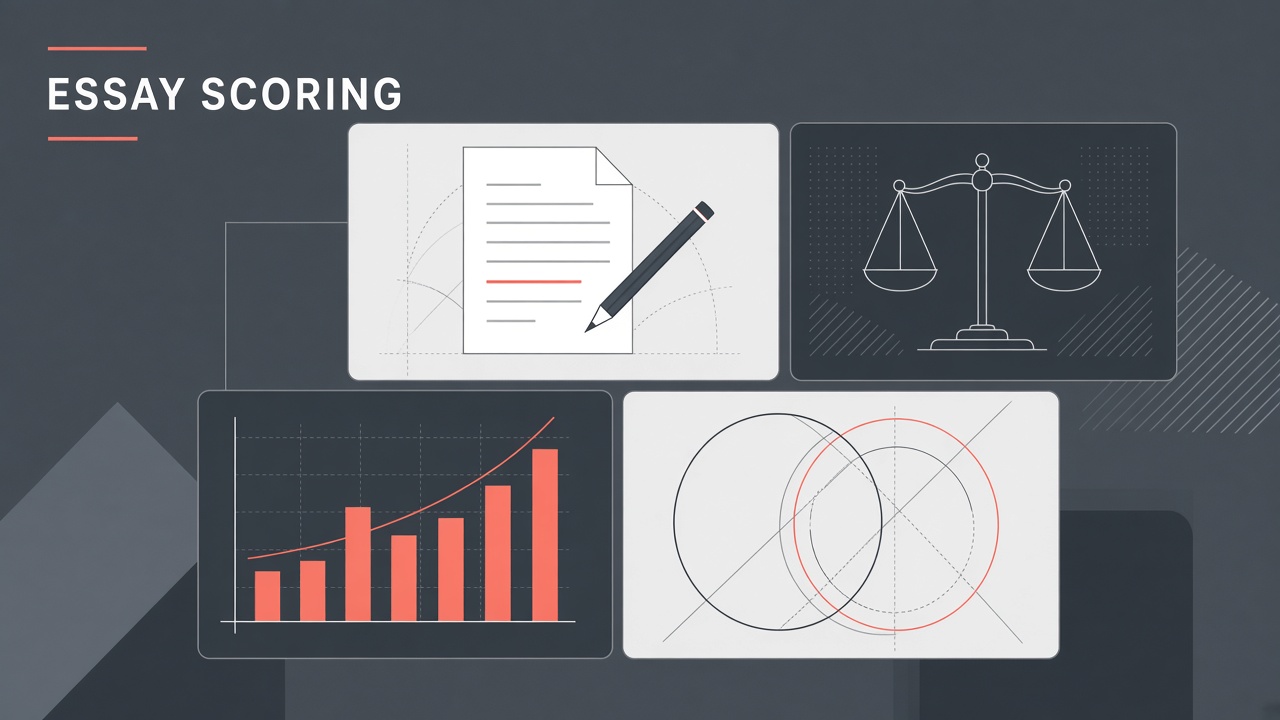
AI automated essay scoring (AES) systems grade millions of standardized tests and classroom drafts using linguistic features and fine-tuned language models, delivering speed and consistency while risking bias against English learners, dialect speakers, and demographic groups underrepresented in training data. ETS, Pearson, and state assessment vendors deploy AES for large-scale writing programs; GPT-4 class models now enter research and classroom pilots. Fairness research shows high-proficiency ESL essays scoring 10 percent lower than native writing of identical human-rated quality, and Asian American students receiving larger score gaps than other groups in GPT-4o grading experiments. Hybrid human-AI workflows and training-time debiasing reduce but do not eliminate disparity. Parents and educators evaluating AI chatbot graders or popular AI tools for writing should demand transparency reports and appeal paths before high-stakes use.
How AES Scales Standardized Testing
Automated essay scoring scales standardized testing by predicting human rubric scores from textual features at throughput impossible for rater pools alone, with quadratic weighted kappa agreement often above 0.7 against expert graders on benchmark corpora. Traditional AES extracts length, lexical diversity, grammar error counts, discourse coherence markers, and prompt relevance embeddings, then regresses to a holistic or analytic score. Transformer models (BERT, DeBERTa, Longformer) fine-tuned on thousands of human-scored essays dominate recent benchmarks. Large language models prompted with rubrics score essays in zero-shot or few-shot modes for research comparisons.
State assessments, GRE Analytical Writing research samples, TOEFL iBT writing tasks, and classroom formative tools use AES at different stakes. High-stakes deployment pairs machine scores with human adjudication on borderline cases and periodic validity studies. Low-stakes classroom tools may show scores directly to students for draft feedback with teacher override.
Speed enables immediate feedback loops in learning platforms: students revise drafts same day instead of waiting weeks for instructor comments. Scale also cuts per-essay grading cost for MOOCs and licensure exams. The tradeoff is opacity when neural models weight surface features correlated with demographics rather than true writing quality.
Linguistic Features Models Overweight
Models overweight essay length, sophisticated vocabulary, and Standard American English syntax markers that correlate with socioeconomic advantage rather than argument quality alone. Longer essays score higher even when verbose and off-topic because length proxies for development in training data. Rare word density rewards privileged exposure to academic register. Conventional grammar error detectors flag legitimate second-language constructions and African American English patterns as errors, depressing scores.
Discourse features such as thesis-statement placement and five-paragraph structure reward Western essay conventions taught in U.S. schools. Creative or nonlinear organization may score lower despite strong content. LLM graders inherit these biases from pretraining corpora and rubric examples skewed toward dominant dialects.
Feature transparency tools (SHAP, attention visualization) help auditors see whether scores track spelling versus reasoning. Regulators increasingly request such documentation when AES influences graduation or placement decisions.
| Feature class | Scoring influence | Fairness risk |
|---|---|---|
| Length / token count | Strong positive correlation | Penalizes concise or timed writers |
| Lexical sophistication | Rewards rare words | Socioeconomic proxy |
| Grammar error rate | Penalizes non-standard syntax | ESL and dialect bias |
| Discourse template fit | Rewards intro-body-conclusion | Cultural rhetorical bias |
Documented Bias Against Dialects
Documented bias against dialects and ESL writers includes lower AES scores for matched-quality essays from English learners, demographic disparities in LLM grading, and amplification when training data lacks balanced representation. A 2026 contrastive learning study on DeBERTa-v3 using ASAP 2.0 and ELLIPSE datasets found high-proficiency ESL essays scored 10.3 percent lower than native essays of identical human-rated quality. Triplet margin loss on 17,161 matched pairs reduced that gap by 39.9 percent while maintaining QWK near 0.76. Separately, ETS researchers compared GPT-4o scores to human ratings on 13,121 student essays: GPT-4o averaged 2.8 versus human 3.7 on a six-point scale, with Asian American students penalized an extra quarter point relative to other groups.
PERSUADE corpus research training Longformer AES on demographically restricted sets showed human ratings themselves explain about 12.5 percent of variance by demographics; restricted-training LLMs amplified bias (marginal R squared near 0.043), while balanced training minimized machine bias beyond human disparities. Gender bias studies report lower scores for female-authored essays of equal quality in some corpora.
African American English and other stigmatized varieties face double penalty: human raters may undervalue dialect features, and AES models encode those patterns as errors. Linguistic justice advocates argue rubrics should separate communicative competence from conformity to mainstream academic English when policy allows.
Hybrid Human-AI Scoring Workflows
Hybrid human-AI scoring workflows route borderline essays, demographic audit samples, and high-stakes appeals to human raters while machines handle clear cases, balancing throughput with fairness safeguards. Typical pipelines: AES scores all essays; humans rescore random 5 to 10 percent for drift monitoring; essays near cut scores or flagged by bias detectors go to second human read. Adjudication teams resolve disagreements. GRE and state testing programs published similar designs for decades; LLM components slot into the same quality gates with updated validity studies.
Classroom formative use inverts the emphasis: teacher reviews all machine suggestions before students see grades, or students receive feature-level feedback (organization, evidence) without a single summative number. Revision cycles pair AES comments with teacher conferences.
Adversarial debiasing during training uses gradient reversal layers to remove demographic predictors from embeddings while preserving score accuracy. Contrastive learning aligns ESL and native representations of equally scored essays. Data augmentation frameworks synthesize minority-dialect high-scoring samples to balance corpora. None achieve perfect fairness; continuous monitoring is required.
Transparency Demands From Parents
Parents and advocacy groups demand score explainability, appeal procedures, and public bias audit results before schools adopt AES for placement, graduation, or scholarship eligibility. Black-box LLM scores frustrate families who cannot see why a thesis lost points. Jurisdictions increasingly require algorithmic impact assessments for education technology. Minimum transparency includes: rubric criteria mapped to feedback; whether AES or human scored each essay; demographic disparity reports by subgroup; and timely human reconsideration.
College admissions largely remain human-read for personal statements, though some MOOC certificates use AES. TOEFL and similar tests disclose machine scoring with human verification options on disputes. K-12 adoption varies by state contract; parents should ask districts which vendor, which model version, and which oversight study dates apply.
Student use of ChatGPT to generate essays creates a new axis: detectors and stylometric AES flags for AI authorship, with separate fairness concerns for false positives on formal ESL writers. Policy layers separate "who wrote it" from "how good is the writing," each needing distinct validation.
Classroom vs High-Stakes Deployment
Classroom formative AES emphasizes revision feedback and teacher mediation; high-stakes standardized testing emphasizes agreement with expert raters, security against collusion, and legal defensibility of score appeals. Formative tools like Writable, Turnitin Revision Assistant, and LMS-embedded rubric graders show feature-level comments (thesis clarity, evidence count) rather than a single summative number students treat as final. Teachers disable scoring entirely for first drafts, enabling comment-only mode. High-stakes programs encrypt prompts, monitor response time anomalies, and flag identical phrasing across test takers before AES runs.
State education agencies publishing AES validity reports every three to five years document population invariance studies across gender, race, and disability status. When invariance fails, states may drop machine scoring for affected subgroups or revert to 100 percent human grading until models retrain. Parents reading score reports deserve plain-language summaries of whether a human, machine, or both contributed to each constructed-response score.
Technical Mitigations and Audit Practices
Technical mitigations combine balanced training corpora, dialect-aware rubrics, subgroup disparity dashboards, and periodic human recalibration studies mandated in vendor contracts. Vendors should publish annual fairness reports with score gaps by race, gender, ESL status, and disability accommodation use. Contrastive learning with matched essay pairs, adversarial debiasing via gradient reversal, and BRIDGE-style augmentation that blends high-scoring minority-dialect content into training sets each address different bias mechanisms. No single method suffices; audit committees stack approaches and monitor drift when model versions update.
Rubric engineering matters as much as algorithms: separating content, organization, and language conventions allows scoring argument strength without penalizing legitimate dialect features when policy permits. Human rater training must align with machine features so teachers do not contradict AES feedback students see on drafts. Double-scoring studies compare human-human agreement to human-machine agreement; acceptable deployment typically requires machine-human QWK within 0.1 of human-human benchmarks on validation sets.
International contexts amplify fairness challenges: TOEFL and IELTS candidates expect assessment of communicative competence in academic English, yet AES trained predominantly on U.S. prompts may still encode unintended cultural assumptions about evidence types and citation norms. Multilingual AES research explores cross-lingual embeddings, but high-stakes use remains conservative. Classroom formative tools in dual-language programs should let teachers disable grammar-weighted features when drafting in translanguaging pedagogies.
Open-source AES benchmarks on ASAP and ASAP 2.0 corpora let researchers reproduce fairness interventions before vendors deploy them commercially. Independent auditors without vendor contracts should access holdout essay sets stratified by demographic metadata to verify marketing claims. Journalists and parent advocates increasingly file public records requests for state AES validity studies; districts should archive reports centrally rather than relying on vendor PDFs buried in procurement folders.
Student writers learning academic English benefit from AES that highlights organization and evidence separately from grammar conventions, with teacher toggles for which dimension displays on each draft. Portfolio assessment combining multiple human-reviewed pieces reduces over-reliance on any single machine score for placement decisions.
Writing center tutors at universities should coach students on how to interpret AES feedback without treating algorithmic suggestions as authoritative style guides. Disagreement between human tutor and machine comment becomes a teaching moment about audience, genre, and rhetorical choices machines poorly evaluate.
Frequently Asked Questions
Are GRE and TOEFL essays scored by AI?
Research and operational programs use AES components with human oversight and dispute processes. Exact vendor stacks change; check current ETS and Pearson technical manuals for the test you take. Practice rubrics publicly available for self-scoring.
Do colleges use AES for admissions essays?
Most selective undergraduate admissions rely on human readers for personal statements. AES appears more in large-scale scholarships, placement exams, and MOOC credentials. Always assume human review for flagship university apps unless stated otherwise.
How do AES systems handle ChatGPT-written essays?
Separate AI-authorship detectors and stylometric models flag synthetic text with imperfect accuracy. High-stakes programs combine authorship checks with proctoring or in-person writing samples. ESL false positives on formality remain a documented risk.
Can students appeal AES scores?
High-stakes tests typically offer human rescoring for a fee or on dispute. Classroom tools depend on district policy; require teacher review pathways in procurement contracts.
Can bias be fixed technically?
Balanced training data, contrastive learning, and adversarial debiasing reduce gaps but do not eliminate them. Hybrid human scoring and rubric reform addressing dialect bias are necessary complements to algorithms.
Is AES safe for classroom drafts?
Lower-stakes formative feedback can help revision when teachers mediate output and students understand limitations. Avoid publishing single machine scores as final grades without human review, especially for ESL and dialect-diverse classrooms.
How should schools evaluate AI essay graders?
Request subgroup fairness studies, QWK against humans, explainability features, and data processing agreements. Compare education-focused tools via AI chatbot directories that document use cases and limitations rather than generic writing assistants.