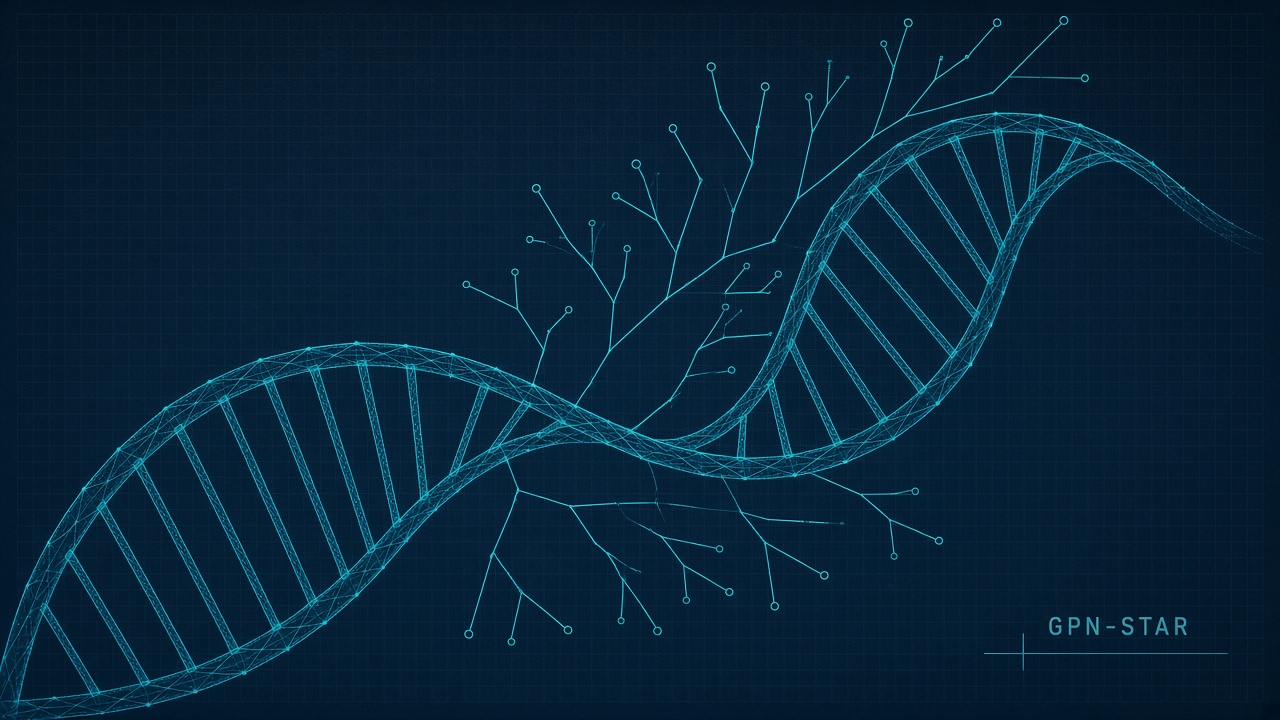
Genomic language models treat DNA sequences the way text models treat words: they learn statistical patterns that predict what comes next. The challenge is scale. Human genomes contain three billion base pairs, and the most capable models demand thousands of high-end GPUs for months of training. Variant interpretation pipelines at clinical labs and direct-to-consumer genetics companies process millions of calls monthly, creating demand for accurate scoring that does not require a dedicated supercomputer per annotation run. GPN-Star, published in Nature in 2026 by researchers at UC Berkeley's Song lab, takes a different path. With 200 million parameters and training on whole-genome alignments (WGAs) across vertebrate, mammal, and primate species, GPN-Star matches or beats much larger models on specific variant prediction tasks while training in days on eight A100 GPUs.
This guide explains genomic language models, how GPN-Star works, why evolutionary alignments matter, and what open science gains from a compact gpn star dna ai model. Readers tracking AI research or building pipelines through an AI API for bioinformatics will find practical context on when smaller, alignment-aware models outperform brute-force scale.
Genomic Language Models: DNA as a Sequence Prediction Problem
A genomic language model learns probability distributions over DNA nucleotides (A, T, C, G) from large sequence corpora, then uses those distributions to score how likely a given variant is to be tolerated or harmful in a biological context. Models like Evo2 train on raw genomes at massive parameter counts. The bet is that scale alone captures enough evolutionary and functional constraint to predict which mutations disrupt proteins, splice sites, or regulatory elements.
That bet works for some tasks but carries steep compute costs. Evo2-class training runs on thousands of H100 GPUs over months. For many research labs and clinical annotation pipelines, that hardware profile is out of reach. GPN-Star asks whether curated evolutionary signal, not raw parameter count, can close the gap on variant pathogenicity prediction.
Inside GPN-Star: Learning From Evolution, Not Just Raw Sequence
GPN-Star conditions its 200-million-parameter transformer on whole-genome alignments that show which positions stayed conserved across vertebrates, mammals, and primates, letting the model infer functional constraint from comparative genomics rather than memorizing a single reference genome. Conservation across species is one of biology's strongest hints that a base pair matters. A mutation at a position identical in humans, mice, and chickens is more likely pathogenic than a change at a fast-evolving site.
The Song lab trained separate alignment scopes: vertebrate WGAs for rare protein-coding variants, mammalian alignments for broader comparative tasks, and primate alignments for complex trait-associated variants in non-coding regions. Each scope teaches the model a different resolution of evolutionary pressure. GPN-Star then scores variants by how much they disrupt the learned distribution at each position.
| Training alignment | Best suited for |
|---|---|
| Vertebrate WGA | Rare protein-coding variants with deep cross-species conservation |
| Mammalian WGA | Broader mammalian comparative variant scoring |
| Primate WGA | Complex trait variants in regulatory and non-coding DNA |
Why Whole-Genome Alignments Beat Bigger Models on Some Tasks
Whole-genome alignments encode billions of years of selective pressure in a structured format, giving GPN-Star functional context that raw sequence models must infer from parameter scale alone. Consider a non-coding variant near a gene enhancer. The reference genome shows one allele; the variant introduces another. Without cross-species data, a model sees only local sequence novelty. With primate alignments, GPN-Star sees whether that position was fixed across great apes, suggesting regulatory importance.
The compute comparison is stark. GPN-Star trained in days on eight NVIDIA A100 GPUs. Evo2-scale models require thousands of H100 GPUs over months. That is not a minor efficiency gain; it changes who can run state-of-the-art variant annotation in-house versus renting cloud clusters. For rare disease clinics processing exome and genome sequences weekly, a 200M-parameter model that runs on modest hardware may be more deployable than a frontier model locked behind API pricing.
Whole-Genome Alignment Data as a Strategic Asset
Organizations with access to updated whole-genome alignments from UCSC, Ensembl, or custom primate sequencing projects hold raw material for GPN-Star fine-tuning that competitors without alignment pipelines cannot easily replicate. Alignment quality depends on reference genome versions, inclusion of newly sequenced species, and gap handling in repetitive regions. Teams that maintain alignment pipelines in-house gain a moat independent of model architecture. When reference assemblies update (as GRCh38 gave way to pangenome references), alignment-aware models need retraining or adapter updates tied to those references.
Disease Variant Prediction: Where GPN-Star Wins and Where It Does Not
On ClinVar pathogenic variant benchmarks and complex trait loci, GPN-Star matched or exceeded larger genomic models when evaluated on tasks aligned with its training alignment scope, though no single model dominates every variant class. Primate-trained weights performed best on regulatory variants tied to polygenic traits. Vertebrate-trained weights excelled on rare missense mutations in conserved protein domains. This task-specific performance profile is a feature, not a bug: bioinformatics pipelines can route variants to the appropriate GPN-Star checkpoint rather than forcing one model to generalize everywhere.
Limitations remain. GPN-Star does not replace functional assays, family segregation studies, or ACMG/AMP clinical interpretation guidelines. It ranks candidate pathogenicity to prioritize lab follow-up. Structural variants, repeat expansions, and mosaic mutations fall outside typical sequence-scoring workflows. Teams should treat GPN-Star output as one evidence line in a multi-source annotation stack alongside CADD, REVEL, SpliceAI, and curated databases.
Integrating GPN-Star Into Clinical Annotation Pipelines
Clinical labs can integrate GPN-Star as a pre-filter in variant annotation pipelines, scoring VCF entries before human geneticists review top-ranked candidates for report inclusion. A typical workflow ingests whole-genome or whole-exome VCF files, annotates variants with population frequency from gnomAD, applies GPN-Star pathogenicity scores using the alignment scope matched to variant type, and merges results with existing predictors in a composite rank. Because GPN-Star runs on modest hardware, on-premise deployment avoids sending patient genomes to third-party APIs.
Population-specific fine-tuning is an active research direction. GPN-Star's base weights reflect vertebrate, mammalian, and primate conservation patterns. Cohorts with high rates of founder mutations or population-specific regulatory variants may benefit from fine-tuning on local alignment references. The open GitHub release makes this feasible for academic medical centers with bioinformatics staff, though validation on held-out clinical cases remains mandatory before changing reporting thresholds.
Open Science: Weights, Code, and Reproducible Genomics AI
The Song lab released GPN-Star on GitHub at songlab-cal/gpn with model weights and training code, enabling academic and clinical labs to reproduce benchmarks without proprietary API dependencies. Open weights matter in genomics because variant calls affect patient care. Black-box scores from commercial APIs create audit challenges for hospital bioinformatics committees. A documented 200M-parameter model that runs locally supports institutional review, fine-tuning on population-specific cohorts, and integration into existing Nextflow or Cromwell pipelines.
The broader implication for genomic AI strategy: evolutionary priors may be a more durable moat than parameter count for variant prediction. As foundation models absorb general capabilities, domain-specific alignment data and curated training scopes become the differentiated asset. Labs sitting on proprietary WGA pipelines or population-specific alignment references could fine-tune GPN-Star checkpoints for regional cohorts at modest cost.
| Model | Parameters | Training compute (approx.) |
|---|---|---|
| GPN-Star | 200M | 8 A100 GPUs, days |
| Evo2-class models | Billions+ | Thousands of H100 GPUs, months |
Strategic Lessons for Genomic AI Teams
GPN-Star demonstrates that alignment-aware training data may matter more than parameter count for variant pathogenicity tasks, shifting R&D investment from bigger clusters toward better curated evolutionary references. Organizations building internal genomic AI should inventory their alignment assets before committing to billion-parameter training runs. Partnerships with comparative genomics consortia and access to primate-specific alignment updates become competitive advantages.
For API-first bioinformatics platforms, GPN-Star's efficiency challenges the assumption that customers always want the largest available model. Offering tiered annotation where GPN-Star handles high-volume screening and frontier models handle complex structural interpretation may optimize cost and accuracy simultaneously. The Nature 2026 publication gives credibility to this tiered architecture with peer-reviewed benchmarks.
Regulatory agencies evaluating AI-assisted variant interpretation tools will scrutinize training data provenance and alignment reference versions. GPN-Star's reliance on public whole-genome alignments from established comparative genomics projects supports reproducibility claims in FDA pre-submission discussions. Labs preparing LDT (laboratory-developed test) filings should document which GPN-Star checkpoint and alignment scope they deploy, along with local validation on known pathogenic and benign variant sets from their patient population.
Educational programs training the next generation of clinical bioinformaticians should include alignment-aware models alongside traditional rule-based classifiers. Understanding when conservation signal outperforms raw sequence modeling prepares graduates for a field where 200M-parameter tools routinely match billion-parameter alternatives on clinically relevant tasks.
Frequently Asked Questions
What is GPN-Star?
GPN-Star is a 200-million-parameter genomic language model from the UC Berkeley Song lab, published in Nature in 2026. It predicts disease-linked genetic variants using whole-genome evolutionary alignments across vertebrate, mammal, and primate species.
How does GPN-Star compare to Evo2?
GPN-Star uses far fewer parameters and trains in days on eight A100 GPUs, while Evo2-class models require thousands of H100 GPUs over months. GPN-Star matches or beats larger models on specific variant prediction tasks, especially when the alignment scope matches the variant class.
Which alignment scope should I use?
Use vertebrate alignments for rare protein-coding variants, primate alignments for complex trait and regulatory variants, and mammalian alignments for broader comparative scoring. The GitHub repository documents checkpoint selection for common pipelines.
Can GPN-Star replace clinical genetic interpretation?
No. GPN-Star prioritizes variants for follow-up; ACMG/AMP guidelines, segregation data, and functional assays remain required for clinical classification. Use it as an annotation layer, not a diagnostic conclusion.
Is GPN-Star open source?
Yes. Model weights, training code, and documentation are available on GitHub at songlab-cal/gpn under the project's published license terms.
Does GPN-Star work on non-coding variants?
Yes, particularly with primate whole-genome alignment training, which captures regulatory conservation across closely related species. Performance varies by locus and should be validated against independent cohorts.
Which lab developed GPN-Star?
GPN-Star was developed by the Song lab at UC Berkeley, led by researchers specializing in computational genomics and machine learning. The Nature 2026 publication and GitHub release at songlab-cal/gpn document the full training methodology and benchmark comparisons against larger genomic models.
How long does GPN-Star take to train?
GPN-Star trains in days on eight NVIDIA A100 GPUs, compared to months on thousands of H100 GPUs for Evo2-class models. Inference on individual variants is fast enough for clinical pipeline integration on standard server hardware without dedicated GPU clusters for every annotation job.
Where can I download GPN-Star?
Model weights, training scripts, and documentation are available on GitHub at songlab-cal/gpn. The repository includes instructions for selecting alignment scopes (vertebrate, mammalian, primate) based on variant type and running inference on VCF files or individual sequences.