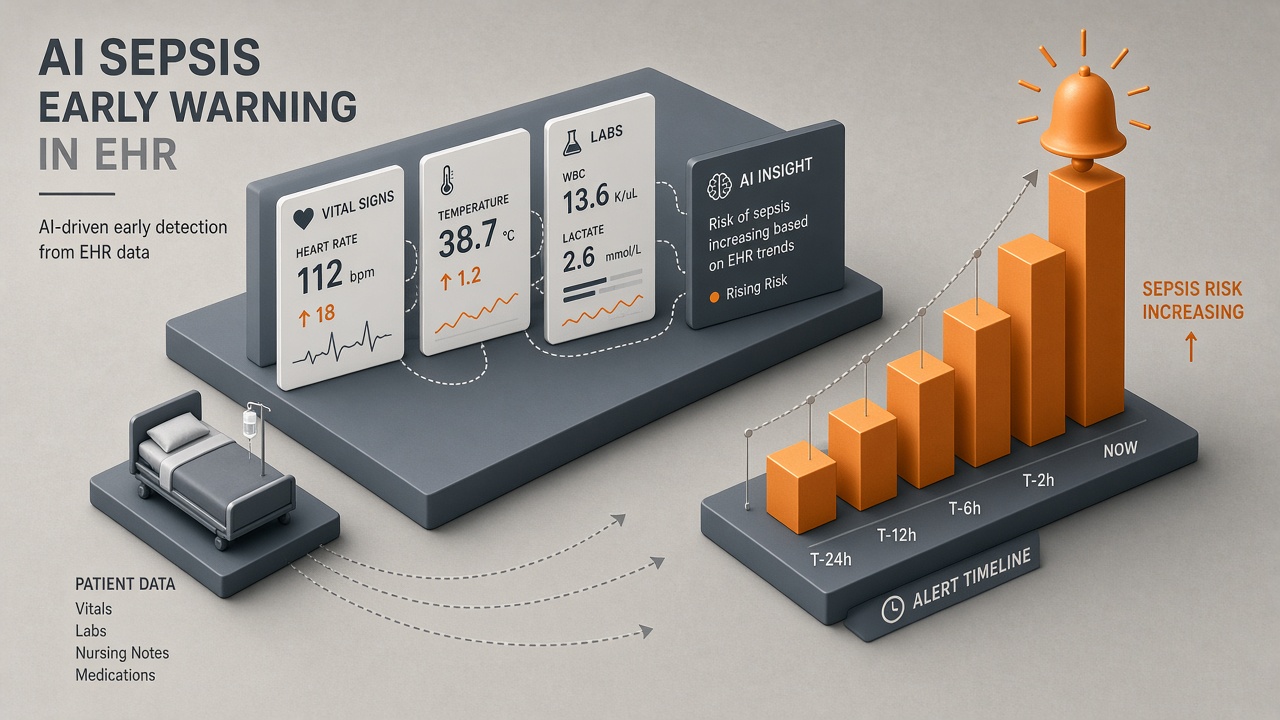
AI sepsis early warning systems analyze electronic health record time series of vitals, labs, and orders to flag deterioration hours before clinicians order antibiotics, but independent validation is mandatory because proprietary models can exhibit poor calibration and alert fatigue. The 2021 JAMA Internal Medicine external validation of Epic Sepsis Model (ESM) v1 at Michigan Medicine found hospitalization-level area under the ROC curve 0.63 (95% CI 0.62 to 0.64), far below Epic's internal reports of 0.76 to 0.83. At the recommended alert threshold of 6 or higher, the model identified only 7% of sepsis patients missed by timely antibiotic administration while missing 67% of sepsis cases and alerting on 18% of all hospitalizations. Hospitals evaluating AI healthcare alerts should run local bias audits before trusting vendor performance slides.
Sepsis Mortality and Time Sensitivity
Sepsis is life-threatening organ dysfunction from dysregulated host response to infection; each hour delay in appropriate antibiotics increases mortality, making early recognition a core hospital quality metric. CDC estimates hundreds of thousands of US hospitalizations annually with sepsis present on admission or acquired in hospital. Surviving Sepsis Campaign bundles emphasize blood cultures, lactate measurement, and broad-spectrum antibiotics within one hour for septic shock. Human nurses and physicians already use SIRS, qSOFA, and NEWS2 scores; EHR models aim to fuse richer signals updated continuously.
Prediction difficulty stems from sepsis heterogeneity: pneumonia, urosepsis, abdominal sources, and culture-negative inflammation present differently. Early-stage sepsis overlaps with benign viral illnesses. Models trained on retrospective billing codes or CDC surveillance definitions may label outcomes inconsistently across sites, degrading generalization when deployed at new hospitals with different documentation habits.
Regulatory and accreditation pressure (CMS SEP-1 measure, state sepsis mandates) incentivized rapid EHR vendor adoption of sepsis scores. That policy momentum outpaced independent evidence in the Epic case, raising national questions about whether hundreds of hospitals deployed underperforming alerts.
Pediatric and neonatal sepsis present distinct physiologic patterns: bradycardia, temperature instability, and maternal risk factors dominate feature sets unlike adult qSOFA criteria. Children's hospitals should not enable adult-trained ESM weights without pediatric-specific validation. Obstetric sepsis from chorioamnionitis similarly falls outside typical inpatient model training distributions.
Features Drawn From EHR Time Series
Sepsis ML models ingest rolling windows of heart rate, blood pressure, respiratory rate, temperature, white blood cell count, lactate, creatinine, bilirubin, and order patterns such as antibiotics and blood cultures, updated every 15 minutes in Epic's implementation. ESM v1 is a penalized logistic regression model, not a deep neural network, trained on 405,000 encounters from three health systems (2013 to 2015). Feature engineering captures trends (rising lactate), abnormal absolute values, and interaction terms. Some features correlate with clinician behavior: antibiotic orders may appear because physicians already suspect sepsis, creating label leakage that inflates internal validation metrics.
Alternatives from academic groups use gradient boosting, recurrent networks, or transformer architectures on MIMIC-IV and eICU datasets with open code. Vendor-agnostic research models such as Sepsis-3-aligned labels attempt fairer outcome definitions. Multi-center federated learning proposals address data sharing barriers but rarely match Epic's distribution through embedded EHR contracts.
Time-series gaps when vitals are charted irregularly on busy wards introduce missingness patterns models may misread as stability. Imputation strategies during model development should mirror deployment conditions: forward-filling last documented blood pressure for six hours differs clinically from true normotension. Sensitivity analyses excluding sparse-documentation units reveal whether alerts disproportionately fire on well-monitored ICU transfers versus understaffed floors.
| Feature category | Examples | Clinical signal |
|---|---|---|
| Vitals | HR, BP, RR, SpO2, temperature | Compensatory then decompensatory shock |
| Labs | Lactate, WBC, creatinine, bilirubin | Organ dysfunction and perfusion |
| Orders | Antibiotics, cultures, IV fluids | Clinician suspicion (leakage risk) |
| Demographics | Age, comorbidity proxies | Baseline risk stratification |
Epic Model Evaluation Controversies
The Michigan Medicine external validation sparked national debate because ESM was already embedded in hundreds of Epic hospitals when independent researchers published poor discrimination and calibration. Wong et al. (2021) analyzed 38,455 hospitalizations (7% with sepsis) and noted time-horizon AUCs of 0.72 to 0.76 look better than hospitalization-level 0.63 but mislead by treating correlated predictions as independent. Median lead time from first score above 6 to sepsis onset was 2.5 hours, yet 60% of missed cases still received timely antibiotics from clinicians without model help. Epic's proprietary training details limited reproducibility.
Epic released updated ESM v2 with multicenter prospective validation reported in JAMA Network Open (2026), showing improved metrics relative to v1, though heterogeneous site performance and confirmation bias concerns persist when alert deployment changes documentation and ordering behavior. Critics argue post-deployment evaluations cannot fully separate model improvement from workflow feedback loops.
Cerner and other EHR vendors offer competing sepsis scores with similar need for local validation. No national guideline mandates a specific vendor model; Surviving Sepsis recommends systematic screening without endorsing proprietary black boxes. Researchers documenting AI research on sepsis prediction emphasize open benchmarks and pre-specified alert thresholds before go-live.
Bias Across Sites and Patient Populations
Sepsis models trained at tertiary academic centers may underperform in community hospitals with sparser lab cadence, different patient demographics, and nursing documentation practices that alter vital sign frequency. Race, insurance status, and ward type influence which patients receive frequent lactate draws; models implicitly learn access patterns, not biology alone. Pediatric, obstetric, and oncology patients often sit outside training distributions. External validation at a single site, even a large one, does not guarantee transportability to critical access hospitals with different sepsis prevalence.
Fairness audits should report sensitivity and false alert rates stratified by race, language, and unit type. If alerts fire disproportionately on wards with more frequent vitals, nurses on medical-surgical floors with q4 vitals appear artificially lower risk. Retraining on local data helps but requires sufficient sepsis cases and governance to avoid overfitting small hospitals.
Federated learning and Bayesian updating offer paths to adapt models without centralizing PHI, yet hospital legal teams remain cautious. Until bias mitigation is demonstrated, some systems disable sepsis alerts entirely and rely on human sepsis huddles.
Alarm Fatigue and Clinician Override UX
Alert fatigue occurs when low-specificity sepsis scores fire on nearly one in five hospitalizations, training nurses to dismiss banners while true positives are missed. ESM's 18% alert rate at Michigan Medicine illustrates the burden: each alert demands assessment, yet two-thirds of sepsis patients never triggered timely model recognition. UX research recommends tiered alerts (watch vs act now), snooze with mandatory reassessment timers, and integration into nurse sepsis huddle checklists rather than modal pop-ups alone.
Override documentation captures why clinicians dismissed an alert (patient on comfort care, known chronic hypotension, duplicate alert). Quality committees review override patterns monthly. Successful implementations tune thresholds locally rather than accepting vendor defaults designed for national averages. Some hospitals combine ML scores with hard rules (lactate above 4 plus hypotension) to reduce false positives.
Liability questions arise when ignored alerts precede adverse events. EHR logs show whether staff acknowledged alerts, supporting malpractice discovery. Institutions should clarify whether sepsis scores are decision support versus quality metrics in informed consent and staff policy manuals.
Nursing union feedback should inform alert design: bedside nurses receive the majority of sepsis banners during medication passes and admissions. Mobile push to dedicated sepsis nurse roles, similar to rapid response team structures, concentrates expertise without interrupting every floor nurse simultaneously. Epic and Cerner both support role-based routing when hospitals configure sepsis dashboards deliberately rather than accepting default layouts.
Post-implementation quality reviews compare sepsis mortality, length of stay, and antibiotic days before and after alert go-live, using interrupted time series methods to account for secular trends. A model that raises alerts without shortening time-to-antibiotics fails its operational purpose even if AUC looks acceptable on paper.
Frequently Asked Questions
Should my hospital use Epic Sepsis Model?
Run local retrospective validation on your own EHR data before enabling alerts. Compare sensitivity, specificity, and alert rate at multiple thresholds. ESM v2 may perform better than v1 but still requires site-specific proof.
Does Cerner have sepsis AI?
Oracle Cerner offers sepsis surveillance tools and partners with third-party analytics. Same validation rules apply: do not trust vendor AUC without independent testing on your population.
How do you validate sepsis models?
Retrospective cohort studies with held-out time periods, prospective silent trials that log alerts without notifying staff, then phased go-live with outcome monitoring. Report calibration plots, not just AUC.
Who is liable for missed sepsis?
Clinicians retain responsibility for patient care. AI alerts are adjuncts. Courts examine whether staff followed hospital protocols and acknowledged alerts in the medical record.
Can open-source models replace vendor scores?
Academic models on MIMIC demonstrate feasibility but require retraining, IT integration, and regulatory review if marketed as clinical decision support. Many hospitals lack data science staff to maintain them.
Do alerts improve mortality?
Mixed evidence. Early recognition helps when alerts are accurate and workflows respond quickly. Poorly calibrated alerts may distract without improving SEP-1 bundle compliance. Outcome trials are harder than discrimination studies.
What threshold should we use?
No universal answer. Higher thresholds reduce alerts but miss cases. Local ROC and precision-recall analysis aligned with nursing capacity should drive the choice, documented in a governance committee record.
Health system chief medical informatics officers increasingly require model cards for sepsis tools: training population, outcome definition, subgroup performance, and known failure modes. Procurement contracts should mandate vendor cooperation with annual revalidation studies as EHR documentation practices drift. Transparency benefits patients when sepsis alerts influence triage in overcrowded emergency departments during influenza surges.
Community hospitals without dedicated data science teams can partner with regional health information exchanges or academic collaborators for retrospective validation before enabling vendor sepsis scores. Shared validation playbooks reduce duplicated effort across small facilities running the same Epic build but serving different rural demographics.