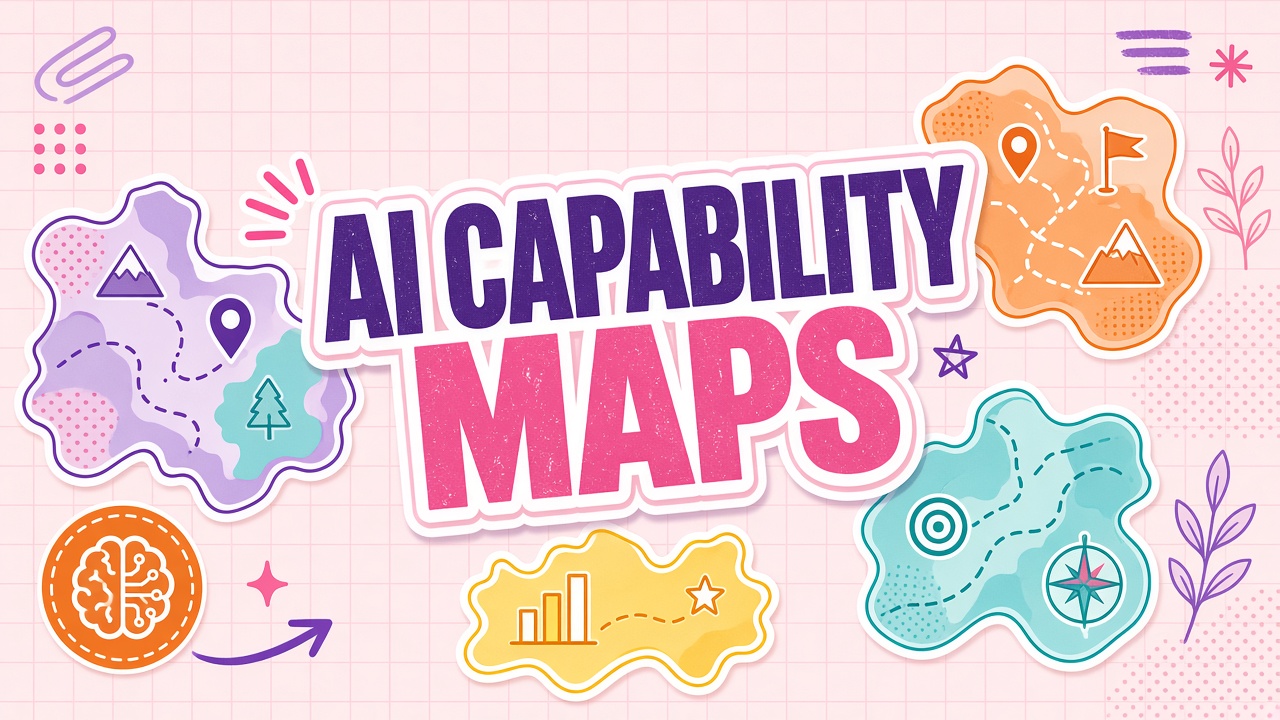
Marketing bought a writing assistant. Engineering deployed an internal chatbot. Sales subscribed to a meeting summarizer on a corporate card nobody tracks. Six months later, procurement asks for a list of every AI tool in use, what data each one touches, and whether anyone vetted security. Without a single source of truth, the answer is guesswork. An AI capability map fixes that: a living document that records what each tool can do, who owns it, how it connects to your stack, and when capabilities were last confirmed.
Capability maps matter for AI productivity rollouts and research workflows alike. Research teams experiment fast; productivity suites spread through departments with free trials. A map does not slow innovation. It makes innovation visible so legal, IT, and finance can support the right tools instead of blocking everything after an incident.
What an AI Capability Map Is and Why Teams Build One
An AI capability map is an inventory plus a skills matrix. The inventory lists tools, vendors, contracts, and data classifications. The matrix maps capabilities (summarize PDF, generate image, code completion, CRM write-back) to those tools with explicit limits: supported languages, max file size, SSO availability, and whether human review is required. Unlike a generic software asset list, the map answers operational questions: "Which approved product can transcribe a ninety-minute webinar in German?" and "Who updates the prompt when refund policy changes?"
Maps reduce duplicate licensing when two departments pay for overlapping features. They expose gaps when no approved tool covers a legitimate need, pushing procurement toward formal evaluation instead of shadow signups. They also give new hires a curated starting point instead of another chaotic search across app stores.
Building the Capability Matrix Row by Row
Start with capabilities your organization actually uses, not every feature on vendor homepages. Group capabilities by workflow: ingest content, transform content, publish content, analyze data, automate actions. For each cell, record the primary tool, backup tool, and "not allowed" status where policy forbids a category (for example, public LLM paste of customer PII).
| Capability | Approved tool | Constraints | Owner |
|---|---|---|---|
| Long document Q&A | Enterprise RAG workspace | Internal docs only; SSO required | Knowledge ops |
| Marketing copy drafts | Approved writing suite | Human publish; brand glossary loaded | Content marketing |
| Code assistance | IDE copilot with privacy mode | No secrets in prompts; repo allowlist | Engineering platform |
| Meeting transcription | Licensed notetaker | Consent banner; 30-day retention | IT + sales ops |
Keep matrix rows outcome-oriented ("generate SOC2-ready access review summary") rather than vendor slogans ("AI-powered insights"). Outcome rows survive vendor swaps without rewriting the whole map.
Ownership, RACI, and Who Updates the Map
Every row needs a named owner, not a department alias. Owners verify capabilities quarterly, file renewal reminders, and route user requests for new features. A lightweight RACI helps: IT approves security, legal approves data use, finance approves spend, business owners approve workflow fit. The map maintainer (often product ops or a central AI council) merges those inputs into one published version.
Without ownership, maps rot. A tool listed as "supports Excel upload" may have dropped that feature in a pricing tier change. Stale maps erode trust; employees return to shadow tools. Owners should attach evidence links: vendor release notes, internal test date, or ticket ID from the evaluation project.
Recommended update cadence
- Monthly: Add newly approved tools; mark trials expired; sync seat counts from SSO logs where possible.
- Quarterly: Re-test top ten capabilities; refresh constraint notes (retention, regions, model versions).
- On vendor change: Major model upgrades, new subprocessors, or pricing tier moves trigger immediate row updates.
- Annual: Full audit against procurement records and credit card spend reports to catch shadow AI.
Avoiding Shadow AI with Visible Alternatives
Shadow AI happens when employees need a capability faster than approval processes allow. Punishment-only policies drive tools underground. Capability maps reduce shadow use by pairing clear rules with fast paths: a documented exception process, pre-vetted trials, and a "request new capability" form that promises response SLAs.
Compare SSO login analytics and network logs (where policy permits) against the map. Tools with usage but no row are shadow candidates. Interview those users: often they chose the shadow tool because the approved tool lacked one concrete feature, such as mobile upload or a specific language. Add that gap to the matrix as an open cell with priority, or approve a bounded trial with data restrictions.
Productivity suites bundled into Microsoft or Google workspaces still belong on the map. Defaults are easy to overlook in audits. Likewise, research tools for literature review should note whether uploads may include unpublished data or patient identifiers.
Using the Map in Procurement and Vendor Comparison
Procurement can score RFP responses against map gaps instead of generic feature checklists. If three vendors claim "enterprise RAG," the map defines your required capabilities: citation links, permission-aware retrieval, export for legal hold, maximum document age. Vendors that cannot fill a required cell are disqualified early, saving demo theater.
Renewal negotiations improve when you know overlap. If two rows point to tools with eighty percent feature overlap, consolidate seats and reallocate budget to a missing capability like multilingual support or on-prem inference. Finance sees savings; security sees fewer data processors.
Connecting the Map to Tool Directories and Evaluations
A capability map is not a replacement for hands-on evaluation. Use it to narrow candidates, then run structured pilots against your golden tasks. When you browse a directory of research AI tools, tag shortlisted products with the capability rows they might fill before you invite vendors to demo. That keeps sales calls focused on gaps the matrix already identified instead of generic feature tours.
After a pilot, update the map with measured results: latency on your document sizes, languages tested, export formats verified, and security questionnaire status. A tool can remain "approved" only while those measurements stay within policy. Demote tools that miss renewal testing to "legacy" status with a migration deadline so teams know to move workflows.
Cross-functional AI councils work well when they review the map monthly for fifteen minutes. Standing agenda items: new shadow tools detected, open capability gaps, upcoming renewals, and one incident or near-miss lesson. Short, frequent reviews beat annual slide decks that nobody maintains.
Where to Host the Map and How to Keep It Readable
Format matters less than accessibility. Wiki tables, Notion databases, spreadsheets, or GRC platforms all work if search is good and links stay stable. Avoid PDF-only maps that nobody updates. Embed deep links to internal runbooks: how to request access, how to report an incident, how to export conversation logs for investigations.
Version the map. Date stamp each publish, summarize changes in a changelog, and notify owners when their rows are due for review. Integration with IT service management (Jira Service Management, ServiceNow) can open renewal tickets automatically sixty days before contract end.
Common Capability Map Failures and How to Fix Them
Maps fail for predictable reasons. Too granular: five hundred rows nobody reads. Collapse to thirty outcome rows with drill-down links. Too vague: rows like "AI assistant" with no data classification. Add explicit allowed and forbidden data types. No enforcement: the map says one thing; SSO allows everything. Align identity policies with approved tools. Orphan pilots: trials never closed. Auto-expire and notify owners.
Another failure mode is treating the map as procurement paperwork only. If engineers and marketers never open it, shadow AI returns. Embed links in onboarding, internal wikis, and the IT request portal. Celebrate when teams request a formal row instead of hiding a new subscription. Governance earns adoption when it speeds access to vetted tools rather than only saying no.
Finally, align the map with incident response. When a model vendor has an outage or a data handling incident, your map should list every workflow that depends on that vendor so comms and engineering can disable or reroute traffic quickly. A row without dependency notes forces fire drills that read Slack history instead of a checklist.
Frequently Asked Questions
How is a capability map different from a software inventory?
Inventories list installed applications. Capability maps describe what work each tool is approved to perform, under what constraints, and who maintains that approval. An inventory might show a browser extension; the map explains whether it may access customer data.
What do auditors ask for during AI procurement reviews?
Expect requests for vendor SOC reports, data flow diagrams, subprocessors, model training opt-out settings, retention periods, and evidence of human oversight for high-risk outputs. A current capability map with owner sign-offs accelerates these reviews because answers are pre-assembled per tool.
Is a capability map overkill for a twenty-person startup?
A lightweight map still helps. One page with five tools, five owners, and five rules beats oral tradition when the first enterprise customer sends a security questionnaire.
How do we document trials and pilots?
Add a "pilot" status with end date, allowed data types, and success criteria. Auto-expire pilots that lack renewal approval so trials do not become shadow production systems.
Should self-hosted open models appear on the map?
Yes. Internal deployments still have capabilities, owners, hardware costs, and patch schedules. Auditors treat them like any other software processing company data.
A Living Map Beats a One-Time AI Audit
AI capability maps turn scattered subscriptions into a governed portfolio. The matrix shows what you can do today; ownership and cadence keep it honest tomorrow. Shadow AI shrinks when approved paths are faster than workarounds.
Whether you standardize productivity AI or govern research tooling, start with outcomes, assign owners, and review quarterly. Procurement audits become routine when the map already answers most questions. Innovation stays fast because teams know where to look before they spin up another trial nobody tracks.