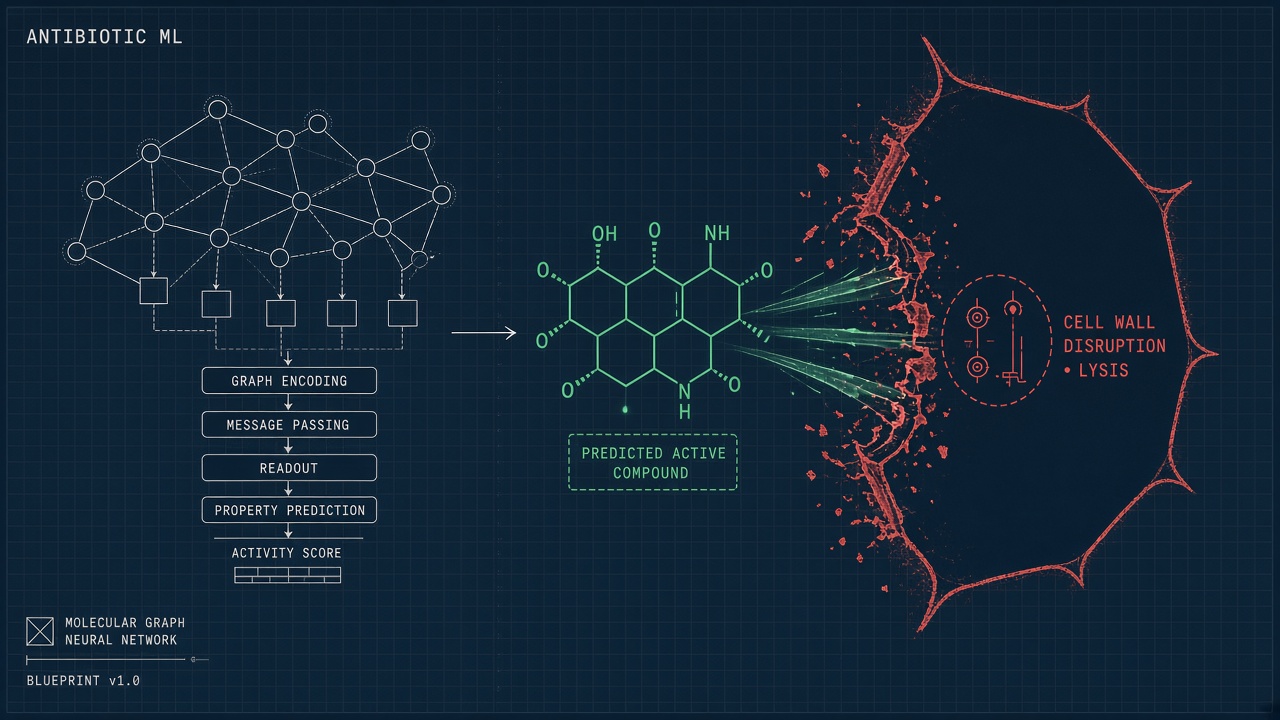
AI antibiotic discovery uses graph neural networks and generative chemistry models to screen vast chemical libraries for molecules that inhibit resistant bacteria, prioritizing candidates for laboratory testing rather than replacing traditional drug development. The landmark halicin study in Cell (2020) trained a deep neural network on 2,335 compounds with measured E. coli growth inhibition, then screened repurposing libraries and more than 107 million molecules from ZINC15. The model surfaced halicin (formerly SU3327), a structurally unconventional compound active against carbapenem-resistant Enterobacteriaceae, Mycobacterium tuberculosis, and pan-resistant Acinetobacter baumannii in murine models. Teams evaluating AI healthcare drug discovery pipelines should treat in silico hits as hypotheses requiring MIC assays, toxicity panels, and pharmacokinetic studies before any clinical claim.
Antimicrobial Resistance Urgency
Antimicrobial resistance (AMR) kills an estimated 1.27 million people globally each year and threatens routine surgery, chemotherapy, and neonatal care when common pathogens no longer respond to frontline drugs. The World Health Organization lists carbapenem-resistant Acinetobacter baumannii and carbapenem-resistant Enterobacteriaceae among critical priority pathogens where new antibiotics are urgently needed. Discovery pipelines slowed for decades because broad-spectrum screening is expensive and most synthetic molecules fail toxicity or absorption filters. Resistance evolves faster than traditional high-throughput screening cycles can deliver novel scaffolds.
Machine learning reframes the bottleneck. Instead of physically testing every compound in a library, models learn structure-activity relationships from thousands of labeled examples and rank unseen molecules by predicted antibacterial probability. When validated hits emerge, they often belong to chemical classes that medicinal chemists would not have prioritized through intuition alone. That novelty is both the opportunity and the regulatory challenge: unfamiliar mechanisms require fresh safety characterization.
Public health framing matters for funding and publication. AMR surveillance data from CDC and EARS-Net inform which pathogens models should weight during training. Researchers publishing AI research on antibiotic ML increasingly report pathogen-specific metrics rather than a single global accuracy score, because a compound active against Staphylococcus aureus may be useless against Pseudomonas aeruginosa, which halicin did not inhibit in the MIT study.
Virtual Screening and Generative Chemistry
Modern antibiotic ML combines graph neural networks (GNNs) for property prediction with generative models that propose entirely new molecular graphs optimized for antibacterial activity and synthesizability. GNNs represent atoms as nodes and bonds as edges, applying message-passing layers so each atom embedding encodes local and distant chemical context. The halicin work used a directed message-passing neural network (Chemprop family) trained to predict growth inhibition labels. Screening scales to 10^7 to 10^8 compounds when inference runs on GPU clusters, collapsing months of wet lab triage into days of computation.
Generative approaches extend beyond ranking existing libraries. Variational autoencoders, reinforcement learning, and diffusion models sample novel SMILES strings or molecular graphs, then filter outputs with predictive models and synthetic accessibility scores. Multi-objective optimization balances potency, mammalian cell cytotoxicity, logP, and rule-of-five compliance. Each generated candidate still faces the same experimental gauntlet: minimum inhibitory concentration (MIC) against target strains, resistance frequency assays, and mammalian toxicity.
Explainability tools such as attention over atom pairs help medicinal chemists understand why a GNN ranked a scaffold highly, though mechanistic validation still requires wet lab biochemistry. Teams that treat the neural score as a black box risk advancing chemically intractable or promiscuous binders. Integrating matched molecular pair analysis with GNN outputs bridges statistical prediction and medicinal chemistry intuition.
| Approach | Input | Strength | Limitation |
|---|---|---|---|
| GNN virtual screening | Known libraries (ZINC, Drug Repurposing Hub) | Fast ranking of purchasable compounds | Bounded by library diversity |
| Generative de novo design | Learned chemical latent space | Novel scaffolds beyond catalogs | Synthesis and liability risk |
| Multi-task property models | Joint potency and ADMET labels | Fewer late-stage failures | Sparse training labels for rare pathogens |
| Phenotypic imaging ML | Microscopy of bacterial cultures | Mechanism-agnostic hit finding | Lower throughput than in silico screens |
Case Studies of AI-Proposed Antibiotics
Halicin remains the most cited AI antibiotic discovery case: identified from the Drug Repurposing Hub, it kills diverse Gram-positive and Gram-negative pathogens by dissipating bacterial transmembrane proton motive force rather than targeting ribosomes or cell-wall synthesis. In laboratory evolution experiments, E. coli exposed to halicin for 30 days did not develop resistance, unlike rapid resistance emergence under ciprofloxacin. Halicin cleared Clostridioides difficile and pan-resistant A. baumannii thigh infections in mice. From 23 empirically tested ZINC15 predictions, eight additional antibacterial compounds structurally distant from known antibiotics were confirmed active, demonstrating that the model generalizes beyond a single lucky hit.
Subsequent academic and industry programs apply similar pipelines to narrow-spectrum agents that spare the gut microbiome, a priority because broad-spectrum overuse drives resistance. MIT and collaborators reported additional deep-learning-guided antibiotics (including abaucin, targeting A. baumannii) in follow-on work, illustrating pathogen-specific model training. Each program shares the same arc: train on phenotypic labels, screen at scale, validate top hits in vitro, then advance only molecules that pass mammalian safety filters.
Case studies should report negative results. Halicin failed against P. aeruginosa, a common ventilator-associated pneumonia pathogen. Transparent reporting of failures helps clinicians and regulators calibrate expectations: AI discovery expands the search space but does not guarantee universal broad-spectrum coverage.
Wet Lab Validation Requirements
No machine learning score substitutes for MIC determination, time-kill curves, resistance frequency studies, and mammalian cytotoxicity assays before an AI-proposed antibiotic enters preclinical development. Standard validation begins with broth microdilution MIC against reference and clinical isolates, including resistant strains on WHO priority lists. Mechanism-of-action studies (transcriptomics, membrane potential assays for halicin-like compounds) confirm the model did not merely rediscover a known class. Mammalian cell lines and early rodent PK/PD studies assess therapeutic window.
Data quality for retraining matters. Label noise from inconsistent growth assays propagates into false positives at screen scale. Active learning loops, where the model selects the next compounds to test in the lab, improve efficiency but require robotic liquid handling and biosafety infrastructure. Open science initiatives such as CO-ADD provide public MIC data, yet proprietary pharma datasets remain larger and less biased toward easy negatives.
Reproducibility checks include independent synthesis of AI-ranked scaffolds and blinded testing across laboratories. A hit that works only in the discovering lab's assay conditions may reflect contamination or strain-specific quirks rather than genuine antibacterial activity. Publication standards increasingly require depositing SMILES, training splits, and code where licensing permits.
Regulatory Path to Clinic
AI-discovered small molecules follow the same FDA and EMA antibiotic development pathways as traditionally discovered drugs: IND-enabling toxicology, phased clinical trials, and post-market surveillance for resistance emergence. Machine learning influences discovery timing, not the evidentiary bar for approval. Regulators treat the final chemical entity as the regulated product; the screening algorithm is part of quality documentation if used in a validated discovery workflow at a GxP-compliant organization. Patent strategy must cover both composition of matter for novel scaffolds and potentially the computational method if defensible.
Incentives such as the FDA Limited Population pathway and UK subscription models for antimicrobials aim to restore economic viability for narrow-spectrum antibiotics. AI may lower discovery cost enough to make smaller-market indications financially feasible, but payers still require demonstrated clinical superiority or stewardship value over generics.
Pharmacovigilance after approval tracks resistance rates in surveillance networks. If halicin-like membrane disruptors eventually select for resistance in clinical use, real-world data should feed back into model retraining. Lifecycle management treats AI as one iteration in a continuous discovery loop, not a one-shot miracle screen.
Combination therapy modeling is an emerging use case: AI screens pairs of molecules predicted to act synergistically against resistant biofilms. Graph networks can represent drug-drug interaction features alongside single-agent potency. Hospital stewardship programs may eventually receive AI suggestions for salvage regimens when first-line antibiotics fail, though clinical decision support for combinations requires even stricter validation than single-agent discovery.
Environmental release concerns apply to novel bactericidal compounds discovered in silico. Manufacturing scale-up, wastewater metabolites, and agricultural runoff from veterinary analogs need environmental risk assessment parallel to human tox. AI accelerates the front of the pipeline but does not remove downstream ecological review that regulators increasingly expect for any new antimicrobial class.
Frequently Asked Questions
Can AI discover broad-spectrum antibiotics?
Models can rank compounds active across multiple phylogenetic groups, as halicin demonstrated against diverse pathogens except P. aeruginosa. Broad spectrum increases microbiome disruption risk; many programs now target narrow spectra by training pathogen-specific models.
How is toxicity predicted before animal studies?
Multi-task GNNs and QSAR models estimate hERG liability, hepatotoxicity proxies, and cytotoxicity on mammalian cell lines. Predictions prioritize which AI hits enter expensive in vivo tox; they do not replace GLP toxicology studies required for IND filing.
Who owns patents on AI-discovered drugs?
Typically the institution or company that synthesizes and validates the compound holds composition-of-matter patents. AI method patents may apply separately. Repurposed molecules like halicin (originally investigated for diabetes) require freedom-to-operate analysis on existing IP.
Will pharma adopt AI discovery at scale?
Major pharmas partner with AI startups and run internal GNN screens, but integration with legacy medicinal chemistry workflows is gradual. AI shortlists candidates; human chemists still optimize lead properties and scale synthesis.
How long from AI hit to clinic?
Halicin was identified in 2020; as of 2026 it remains a research lead, illustrating that discovery acceleration does not compress clinical trial timelines. Typical antibiotic development still spans 10 to 15 years from validated hit to approval without expedited pathways.
What data trains antibiotic models?
Phenotypic growth inhibition labels paired with molecular structures dominate training sets. Public repositories (ChEMBL, CO-ADD) and proprietary corporate assay archives supply millions of labeled examples when aggregated across programs.
Does AI reduce antibiotic resistance?
AI may discover novel mechanisms less prone to rapid resistance in lab evolution experiments, but clinical resistance will eventually emerge with widespread use. Stewardship and narrow-spectrum design matter as much as discovery technology.
WHO global action plans on AMR increasingly cite computational discovery as one pipeline alongside traditional natural product screening. National funding agencies in the UK, US, and EU co-invest in open antibacterial databases so academic GNN screens complement rather than duplicate proprietary pharma libraries. Sustainable impact depends on pairing discovery with access programs in low-income settings where resistant infections cause the highest mortality.