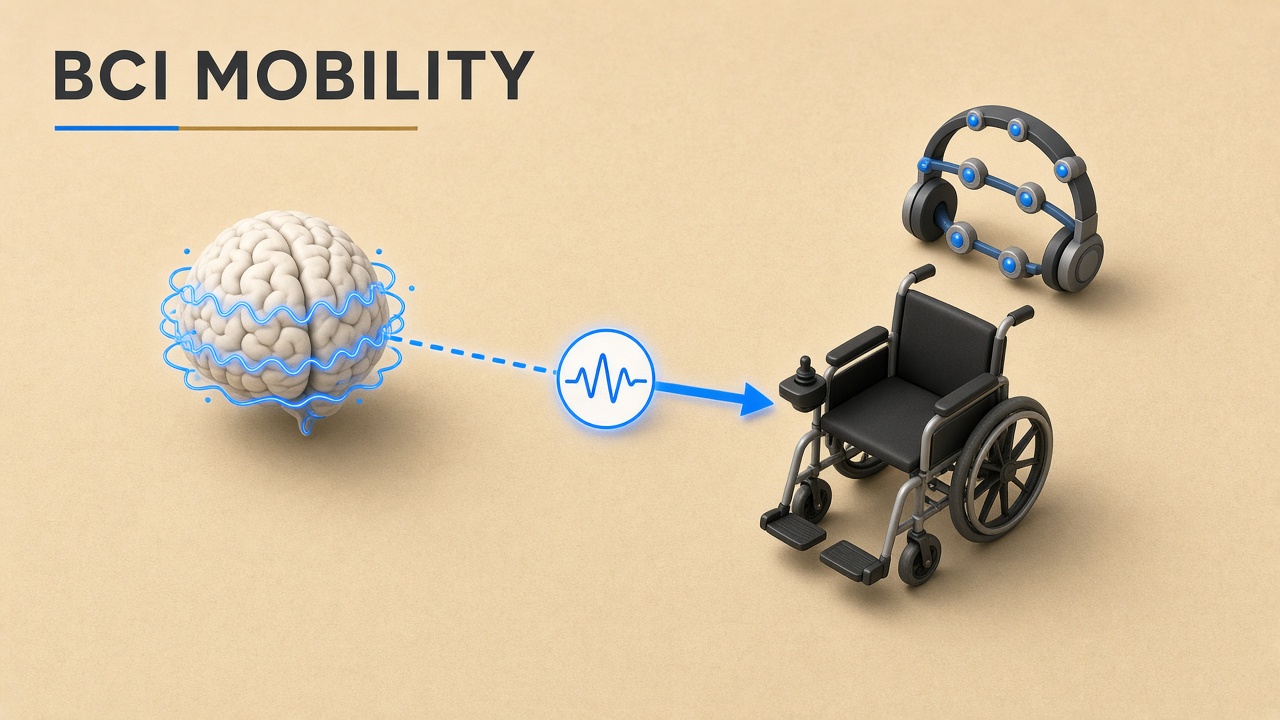
A person with severe motor impairment imagines moving the left hand. Electrodes on the scalp record faint electrical rhythms from motor cortex. A classifier trained on prior sessions labels that pattern as "turn left," and a wheelchair controller receives the command. No surgery, no wires into brain tissue: the entire loop runs through electroencephalography (EEG) and software. Non-invasive BCI wheelchair systems aim to restore independent mobility when spinal cord injury, stroke, or neuromuscular disease blocks conventional joystick or sip-and-puff control. Recent research combines deep learning decoders, shared-control navigation, and hybrid paradigms (motor imagery plus steady-state visual evoked potentials, or SSVEP) to push accuracy toward usable daily driving, though published results still vary widely by user, environment, and training time. Teams building assistive stacks can compare this signal-processing pipeline to how AI chatbot products chain perception, classification, and action in other domains; more background on applied AI appears in the EliteAI.tools blog.
What Is Non-Invasive BCI Wheelchair Control?
A non-invasive brain-computer interface (BCI) wheelchair translates patterns in scalp-recorded brain activity into movement commands for a powered chair, without implanting electrodes under the skull. The user performs a mental task the system was trained to recognize: imagining left- or right-hand movement (motor imagery), focusing on flickering targets on a screen (SSVEP), or reacting to rare visual flashes (P300). The BCI outputs discrete directions (forward, left, right, stop) or continuous velocity signals. A low-level motor controller on the wheelchair executes those commands, often with safety layers that override unsafe paths.
Non-invasive BCIs differ from invasive approaches that place microelectrode arrays (such as Utah arrays used in BrainGate trials) or electrocorticography (ECoG) grids directly on cortex. Invasive systems can record sharper neural signals and have demonstrated long-term home use for hand grasp and cursor control in clinical studies, but they require neurosurgery and ongoing medical monitoring. EEG-based wheelchairs trade signal quality for accessibility: caps or headsets, gel electrodes, and laptop-class processors are enough to run experiments in university labs and, in a few prototypes, supervised real-world trials.
| Approach | Signal source | Typical wheelchair role | Trade-off |
|---|---|---|---|
| EEG (non-invasive) | Scalp electrodes, 8 to 64+ channels | Research prototypes, shared-control pilots | Low setup risk, noisy signals |
| ECoG (invasive) | Subdural electrode strips | Often orthosis or grasp, not mass-market chairs | Higher fidelity, requires implant surgery |
| Intracortical (invasive) | Microelectrode arrays in motor cortex | Cursor and robotic arm in trials | Best spatial resolution, chronic care burden |
| Conventional assistive | Joystick, sip-puff, head array | FDA-cleared commercial wheelchairs | Proven, but unusable when limb control is absent |
Motor imagery is the paradigm most often associated with asynchronous wheelchair control: the user can start and stop imagining movement without waiting for external flashes. SSVEP and P300 paradigms usually depend on visual stimuli on a monitor mounted to the chair, which can raise fatigue and exclude users with certain visual impairments. Hybrid designs merge paradigms, for example SSVEP for direction selection plus electrooculography (EOG) blink detection to start and stop sessions asynchronously.
The AI Pipeline: From EEG to Wheelchair Commands
Modern non-invasive BCI wheelchairs treat brain-signal decoding as a supervised machine learning pipeline: acquire EEG, clean artifacts, extract features or learn representations, classify intent, then fuse outputs with navigation logic. Each stage introduces latency and failure modes engineers must budget explicitly.
Signal Acquisition and Preprocessing
EEG amplifiers sample cortical activity, commonly at 250 to 1000 Hz, across electrodes placed according to the international 10-20 system. Motor imagery tasks produce event-related desynchronization over contralateral sensorimotor cortex (often channels C3 and C4). Raw traces mix brain signals with muscle activity, eye blinks, electrode drift, and motion artifacts from the wheelchair itself. Pipelines apply band-pass filtering (often 8 to 30 Hz for motor imagery mu and beta rhythms), independent component analysis (ICA) or Savitzky-Golay smoothing, and sometimes wavelet packet decomposition to suppress low-frequency motion noise while preserving discriminative content.
Feature Learning and Classifiers
Classical pipelines computed common spatial patterns (CSP) or band-power features, then fed support vector machines or random forests. Deep learning models now dominate many published benchmarks: EEGNet, compact convolutional networks designed for EEG topology; convolutional neural networks (CNNs) paired with transformer encoders (hybrid CTHM architectures on arXiv in 2025); and ensemble methods such as Extra Trees with explainable AI overlays. A 2025 Journal of Big Data study on wheelchair navigation reported Extra Trees reaching roughly 0.92 ROC AUC on the best movement class in offline evaluation, while stressing that class imbalance and outlier trials still degrade real-time performance. Reported accuracies above 90% in papers usually reflect controlled lab sessions with trained users, not guaranteed home deployment metrics.
Decoding Paradigms in Wheelchair BCIs
Motor imagery classifiers typically discriminate two to four classes (left hand, right hand, feet, rest). SSVEP systems identify which of several flickering targets the user watches, enabling more command classes at the cost of continuous visual stimulation. Shared-control layers interpret low-confidence BCI output jointly with lidar, cameras, or ultrasonic maps so the chair avoids obstacles even when the decoder hesitates. A 2025 IOP Journal of Neural Engineering paper on potential-field shared control reported raising virtual navigation success from 8.33% (BCI-only) to 83.33% in complex environments by fusing motor imagery decoding with environmental fields, with real-world two-way navigation success improving from about 23% to 67% in a small cohort (five subjects). Those gains illustrate why AI navigation stacks matter as much as raw classification accuracy.
Closed-Loop Timing and Safety
End-to-end latency from intent to motor command often spans 0.5 to 3 seconds depending on epoch length and model complexity. Safety firmware enforces maximum speed, emergency stop (hardware button or caregiver override), and geofencing in indoor pilots. ROS2-based simulation frameworks (reported in IEEE literature in 2025) integrate SSVEP decoders with Nav2 navigation on TurtleBot3 stand-ins for intelligent wheelchairs, validating obstacle avoidance before human trials. Production systems would still need regulatory clearance, redundant braking, and fail-safe defaults when EEG quality drops below threshold.
Real Deployments and Published Evidence
Non-invasive BCI wheelchairs remain predominantly research platforms, but peer-reviewed studies document online control in virtual environments, embedded prototypes, and shared-control navigation with measurable task completion rates. Claims of "fully autonomous brain-driven wheelchairs" in marketing copy often overshoot what trials demonstrate; the evidence below is qualified to published cohorts and conditions.
Motor Imagery and Deep Learning Prototypes
A 2025 arXiv preprint from Tribhuvan University describes a CNN-transformer hybrid (CTHM) trained on open motor imagery EEG segments (19 channels, 200 samples per epoch) for left versus right hand classification intended to steer a simulated wheelchair. The authors compare CTHM against XGBoost, EEGNet, and transformer baselines with hyperparameter search. As with many simulation-first papers, on-road validation with disabled users at home is not yet reported; treat this as algorithmic evidence, not a commercial product review.
SSVEP Hybrid and Embedded Systems
A 2025 embedded brain-controlled wheelchair study in Journal of Xidian University combined SSVEP with EOG blink detection for asynchronous start/stop. Online EEG classification accuracy averaged roughly 81 to 83% across straight-line and complex scenes, with task completion up to 87.5% in simpler paths and about 62.5% in complex environments (12 subjects in online evaluation). Savitzky-Golay filtered wavelet preprocessing and extended canonical correlation analysis (CCA) for frequency tagging were integrated on embedded hardware, showing that non-invasive stacks can leave the desktop when engineering budgets allow.
Shared Control and SLAM Integration
Beyond single-decoder accuracy, 2024 to 2025 literature emphasizes shared autonomy. The potential-field shared controller cited above matched keyboard navigation success in some statistical comparisons while cutting navigation time versus BCI-only mode by nearly 100 seconds in real-world trials. Separately, an SSVEP-SLAM hybrid framework decoded 12-class SSVEP with CCNN at about 90.28% on a laboratory dataset, then drove a simulated wheelchair through ROS2 Nav2 with obstacle avoidance in Gazebo. These studies support the thesis that AI planning and computer vision compensate for noisy EEG rather than replacing the need for robust decoding.
Invasive Contrast: Why It Matters for Expectations
Fully implanted ECoG systems have achieved roughly 88 to 91% grasp decoding accuracy sustained for years in individual spinal cord injury cases, with wheelchair-mounted hardware controlled via smartphone apps. BrainGate intracortical trials demonstrate cursor control competitive with able-bodied mouse movement in selected participants across multi-year implants. Those results set an upper bound on signal quality that non-invasive wheelchairs do not yet match for fine control, but invasive systems are not scalable wheelchair products either. Non-invasive EEG wheelchairs target a different niche: users who cannot operate standard interfaces yet cannot or will not undergo implant surgery.
Limits, Risks, and Ethics
EEG-based wheelchair BCIs face physics limits, user burden, safety liability, and data ethics that AI accuracy curves alone do not solve. Responsible development treats decoding metrics as necessary but insufficient for deployment.
- Signal-to-noise ceiling: Scalp EEG smears and attenuates cortical signals. Day-to-day variance from hydration, fatigue, medication, and electrode contact can swing accuracy more than a new neural network architecture.
- Training and BCI illiteracy: Motor imagery proficiency varies; some users never achieve reliable class separation without weeks of feedback training. SSVEP reduces training but imposes visual load.
- Safety and liability: Misclassified commands near stairs, curbs, or traffic are hazardous. Shared control mitigates risk but does not eliminate it. Regulatory pathways (FDA, EU MDR) for AI-enabled mobility devices remain demanding.
- Privacy: Continuous EEG recording is sensitive biometric data. Cloud training pipelines must address consent, encryption, and whether raw brain data may be reused for unrelated model training.
- Equity and access: Research cohorts are small and often young, able-bodied during baseline tests, or drawn from university clinics. Generalization to aging populations and diverse etiologies is unproven.
- Autonomy narratives: Press releases sometimes imply independence that trials do not support. Ethical communication should distinguish supervised laboratory success from unsupervised community mobility.
Explainable AI (XAI) overlays, featured in recent wheelchair EEG papers, help clinicians see which frequency bands or electrodes drove a decision. That transparency supports debugging but does not by itself guarantee safe failure modes when the model encounters out-of-distribution artifacts.
Who Should Use It vs Who Should Wait
Today, non-invasive BCI wheelchairs are appropriate for research participants, clinical trial candidates, and engineering teams prototyping assistive autonomy, not for consumers expecting a drop-in replacement for commercial power chairs.
| Profile | Recommendation | Rationale |
|---|---|---|
| SCI patient with no hand control, declined surgery | Consider trial enrollment | May access supervised shared-control pilots |
| User with workable sip-puff or head control | Prefer proven interfaces first | Lower risk, immediate commercial support |
| Candidate for ECoG or intracortical trial | Discuss with clinical team | Different risk-benefit than scalp EEG |
| AI engineer building assistive robotics | Prototype with open EEG datasets | BCI Competition datasets, MOABB tooling |
| Caregiver seeking home device now | Wait for cleared products | No widely cleared EEG wheelchair as of 2026 |
Clinicians should screen for seizure risk, skin integrity at electrode sites, cognitive ability to sustain motor imagery or visual attention, and realistic goals (indoor corridor navigation versus crowded urban travel). Rehabilitation teams may pair BCI training with conventional wheelchair skills while monitoring whether cognitive load causes fatigue that offsets mobility gains.
Frequently Asked Questions
What does non-invasive BCI wheelchair control mean?
Non-invasive BCI wheelchair control uses external scalp EEG electrodes and software decoders to steer a powered chair without brain implants. The user performs a trained mental task; AI classifies the resulting brain patterns into movement commands, often with shared navigation assistance.
Motor imagery or SSVEP for wheelchairs?
Motor imagery supports asynchronous start-stop control with minimal visual hardware; SSVEP often yields higher classification accuracy and more command classes when users can tolerate on-chair flickering displays. Hybrid SSVEP plus blink-based switches appear in recent embedded prototypes.
What accuracy should users expect?
Published online accuracies for non-invasive wheelchair BCIs commonly fall in the 80 to 90% range in small cohorts, but task completion in cluttered environments can be substantially lower. Shared-control AI may improve success rates more than marginal decoder tweaks alone.
Do these systems require brain surgery?
EEG-based non-invasive wheelchairs do not require surgery; ECoG and intracortical BCIs do, and they target different assistive goals in current clinical trials. Do not conflate research implant outcomes with scalp EEG product readiness.
Which AI models decode wheelchair EEG?
EEGNet, CNN-transformer hybrids, CCNN, Extra Trees ensembles, and CCA-based SSVEP decoders appear in 2024 to 2025 literature, often paired with ICA or Savitzky-Golay preprocessing. Model choice matters less than session quality, user training, and navigation fusion.
Can I buy a BCI wheelchair today?
As of 2026, widely cleared consumer EEG wheelchairs are not established; most systems remain laboratory or clinical investigational devices. Commercial power chairs with conventional inputs remain the practical default.
How does shared control improve safety?
Shared control merges low-rate BCI intent with obstacle maps and potential-field planners so the chair avoids collisions when decoding is uncertain. Reported success-rate gains in narrow environments illustrate why autonomy stacks are part of the safety story.
Is EEG data private?
EEG traces can reveal health-related patterns and should be treated as sensitive data with explicit consent, local processing where possible, and strict limits on secondary use. Cloud-based model training raises additional governance questions for disability tech vendors.
Conclusion
Non-invasive BCI wheelchair control sits at the intersection of neurophysiology, embedded AI, and assistive robotics. Scalp EEG captures motor imagery, SSVEP, or hybrid signals; machine learning pipelines from CSP and SVM baselines to EEGNet and transformer hybrids translate those signals into commands; shared-control navigation compensates for noise in real corridors. Published evidence shows meaningful progress in embedded prototypes, simulated ROS2 navigation, and shared-control field tests, yet no substitute for FDA-cleared commercial mobility products at scale. Non-invasive BCI wheelchair research offers a credible path for users who lack both limb control and surgical options, provided expectations stay anchored to qualified trial data, not headline accuracy percentages. Follow ongoing assistive AI coverage on the blog index and explore conversational AI parallels under AI chatbot tooling tags.