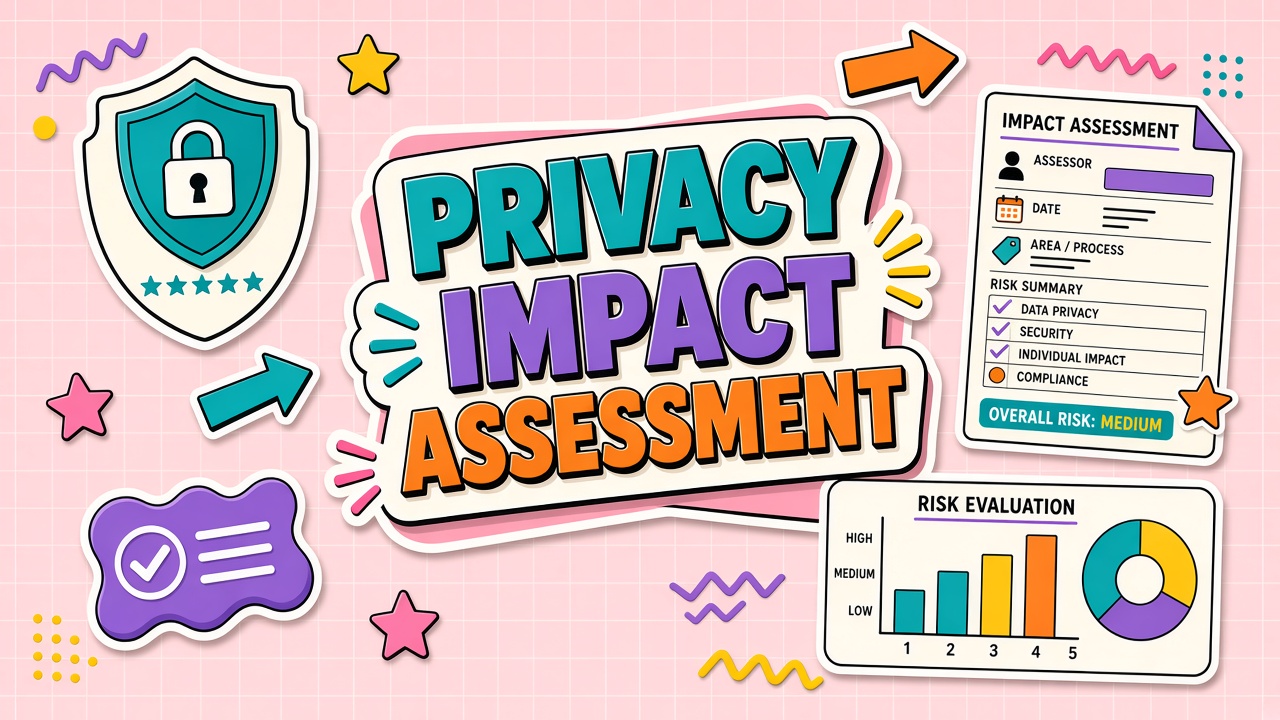
A team wants to deploy a summarization feature on support tickets. Engineering has a vendor selected. Privacy asks whether anyone documented what personal data leaves the CRM, how long the vendor stores it, and what happens if the model hallucinates a disclosure. Without a structured AI privacy impact assessment, decisions happen in Slack and audits find gaps months later.
This template-style guide helps privacy and product teams evaluate tools such as private AI chatbots and customer-facing bots before production data flows. It aligns with GDPR DPIA thinking; adapt for HIPAA, CPRA, or sector rules with counsel.
Risk registers should include likelihood and impact scores with explicit rationale, not gut feel numbers. Mitigations map to risks one-to-one; orphan mitigations indicate checklist theater. Residual risk after mitigation drives steering approve, pilot, or deny decisions.
PIAs for employee-facing tools must address workforce privacy: who can access logs, whether managers see individual prompts, and how performance evaluation uses AI output if at all. Employee PIAs skipped in favor of customer-only templates create HR exposure.
Link completed PIAs to tool registry entries alongside DPA and escalation cards. Onboarding a chatbot without linked PIA should block production toggle in change management systems where technically feasible.
When a PIA Is Required for AI
Trigger a PIA (or DPIA under GDPR) when AI processing is likely to result in high risk to individuals. Common AI triggers include:
- Systematic monitoring of employees or customers
- Large-scale processing of sensitive categories (health, biometrics, children)
- Automated decisions with legal or similarly significant effects
- Innovative technology combining personal data with profiling
- Processing that prevents data subjects from exercising rights
Low-risk internal pilots on synthetic data may use a lightweight screening questionnaire. Escalate to full PIA when pilot scope expands to real customer data or new geographies.
Data Flow Diagram Fields
Every PIA should include a data flow description. You do not need fancy tooling; a clear diagram with labeled fields suffices.
- Sources: CRM, tickets, documents, audio, user uploads, third-party enrichment
- Ingestion path: API, browser extension, batch export, real-time stream
- Processing locations: Vendor region, your VPC, hybrid retrieval index
- Model operations: Inference only, fine-tuning, evaluation, human review queues
- Outputs: Draft replies, scores, tags, generated files sent where
- Storage: Prompt logs, embeddings, backups, analytics warehouses
- Deletion: Triggers, SLAs, proof mechanisms
For writing assistants integrated into CMS publish flows, extend the diagram through publication and CDN cache invalidation. Data may linger in caches after vendor deletion.
Risk Scoring and Mitigations
Score inherent risk before controls, then residual risk after mitigations. Use a consistent scale (e.g., 1–5 likelihood × impact).
| Risk | Example scenario | Mitigation |
|---|---|---|
| Unauthorized disclosure | Model outputs another customer's data | Tenant isolation, retrieval filters, output review |
| Training leakage | Prompts used to improve public model | Enterprise no-train DPA, config verification |
| Inaccurate automated decision | Wrong eligibility denial | Human review, appeal path, logging |
Document why residual risk is acceptable or what additional controls are planned before launch. Link mitigations to owners and due dates.
Sign-Off and Review Cadence
PIA sign-off should include data protection lead (or DPO), product owner, security, and legal for high-risk cases. Engineering signs that implemented controls match the document.
- Initial sign-off: Before production processing of personal data
- Change triggers: New data category, new subprocessor, new geography, new model capability (e.g., vision on user photos)
- Periodic review: Annually or on contract renewal for ongoing high-risk systems
- Version control: Store PIAs with change history in GRC repository
Teams adopting AI coding tools with repository access should revisit PIAs when agents gain write permissions or new integrations.
Screening Questionnaire Before Full PIA
Use a ten-question screening form for low-risk internal experiments. Triggers that force full PIA include customer personal data, automated decisions with legal effect, systematic monitoring, and novel combinations of sensitive datasets. Screening results attach to steering intake packets even when full PIA is deferred.
PIA Integration With Vendor Selection
Complete draft PIAs before final vendor selection when personal data is in scope. Vendor answers on retention, subprocessors, and training use should populate PIA data flow sections directly. Switching vendors after PIA approval triggers re-review, not silent reuse of old assessments.
Stakeholder Workshop for PIAs
Schedule a 90-minute workshop with product, engineering, security, legal, and a business sponsor before drafting. Walk the future user journey whiteboard to live service. Workshops surface "we also send data to Slack webhook" surprises that questionnaires miss.
Document alternatives considered: why not manual process, why not on-prem model, why this vendor tier. GDPR expects proportionality reasoning, not only risk scores.
PIA triggers on vendor change
Switching from one writing assistant to another is a PIA trigger even if features look identical. Residency, subprocessors, and training defaults differ. Lightweight delta PIAs reference the original assessment and detail what changed.
Coding agent PIAs
AI coding tools with repository write access elevate impact: supply chain risk, secret exposure, license contamination in generated code. PIAs should list mitigations: read-only mode, branch protections, secret scanning, human merge requirement.
PIA Triggers in Product Lifecycle
Define PIA triggers at roadmap intake: new data field, new region, new subprocessor, new automated decision, new customer segment including minors. Product managers complete screening questionnaire before engineering sprint commitment. Late PIAs block launches or force expensive rework.
PIA outcomes should constrain technical design: if mitigation requires human review, architecture must allocate review capacity before launch metrics commit to full automation. PIAs that recommend mitigations without owners and dates fail audits.
PIA Evidence for Steering
Steering committee packets should include PIA summary, residual risk level, and mitigation status for any tool requesting customer data tier. Summaries fit one page; full PIAs remain linked for legal delegates. Approvals without PIA attachment should be procedurally blocked.
Track PIA age on tool registry dashboards. PIAs older than annual review date trigger refresh tickets before renewal approvals proceed.
Frequently Asked Questions
Can low-risk pilots skip a full PIA?
Use a screening form. If any high-risk trigger is yes, complete the full template. Pilots on anonymized or synthetic data still need vendor review if contracts will cover production later.
How do employee monitoring features affect PIAs?
Employee analytics on AI usage (keystroke logging, prompt inspection) heighten scrutiny. Document purpose limitation, transparency to staff, and proportionality. Works councils or unions may require consultation in some regions.
When must we consult a supervisory authority?
Under GDPR Article 36, when residual high risk remains after mitigations. Legal should make that call; the PIA should show you considered alternatives and safeguards.
PIA vs security review: duplicate work?
Overlap exists but focus differs. Security emphasizes controls and threats; PIA emphasizes data subject rights, lawful basis, and transparency. Cross-reference one document from the other.
How long should the PIA be?
Long enough to answer auditor questions, short enough that product teams read it. Most AI PIAs run five to fifteen pages plus diagrams.
Consulting Stakeholders During PIA
Consult works councils, employee representatives, or customer advisory groups when PIAs cover monitoring or customer-facing inference at scale. Consultation records attach to Section 7 of the template even when law does not mandate formal opinion.
Customer trust teams should review PIAs for features that change notice requirements. A PIA approved without comms alignment produces accurate legal docs and surprised customers.
When comparing private chatbot vendors, attach vendor security answers as PIA appendices. Identical use cases with different hosting models produce different risk scores and mitigation plans.
Residual Risk Acceptance
When mitigations cannot reduce risk to acceptable levels, document residual risk acceptance with steering sign-off, conditions, and review date. Residual acceptance is not failure; undocumented residual risk is. Accepted risks may require enhanced monitoring or customer notice beyond standard privacy policy updates.
Rejected high-risk designs should capture why alternatives were infeasible to prevent repeat proposals next quarter with the same gaps.
PIA Version Control and Linkage
Store PIAs next to architecture decision records in git or GRC. Link each production feature flag to PIA version ID. When engineering ships a change that expands data fields sent to models, the PR template asks: does this require PIA delta? Block merge without privacy sign-off for high-risk services.
Annual PIA refresh should compare last year's mitigations to actual controls deployed. Auditors reward honesty about partial implementation over aspirational checkbox PIAs never revisited.
PIA for Vendor Changes
Material vendor changes trigger PIA delta review: new subprocessor geography, new data types in scope, new automated decisions, or training policy changes. Full PIA rewrite is not always required; documented delta with legal sign-off may suffice for low-impact changes.
Deltas attach to original PIA version chain so auditors see evolution rather than orphaned assessments replaced without history.
Include accessibility and fairness considerations in PIAs when AI outputs affect customers or employees materially. Bias mitigation may be contractual or regulatory expectation beyond pure privacy scope in some jurisdictions.
DPO or privacy delegate should maintain a PIA register with status, review dates, and linked tools. Registers beat shared drives where assessments are hard to find during audits.
Product and engineering leads should attend PIA screening for features touching personal data. Their attendance reduces back-and-forth on feasibility of mitigations and speeds accurate data flow documentation.
Schedule PIA refresh reminders in the same calendar as vendor contract renewal so privacy assessment and commercial leverage align rather than conflicting at the last week before auto-renew.
PIAs Turn Privacy into a Design Requirement
A privacy impact assessment template for AI tools forces clarity on flows, risks, mitigations, and sign-off before launch. Use it for coding and writing deployments alike, and refresh when models, vendors, or data scope change. Privacy by design beats retrofitting controls after customer data has already trained someone's demo environment.