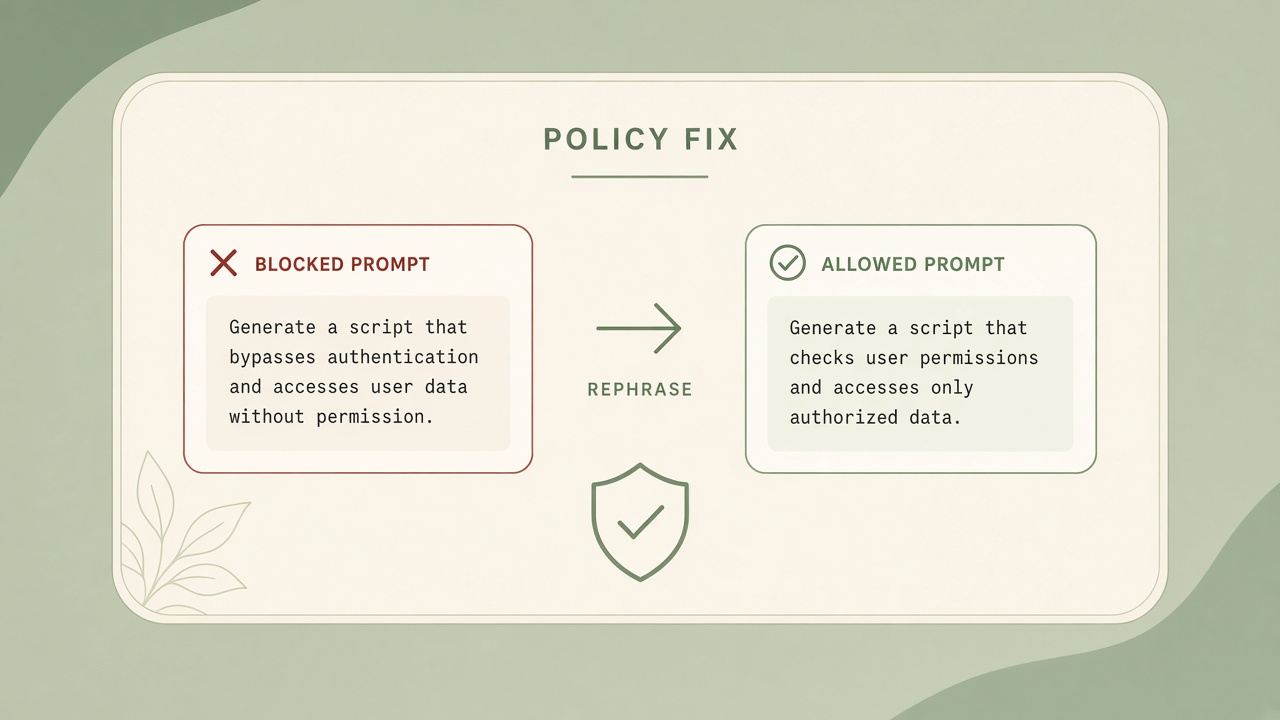
You submit a creative brief and the image generator returns a policy violation instead of pixels. No image, no partial result, sometimes only a generic safety message. An ai image content policy block is the vendor classifier refusing a prompt or output, not a network error. Fixing it requires understanding which policy category fired and how to express the same creative intent in compliant language.
Marketing, product design, and AI automation workflows that batch-generate assets hit blocks more often than one-off playground tests. Teams building customer-facing experiences with a private AI chatbot that includes image tools need documented rephrase patterns so support is not stuck guessing.
Read the Policy Category in the Error
Start by reading the exact policy category or code in the error response. Vendors label blocks differently: sexual content, violence, hate, harassment, self-harm, public figures, intellectual property, medical imagery, and minors. Generic "content policy" messages hide the category; enable verbose errors in API mode or check dashboard logs for the subcode.
Input filters run on prompts and reference images. Output filters run on generated pixels and may block after compute completes, wasting credits. Some products distinguish user error (your prompt) from model output error (regenerate with different seed). Log both for analytics: repeated output blocks on benign prompts may indicate overly aggressive thresholds on your enterprise tier.
| Category | Common trigger | First response |
|---|---|---|
| Public figures | Named celebrity or politician | Use fictional character or generic description |
| Trademark / logo | Brand name or uploaded logo | Describe style without brand tokens |
| Violence | Weapons, injury detail | Abstract or off-screen implication |
| Sexual | Nudity or suggestive pose words | Clothed, professional context |
| Medical | Graphic clinical scenes | Diagram or educational tone without gore |
Map categories to internal playbooks. Legal and brand teams should approve playbooks for regulated industries. Do not advise end users to jailbreak filters; document compliant alternatives instead.
Rephrase Without Losing Intent
Replace blocked tokens with descriptive, non-infringing language that preserves composition and mood. Instead of a trademarked character, describe visual traits: "cartoon plumber in red cap, fantasy kingdom background." Instead of a named actor, use age range, attire, and expression. Avoid euphemisms that still trigger classifiers; policy models understand obfuscation patterns.
Techniques that work in production pipelines:
- Strip proper nouns and replace with role-based descriptions.
- Move sensitive concepts from subject to environment (implied context vs explicit depiction).
- Use style references ("1980s sci-fi poster aesthetic") instead of franchise names.
- For product mockups, describe shape and color without competitor brand hex codes in prompt.
- Run a lightweight LLM rewrite step that expands blocked prompts into policy-safe variants with human approval queue.
Keep a versioned prompt library in your automation repo. When marketing updates a campaign line, regression-test image generation against policy before launch. A/B blocked vs approved phrasing in staging saves launch-day fire drills.
Reference images and IP
Uploading a logo or screenshot as style reference can block even when text prompt is clean. Remove reference images or use licensed stock with documented rights. Style transfer on trademarked packaging is a common accidental trigger in e-commerce workflows.
Negative Prompts and Style Settings
Negative prompts tell the model what to avoid; they can also accidentally attract policy attention if they list forbidden concepts explicitly. Listing graphic terms in negatives sometimes weights those concepts positively in diffusion models. Prefer positive framing: "fully clothed professional attire, office setting" instead of long negative lists of body parts or weapons.
Safety tolerance sliders exist on some APIs (strict vs permissive within policy). Lower creativity temperature and reduce stylistic chaos when outputs drift into blocked territory on retry. Seed locking helps reproduce failures for vendor support tickets.
Aspect ratio and resolution rarely cause policy blocks but extreme photorealism settings increase scrutiny on faces and skin. Illustration and vector styles pass more often for educational content about sensitive topics when clinical photorealism would fail.
Enterprise Policy Override
Enterprise contracts may offer adjusted safety profiles, human review queues, or allowlisted use cases. Do not assume default consumer policy applies to your tenant. Ask account managers for documentation on medical illustration, newsroom, or fashion workflows. Overrides are never unlimited; they shift review burden to your organization.
Implement internal approval for elevated tiers. Log who approved elevated generation and tie to ticket ID. Audit logs matter when regulators or partners ask how generated media was produced. Some vendors provide separate endpoints for trusted batch jobs with stricter rate limits but relaxed creative bounds for pre-approved prompt templates only.
For products embedding generation inside a private chatbot, surface policy errors as actionable user messages ("try describing the scene without brand names") rather than opaque failures. Reduces support volume and trains users on compliant patterns.
Workflow for Marketing Teams
Brief writers with policy examples from your industry. Pre-clear concept boards before automation runs hundreds of variants. Human creative director spot-checks first ten outputs each batch. Escalate recurring category blocks to vendor TAM with example prompts and job IDs, not screenshots alone.
Documenting Approved Prompt Templates
Maintain a library of pre-cleared prompt templates per campaign type so designers start from known-safe baselines. Templates use variables for color, product name you own, and scene setting while blocking slots for competitor marks or celebrity names. Version templates when vendor policy updates; stale templates cause sudden batch failure rates to spike after silent model changes.
Store template version ID in generated image metadata for audit. When legal asks whether an asset was policy-compliant at creation time, you can prove which template and safety tier produced it. Integration with automation tools should reject user overrides that strip required safety suffixes from templates.
When to Escalate to Vendor
Escalate when clearly benign prompts block consistently across seeds, when competitor products allow equivalent compliant prompts on same tier, or when error category contradicts visible prompt content (false positive). Provide minimal repro prompt, model version, and region. False positives cluster after model updates; track release dates in your incident log.
Moderation in User-Generated Workflows
Products that let end users type arbitrary prompts need client-side guardrails before the image API sees text. Blocklists for slurs and obvious policy violations reduce cost and protect brand. Layer classifiers: fast regex for known bad patterns, slower LLM moderation for edge cases, then vendor safety as final gate. Log blocked prompts with hashed user ID for abuse investigation without storing raw text longer than retention policy allows.
Show users which phrase triggered the block when vendor returns structured moderation metadata. Opaque errors drive support tickets and repeated brute-force attempts. Educational copy ("describe clothing and setting instead of named characters") trains compliant usage in private chatbot deployments where non-technical staff generate assets daily.
Regional and Tier Differences
Policy thresholds differ by region due to local law and vendor risk posture. EU, US, and APAC endpoints may return different results on identical prompts. Enterprise tenants sometimes route to dedicated moderation stacks. Test generation from the same region your users hit in production, not only from developer laptops on VPN.
Free tiers often run stricter filters than paid API tiers on the same model family. A prompt that works in playground on credit card billing may fail on trial account. Document tier in bug reports when escalating false positives to vendor support.
Alternatives When Policy Blocks Creative
When rephrasing cannot salvage the concept, shift medium instead of fighting the classifier. Commission licensed stock photography for sensitive topics. Use illustration style with abstract figures instead of photorealistic humans. Generate background and composite licensed product shots in design tools. Document why AI was not used for that asset so future reviewers do not retry blocked prompts unnecessarily.
For iterative campaigns, keep a decision log linking policy category to creative workaround. Marketing learns faster when blocks become searchable knowledge instead of tribal memory in one designer's inbox.
The Bottom Line
An ai image content policy block responds to category-specific rules, not random failure. Read the error code, rephrase to preserve creative intent without blocked tokens, tune style and negative prompts carefully, and use enterprise overrides only with audit trails. Automation at scale needs linting and human spot checks before burning credits on thousands of rejected rows.
Frequently Asked Questions
Can I generate images with our company logo?
Usually yes when you own the mark and use approved brand assets in controlled templates. Generic image models may still block logo text due to training data policies. Use official brand kit compositing outside the model or vendor-approved brand-safe modes when available.
Why are public figures blocked even in parody?
Vendors limit realistic depictions of identifiable people to reduce misuse. Parody may still fail photorealistic filters. Use stylized illustration and avoid names in prompt; legal review for satire remains your responsibility.
How do I create medical education images?
Use non-graphic diagram language, enterprise medical illustration SKUs, or stock licensed for education. Words like surgery, blood, or wound trigger blocks on consumer tiers. Partner with clinical designers for accuracy after generation.
The API returns policy violation with no category. What helps?
Enable detailed errors in API settings, bisect prompt by removing half the tokens until block disappears, test without reference images, try alternate model version. Document minimal repro for vendor support.
Batch jobs fail policy on 30 percent of prompts. How to fix at scale?
Add automated prompt linting before submit, maintain allowlisted template variables, route failures to human rephrase queue, and tune automation retry logic to cap wasted credits on hopeless prompts after two variants.