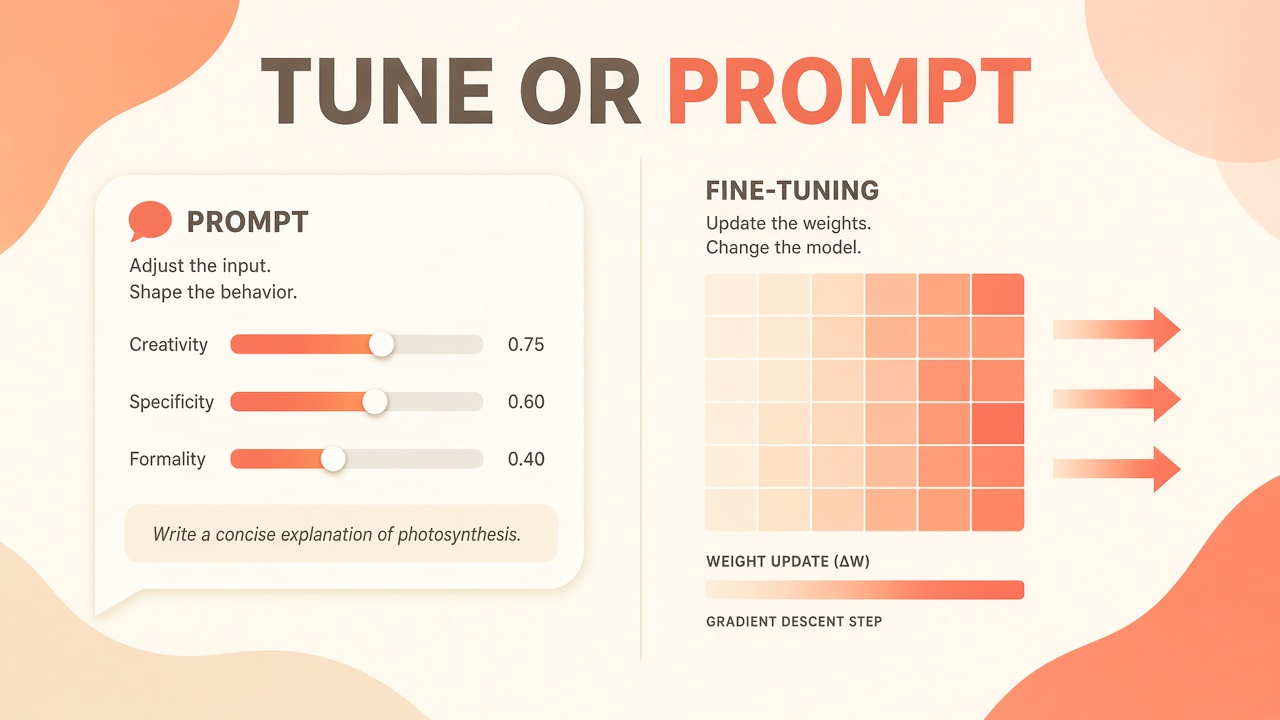
A legal tech startup wants contract summaries in a strict JSON schema with firm-specific clause names. Should the team craft a detailed system prompt, or fine-tune a base model on five hundred annotated agreements? Fine tuning vs prompt engineering is the central tradeoff: prompts change what you send the model at request time; fine-tuning changes the model itself. Developers in AI code tools debate the same choice for commit-message style and lint rules, while AI image generator products combine prompt templates with LoRA adapters for brand-consistent visuals.
Definitions: Prompt Engineering and Fine-Tuning
Prompt engineering designs instructions, examples, and output formats in the input context to steer model behavior without changing weights. Techniques include system prompts, few-shot exemplars, chain of thought scaffolding, tool definitions, and structured output schemas. Fine-tuning (including LoRA and full fine-tunes) trains the base model on a curated dataset so behavior is baked into parameters. Inference uses the adapted weights; prompts can be shorter because the model already learned the task distribution.
| Approach | What changes | Iteration speed |
|---|---|---|
| Prompt engineering | Input text per request | Minutes to hours |
| Fine-tuning (LoRA) | Adapter weights | Days (data + GPU) |
| Full fine-tune | All or many layers | Weeks, higher risk |
Data Requirements and Evaluation
Prompt engineering needs little or no labeled data beyond a handful of examples; fine-tuning needs hundreds to thousands of high-quality input-output pairs and a held-out eval set. Bad fine-tuning data teaches hallucinations and format errors that prompts cannot easily override. Build eval suites with exact match on structured fields, LLM-as-judge with human audit, and task-specific rubrics (legal risk, code compile rate). Compare prompt-only and fine-tuned baselines on the same eval before production.
Minimum viable datasets
- Prompt path: 10 to 50 edge-case examples in the prompt or eval set.
- LoRA fine-tune: 500 to 5,000 diverse pairs for narrow tasks.
- Full fine-tune: Tens of thousands plus rigorous safety filtering.
Cost: Tokens vs GPU Training
Prompt engineering pays per inference token (long prompts increase cost every request); fine-tuning pays upfront GPU hours then often lower per-request token use. A ten-thousand-token system prompt on one million monthly calls dwarfs a one-time LoRA job for stable tasks. Conversely, fine-tuning a huge model repeatedly on drifting data burns GPU budget. Model the break-even: monthly token surcharge from long prompts versus amortized training plus shorter prompts. API fine-tuning offerings (OpenAI, etc.) price training by token count and storage for adapted models.
| Cost driver | Prompt-heavy stack | Fine-tuned stack |
|---|---|---|
| Upfront | Low | Data labeling + GPU |
| Per request | High if prompts are long | Lower prompt tokens |
| Maintenance | Edit prompts in git | Retrain on drift |
Drift, Retraining, and Model Upgrades
Product terminology, regulations, and base model versions drift; prompt changes deploy instantly while fine-tuned weights require retraining and regression tests. When OpenAI or Anthropic ships a new base model, prompt-based apps often switch with config changes; fine-tuned adapters may be incompatible and need rebuild. Schedule quarterly eval runs on live traffic samples. Document which behaviors live in prompts versus weights so incident response knows where to patch.
Hybrid: RAG, Prompts, and Adapters
Production systems combine retrieval for fresh facts, prompts for guardrails and format, and LoRA adapters for tone and task-specific structure. RAG supplies policy text; the prompt enforces citation format; the adapter reduces verbose hedging learned from generic pretraining. Avoid fine-tuning on facts that change weekly; retrieve those instead. Fine-tune on stable style and extraction patterns. Parameter-efficient fine-tuning (LoRA, QLoRA) keeps multiple customer adapters on one base model for SaaS multi-tenancy.
When to choose which layer
| Need | Prefer | Why |
|---|---|---|
| Fresh knowledge | RAG | Weights stale without retrain |
| Output JSON schema | Prompt + constrained decode | Fast iteration |
| Brand voice at scale | LoRA adapter | Shorter prompts, consistent tone |
| Rare proprietary jargon | Fine-tune + RAG | Jargon in weights, facts retrieved |
Prompt Engineering Patterns That Scale
Version prompts in git, A/B test variants, separate system from user templates, and use eval hooks on every merge. Dynamic prompt assembly injects user locale, retrieved chunks, and tool results without hand-editing monolithic strings. Cache static system prefixes where APIs support prompt caching to cut cost. Document failure modes: models ignoring late instructions in long contexts favors putting critical rules at both top and bottom or using fine-tuning for stubborn format adherence.
Structured Output Without Full Fine-Tune
Before fine-tuning for JSON compliance, try constrained decoding, response_format schemas, and validation-retry loops in the application layer. Many providers expose JSON mode that reduces parse failures dramatically with prompt engineering alone. Retry once with error feedback ("field X must be integer") before escalating to fine-tune. Log parse failure rate; if below one percent after schema constraints, fine-tuning may not pay off. Image and code products often need adapters for aesthetic or syntax style where JSON mode does not apply.
Organizational Workflows for Prompt Teams
Treat prompts as code: pull requests, reviewers, staging environments, and rollback. Separate roles: product writes intent, engineers wire templates, legal reviews refusal language. Prompt registries (Humanloop, LangSmith, homegrown YAML) diff versions against eval scores. Never hot-edit production system prompts from a chat UI without audit trail. Schedule monthly prompt debt reviews to prune contradictory instructions accumulated across feature launches.
Fine-tune ops maturity
- Experiment tracking for datasets and hyperparameters.
- Held-out safety eval after every training job.
- Canary release of new adapter to five percent traffic.
- Automatic rollback if error rate exceeds threshold.
- Quarterly retrain decision based on drift metrics.
Compliance and Data Residency
Fine-tuning on customer data may violate contracts if the provider retains weights for other tenants; prompt-only paths keep data ephemeral per request subject to API logging policies. Read data processing agreements for training data retention, opt-out, and deletion after contract end. Some enterprises prohibit fine-tuning entirely and allow only RAG plus prompts inside their VPC. Document the chosen path in security questionnaires to avoid sales blockers late in procurement.
Fine-Tuning Risks and Guardrails
Fine-tuning can amplify biases in training data, weaken safety refusals if mislabeled, and create compliance liability for derivative models. Filter PII from training sets. Run safety evals after every tune. Prefer adapters over full weight merges when experimenting. Keep a prompt-based fallback if the adapted model regresses on out-of-domain inputs. Some regulated buyers prohibit fine-tuning on customer data in multi-tenant APIs; verify vendor contracts.
Frequently Asked Questions
Should I always start with prompts?
Yes for most greenfield tasks: validate product fit with prompts before investing in labeled data and GPU fine-tuning. Move to fine-tuning when eval plateaus, prompt length hurts economics, or format compliance remains unreliable.
How does few-shot prompting compare to LoRA?
Few-shot adds examples to every request (token cost); LoRA encodes patterns in weights (upfront training). Few-shot flexes without retraining; LoRA wins at high volume with stable patterns.
Can I distill prompts into a smaller fine-tuned model?
Distillation generates training data from a large prompted teacher model, then fine-tunes a smaller student. Useful for latency and cost. Verify student quality on safety and edge cases the teacher handled.
Does fine-tuning work on closed APIs?
Major providers offer managed fine-tuning on select base models with upload formats and hosting of adapted checkpoints. Open-weight models allow full control on your GPUs. Match choice to data residency and budget.
Can RAG replace fine-tuning?
RAG replaces fine-tuning for factual knowledge, not for deeply ingrained format or style. Combine both when products need current documents and consistent voice.
Case Study Patterns by Industry
Support macros and tone often stay prompt-driven because policies change weekly; medical coding extraction with stable schemas favors LoRA after a labeled pilot. E-commerce product attribute tagging may use zero-shot or prompts until catalog scale justifies fine-tune. Developer tools fine-tune on internal repos for style but retrieve API docs via RAG. Image generators sell LoRA packs for brand style while prompts handle scene composition. Map your use case to the cheapest layer that passes eval, not the most impressive technique in a conference talk.
Typical timeline to production
Prompt-only MVPs ship in one to two weeks with eval harness. LoRA pilots need four to eight weeks for data collection, labeling QA, training, and canary. Full fine-tunes extend further. Plan procurement and legal review parallel to technical work so contracts do not block launch after models are ready.
Measuring ROI Between Approaches
ROI compares incremental revenue or cost saved (fewer human edits, faster resolution) against token, GPU, and engineer maintenance cost over twelve months. Prompt iteration cost is mostly engineer salary; fine-tuning adds label vendor fees and GPU bills. Spreadsheet the break-even month when long prompts exceed one-time tune amortization. Include retrain cost when data drifts quarterly. Present finance with cost per successful task, not vanity accuracy on a public benchmark unrelated to your users.
Versioning Base Models and Adapters
Pin base model version, adapter checkpoint, and prompt hash together in deployment manifests so rollbacks restore a known triple. Upgrading GPT-4.1 to a new snapshot may invalidate LoRA trained on the prior tokenizer behavior. Maintain compatibility matrix in internal docs. Canary new base models with prompt-only fallback if adapter fails eval. Customers on dedicated adapters need comms before forced upgrades.
Team Skills for Each Approach
Prompt engineering leans on product sense, eval design, and rapid experimentation; fine-tuning needs ML engineers comfortable with datasets, GPUs, and hyperparameter sweeps. Small startups often start with full-stack engineers writing prompts; scale triggers hire or vendor for MLOps. Prompt registries democratize iteration but require governance to avoid prompt spaghetti. Fine-tune projects stall without labeling budget and clear acceptance criteria. Hybrid teams pair domain experts (label quality) with engineers (pipeline reliability). Training courses for PMs on eval metrics pay off before first LoRA experiment.
Buyer Questions for AI Vendors
Procurement should ask whether the vendor supports custom fine-tunes, prompt-only customization, data isolation, eval tooling exports, and rollback of adapter versions. Request side-by-side accuracy on your eval set for prompt template versus managed fine-tune SKU. Hidden professional services fees often appear when fine-tune data needs cleaning the vendor will not do in base price. Ask for sample prompt and adapter eval reports from a reference customer in your industry before selecting a platform. Internal champions should own a shared spreadsheet comparing prompt token spend versus projected fine-tune GPU hours over twelve months. Revisit the spreadsheet after each base model upgrade because relative economics can flip overnight when providers cut training prices or raise context limits on flagship models.
Conclusion
Prompt engineering iterates fast and costs tokens; fine-tuning invests in data and GPU for baked-in behavior and shorter inference prompts. Evaluate on the same metrics, plan for base model upgrades and drift, and hybridize with RAG for facts plus adapters for tone. Choose the cheapest layer that meets your SLA, then escalate to fine-tuning only when prompts demonstrably fail at scale.