AI veterinary practice tools help clinics reduce documentation burden and improve client communication without replacing licensed clinical judgment. Species-specific medicine, prescription rules, and medical record standards mean general consumer chatbots need guardrails before they touch patient charts.
This guide covers medical record documentation assistance, client education content guardrails, prescription and diagnosis boundaries, practice information management system (PIMS) integration, and common FAQ topics. Evaluate options in AI transcription and AI chatbot categories through a clinical vs admin workflow split before rollout.
Medical Record Documentation Assistance
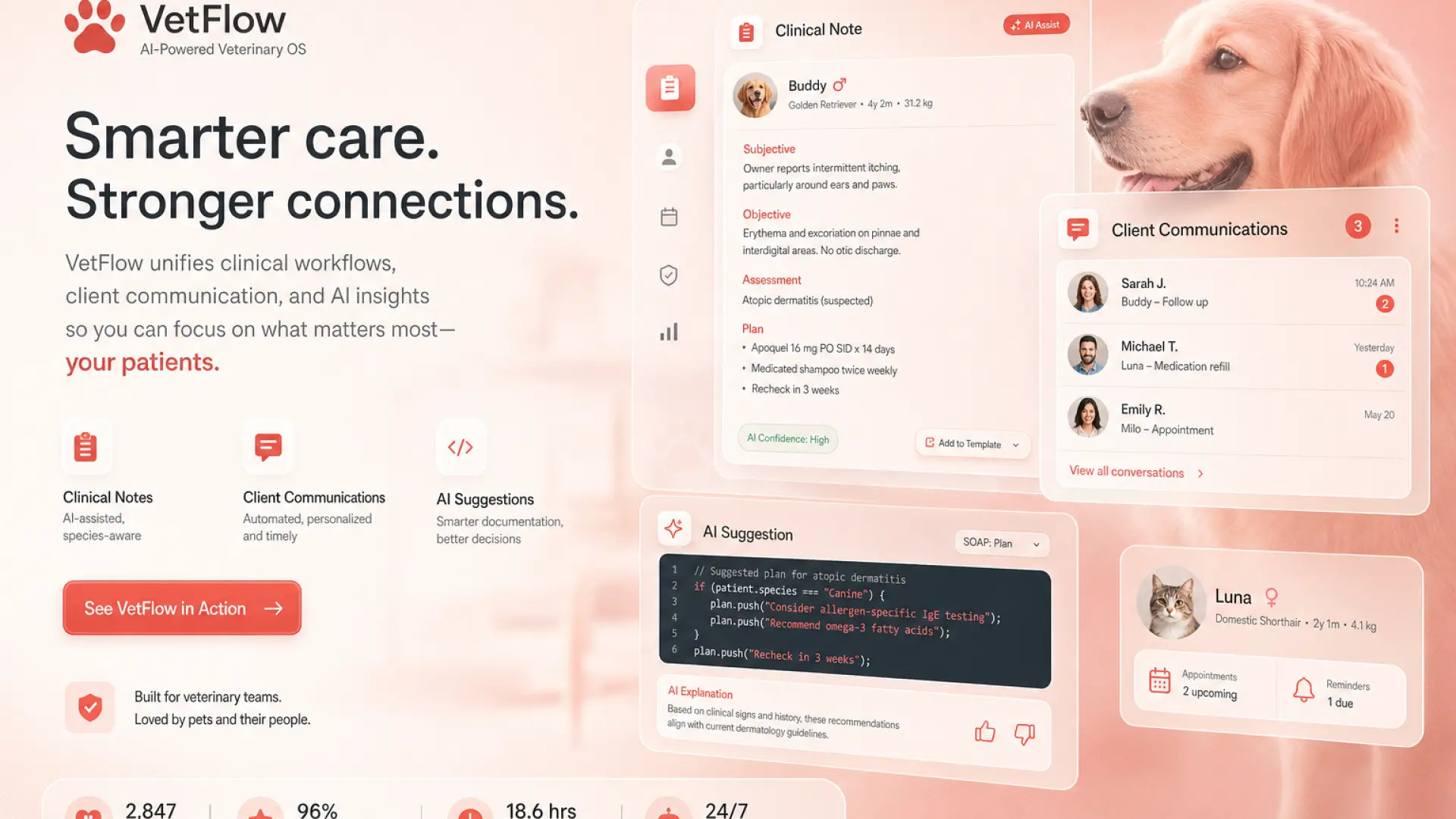
AI scribes and transcription tools can draft SOAP notes from exam room audio when veterinarians review and sign every entry before it becomes part of the legal medical record. Accuracy varies by accent, background noise, and medical terminology. Never auto-publish AI-generated notes without DVM review.
- Record consent for audio capture in the exam room where local law requires it.
- Map species, breed, weight, and drug names to PIMS fields with structured output templates.
- Flag uncertain drug dosages or diagnoses for manual correction before save.
- Retain original audio or transcript alongside the signed note for dispute resolution.
- Train staff on what the scribe captures vs what the veterinarian must add manually.
| Documentation task | AI assist level | Required human gate |
|---|---|---|
| Exam SOAP notes | Draft from audio or bullet prompts | DVM review and electronic signature |
| Discharge summaries | Template expansion from diagnosis codes | Verify instructions match prescribed care |
| Referral letters | First draft from chart export | Attending vet approval before send |
| Lab result narratives | Summarize panels with reference ranges | Clinical interpretation by veterinarian |
Client Education Content Guardrails
AI can draft post-visit care sheets, FAQ responses, and appointment reminders, but every client-facing health statement must align with clinic-approved protocols and avoid diagnosing new conditions. Generic pet health content from large language models may cite wrong species dosages or outdated guidelines.
- Maintain an approved snippet library for common conditions your clinic treats.
- Block AI from generating prescription instructions without linking to the signed chart.
- Use plain language checks for readability without simplifying away critical warnings.
- Escalate symptom triage chatbots to staff when urgency keywords appear.
- Disclose when clients interact with automated systems vs live team members.
Prescription and Diagnosis Boundaries
Only licensed veterinarians may diagnose, prescribe, or authorize treatment plans. AI tools must not autonomously recommend controlled substances, off-label uses, or euthanasia decisions. Veterinary boards treat unauthorized practice of veterinary medicine seriously regardless of whether a human or model drafted the output.
- Prohibit AI from selecting drug, dose, route, or duration without DVM input.
- Separate triage bots from prescription refill workflows with identity verification.
- Log all AI-assisted triage conversations for medical-legal review.
- Review telehealth AI workflows against state veterinary practice acts.
- Document override reasons when staff reject AI-suggested clinical text.
PIMS Integration Considerations
Practice information management systems remain the system of record; AI vendors should integrate via APIs or secure exports rather than shadow spreadsheets. Data residency, BAAs where applicable, and audit trails matter when patient identifiers flow to third-party models.
- Confirm vendor SOC 2 status and subprocessors before connecting production charts.
- Test integration in a sandbox clinic with synthetic patients first.
- Map AI output fields to PIMS templates to avoid duplicate data entry.
- Plan rollback if the vendor changes model behavior without notice.
- Include IT and practice manager in vendor selection alongside clinical leads.
Clinical vs Admin Workflow Split
Successful veterinary AI rollouts separate exam room documentation from front-desk scheduling and billing automation. Admin tools can move faster with office manager ownership while clinical scribes require medical director policy and malpractice carrier notification.
- Inventory current documentation time per DVM and technician role.
- Pilot scribe tools on low-acuity appointment types before surgery blocks.
- Deploy client chatbots only for scheduling and billing FAQs initially.
- Measure edit burden per note and client complaint rates monthly.
- Expand scope only after 90 days of stable error rates and staff satisfaction.
Frequently Asked Questions
Can AI run veterinary telehealth visits?
AI may assist with scheduling and intake forms, but the telehealth encounter itself requires a licensed veterinarian where state law mandates. Some states restrict telemedicine without an existing VCPR. Check board rules before deploying AI triage that implies a diagnosis.
How do AI workflows differ for livestock vs companion animals?
Livestock operations often involve herd-level records, withdrawal periods, and food chain regulations that companion clinics rarely face. AI templates must encode species-specific withdrawal intervals and regulatory reporting fields. One-size-fits-all pet content fails on production medicine.
How accurate are veterinary AI scribes?
Accuracy depends on audio quality, terminology training, and post-edit review culture. Benchmarks from human medicine do not transfer directly. Pilot with your busiest clinicians and measure edit time per note before clinic-wide rollout.
Should clinics deploy client-facing AI chatbots?
Appointment scheduling and billing FAQs are lower risk; symptom assessment requires strict escalation rules and veterinary oversight. Never present chatbot output as a substitute for an exam when the pet may need urgent care.