Production teams pinning model strings in environment variables learned in 2026 that deprecation emails arrive in clusters, not single lines on a changelog. OpenAI's official deprecations page lists shutdown dates with named replacements, spanning Sora video APIs in September, legacy instruct models later that month, a large GPT-4 and reasoning model batch on October 23, platform feature removals in November, and GPT-5 snapshots in December. Missing a date breaks CI, customer-facing agents, and fine-tuned workflows simultaneously.
OpenAI deprecation timeline 2026 requires a consolidated calendar, replacement mapping, and regression tests before each cutoff. Audit dependencies in AI code projects and AI chatbot products that may still call retired snapshots.
2026 Sunset Calendar for OpenAI Models
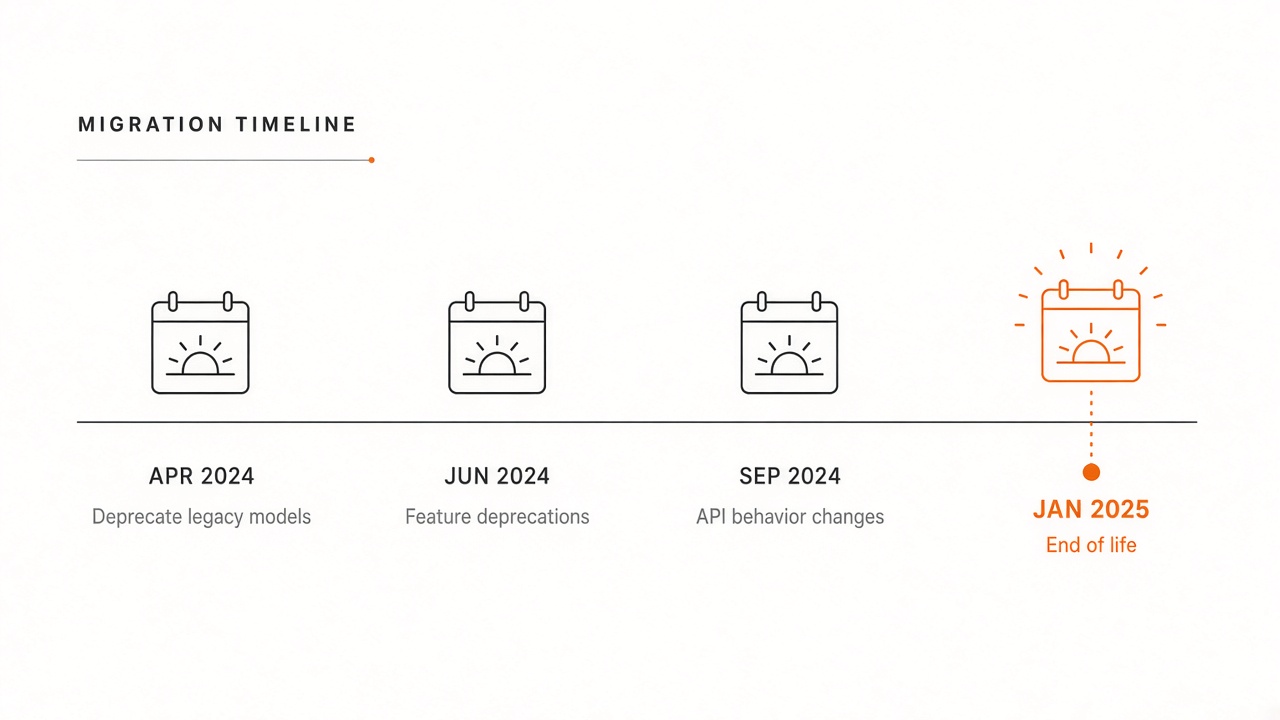
The nearest 2026 shutdowns cluster in September through December, with legacy audio and transcription families extending into January and February 2027. Dates below come from OpenAI's published deprecations documentation; confirm on platform.openai.com/docs/deprecations before planning because preview models can move faster.
| Shutdown date | Retiring items | Notes |
|---|---|---|
| Aug 26, 2026 | Assistants API | Migrate to Responses and Conversations APIs |
| Sep 24, 2026 | Sora 2 models and Videos API | Plan alternative video providers if needed |
| Sep 28, 2026 | Legacy instruct and completions models | Move to chat/completions on supported GPT-5.6 tiers |
| Oct 23, 2026 | gpt-4, gpt-3.5-turbo, gpt-4-turbo, gpt-4o-2024-05-13, o1, o3-mini, o4-mini, gpt-image-1, fine-tunes | Largest single-day batch; map to gpt-5.6-sol and gpt-image-2 |
| Nov 30, 2026 | Reusable prompts, Evals platform, Agent Builder | Platform feature migration, not only model weights |
| Dec 1, 2026 | Remaining gpt-image-1 variants | Consolidate on gpt-image-2 family |
| Dec 11, 2026 | gpt-5-2025-08-07 snapshots, gpt-5-mini, gpt-5-nano, gpt-5-pro, o3, o3-pro | Upgrade to gpt-5.6-sol, terra, luna tiers |
| Jan 20, 2027 | Legacy audio, realtime, and related snapshots | Move to gpt-realtime-2.x and gpt-audio-2.x families |
| Feb 26, 2027 | whisper-1, gpt-4o-transcribe family | Migrate to gpt-live-transcribe or gpt-transcribe |
OpenAI states minimum notice of six months for generally available models, three months for specialized variants, and as little as two weeks for preview endpoints. Treat preview model IDs as non-production unless you can migrate within days.
Replacement Model Map
OpenAI pairs each retiring model with a recommended replacement in the deprecations table; most 2026 chat migrations point to the GPT-5.6 family (sol, terra, luna) with reasoning.mode flags for former o-series behavior. Use this map as a starting checklist.
- gpt-4 / gpt-4-0613: gpt-5.6-sol
- gpt-3.5-turbo variants: gpt-5.6-luna or gpt-5.6-sol depending on latency budget
- o1 / o3-mini / o4-mini: gpt-5.6-sol with appropriate reasoning settings
- o3-pro / gpt-5-pro: gpt-5.6-sol with reasoning.mode: pro
- gpt-image-1: gpt-image-2 or gpt-image-1-mini where supported
- Assistants threads: Conversations API plus Responses API runs
- Realtime Beta: Released Realtime API (beta interface removed May 2026)
API Code Changes for Migration
Beyond swapping model strings, migrations may require endpoint changes, parameter renames, and tool schema updates when moving from Assistants to Responses. Common engineering tasks:
- Inventory model IDs: Grep repositories, LangChain configs, and feature flags for deprecated strings and fine-tune names.
- Update SDK versions: OpenAI Python and Node SDKs added Responses helpers; older Assistants clients will fail after August 2026.
- Map threads to conversations: Export historical threads if retention required; map runs to Responses with stored conversation IDs.
- Retune prompts: GPT-5.6 models differ in verbosity and tool-calling behavior; rerun eval suites.
- Re-train or drop fine-tunes: Fine-tuned gpt-3.5 and gpt-4 models sunset with base weights; schedule retraining on supported bases or switch to prompt+RAG.
- Adjust billing alerts: New models change per-token pricing; update cost dashboards before cutover.
Testing Before Cutover
Run shadow traffic comparing old and new models on production-shaped prompts at least two weeks before each shutdown date, with automated regression on tool calls, JSON schema outputs, and latency SLOs. Suggested test matrix:
- Functional parity: Same inputs, diff outputs flagged for human review.
- Safety filters: Confirm moderation endpoints still align with policy for your use case.
- Streaming: Validate SSE chunk boundaries for chat UIs.
- Multimodal: Image and audio paths need separate checks when migrating gpt-image and realtime stacks.
- Rollback plan: Keep previous model ID behind a feature flag until 48 hours after successful canary.
Subscribe to OpenAI changelog RSS or webhook notifications and pin the deprecations page in your platform runbook. Calendar invites for October 23 and December 11 should include engineering, product, and customer success owners.
Frequently Asked Questions
What happens on October 23, 2026?
OpenAI shuts down a large set of GPT-4 era chat models, o-series reasoning snapshots, gpt-image-1, and associated fine-tunes. Applications still calling those IDs will receive errors until updated to GPT-5.6 replacements.
Is the Assistants API still available?
No after August 26, 2026. Migrate to Responses and Conversations using OpenAI's migration guide mapping threads, messages, and runs.
How much notice do preview models get?
OpenAI may retire preview models with roughly two weeks notice. Do not build production SLAs on preview IDs unless you maintain rapid migration playbooks.
Do fine-tuned models outlive base models?
Not indefinitely. When a base model sunsets, dependent fine-tunes retire on the same or an earlier published date. Check the deprecations table for ft- model entries.