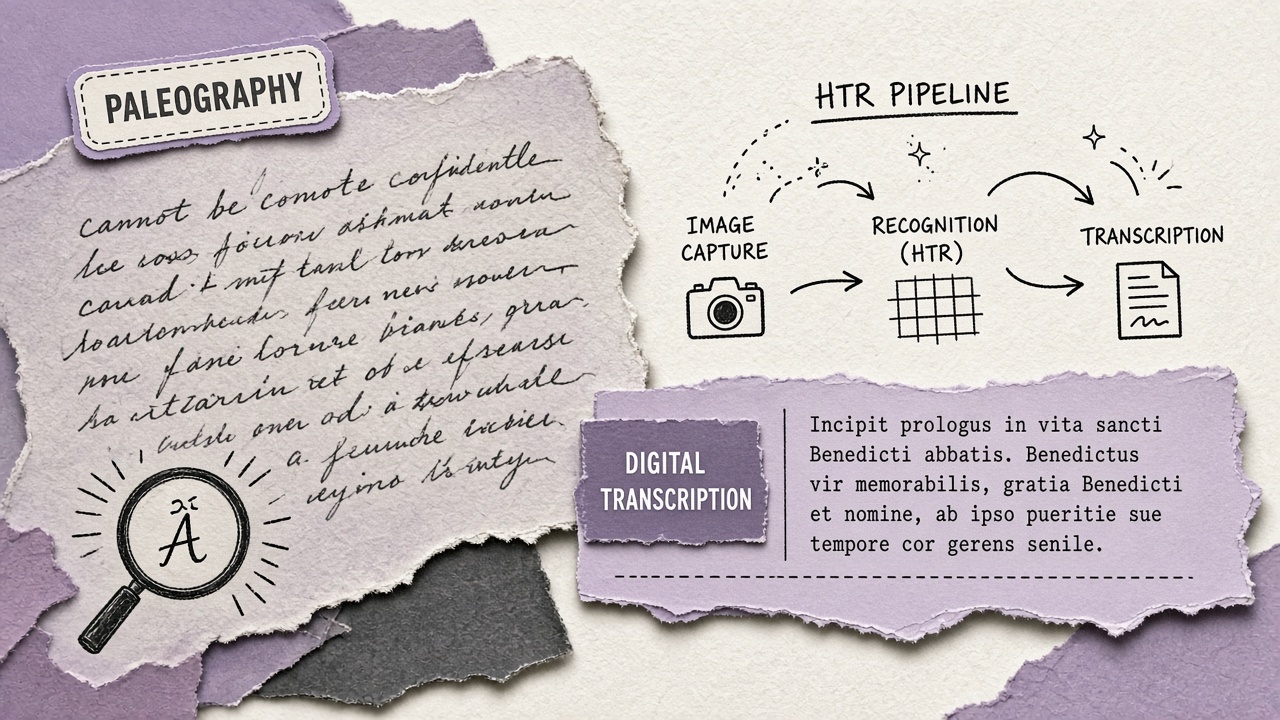
AI manuscript paleography digitization uses Handwritten Text Recognition (HTR) to transcribe historical handwriting at scale, with platforms like Transkribus and eScriptorium training script-specific models that outperform generic OCR on monk Latin, Kurrent German, and civil registry hands. Large language models now supplement line transcription with layout understanding and entity extraction, but specialized HTR still wins on rare scripts and damaged folios. Archives pair automated drafts with active-learning correction queues so paleographers validate ambiguous abbreviations before publication. Researchers exploring AI research on document AI or AI research infrastructure for cultural heritage should budget human review, not treat character error rate alone as success.
Why Printed OCR Fails on Manuscripts
Optical Character Recognition assumes fixed fonts and horizontal lines; manuscripts introduce ligatures, inconsistent slant, bleed-through, marginalia, and abbreviations that break commercial OCR pipelines. A civil registry book from 1850 may mix printed headers with clerk cursive in multiple ink colors. Medieval choir books layer Latin neumes over text. Each script demands custom line segmentation before character recognition. Feeding manuscript photos into generic OCR yields gibberish that pollutes search indexes if uploaded without quality gates.
Page curvature, worm holes, and conservation repairs add noise. HTR pipelines therefore begin with layout detection that finds text lines, blocks, and tables, then routes each line to a recognizer trained on similar hands. Error propagation is real: a mis-segmented line boundary splits words and confuses the language model downstream.
Copyright and privacy rules differ from printed books. Civil registers contain living-person descendants' data; embargo periods may block public release even after accurate transcription. Digitization ethics belong in the same workflow as model accuracy metrics.
Line Segmentation and HTR Architectures
Modern HTR stacks combine layout transformers, convolutional or transformer encoders, and CTC or attention decoders; engines compared in 2025 benchmarks include PyLaia, Kraken, TrOCR, IDA, HTR+, and Transkribus Titan supermodels. Transkribus reports over 200 million pages processed by a global user base, with 300-plus community models covering 100-plus languages. eScriptorium offers open Kraken training for Byzantine Greek and other traditions, favoring institutions that want self-hosted control on Linux or cloud CREMMA servers.
Titan and TrOCR-f show strong out-of-the-box Latin results, while PyLaia and IDA excel on selected non-Latin scripts when fine-tuned. Architecture choice matters less than labeled line data quantity: a few hundred carefully corrected lines often bootstrap usable models for a single scribal hand. Monk script training benefits from consistent ductus within one scriptorium, whereas civil registries mix multiple clerks and require clerk-specific submodels or heavy augmentation.
Benchmark studies in 2025 also tested multimodal LLMs such as Claude 3.5 Sonnet and Gemini 1.5 Pro on handwriting photos. LLMs perform well on modern English and some Italian samples but lag specialized HTR on German Kurrent and low-resource historical scripts unless fine-tuned with domain images. Hybrid workflows transcribe lines with HTR, then ask LLMs to expand abbreviations or tag entities with citations back to folio coordinates.
| Platform or engine | Strength | Typical archive use |
|---|---|---|
| Transkribus Titan | Strong Latin out-of-the-box HTR | National archives, civil records |
| eScriptorium + Kraken | Open training, Byzantine Greek models | Universities, self-hosted pipelines |
| PyLaia / HTR+ | Fine-grained custom script training | Rare hands, non-Latin scripts |
| Multimodal LLMs | Layout reasoning, abbreviation expansion | Post-processing, modern handwriting |
Active Learning with Scholar Corrections
Production archives route low-confidence lines to paleographer review queues; corrected transcripts retrain models in active-learning loops that shrink error rates over successive batches. Transkribus workflow tools export structured XML with coordinates linking each glyph hypothesis to image regions, supporting scholarly editions and public digital exhibits. Confidence thresholds should be conservative on legally sensitive registers: publishing a misread surname can harm living relatives.
Crowdsourced volunteer correction helps NGOs with backlogs but requires training on abbreviation conventions. Medieval Latin volunteers must distinguish tall s from f, recognize common sigla, and avoid modernizing spelling. Quality control samples a percentage of volunteer work for expert re-audit before merging into gold training sets.
Character Error Rate (CER) and Word Error Rate (WER) track progress, yet historians care about semantic errors: confusing two similar legal terms changes interpretation. Evaluation should include domain-specific spot checks on dates, placenames, and currency amounts that matter for genealogical researchers.
Multilingual Script Challenges
Multilingual manuscripts mix scripts in one codex: Hebrew numerals beside Latin text, Arabic comments in margins, or code-switching registries in border regions. Single-language models degrade when lines alternate scripts. Layout detection must tag script per line before routing to the correct recognizer. Community models on Transkribus cover Kurrent, Fraktur, and historical French cursives, but every new script still needs dozens of annotated lines minimum.
Right-to-left and vertical scripts add segmentation complexity. Japanese kanbun and classical Mongolian vertical hands require orientation-aware preprocessing. LLM post-processors must not auto-translate without marking modern language output as separate from diplomatic transcript layers expected by philologists.
Historical handwriting recognition AI for civil registries unlocks genealogy markets yet demands GDPR-style erasure when subjects request removal. Archives should separate public index fields (name, year) from full transcript access tiers requiring reading-room login. Automated entity tagging of occupations and crimes needs bias review so search facets do not reproduce nineteenth-century prejudices uncritically.
Digitization vendors quoting flat per-page OCR pricing often underestimate HTR correction labor on monk script antiphonaries. Request pilot CER/WER reports on ten representative folios before signing multi-year contracts. Manuscript paleography digitization ROI appears when full-text search replaces manual index cards, not when raw character error rates alone hit arbitrary thresholds.
Colonial archive digitization often encodes power asymmetries: indigenous language marginalia transcribed poorly while metropolitan languages receive model investment. Funding should prioritize community-led training data for understudied hands rather than only high-traffic European collections.
Archive Discovery Impact
Searchable transcripts unlock collections previously indexed only by shelf marks, enabling full-text discovery of placenames, trade routes, and personal names across millions of folios. When HTR quality crosses usability thresholds, historians shift from hunting individual volumes to corpus linguistics on entire archives. Linking transcripts to authority files (VIAF, GeoNames) multiplies discovery value. Oral history projects increasingly mirror manuscript pipelines with dialect-aware ASR plus human post-editing for pause and speaker identity preservation.
Public digital editions built from HTR output should expose correction interfaces so readers flag errors tied to image crops, improving models and trust simultaneously. Embargo metadata must travel with transcripts so sensitive civil records do not leak through API mirrors.
Integration with library management systems lets curators attach HTR confidence scores to catalog records, signaling when on-site consultation remains advisable. AI manuscript paleography digitization is a throughput multiplier, not a replacement for expert paleographic judgment on high-stakes authentication questions.
Norwegian National Library community models such as NorHand demonstrate how open weights on Transkribus accelerate regional hands without vendor lock-in. Comparable releases for South Asian scripts remain sparse; grant proposals should fund labeled lines from diaspora archives willing to share anonymized training data. Quality review queues benefit from side-by-side UI showing image crop, HTR hypothesis, and prior catalog abstract so correctors spot semantic drift quickly.
Medieval Latin FAQ topics recur in help desks: tall s versus f, punctuation absent from source, and abbreviations expanded differently across editions. Embedding paleographic tooltips inside correction software reduces repeated scholar email. For civil registries, redact living-person fields before crowdsourcing transcripts to volunteers lacking data-protection training.
Long-term preservation pairs HTR transcripts with PREMIS metadata recording model ID, training corpus, and correction pass dates so future scholars know which automation layer produced each reading. Without that lineage, later retractions of erroneous transcriptions become impossible to audit across million-page corpora migrated between vendors.
Volunteer quality FAQ workflows should document acceptable CER thresholds per collection type: civil birth registers tolerate lower error than legal contracts affecting land title. Publishing those thresholds on archive websites sets researcher expectations before they download bulk transcript dumps for computational social science projects.
National libraries running million-page backlogs often stage HTR in waves: printed covers via OCR, handwritten interiors via Transkribus or eScriptorium, then LLM-assisted metadata extraction for dates and jurisdictions. SLA metrics track median time from scan ingest to searchable transcript, with escalation paths when CER exceeds thresholds on named record series. AI manuscript paleography digitization succeeds when IT teams treat models like software releases with regression tests on golden folio sets after each engine upgrade.
Monk script versus civil registry workflows diverge in layout complexity. Choir books need neume-aware segmentation optional modules; tabular registries need column detection before line HTR. Choosing the wrong layout model wastes recognizer capacity on mis-cropped lines that look like gibberish despite excellent character weights. Pilot ten pages per collection before batch committing cloud GPU hours.
Frequently Asked Questions
Can HTR read medieval Latin abbreviations?
Specialized models trained on abbreviated hands outperform generic LLMs, but scholars should still expand sigla manually in critical editions. Never trust raw output for legal or theological claims without review.
How many training lines are needed?
Roughly 100 to 500 corrected lines bootstrap many single-script models; complex multi-scribe registers need more. Quality of labels beats raw quantity.
Is Transkribus free for archives?
Transkribus offers tiered plans; universities and national libraries often hold site licenses. eScriptorium remains a common open-source alternative for self-hosting.
Do LLMs replace Transkribus?
Not yet for rare scripts and damaged folios. Benchmarks show LLMs competitive on modern English handwriting while specialized HTR leads on German and multilingual historical sets.
What about copyright on transcripts?
Facts are not copyrightable, but creative arrangement and editorial normalization may be. Respect donor agreements and living-person privacy in civil registers.
Can volunteers help correct HTR?
Yes, with training and spot audits. Provide abbreviation guides and bar random modernized spellings from entering gold data.
Where should I follow HTR research?
Digital humanities journals and Transkribus research blog publish benchmarks. For broader document AI trends, browse AI research on multimodal transcription and archive tooling.