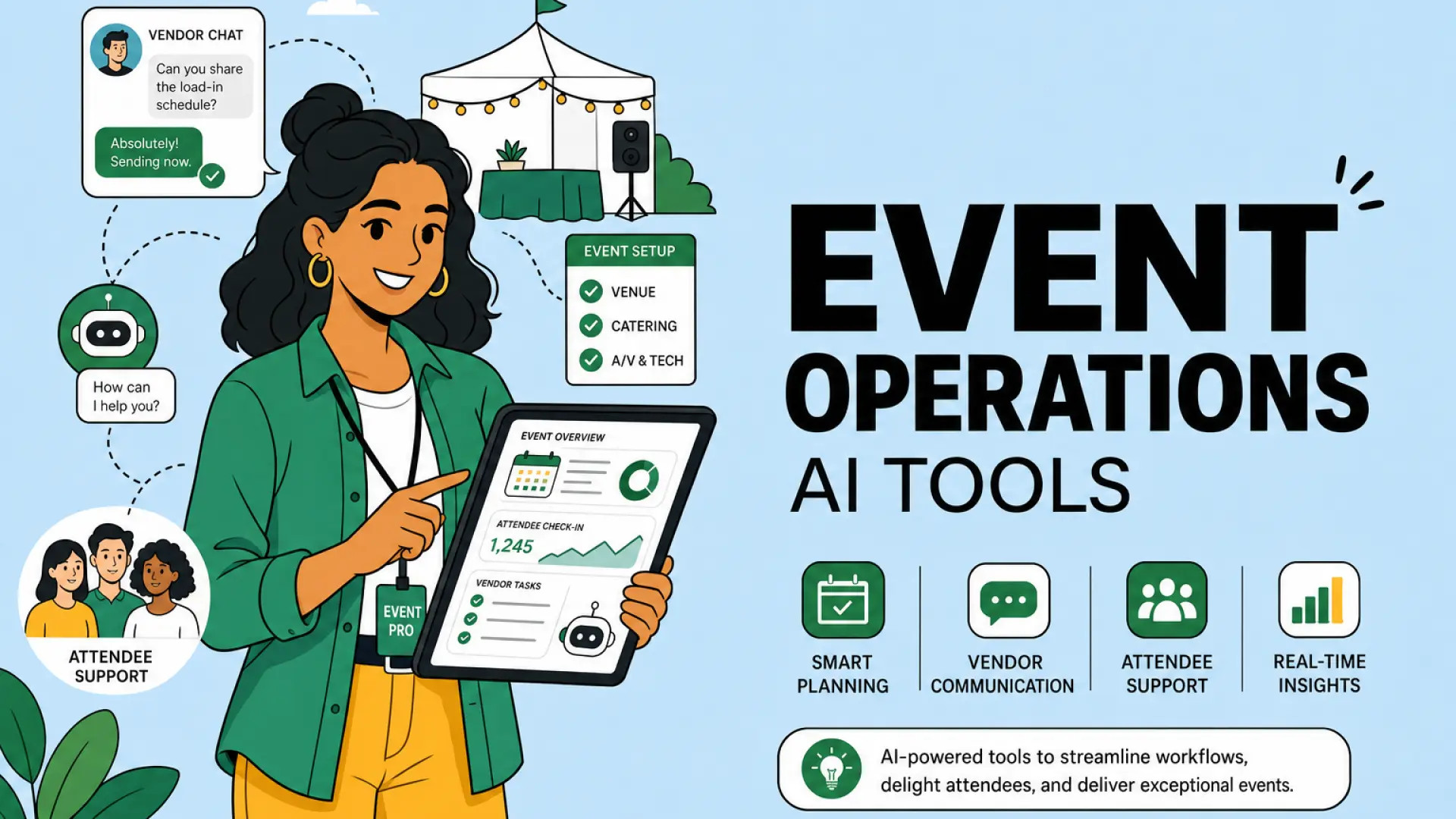
AI event management operations scale run-of-show documents, vendor coordination, and attendee support across conferences, festivals, and corporate activations. Live events fail loudly: a wrong session time in the app or a robotic crisis tweet damages brand trust in minutes.
This guide maps timeline coordination, FAQ bots with escalation, post-event survey analysis, and crisis playbooks. Review AI research tools for sponsor intelligence and AI video tools for highlight reels after your legal team clears likeness rights.
Timeline and Vendor Coordination
AI consolidates vendor contracts, load-in schedules, and technical riders into a master run-of-show, but producers validate every cue against venue realities and labor rules. Models miss freight elevator bookings, union call times, and weather contingencies unless you feed structured inputs.
| Run-of-show element | AI assist | Producer verification |
|---|---|---|
| Session schedule grid | Draft from CMS export | Confirm speaker availability and A/V needs |
| Catering and staffing counts | Forecast from registration trends | Apply walk-in buffer; confirm dietary flags |
| Vendor contact trees | Extract from contract PDFs | Call primary cell before show day |
| Technical cue sheets | Format from show caller notes | Stage manager walkthrough required |
| Contingency time blocks | Suggest based on past events | Adjust for venue-specific constraints |
Event planning AI operations improve when integrated with your registration platform API. Manual spreadsheet uploads introduce stale capacity numbers that confuse both staff and attendees.
Attendee FAQ Bots With Escalation
FAQ bots answer parking, Wi-Fi, and session location questions at scale, but billing disputes, accessibility emergencies, and VIP requests route to humans within defined SLA windows. Disclose bot identity at conversation start per emerging consumer protection expectations.
- Ground answers in a curated knowledge base updated hourly on show days.
- Provide one-tap escalation to live staff with event context attached.
- Disable speculative answers when confidence falls below threshold.
- Log conversations for post-event FAQ improvements, not for unrelated marketing.
- Support multilingual prompts where your audience requires it, with human backup.
Post-Event Survey Analysis
AI clusters open-ended survey responses into themes, sentiment trends, and sponsor ROI talking points faster than manual coding. Executive summaries still need an ops lead who attended the event to catch sarcasm, inside jokes, and complaints about issues staff already knew.
- Export raw responses before anonymization rules strip booth identifiers you need for B2B events.
- Segment analysis by ticket type, track, and first-time versus returning attendee.
- Cross-reference negative themes with operational logs (queue times, app outages).
- Share vendor-specific feedback only through contractual dispute channels when required.
Crisis Communication Playbooks
Pre-written crisis templates for weather delays, medical incidents, and security threats save minutes when AI personalizes placeholders, but only designated spokespeople publish external statements. Never auto-post AI crisis copy to social channels without human approval.
Build playbooks for: evacuation announcements, session cancellations, speaker no-shows, data breach at registration vendor, and infectious disease protocols. Tabletop each playbook annually. AI fills venue name, time, and hotline numbers; legal reviews the master templates quarterly.
Vendor Contract and Rider Parsing
AI extracts load-in windows, insurance minimums, and cancellation clauses from vendor contracts into your master timeline, but legal reviews force majeure and indemnity language before sign. Missing a union jurisdiction clause in a venue contract can halt build overnight.
Registration Platform Synchronization
Real-time sync between registration CRM and AI knowledge bases prevents bots from telling attendees a session moved when the app still shows the old room. On show days, update the knowledge base hourly from the registration API. Assign one ops lead as the single source of truth for schedule changes.
| Event phase | AI ops focus | Human escalation trigger |
|---|---|---|
| Pre-event (90 days) | Vendor timeline drafts | Contract disputes |
| Pre-event (30 days) | Attendee FAQ seeding | Refund policy questions |
| Show days | Real-time FAQ bot | Medical, security, VIP issues |
| Post-event (14 days) | Survey theme analysis | Legal complaints in open text |
Hybrid Stream and In-Room Coordination
Hybrid events need synchronized cue sheets for stage manager, virtual producer, and stream engineer. AI drafts the combined run-of-show, but a live rehearsal validates latency offsets between in-room applause and stream audio. Bot answers about virtual links must match the stream platform status page.
Crisis Communications Escalation Tree
Pre-assign spokesperson, legal contact, and venue security lead in a crisis tree AI can populate with event-specific phone numbers. During incidents, AI drafts holding statements; only the designated spokesperson publishes. Social listening alerts feed the crisis channel but do not auto-respond.
Attendee Support SLA Design
Define bot response time targets and human escalation SLAs by ticket tier: general attendee, speaker, sponsor, and VIP. VIP paths bypass bots after authentication. Measure deflection rate and accuracy weekly during multi-day events. Wrong room assignments spike support volume faster than any other bot error.
Post-Event Analytics for Stakeholders
AI synthesizes survey themes into executive summaries for sponsors, speakers, and internal retrospectives with different emphasis per audience. Sponsors care about lead quality; operations cares about queue times. Sanitize open text before sharing externally to remove personal complaints naming staff.
VIP and Speaker Operations
VIP itineraries, green room schedules, and speaker travel updates flow through concierge staff with CRM-backed AI briefings, not public FAQ bots. Speakers receive human contacts for A/V failures five minutes before keynote. AI preps the concierge with bios and session links only.
Hybrid Event Technical Rehearsal
Schedule a full hybrid rehearsal seventy-two hours before doors open: in-room audio, stream latency, caption delay, and backup internet. AI-generated run-of-show scripts include stream-specific cues producers verify live. Attendee bots should not go live until rehearsal completes.
Sponsor Deliverable Tracking
AI extracts sponsor contract deliverables into a master checklist: logo placement, speaking slots, lead retrieval, and hospitality commitments. Account managers sign off before show open. Missed deliverables trigger makegoods documented in the post-event report.
Labor and Union Coordination
Verify AI-suggested load-in schedules against union jurisdiction and call time rules before sharing with venues. A technically optimal timeline that violates local labor agreements stops construction cold.
Run-of-Show Template Library
Build template libraries by event type: gala, trade show, hybrid conference, festival. AI customizes templates from registration data and venue specs. Producers inherit proven cue structures instead of starting blank. Update templates after each event retrospective.
Accessibility in Event Operations
AI helps draft accessibility FAQs covering ASL interpretation schedules, wheelchair routes, and sensory-friendly spaces. Accessibility coordinators verify every claim against venue surveys. Captioning for general sessions needs human QC before promoting on the website.
Weather and Contingency Planning
AI drafts contingency timelines for outdoor events using historical weather and venue backup plans. Decision trees specify who calls hold, delay, or cancel. Communicate changes through multiple channels when bots may be overwhelmed.
Vendor Scorecard and Post-Event Review
Post-event vendor scorecards combine survey data, on-time delivery logs, and incident reports; AI summarizes themes for procurement. Share constructive feedback with vendors under contract terms. Blacklist repeat failures from AI-suggested vendor shortlists.
Event Operations AI Roadmap
Pilot FAQ bots on a single-track conference before multi-venue festivals; measure accuracy and escalation rate per thousand attendees. Expand to run-of-show AI only after knowledge base sync proves reliable. Crisis playbooks stay human-approved regardless of automation maturity.
Multi-Year Event Series Operations
Recurring conferences benefit from AI that compares year-over-year survey themes, sponsor retention, and operational incidents to improve each edition. Producers inherit institutional memory instead of reinventing runbooks. Archive run-of-show and incident logs in searchable knowledge base.
Contract renewals with venues and AV vendors reference past performance data AI summarizes for procurement negotiations.
Staff Communication Channel Design
Show-day staff use dedicated Slack or Teams channels with AI summarization of long threads for shift handoffs. Critical safety messages bypass summarization and require read receipts from leads. Do not rely on bots for emergency evacuation instructions.
Exhibitor Operations and Floor Plan Coordination
Trade shows use AI to answer exhibitor questions about move-in windows, drayage, and power orders from the exhibitor manual. Complex booth builds escalate to show management. Floor plan changes propagate to all channels within fifteen minutes to prevent freight delivered to wrong halls.
Speaker Management Workflow
Speaker coordinators use AI to draft briefing emails, AV requirement summaries, and session intro scripts from speaker questionnaires. Speakers approve bios and headshots before publication. Last-minute slide uploads need virus scan and format check independent of AI.
Event insurance carriers increasingly ask about crisis communication and data security practices including AI vendors; maintain certificates of insurance and AI subprocessors list for rider renewals. Failure to disclose AI processing attendee PII may void coverage after an incident.
Security Operations at Large-Scale Events
Major festivals coordinate with local law enforcement and private security; AI drafts incident communication templates integrated into unified command structure. Security leads approve all external messaging during incidents. Credentialing systems sync with AI attendee support to deny social engineering attempts at will-call.
Counter-terrorism and crowd crush prevention protocols override AI suggestions when density sensors or security staff raise alarms. Run tabletop exercises with AI-generated scenarios reviewed by certified crowd managers.
Post-Pandemic Hybrid Event Operational Norms
Hybrid events permanently split staffing between physical and virtual producer roles; AI coordinates handoffs but cannot replace redundant communication paths when streaming platforms fail. Backup audio dial-in for speakers prevents total session loss. Attendee bots should surface known streaming issues proactively from status integrations.
Volunteer Coordinator AI Support
Large events depend on volunteers; AI drafts shift assignments and briefing emails from skill surveys but volunteer managers confirm background check status before assignments. Volunteers receive human contacts for no-shows and emergencies. AI scheduling must respect labor law distinctions between volunteers and paid staff.
Post-event retrospectives include AI accuracy scorecards alongside financial reconciliation so leadership sees operational quality, not only P and L outcomes. Repeat events apply lessons to template libraries before the next sales cycle opens.
Sponsor fulfillment reports generated by AI after events should match contract deliverable checklists line by line before accounts receivable invoices sponsor retainers. Billing disputes damage multi-year sponsorship renewals more than single event margin loss.
Load-in traffic management plans benefit from AI simulations using historical gate entry data, but police and fire marshals approve final traffic control plans. Municipal permits override model-optimized flow that violates local road closure rules.
Multi-city event tours maintain master templates with city-specific annexes AI generates from venue contracts and local permit requirements. Tour managers audit annex accuracy before each leg opens registration to prevent repeating prior city mistakes.
Certificate of insurance collection from vendors indexes in AI systems with expiry alerts sixty days ahead of event dates. Uncovered vendors do not load in until certificates validate against event liability minimums stated in master service agreements.
Post-event vendor payment release checklists cross-reference AI-generated fulfillment reports against signed delivery receipts before accounts payable releases final retainers. Disputed line items escalate to show producers before payment disputes damage vendor relationships for next year bookings.
Frequently Asked Questions
How does AI support hybrid event operations?
Hybrid events need synchronized run-of-show for in-room and streaming cues, plus bots that distinguish virtual versus on-site logistics. AI can flag when virtual session links disagree with the master schedule. Assign a dedicated virtual producer who validates bot answers about stream quality issues.
Should VIP attendees use the same FAQ bot?
VIPs receive white-glove escalation paths, not generic bot loops. Route recognized VIP registrants to named concierge staff based on CRM tags. AI may brief concierges on preferences but should not auto-respond as if VIP and general attendees share the same service tier.
What attendee data can event AI process?
Process registration data only under your privacy policy and applicable GDPR or state laws. Do not feed attendee lists into consumer AI for sponsor prospecting without consent. Delete bot logs per retention schedule after disputes window closes.
How do you measure AI ROI in event ops?
Track support ticket deflection, average response time, producer hours saved on run-of-show updates, and attendee satisfaction on info accuracy. ROI collapses if bots give wrong room numbers; measure error rate alongside volume metrics.