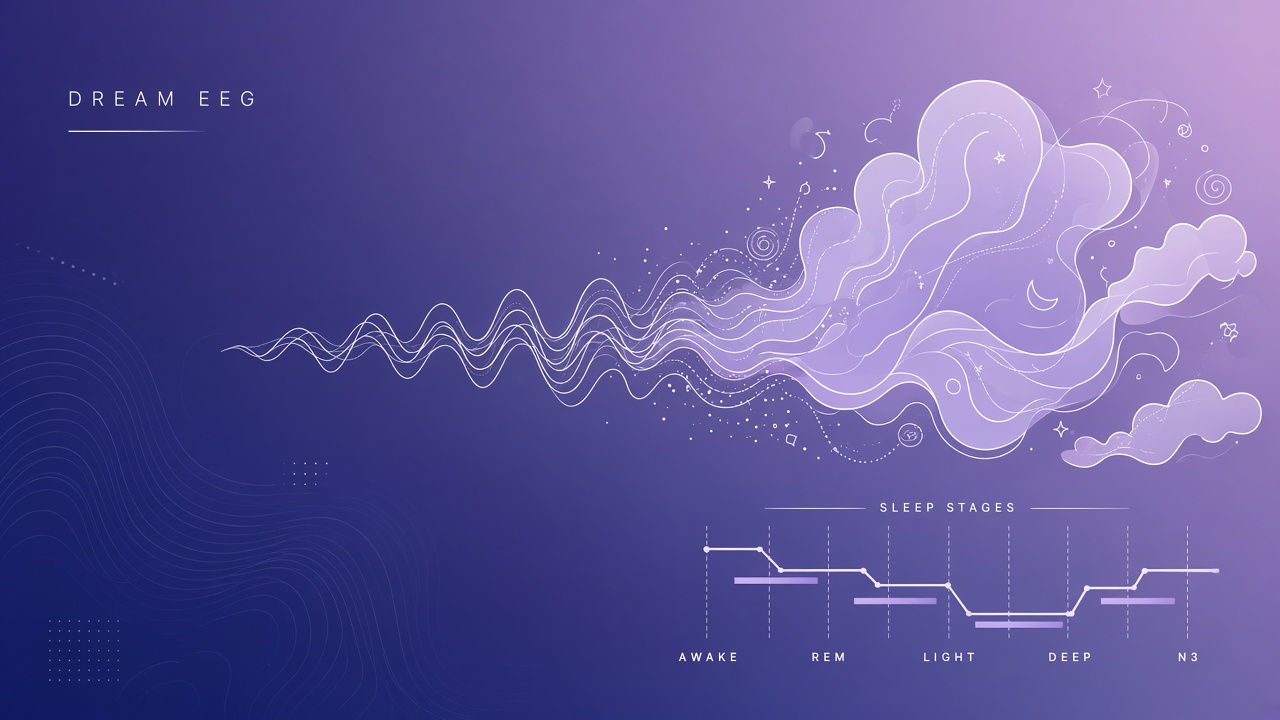
Headlines ask whether artificial intelligence can replay your dreams like a Netflix stream. The research reality is narrower and, in some ways, more interesting. AI dream decoding EEG studies use machine learning to detect whether someone was likely dreaming, classify broad emotional tone, or match coarse object categories from brain activity recorded during sleep. The landmark Horikawa, Tamaki, Miyawaki, and Kamitani work in Science (2013) decoded hypnagogic visual imagery categories from fMRI with EEG-timed awakenings, not from EEG alone. Later EEG-focused papers report promising within-study accuracies for dream versus no-dream classification, while large multi-lab databases show modest cross-dataset performance. This article separates evidence from hype for readers evaluating sleep tech startups, neuroscience tooling, or research coverage on EliteAI.tools.
What AI Dream Decoding Means
AI dream decoding means training statistical or deep learning models to predict aspects of reported dream experience from neurophysiological recordings collected during sleep, using verbal reports, structured questionnaires, or category labels as supervision. Dreams are private first-person events. Objective measurement therefore always passes through human description after awakening (or, in rare protocols, limited real-time signaling). Models learn correlations between brain activity patterns and those labels. They do not read prose narratives directly from voltage traces.
Decoding granularity varies by modality and study design. At the coarsest level, classifiers distinguish epochs with any dream report from dreamless sleep. Finer tasks separate positive versus negative emotional tone, or predict object categories such as "face," "building," or "animal" when subjects describe visual content. At the ambitious end, deep image reconstruction methods optimize pixel arrays so that deep neural network features resemble those decoded from fMRI during waking perception or imagery. Those reconstructions look like blurry, category-consistent textures, not faithful home videos of last night's plot.
EEG (electroencephalography) records scalp electrical activity with millisecond resolution but limited spatial precision for deep cortical sources. fMRI captures spatial patterns across visual cortex with seconds-scale latency. Most category-level dream content decoding with rigorous validation has used fMRI; EEG work emphasizes dream presence, stage correlates, and emotion. Conflating the two modalities when reading press releases leads to overbelief in consumer headband products.
The AI Pipeline for Dream Decoding
A dream decoding pipeline collects sleep neuroimaging, aligns it with awakening reports, engineers features or trains end-to-end models, and evaluates on held-out nights or subjects with strict leakage controls. Sleep labs add complexity: artifacts from movement, muscle tone, and electrode drift dominate naive pipelines.
Acquisition and Sleep Staging
Researchers record EEG (and sometimes fMRI or MEG) while subjects sleep, stage epochs into wake, NREM, and REM using standard criteria, and trigger awakenings or post-hoc windows linked to dream reports. Horikawa et al. focused on sleep-onset (hypnagogic) periods in stages 1 and 2 because repeated awakenings yield many labeled samples. EEG signatures helped time when to wake participants for reports. Each awakening produced a verbal description later mapped to object categories via lexical databases (WordNet-style synsets). That labeling step is part of the model interface: change the taxonomy, change what "decoding" means.
Feature Engineering and Classifiers
Classical pipelines extract band-power spectral density, time-frequency features, or connectivity metrics, then feed gradient boosting, random forests, or support vector machines; newer studies apply convolutional networks on raw or decomposed signals. A 2024 ESANN study on high-density NREM EEG used multivariate empirical mode decomposition plus power spectral density features with XGBoost, reporting about 0.915 accuracy distinguishing dream experience from no experience within their dataset. A companion ESANN paper with K-nearest neighbors after PCA and common spatial pattern filtering reported about 0.94 accuracy on 58 channels, with similar performance on reduced 10-channel subsets in that study's conditions. These figures describe within-cohort benchmarks, not universal headband performance.
fMRI Category Decoders and DNN Features
Horikawa et al. trained linear support vector machines on fMRI responses to awake viewing of web images per category, then applied those decoders to pre-awakening fMRI patterns to predict reported dream categories. Follow-on work decoded hierarchical features from deep neural network layers associated with dreamed objects, showing above-chance category matching using mid- to high-level DNN representations (Frontiers in Computational Neuroscience, 2017). Shen, Horikawa, and Kamitani's deep image reconstruction combined multi-layer DNN feature decoding from fMRI with generative optimization to produce still images resembling viewed or imagined natural scenes. That reconstruction pipeline was validated on waking perception and imagery paradigms; translating it to unreported overnight dreams without awakening remains an open engineering and ethical problem.
Encoding Models on EEG
Encoding approaches predict EEG from visual stimulus features (or vice versa) and test whether dream-period EEG shares representational geometry with waking visual responses. Open research code such as the dream-viewer project trains encoding models on THINGS EEG datasets and evaluates spatial correlation on the Zhang and Wamsley dream EEG corpus. Results are exploratory: correlation scores vary by sleep stage and feature selection, illustrating feasibility more than a product-ready decoder.
| Modality | Typical decoded target | Representative evidence | Practical limit |
|---|---|---|---|
| fMRI + EEG-timed awakenings | Object categories in hypnagogic imagery | Horikawa et al., Science 2013 | Scanner cost, few subjects, staged sleep |
| fMRI + DNN features | Hierarchical visual features, blurry reconstructions | Shen et al., PLOS Comp Biol 2019; Frontiers 2017 | Not real-time; waking/imagery stronger than REM dreams |
| Low-channel EEG (REM) | Dream vs no dream; emotion valence | Moctezuma et al., MetroXRAINE 2023 (up to ~0.85 / ~0.64 acc.) | Subject-specific training; coarse labels |
| High-density EEG (NREM) | Dream experience vs none | ESANN 2024 studies (~0.915 to 0.94 within cohort) | Generalization untested at consumer scale |
| Multi-lab EEG database | Experience vs no experience | DREAM database, Nat Commun 2025 (AUC ~0.59 NREM, ~0.70 REM) | Modest cross-dataset discrimination |
Real Deployments and Evidence
Dream decoding remains a laboratory paradigm, not a deployed clinical or consumer service with regulatory clearance. Evidence clusters in university sleep centers and neuroimaging groups at institutions such as ATR (where Kamitani's team published foundational work) and international collaborators contributing to shared EEG corpora.
The Horikawa Science study remains the most cited demonstration that visual cortical activity patterns during early sleep can predict coarse category labels later described upon awakening. Three participants, hundreds of awakenings each, linear decoders trained on awake viewing: the design is intensive, not scalable to nightly home use. It established proof of concept that dream content shares representational structure with perception, not that dreams are legible sentences in BOLD signal.
EEG emotion work by Moctezuma and colleagues (2023) collected REM sleep EEG from 38 subjects with six channels, using wavelet features and models including gradient boosting and convolutional networks. They reported up to about 0.85 accuracy distinguishing dream-containing sleep from dreamless sleep, and roughly 0.64 to 0.66 accuracy on positive versus negative emotional content in subject-independent setups. Channel selection reduced hardware to two or three electrodes in some configurations within that study. Again, labels came from post-awakening reports, and performance aggregates hide night-to-night variance.
The 2025 DREAM database release in Nature Communications aggregates 20 datasets, 505 participants, and 2,643 awakenings with standardized report classifications. Multi-lab analyses found statistically significant but modest discrimination between experience and no experience (average AUC about 0.586 for NREM using power spectral features, about 0.700 for REM using nonlinear catch22 features). That resource is the sobering counterweight to single-lab accuracies above 0.9: pooling heterogeneous protocols shrinks effect sizes. For the field, the database enables reproducible benchmarks; for product marketers, it warns against quoting peak lab numbers as universal headband specs.
No peer-reviewed system reconstructs arbitrary narrative dream plots from EEG in real time without awakening. Research repositories and student projects explore encoding-model correlations on public dream EEG sets; these are hypothesis generators for cognitive neuroscience, not FDA-reviewed diagnostics for nightmare disorder or PTSD.
Limits, Risks, and Ethics
Report bias dominates: models decode brain activity paired with what subjects remember and choose to say after waking, not a complete dream archive. Sleep inertia, social desirability, and interview structure skew labels. Category mapping from free text to WordNet synsets discards idiosyncratic detail. Claiming "the AI saw your dream" overstates a correlation with a coarse label bucket minutes later.
Generalization is fragile. Subject-specific fMRI decoders excel within trained individuals but degrade across people because functional anatomy varies. EEG classifiers trained on high-density caps may fail on consumer two-channel forehead sensors without recalibration. The gap between within-study accuracy (0.9+) and multi-lab AUC (0.6 to 0.7) is the number investors and journalists should weight most heavily.
Privacy and mental integrity raise stakes beyond typical AI chatbot logging concerns. Dream content can include trauma, sexuality, and involuntary imagery. Pipelines that store raw EEG plus reports create sensitive datasets. Covert dream decoding without consent is not viable in reputable research today but belongs in policy conversations if wearable EEG becomes ubiquitous. Insurance or employment inference from inferred mental states would be ethically and legally fraught in most jurisdictions.
Clinical claims require caution. Nightmare disorder and PTSD-related sleep disturbance are real targets for future closed-loop stimulation research, but current decoding performance does not justify automated intervention without human oversight. False positives (labeling a dream when none was reported) and false negatives carry different harms in therapeutic contexts.
Who Should Pursue Dream Decoding AI Now vs Wait
Sleep neuroscience labs with polysomnography infrastructure, IRB-approved awakening protocols, and ML collaborators should pursue EEG and fMRI decoding now; consumer wellness startups and mental-health apps without clinical validation should wait. If you can contribute data to communal benchmarks like the DREAM database and publish methods, you advance the field. If you plan to sell "dream replay" features on a phone app, current science does not support that UX honestly.
BCI researchers exploring closed-loop sleep studies may prototype dream-presence detectors as triggers for targeted memory reactivation experiments under ethics review. Psychiatrists should treat decoding metrics as research endpoints, not diagnostic criteria. Journalists and educators should cite Horikawa for category-level fMRI results, Moctezuma and ESANN 2024 papers for within-lab EEG classification, and DREAM database analyses for cross-lab realism.
Hardware vendors should publish channel layouts, sampling rates, and out-of-sample validation on independent cohorts before comparing themselves to academic peaks. Teams without sleep-scoring expertise should partner with accredited sleep centers rather than training on unlabeled overnight streams scraped from wearables.
Frequently Asked Questions
Can AI read my dreams from a consumer EEG headband?
Not in the detailed sense implied by marketing. Research systems at best classify coarse states (dream vs no dream, broad emotion) under lab conditions with post-awakening labels. Narrative or visual replay is not supported by current peer-reviewed EEG evidence.
What did the Horikawa Science 2013 study actually show?
It showed that fMRI patterns in visual cortex before timed awakenings could predict object categories subjects later reported from hypnagogic imagery, using decoders trained on awake image viewing. EEG was used to time awakenings; decoding used fMRI.
Is EEG or fMRI better for dream decoding?
fMRI offers spatial resolution for category-level visual decoding; EEG offers temporal resolution and portability for presence/emotion classifiers. Neither modality delivers full content transcripts today.
Why do studies report 0.9 accuracy while the DREAM database shows ~0.6 AUC?
Single-lab studies optimize within cohorts; multi-lab databases include protocol heterogeneity that lowers aggregate performance. Both numbers are real; scope matters when evaluating products.
Does deep image reconstruction play back dreams?
Reconstruction methods generate blurry images aligned with decoded DNN features from fMRI during waking perception and controlled imagery paradigms. Direct overnight dream reconstruction without awakening remains unvalidated.
Are REM or NREM dreams easier to decode?
REM dreams are often more vivid and frequent; NREM hypnagogic imagery featured in Horikawa work; recent EEG papers target both stages with different feature sets. DREAM database analyses suggest REM experience may be slightly more discriminable than NREM in pooled EEG features.
Can dream decoding treat nightmares clinically?
Not yet as an approved therapy. Research may eventually pair detectors with stimulation or sound cues, but clinical trials require evidence beyond offline classification accuracy. Consult licensed clinicians for nightmare disorder treatment today.
Which open datasets exist for dream EEG research?
The DREAM database (2025) aggregates multi-lab EEG/MEG with standardized report codes; Zhang and Wamsley datasets appear in encoding-model projects such as dream-viewer on GitHub. Always check license terms and citation requirements.
Conclusion
AI can relate measurable brain activity to coarse aspects of reported dream experience, especially when fMRI spatial patterns meet careful awakening protocols (Horikawa et al.) and when EEG classifiers target presence or emotion within studied cohorts. AI dream decoding EEG research does not yet deliver cinematic dream playback from a bedside sensor. The DREAM database's multi-lab benchmarks temper single-study peaks and chart a path toward reproducible science. Treat consumer claims skeptically, cite modality limits honestly, and separate laboratory category decoding from products promising nightly dream journals generated from voltage alone. For more grounded coverage of machine learning in specialized domains, browse the EliteAI.tools blog and related tags on research tooling and responsible deployment.