GPT-6 Astra's September 2026 launch was never a single flip switch. OpenAI seeded the model to Daybreak cybersecurity partners first, expanded to ChatGPT Plus through Enterprise over several days, and left API defaults unchanged until platform teams completed eval gates. Enterprise buyers who assumed "generally available" meant "on for every seat" discovered Astra disabled until an administrator toggled model access.
GPT-6 Astra enterprise rollout spans ChatGPT Work, Codex, the OpenAI API, Microsoft Foundry, and AWS Bedrock with different SLA packaging per channel. This timeline maps access waves, support tier changes, data residency options, benchmarking steps before cutover, and rollback planning. Coordinate with AI chatbot deployments and AI code assistants that will inherit new model defaults.
Enterprise Access Waves for GPT-6 Astra
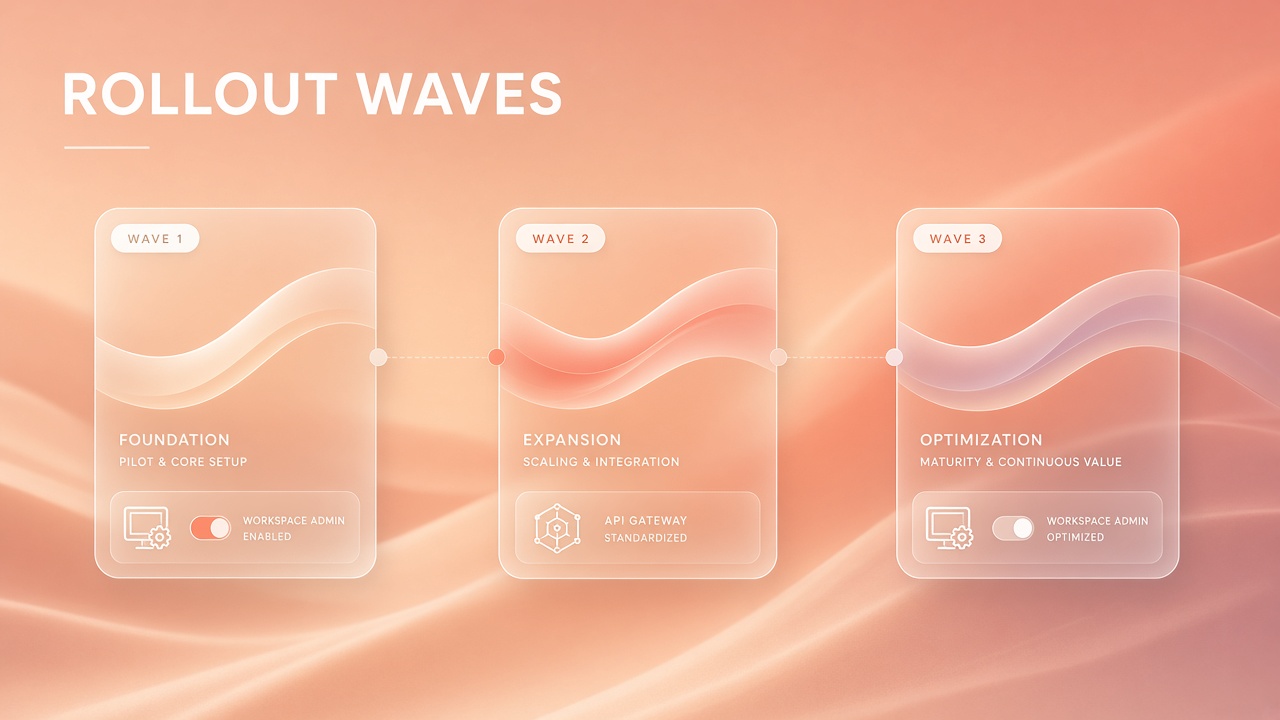
OpenAI shipped GPT-6 Astra in three broad waves: Daybreak trusted-access organizations on September 3, paid ChatGPT tiers through September 5, and full API plus cloud marketplace availability once regional certification completed. Enterprise ChatGPT workspaces require an administrator to enable Astra under model access settings before end users see the model picker. Access is off by default at launch to give security teams time to review Critical cyber capability disclosures under the Preparedness Framework.
| Wave | Audience | Access notes |
|---|---|---|
| Wave 1 (Sep 3) | Daybreak / trusted cyber orgs | Limited preview cohort |
| Wave 2 (Sep 4-5) | Plus, Pro, Business, Enterprise ChatGPT | Admin enable required on Enterprise |
| Wave 3 (ongoing) | API, Azure Foundry, AWS Bedrock | Regional SKU rollout varies |
| Astra Pro variant | Pro, Business, Enterprise plans | Higher capability tier within subscription |
Admin Controls and Seat Rollout
Enterprise administrators can restrict Astra to approved websites, desktop applications, uploads, downloads, and browsing history through new ChatGPT Work and Codex controls announced alongside the work-focused launch blog. Confirmation policies can require human approval before consequential tool calls. Teams often pilot Astra on security-reviewed cohorts before enabling company-wide, even after the model appears in the admin console.
SLA and Support Changes for Astra Tenants
ChatGPT Enterprise and API customers inherit existing agreement SLAs for uptime, but Astra's Critical cyber classification triggers additional deployment review for regulated API buyers and may affect support escalation paths for security incidents. Microsoft Foundry offers Standard pay-as-you-go and Provisioned Throughput deployments with dedicated capacity for latency-sensitive workloads. Azure documents Global and US Data Zone geographies with Entra identity, private networking, and content filtering layered on top of model-level safety evals.
| Channel | SKU / identifier | Enterprise SLA notes |
|---|---|---|
| OpenAI API | gpt-6-astra |
ZDR eligible; $10/M input, $50/M output |
| ChatGPT Enterprise | GPT-6 Astra / Astra Pro | Included in plan; credits for overage |
| Microsoft Foundry | Standard / Provisioned Throughput | Dedicated capacity option for latency |
| AWS Bedrock | Partner listing | Follows AWS enterprise support tier |
Support Escalation and Incident Handling
Teams should update runbooks to include Astra-specific logging for computer use and browsing tool calls, because support tickets now involve action traces rather than text-only transcripts. Escalate policy blocks separately from infrastructure outages; refusals may reflect Preparedness controls rather than platform downtime.
Data Residency Options for Astra
Eligible OpenAI API customers can use Zero Data Retention for Astra workloads; Azure Foundry exposes Global and US Data Zone deployments; AWS Bedrock follows regional model hosting policies negotiated in enterprise agreements. Multi-cloud buyers must verify which geography hosts inference for each SKU before migrating regulated data. ChatGPT Enterprise retains conversation data according to workspace retention settings unless ZDR API paths are used for programmatic integrations.
Data residency decisions should precede wide rollout. Retrofitting EU-only processing after thousands of users adopt Astra in ChatGPT creates expensive re-architecture. Map data flows for Codex sessions, which may touch repositories and CI systems outside traditional chat logs.
Benchmarking Before Astra Cutover
Run production-shaped evals on Astra covering reasoning depth, computer use reliability, coding tasks, and refusal behavior before changing default model routes. OpenAI reported substantial gains over GPT-5 on professional work, software engineering, cybersecurity benchmarks, and scientific synthesis, but your prompts may behave differently. Token pricing above 272K input tokens carries surcharges documented in API pricing pages; forecast spend with real context lengths, not marketing averages.
- Export golden prompts from support, sales engineering, and developer workflows.
- Score outputs for accuracy, latency, cost, and policy refusals against GPT-5 baselines.
- Pilot Astra Pro only where higher capability justifies slower latency or higher price.
- Validate Codex-specific sessions if engineering teams depend on long-running agent tasks.
- Document sign-off from security for Critical cyber capability exposure.
Rollback Planning for Astra Migrations
Keep GPT-5.6 or prior approved models routable behind feature flags for at least one quarter after Astra becomes the default, because eval gaps surface only under peak load or edge-case prompts. Rollback steps should include reverting admin toggles in ChatGPT, switching API routing config, and notifying users that transient quality differences are expected during fallback.
Contractually, note that OpenAI will deprecate older snapshots on published timelines. Rollback is a bridge, not a permanent strategy. Maintain migration budget for December 2026 GPT-5 era shutdowns while Astra stabilizes.
Frequently Asked Questions
Why is Astra off by default in Enterprise ChatGPT?
OpenAI disabled Enterprise access at launch so administrators could review Critical cyber capability disclosures and configure browsing or computer use restrictions before general availability. End users see nothing until an admin enables the model.
What is the difference between Astra and Astra Pro?
Astra Pro is a higher-capability variant available on Pro, Business, and Enterprise ChatGPT plans, while standard Astra serves Plus and shared API traffic. API customers should confirm SKU mapping with account teams before capacity planning.
When is Astra available on Azure Foundry?
Microsoft announced general availability in Foundry on September 3, 2026 with Standard and Provisioned Throughput options. Confirm regional availability in your tenant before promising dates to internal stakeholders.
Can we run Astra and GPT-5 in parallel?
Yes, and you should during migration. Route low-risk traffic to Astra while keeping GPT-5.6 tiers for workflows that fail eval gates until retraining or prompt fixes land.