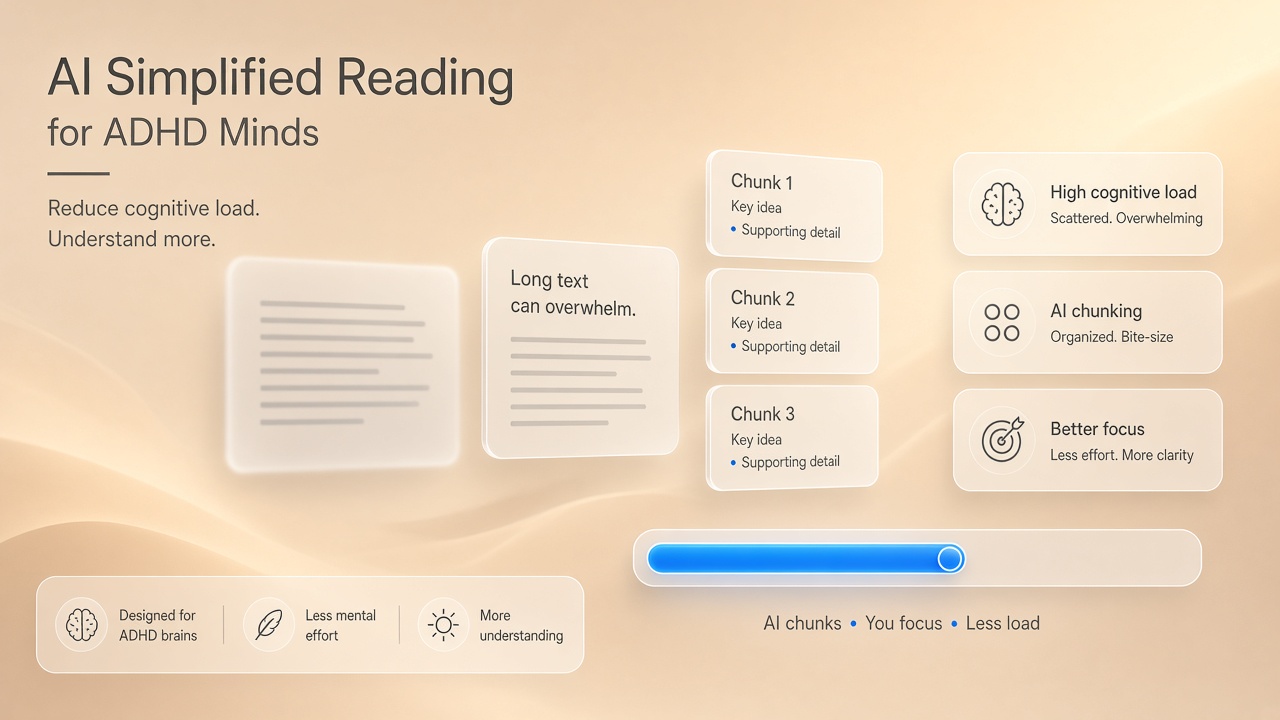
A student with ADHD opens a dense policy PDF. Sentences run six lines, jargon stacks three deep, and the page offers no visual anchors. By paragraph three, working memory is full and motivation collapses. AI simplified reading ADHD tools apply natural language processing to shorten sentences, replace rare words, insert headings, and highlight key phrases so readers can process information in smaller units. The promise aligns with cognitive load theory: reduce extraneous load so limited attention can focus on essential content.
Educators, workplace accessibility teams, and health communicators need realistic expectations. Text simplification is not a clinical treatment for ADHD, and "bionic reading" font tricks remain scientifically contested. Teams deploying AI chatbot tutors should pair simplified output with human oversight for accuracy. More accessibility research explainers appear on the EliteAI.tools blog index.
What AI Simplified Reading ADHD Means in Plain Language
AI simplified reading ADHD refers to software that rewrites or reformats text to lower reading difficulty and cognitive demand for people with attention deficits, learning disabilities, or anyone overwhelmed by complex prose. Techniques include lexical simplification (swap "utilize" for "use"), syntactic shortening (split compound sentences), structural chunking (add bullets and subheadings), readability scoring (Flesch-Kincaid, CEFR levels), and visual emphasis (bold key terms, bionic-style weighting of word stems).
ADHD affects executive function: sustaining attention, inhibiting distractions, and organizing information. Reading difficulty is not intelligence; it is often a mismatch between text design and cognitive resources available on a given day. Medication, sleep, and environment modulate capacity, so simplification tools should offer adjustable levels rather than one permanent "easy mode."
| Cognitive load type | Definition | Simplification target |
|---|---|---|
| Intrinsic load | Complexity inherent to the topic | Cannot remove; teach in stages |
| Extraneous load | Poor layout, unclear wording | Primary AI simplification target |
| Germane load | Effort devoted to learning | Free capacity by cutting extraneous load |
Readability scores and their limits
Flesch-Kincaid, SMOG, and Lexile formulas estimate grade level from word length and sentence length; they correlate weakly with comprehension for neurodivergent readers and ignore concept difficulty. AI systems often optimize these metrics as proxy objectives, which can produce grammatically simple text that still hides confusing logic. Better pipelines combine readability scores with human rubrics for coherence and factual preservation.
How the Underlying AI Pipeline Works
Modern simplification stacks use transformer models fine-tuned on parallel corpora (Wikipedia simple English pairs, Newsela education levels), LLM prompts with level instructions, and post-processing for chunking, glossary insertion, and text-to-speech sync. Retrieval-augmented steps pull definitions for domain terms instead of deleting them blindly.
Text simplification NLP methods
Lexical simplification identifies complex tokens via frequency lists and WordNet hypernyms, then ranks replacements with BERT-based acceptability scorers. Sentence splitting uses dependency parses to break at conjunctions without orphaning pronouns. Document-level models maintain entity consistency so "the regulator" does not become three different plain words in adjacent paragraphs. Open models (T5 fine-tunes, Llama instruct variants) and APIs from major cloud providers compete on multilingual support and tone control.
Chunking and structural reformating
Chunking inserts H2 and H3 headings every 150 to 200 words, converts dense paragraphs to numbered steps, and pulls quotations into callout boxes. AI layout tools for PDF and EPUB detect column width and reflow for mobile reading. Spacing and line height adjustments follow WCAG guidance (1.5 line spacing helps dyslexic and ADHD readers). Progress indicators ("Section 2 of 5") exploit completion motivation common in ADHD behavioral research.
bionic reading and visual emphasis debates
Bionic Reading, a commercial font technique, bolds the first few letters of each word hoping to guide the eye and reduce fixation time. Social media testimonials abound; peer-reviewed evidence remains thin. A 2023 study in Scientific Reports found no significant reading speed gain for dyslexic participants versus standard fonts; some users report subjective ease, others find the pattern distracting. AI products that simulate bionic weighting via CSS should offer toggles and avoid marketing claims of clinical efficacy without trials. Highlighting key terms with conservative bold or color (with non-color backup) is better supported by instructional design research than proprietary letter-weighting schemes.
| Technique | Evidence strength | Risk |
|---|---|---|
| Sentence splitting | Strong in NLP benchmarks | Broken anaphora ("It" unclear) |
| Lexical replacement | Moderate; domain dependent | Changes legal or medical meaning |
| Heading chunking | Strong UX research | Over-fragmentation annoys experts |
| Text-to-speech pairing | Strong for dual coding | Robotic voice fatigue |
| Bionic letter bolding | Weak / mixed | Subjective distraction |
Measuring comprehension outcomes
Product teams should evaluate simplification tools with pre/post comprehension quizzes rather than readability scores alone. A passage at fifth-grade Flesch-Kincaid can still confuse if causal relationships are garbled. NASA-TLX or subjective cognitive load scales administered to ADHD participants after reading tasks reveal whether chunking reduces mental effort without harming recall. A/B tests in learning apps measure time-on-task and completion rates; simplification wins when drop-off falls and quiz scores hold steady. If scores drop, the model likely removed content critical to understanding rather than extraneous prose.
Typical workflow steps
- Assess source material type (news, legal, clinical) and set maximum simplification aggressiveness.
- Run NLP simplification with entity preservation flags for names, doses, and dates.
- Insert structural chunks, summaries, and glossary tooltips for unavoidable jargon.
- Score readability and run automated fact-alignment checks against source sentences.
- Human editor reviews for meaning drift, especially in health and legal text.
- Publish multiple levels (original, simplified, audio) with user-selectable toggles.
Real Deployments and Published Evidence
Education technology platforms (Newsela historically, Microsoft Immersive Reader, Google Reading Mode) ship simplification and read-aloud features used in K-12 and higher education accessibility offices. Immersive Reader combines syllable highlighting, parts-of-speech color (with accessibility caveats), line focus, and translation. Wikipedia's Simple English subset remains a human-curated parallel corpus training many models.
Workplace tools from Adobe, Dropbox, and browser extensions offer "simplify this page" via LLM summarization, which overlaps with but differs from sentence-level simplification. Summaries drop detail; simplification preserves coverage at lower linguistic level. ADHD readers may need both modes: summary for orientation, simplified full text for homework compliance.
Clinical and government health agencies experiment with plain-language AI for patient leaflets. The U.S. CDC plain language initiative predates generative AI but now pilots GPT-assisted drafts reviewed by health literacy specialists. Studies in Journal of Medical Internet Research show simplified discharge instructions reduce callback questions when accuracy is verified; unreviewed model output has introduced wrong dosage units in simulation exercises.
Combining AI with established reading strategies
Occupational therapists teach Pomodoro-style reading sprints, active recall, and margin note-taking for ADHD students. AI simplification complements those strategies by shrinking the unit of attack: a 30-page chapter becomes ten three-page sections each with a one-sentence summary at the top. Text-to-speech with synchronized highlighting (karaoke-style) engages auditory processing while the eye tracks words, reducing mind-wandering for some learners. Speech rate control lets users match narration pace to comprehension speed faster than silent reading for dense material.
University disability services increasingly bundle Immersive Reader, Notion AI rewrite, and human note-taker accommodations in formal plans. Faculty pushback centers on whether simplified texts water down examinable material; compromise formats provide simplified study guides while exams reference original sources. Workplace reasonable accommodation requests for ADHD may include documentation formatting standards (short paragraphs, descriptive link text, no wall-of-bullet slides) that AI tools can enforce in template libraries without rewriting legal meaning.
Open-source NLP datasets for controllable simplification (Newsela-auto, WikiLarge, ASSET, TurkCorpus) let research teams fine-tune smaller models that run on-device in privacy-sensitive environments. On-device inference avoids uploading student essays or patient records to third-party APIs, addressing FERPA and HIPAA concerns while still delivering chunked output. Model size tradeoffs favor distilled transformers under 500 million parameters for laptop deployment in exam proctoring scenarios where cloud calls are blocked.
Parents and adults self-managing ADHD often combine simplified reading apps with calendar blocking and notification batching so reading sessions coincide with peak medication windows. AI tools that integrate with focus timers (Forest, Freedom) can auto-simplify only the article tab active during a Pomodoro, reducing temptation to context-switch across simplified and original versions of the same document open in adjacent tabs. Clinicians caution that tooling should supplement, not replace, skills coaching and treatment plans tailored to each person.
Limits, Risks, and Ethical Guardrails
AI simplification can flatten nuance, erase conditional language in contracts, and infantilize adult readers if tone is patronizing. ADHD users are not a monolith: some prefer graphic novels and video; others read voraciously in niche hobbies. Assuming everyone needs elementary vocabulary is stigmatizing.
- Meaning drift: Replacing "may cause" with "causes" in medical text is dangerous.
- Academic integrity: Students might submit simplified summaries as original analysis.
- Over-reliance: Skipping development of compensatory strategies therapists teach.
- Privacy: Uploading HR policies to cloud simplifiers leaks confidential content.
- Equity: Paid "focus reading" apps widen gap if public schools lack licenses.
Ethical guardrails include human review for high-stakes content, adjustable reading levels, transparent labeling when text is machine simplified, and co-design with ADHD advocacy groups (CHADD, ADHD Europe). WCAG does not mandate simplified language, but WCAG 3.0 draft concepts discuss cognitive accessibility; plain language supports broader inclusion goals.
Who Should Use This and Who Should Wait
School districts, university disability services, internal comms teams with dense policy docs, and health educators should deploy reviewed simplification pipelines with human QA. Legal departments should wait or restrict to layout chunking without lexical changes until counsel approves workflows. Consumers can experiment with browser extensions for personal reading but should verify medical and financial facts against originals.
| Use case | Recommendation | Guardrail |
|---|---|---|
| K-12 supplemental reading | Immersive Reader or vetted edtech | Teacher reviews altered assignments |
| Employee handbook | Chunking plus glossary, legal review | Official version stays canonical |
| Patient education | Clinical editor signs off | No unsupervised dosage changes |
| Personal news reading | Browser simplify extensions OK | Verify quotes against source |
Frequently Asked Questions
Do users need an ADHD diagnosis to benefit?
No. Plain language and chunking help busy adults, ESL readers, and anyone facing high extraneous cognitive load. Marketing should avoid implying medical treatment without clinical evidence.
Does bionic reading help ADHD?
Anecdotal reports exist, but controlled studies do not show consistent reading speed or comprehension gains over standard fonts. Offer as optional styling, not a proven intervention.
How accurate is LLM text simplification?
Accuracy varies by domain; legal and medical passages show higher error rates in independent evaluations. Human review and automated entailment checks against source sentences reduce drift.
What reading level should ADHD content target?
Many public health materials aim for sixth to eighth grade Flesch-Kincaid, but audience testing matters more than a single grade number. Provide sliders for more or less detail.
How is Immersive Reader different from ChatGPT simplify?
Immersive Reader focuses on visual reading aids and TTS without rewriting meaning; LLM simplify alters wording and may omit content. Choose based on whether preservation of exact text is required.
Does WCAG require simplified language?
Current WCAG 2.x does not set reading level requirements; emerging cognitive accessibility guidance encourages plain language as best practice. Sector regulations (health, government) may impose plain-language mandates separately.
How long should text chunks be for ADHD readers?
UX research suggests 150 to 250 words between headings for digital articles, with one idea per paragraph and bullet lists for sequences of three or more items. AI chunking tools should expose slider controls because optimal length varies by topic complexity and reader fatigue on a given day.
Conclusion
AI simplified reading ADHD tools apply cognitive load principles, NLP simplification, readability metrics, chunking, and optional visual emphasis to make text approachable for readers with attention challenges. Text simplification models and platforms like Immersive Reader show real classroom utility when accuracy is guarded; bionic reading hype outpaces evidence. Teams should offer adjustable levels, preserve entities in sensitive domains, and pair automation with human review. Simplification supports access; it does not replace diagnosis, medication, or coaching. Built thoughtfully, it turns inaccessible walls of text into navigable paths that respect adult dignity and factual precision.