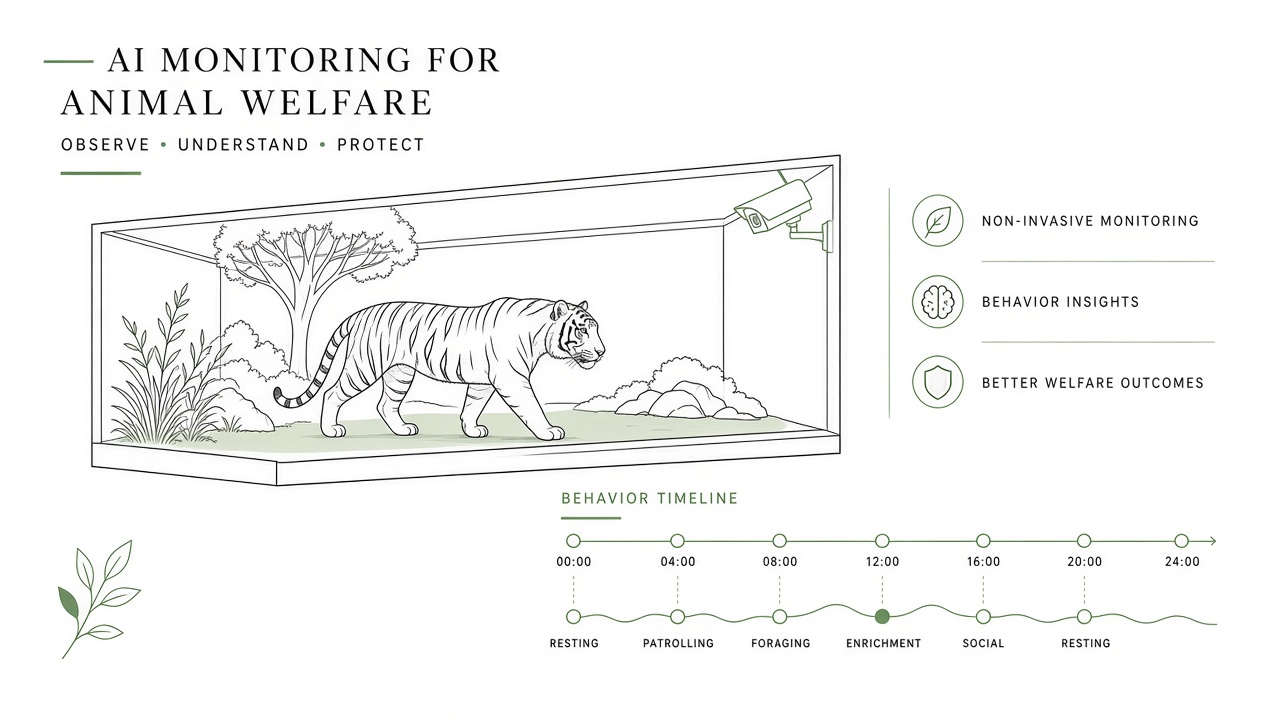
AI zoo animal welfare monitoring applies computer vision and machine learning to enclosure video, automating ethograms that track activity budgets, stereotypical pacing, social interactions, and space use for accreditation audits and daily husbandry decisions. Tools such as PantherAI for tigers and long-term polar bear stereotypy detectors demonstrate mean detection accuracy above 75 percent for key behaviors, though species-specific training and camera placement remain essential. This research explainer covers welfare indicators, video ethogram automation, early stress detection, keeper workflows, and public transparency concerns for teams following AI research in conservation technology and popular AI tools for computer vision deployment.
What AI Zoo Welfare Monitoring Means
AI zoo animal welfare monitoring automates ethograms from enclosure video by detecting species-specific behaviors, stereotypies, and space use patterns that keepers historically logged through manual interval sampling during daylight shifts. The approach does not replace veterinary diagnosis or keeper relationships; it extends observation to overnight hours and produces exportable metrics for accreditation, enrichment trials, and research collaboration when institutions govern footage responsibly.
Welfare Science Indicators Zoos Track
Modern zoo welfare programs combine resource-based measures (enclosure size, diet, veterinary care) with animal-based indicators including activity budgets, stereotypic behavior rates, social grouping quality, and voluntary engagement with enrichment. The Association of Zoos and Aquariums (AZA) accreditation standards expect documented welfare assessment programs. Manual ethograms require trained observers to log behaviors at fixed intervals, a process that is labor-intensive, limited to daylight hours, and vulnerable to observer drift.
Activity budgets compare time spent resting, locomoting, feeding, and interacting with conspecifics against species-appropriate baselines. Stereotypies such as repetitive pacing or head-weaving often signal chronic stress, though context matters: brief pacing before feeding may be normal. Space use heatmaps reveal whether animals access all habitat zones or cluster near gates and public viewing glass.
| Indicator | Manual method | AI-assisted method |
|---|---|---|
| Activity budget | Interval sampling by keeper | 24-hour video classification |
| Stereotypy rate | Event recording during watches | Trajectory pattern detection |
| Social interaction | Ad libitum notes | Multi-animal tracking and proximity |
| Enrichment use | Checklist per session | Object manipulation classifiers |
Video Ethogram Automation
Video ethogram automation detects and classifies behaviors from CCTV or research cameras using object detection, pose estimation, and trajectory analysis pipelines tuned per species. PantherAI applies YOLOv8 to zoo-housed tiger footage, classifying stereotypical pacing, resting, locomotion, feeding, and object manipulation with mean average precision above 75 percent on test data. Stereotypical pacing detection reached 92 percent accuracy in published results, while feeding and manipulation classes remain harder due to occlusion and rare pose variety.
Polar bear frameworks localize individuals with F1 scores around 86 percent, transform camera coordinates to enclosure maps, and classify trajectory patterns as stereotypic or normal with roughly 95 percent accuracy in longitudinal studies spanning hundreds of days. AnimalYOLO-Bytetrack networks track slow lorises to detect small-displacement stereotypies using movement amplitude periodicity, reaching 96.7 percent detection precision in multi-animal enclosures.
Species transfer is limited. A model trained on tigers will not generalize to leopards without new labeled data. Zoos should budget annotation time: expert keepers confirm bounding boxes and behavior labels on sample frames before deployment.
Camera Placement and Species Calibration
Enclosure cameras must cover water sources, shelter entries, feeding stations, and public viewing glass without blind spots that bias activity budgets toward visible zones only. Night-vision or low-light capable sensors extend monitoring past guest hours when many species are most active. Mount height affects identification: overhead views simplify tracking but obscure facial expressions and oral behaviors relevant to primate welfare.
Calibration runs per species and per individual when coat patterns differ. Re-identification models struggle when animals molt, gain weight, or receive veterinary shaving. Plan quarterly recalibration sessions and maintain gold-standard manual samples for drift detection. Institutions publishing AI research should share anonymized benchmark clips to accelerate cross-zoo model improvement while respecting animal privacy policies.
Early Illness and Stress Detection
Sustained deviations from baseline activity budgets can precede visible clinical symptoms, giving veterinary teams earlier intervention windows when AI monitoring flags anomalies automatically. A tiger resting 40 percent more than its 30-day median across multiple habitats warrants a veterinary consult even if guests see no obvious lameness. Sudden increases in stereotypy after exhibit renovation or social group changes document husbandry experiment outcomes objectively.
AI does not diagnose disease. It prioritizes review queues. Keepers remain responsible for physical exams, blood work, and treatment plans. Combine vision alerts with keeper intuition rather than replacing daily walk-throughs.
Keeper Workflow Integration
Successful deployments embed AI summaries into existing husbandry software as daily dashboards, not as parallel surveillance programs that keepers distrust. Morning briefings might show overnight activity budget deltas and stereotypy minutes compared to the prior week. Alerts should link to timestamped video clips so keepers verify context before escalating. PantherAI supports both recorded 24-hour samples and live streams when network infrastructure allows.
Training keepers on false positives reduces alarm fatigue. Rain, construction noise, and breeding season behavior shift baselines; models need seasonal recalibration. Document who can access raw video and how long footage is retained to align with institutional privacy policies.
Accreditation and Audit Documentation
AZA and equivalent regional bodies expect measurable welfare outcomes; AI ethograms produce exportable CSV timelines that auditors can sample against keeper logs. Document model version, training date, and known failure modes in accreditation packets. When stereotypy rates drop after enrichment changes, attach vision-derived charts to internal husbandry committee minutes. Auditors may ask whether staff relied solely on algorithms; show paired human verification samples.
Safari parks and drive-through exhibits face additional vehicle glare and guest feeding interference in footage. Filter events where cars stop in camera view to avoid misclassifying animal approach-to-glass as abnormal pacing. Aquarium penguin and sea otter exhibits need waterproof housings and anti-condensation heating; salt spray degrades lenses on quarterly maintenance cycles.
Public Transparency Concerns
Guests and advocacy groups question whether continuous enclosure monitoring serves animals or institutional liability management; zoos should publish welfare goals, third-party audit relationships, and how vision data influences enrichment budgets. Surveillance framing erodes trust. Welfare framing emphasizes that cameras replace impossible 24-hour human watches, extending care rather than punishing keepers. Avoid using behavioral scores in marketing without explaining scientific limits.
Data governance should restrict vendor cloud uploads of identifiable animal medical histories. On-premise inference respects air-gapped research agreements at some institutions. When sharing aggregated heatmaps publicly, anonymize individual animals and explain that AI estimates include measurement error.
Research Collaboration and Data Sharing
Universities and zoos increasingly co-develop models with shared annotation protocols, but data use agreements must specify whether footage can train commercial products. Open-source releases like PantherAI on GitHub accelerate replication while requiring each institution to collect local training labels. Funders want reproducible welfare metrics across sites; standardize behavior ethogram definitions before merging datasets from different camera angles and frame rates.
Elephant welfare programs track foot health, social bonding, and musth-related aggression patterns that vision alone cannot fully capture. Combine AI ethograms with thermal imaging pilots for joint inflammation and keeper-led body condition scoring. Aquarium mammals present different challenges: porpoise burst swimming in circular tanks creates motion blur; adjust shutter speed and frame sampling before training detectors. Reptile exhibits with cryptic species may need longer observation windows because activity bursts are brief and easily missed by interval sampling.
Union and staff consultation matters when cameras feel like performance monitoring of keepers rather than care of animals. Frame deployments as reducing midnight observation shifts and document how alerts reduce emergency callouts. Ethics committees at universities partnering with zoos should review whether publication incentives bias institutions toward surveillance narratives over enrichment funding.
Longitudinal stereotypy studies on polar bears demonstrate seasonal variation that single-week manual samples would miss. Automated trajectory classifiers processed hundreds of days, revealing patterns keepers could correlate with temperature and visitor density changes. Similar deployments on great apes track social grooming frequency after group introductions, a welfare signal manual logs often undersample when staff rotate across sections. When publishing results, cite model confidence intervals so peer institutions do not treat point estimates as ground truth without replication on their own herds or packs.
Cloud versus edge deployment trades annotation convenience against data sovereignty. Smaller zoos may prefer edge boxes that process RTSP streams locally and upload only aggregate statistics. Larger institutions with research departments may centralize training on GPU clusters but should still segment keeper-only footage from public livestreams. Visitor education panels explaining welfare monitoring as care technology (not entertainment surveillance) reduce social media backlash when guests notice new cameras after exhibit upgrades. Annual welfare reports that include anonymized trend charts build public trust more effectively than raw metric dumps without context.
Frequently Asked Questions
Does this work for elephants and large mammals?
Large mammals are active research targets, but multi-animal occlusion and vast enclosure scale raise annotation cost. Pilot on single-animal night housing or focused zones before full-habitat coverage.
What about aquariums?
Underwater visibility, turbidity, and schooling behavior require different architectures (often species-specific trackers in research aquaria). Terrestrial CCTV pipelines do not transfer directly to open ocean exhibits.
Do safari parks differ from urban zoos?
Free-ranging herds increase identification difficulty. GPS collars and drone video introduce separate ethics reviews. Fixed camera nodes at water holes are more feasible than full-range tracking.
What privacy rules apply to staff and guests?
Mask or crop human regions in keeper work areas where policy requires. Public viewing zones may capture guests incidentally; retention policies should match local surveillance law and union agreements.
How does AI align with AZA standards?
AZA expects welfare assessment programs with measurable outcomes. AI ethograms supplement, not replace, veterinary programs, enrichment schedules, and peer review. Present tools as evidence generators for accreditation documentation.
Where should I follow this research?
Peer-reviewed venues include Ecological Informatics and Animals. For broader perception methods, browse AI research on edge vision and conservation ML, or explore popular AI tools for labeling and training pipelines.
How do multispecies exhibits complicate tracking?
Mixed-species aviaries and primate groups require multi-target trackers with identity persistence. Annotation cost scales with group size. Start with dyads or single-species night housing before full mixed exhibits.
Can AI measure enrichment efficacy?
Compare activity budgets and object manipulation rates before and after new enrichment devices. Vision metrics quantify engagement duration more consistently than ad hoc keeper notes, though novelty effects fade within days and require rotating enrichment schedules.
Which species benefit most from 24-hour monitoring?
Nocturnal carnivores, big cats, and bears show behavior shifts invisible during guest hours. Diurnal primates still gain value from overnight resting pattern baselines. Match camera specs to species activity chronotype.
How do zoos avoid vendor lock-in?
Export behavior logs as open CSV with UTC timestamps and behavior codes aligned to published ethograms. Contract for on-premise inference options and model weights transfer if the vendor exits the market.