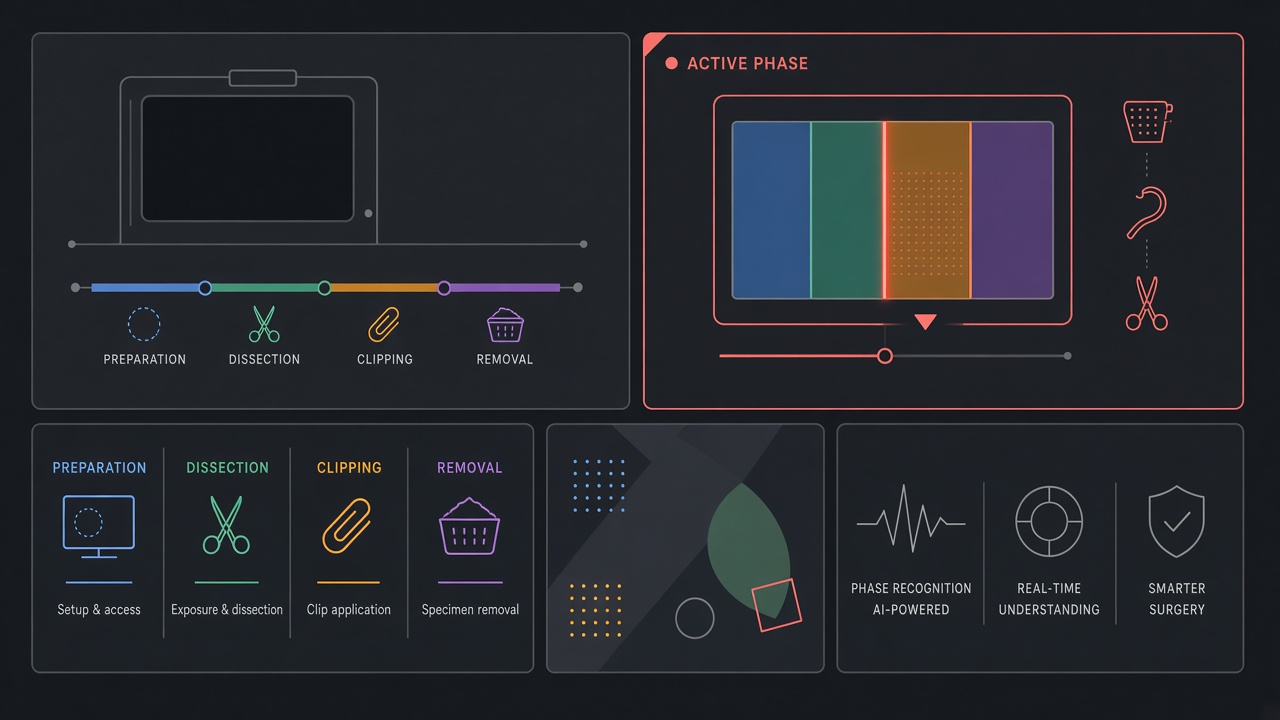
AI surgical phase recognition classifies operating room video into anatomically defined workflow segments (preparation, dissection, clipping, gallbladder removal) to power training feedback, case timing analytics, and safety checklist verification, always under surgeon oversight in current deployments. Deep learning models on the public Cholec80 dataset report frame-level accuracy from roughly 89% to 92%, with 3D-ResNet approaches reaching 91.2% overall accuracy on institutional test sets (2024). Architectures combine ResNet or EfficientNet spatial encoders with multi-stage temporal convolutional networks (MS-TCN), LSTMs, or transformers for causal online inference. Hospitals exploring AI healthcare OR analytics must address HIPAA consent, video de-identification, and clear labeling that phase labels assist humans rather than control robots autonomously.
Why Phase Labels Matter for Training
Automatic phase labels turn unstructured laparoscopic video into searchable curricula: educators locate Calot triangle dissection segments across hundreds of resident cases without manual scrubbing. Competency-based surgical education requires objective feedback on time spent in critical phases, instrument handling smoothness, and deviation from expert reference timelines. Phase recognition enables dashboards comparing trainee versus attending duration in high-risk steps where bile duct injury risk concentrates. Research groups at MICCAI and IEEE EMBC publish benchmark leaderboards on Cholec80, CholecT50, and EndoVis challenge datasets with seven standard cholecystectomy phases.
Beyond education, hospital operations use phase timestamps for OR utilization studies: when does draping end, when is the critical view of safety achieved, when does closure begin. Perioperative leaders identify bottlenecks without manual video review. Safety programs correlate phase transitions with timeout compliance and sponge count events, though causal claims require careful study design.
Autonomous robotic surgery marketing sometimes conflates phase recognition with closed-loop control. Current FDA-cleared surgical robots remain surgeon-driven; phase AI informs analytics and alerts, not independent incision planning. Regulatory pathways for autonomous phases differ sharply from assistive labeling.
Generalization beyond cholecystectomy requires re-annotation: appendectomy, hernia repair, and colorectal phases use different nomenclature. Transfer learning from Cholec80 pretraining accelerates institutional fine-tuning but rarely achieves benchmark accuracy without hundreds of locally labeled cases. Multi-procedure platforms segment models per specialty service line rather than forcing one global phase taxonomy.
Video Datasets and Surgeon Consent
Public datasets like Cholec80 provide 80 laparoscopic cholecystectomy videos with phase annotations, but hospital deployment requires explicit informed consent, IRB approval, and policies for who may view OR recordings. HIPAA treats surgical video as PHI when linked to patients; faces, tattoos, and voice must be de-identified or covered before research use. Surgeon consent is separate: operating clinicians may object to performance monitoring by department chairs. Union and employment contracts in some jurisdictions restrict video-based evaluation without collective bargaining agreement.
Consent forms should specify whether video trains vendor models shipped to other hospitals, stays on-premise only, or contributes to federated learning. Patients may withdraw consent retroactively, requiring ability to purge derived model weights tied to identifiable cases (technically challenging for deep learning). Ethics boards increasingly demand surgeon-facing transparency dashboards showing who accessed their case footage.
Researchers publishing AI research on surgical video should document annotation protocols: phase boundaries differ between experts, and label noise limits model ceiling. Multi-rater agreement (Cohen's kappa) should appear in methods sections.
Real-Time Segmentation Architectures
Real-time phase recognition pipelines sample video at 1 fps or process 16-frame clips through 3D convolutions, then apply temporal smoothing (CRF layers, phase consistency feedback loops) to suppress flickering mislabels between adjacent phases. Spatial backbones extract 2048-dimensional embeddings per frame. MS-TCN++ stacks dilated causal convolutions to respect temporal order during live surgery. Transformer hybrids (Trans-SVNet) aggregate long-range dependencies for phases separated by variable duration. Instrument detection heads (YOLO-style) optional improve accuracy when tool presence disambiguates visually similar frames.
PCNet (2024) introduced phase consistency feedback to reduce spurious rapid phase switches critical for online OR displays. Surgical Endoscopy (2022) CNN models added redundant "transition" phases between standard steps to handle blurry endoscopic images during irrigation or smoke, improving clinical robustness over benchmark-only training.
Latency budgets for OR overlays typically target under 500 milliseconds from frame capture to phase label display so surgeons perceive real-time guidance. Edge GPUs in sterile-adjacent equipment racks avoid cloud round-trips; failover to cached last-known phase during network outages prevents blank dashboards mid-case. IT disaster recovery drills should include video pipeline continuity because phase analytics become operational dependencies once residency programs rely on automated clip extraction.
| Component | Typical choice | Role |
|---|---|---|
| Spatial encoder | ResNet50, EfficientNet-B4, ResNeSt | Frame-level visual features |
| Temporal model | MS-TCN++, LSTM, Transformer | Phase sequence coherence |
| Post-processing | CRF, phase consistency loop | Reduce label flicker |
| Inference hardware | NVIDIA edge GPU in OR rack | Sub-second latency for overlays |
Safety Checks: Instrument Counts, Timeouts
Phase recognition integrates with WHO surgical safety checklist verification: models detect whether timeout occurred before incision phase, and whether instrument counts align before closure phase transitions. Computer vision counts sponges and needles only in experimental systems; most hospitals still rely on nursing manual counts with AI auditing video for procedural steps associated with count documentation. Timeout detection compares audio keyword spotting ("time out") with visual draping-complete phase classifiers. False positives from overlapping conversations require human confirmation before delaying surgery.
Critical view of safety (CVS) achievement in cholecystectomy is a separate computer vision task from coarse phase labeling: models analyze triangle clearing and two-structure exposure. Regulatory claims for CVS detection would require prospective validation tying AI prompts to bile duct injury rate reduction, evidence not yet established at scale.
Liability for missed retained surgical items remains with the surgical team unless hospitals contractually shift responsibility to vendors, which malpractice insurers resist. Phase AI should log suggestions without overriding nurse count sheets.
Smoke, irrigation fluid, and camera white-balance shifts during laparoscopy degrade frame-level classifiers trained on clean public datasets. OR integration teams should budget for domain adaptation retraining using de-identified local cases after six months of capture, capturing the messy reality absent from Cholec80's curated videos.
Vendor Landscape and Hospital IT
Vendors including Proximie, Surgical Safety Technologies, and academic spinouts package phase analytics into cloud or on-premise platforms integrated with existing laparoscopic tower video outputs via SDI or HDMI capture cards. Hospital IT must segment OR video traffic from guest Wi-Fi, encrypt streams to HIPAA-compliant storage, and patch edge inference servers without disrupting live cases. Integration with Epic or Cerner perioperative documentation is early-stage: phase timestamps may eventually auto-populate operative reports, but NLP from surgeon dictation remains dominant.
Cost models include per-OR annual licenses plus GPU hardware. ROI arguments cite reduced training time and malpractice risk reduction, both difficult to quantify in year-one budgets. Rural hospitals with low cholecystectomy volume may lack sufficient local video to fine-tune models, relying on pretrained Cholec80 weights with accuracy penalties on atypical anatomy.
Robot-assisted surgery platforms (da Vinci) generate proprietary video feeds; third-party AI requires vendor cooperation on API access. Closed ecosystems slow innovation relative to open laparoscopic stacks where any capture card can tap the signal.
Fellowship programs pilot phase-tagged video libraries where residents review only Calot dissection segments from 200 historical cases before live OR participation. Faculty annotate expert commentary audio synced to phase timestamps. Learning management integrations export completion certificates when trainees watch minimum hours per phase, supplementing ACGME case log numbers with process quality metrics.
Malpractice insurers watch surgical video analytics cautiously: demonstrable adherence to CVS phases might reduce bile duct injury claims, but video evidence also documents deviations usable in plaintiff discovery. Hospital risk managers should define retention schedules and legal hold policies before enabling continuous OR recording beyond quality improvement exemptions.
Frequently Asked Questions
Does phase AI perform surgery?
No. Current systems label phases and analytics for humans. Autonomous incision or suturing based on phase classifiers is research-stage and not cleared for unsupervised clinical use.
How accurate is phase recognition?
Published cholecystectomy models report 89 to 92% frame accuracy on held-out videos. Clipping and cutting phases show lower F1 scores than Calot dissection due to visual similarity. Real OR conditions may reduce accuracy further.
Is OR video recording legal?
With patient consent and institutional policy, yes in most US hospitals. Laws vary by state and country. Recording for quality improvement differs legally from research use requiring IRB.
Can residents opt out of video?
Program policies differ. Accreditation bodies encourage video review for competency; employment law may require notice. Transparent governance reduces disputes.
Does robotic surgery use phase AI?
Intuitive and competitors research workflow analytics on console video, but marketed robot features focus on tremor filtration and 3D vision, not autonomous phase-driven action.
What data trains phase models?
Cholec80 (80 videos), CholecT50 (50 videos with tool labels), and institutional archives with expert phase annotations. Transfer learning from ImageNet pretraining is standard.
How handle patient privacy?
De-identify video (mask faces, remove metadata), restrict access with audit logs, encrypt storage, and honor withdrawal of consent. On-device inference minimizes cloud PHI exposure.
Surgical video AI sits at the intersection of quality improvement, education, and research IRB pathways. Hospitals should publish patient-facing OR recording policies on preoperative consent forms, distinguishing de-identified algorithm training from identifiable performance review. As phase recognition matures, expect joint society statements from SAGES and ACS clarifying acceptable use of automated workflow labels in competency committees without replacing human operative assessments.
Benchmark leaderboards on Cholec80 encourage academic competition but overstate readiness for messy OR video. Hospitals piloting phase analytics should report prospective deployment accuracy alongside retrospective benchmark scores, giving surgeons realistic expectations before dashboards appear on wall monitors.