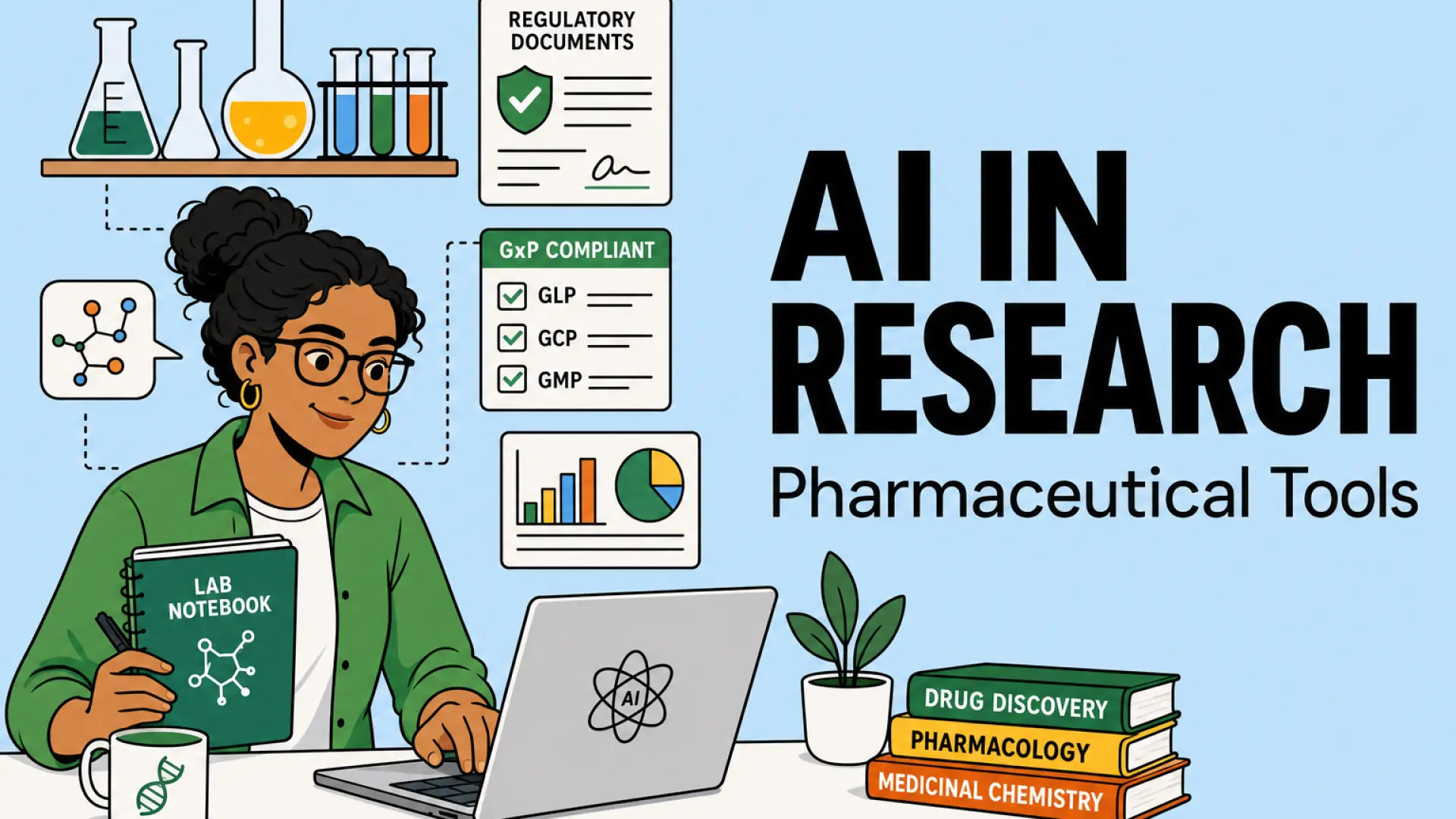
Scientists want faster literature synthesis and protocol drafts; quality assurance demands audit trails and validated systems. AI pharmaceutical research documentation sits in that tension. Consumer chatbots are inappropriate for GxP records. Validated platforms with access controls, electronic signatures, and change history are the only acceptable path for data that supports regulatory submissions.
This guide covers GxP and 21 CFR Part 11 awareness, ELN integrations, IP protection, and human review for submissions. Internal productivity tools in AI productivity categories may help non-GxP brainstorming; segregate that from regulated workflows. For secure internal Q&A, compare enterprise private AI chatbot options against your validation requirements.
GxP and 21 CFR Part 11 Considerations
Any AI system that creates, modifies, or stores GxP records must support attributable, legible, contemporaneous, original, and accurate data principles. Part 11 applies when electronic records substitute for paper and electronic signatures substitute for handwritten signatures. Shadow IT chat tools fail these requirements by design.
| Requirement | Consumer AI gap | Validated approach |
|---|---|---|
| Audit trail | No immutable history | ELN with versioned entries |
| E-signatures | Not binding | Qualified e-sign workflow |
| Validation | No IQ/OQ/PQ | CSV per GAMP 5 |
Electronic Lab Notebook Integrations
Embed AI inside validated ELN workflows so suggestions become draft entries requiring scientist review and sign-off, not freestanding chat logs. Integration points include protocol templates, experiment summaries, deviation narratives, and inventory lookups against approved material master data.
- AI outputs land in draft state; publish requires electronic signature.
- Link AI suggestions to source attachments (chromatograms, raw files).
- Block paste of unverified numerical results from external chat.
- Sync model version metadata into notebook metadata fields.
IP and Trade Secret Protection
Proprietary structures, formulations, and unpublished results must not enter vendor training corpora without contractual prohibition and technical controls. Data loss prevention rules should block upload of structure files and internal codenames to unapproved URLs.
A private chatbot on-premises or in a dedicated tenant may suit early discovery brainstorming if outputs never auto-flow to GxP systems without human transfer and review.
Human Review for Submissions
Regulatory submissions require qualified human authorship; AI drafts accelerate assembly but cannot replace medical writer and QC sign-off. Every statistic, table, and claim must trace to underlying study reports. AI summarization risks omitting limitations or misstating endpoints.
Technology Transfer and Manufacturing Interfaces
Process development documentation that feeds tech transfer packages needs the same GxP controls as discovery notebooks. AI drafts of control strategies require manufacturing science review before sending to CMO partners. Version alignment between R&D and MSAT prevents ambiguous parameter ranges.
Audit Readiness
Inspectors will ask how AI-generated text entered the quality system. Maintain validation reports, training records, and example audit trails showing reject/edit/approve paths. If AI suggested an incorrect calculation, the corrected signed entry is the record; retain both versions if policy requires.
Pharmacovigilance Boundaries
Adverse event narrative drafting is high risk; medical reviewers verify every fact against source documents. Do not use generative AI to infer causality or omit events. ICH E2B fields map to structured data in validated safety systems, not free chat. Literature monitoring alerts may use AI ranking with human triage; case submission content stays in GxP workflows.
Clinical vs Preclinical Documentation
Tighter controls apply as candidates approach IND and NDA filing. Preclinical method development may pilot AI on non-GLP notebooks with clear boundaries. GLP studies require full CSV on any AI feature touching raw data or report tables. Clinical study report tables must reconcile to SDTM and ADaM; AI must not round or transform statistics without programmer validation.
Vendor Qualification for AI Features
Qualify ELN and LIMS vendors on AI change control: model updates, subprocessors, and incident notification SLAs. Include AI in periodic vendor audit questionnaires. Require sandbox regression before production model pushes. Exit plan must export prompts, configs, and validation evidence if vendor discontinues feature.
Compare productivity tools used in discovery marketing separately from regulated stacks. IT should block install of unapproved browser extensions on R&D VLANs processing structure data.
Training Scientific Staff
Scientists need training on intended use, prohibited prompts, and how to reject AI suggestions in ELN audit trail. Annual refresher when models update. Quiz on scenarios: paste NMR interpretation, upload patient narrative, share draft IND section in chat. Failed scenarios trigger remedial training and access review.
Data Integrity and ALCOA+ Principles
AI-assisted entries must remain attributable, legible, contemporaneous, original, accurate, complete, consistent, enduring, and available. Timestamp model suggestions when displayed. Prevent backdating by locking entries after sign-off. Original raw data attachments stay linked; AI paraphrase is derivative, not substitute for instrument output files.
Periodic review of AI-assisted notebooks samples twenty entries per quarter for numerical accuracy against LIMS source. Document corrective actions in quality system when drift detected. Include AI feature in annual data integrity risk assessment alongside spreadsheet controls.
Standard Operating Procedures for AI Assist
Publish SOPs defining who may invoke AI, on which record types, and required second-person review. SOPs reference validation status and version numbers. Deviations require quality investigation. Annual SOP review coincides with vendor model updates and revalidation triggers.
Include decision tree: green zone non-GxP brainstorming in approved sandbox; yellow zone draft ELN entries; red zone prohibited uploads including patient identifiers, batch records, and stability raw data outside validated path. Post decision tree in lab and on intranet.
Cross-Functional Governance Committee
Charter a committee with quality, IT, legal, R&D, and regulatory affairs meeting monthly during rollout. Review incidents, vendor roadmaps, and training completion rates. Escalate novel use cases before pilot. Sunset tools that bypass audit trail even if scientists prefer convenience.
Computerized System Validation Detail
Follow GAMP 5 risk-based approach: categorize system, define requirements, IQ/OQ/PQ, and periodic review. User requirements specification must state AI intended use narrowly. Functional specs cover input validation, audit trail, e-sign integration, and model version display. OQ test cases include rejection path, edit path, and approve path for AI suggestions. PQ monitors ongoing accuracy on golden experiment set.
Change control triggers revalidation when vendor changes foundation model affecting regulated outputs. Impact assessment documents whether full or partial re-test required. Retain validation package accessible for FDA inspection within twenty-four hours request. Include network diagram showing data flow between ELN, LIMS, and AI inference endpoint.
Collaboration and Licensing Agreements
CRO and academic collaborations need contractual clarity on who may use shared data in AI tools. Joint invention and publication clauses may restrict feeding collaborator datasets into vendor models. MTAs often prohibit cloud upload entirely. Legal review before any AI pilot on licensed compound series.
The Bottom Line
AI pharmaceutical research documentation belongs inside validated ELN and quality workflows, not consumer chat tabs. Address GxP and Part 11, protect IP aggressively, and keep humans accountable for every submission claim.
Frequently Asked Questions
Can the same AI tool serve clinical and preclinical teams?
Only if validation scope, access controls, and data segregation cover both with appropriate change control. Many organizations deploy separate instances or disable features by study phase to reduce validation burden.
What do auditors ask about AI in lab notebooks?
Intended use, validation status, training records, audit trail samples, and how incorrect AI outputs are caught before sign-off. Be able to demonstrate a rejected AI suggestion with scientist correction in the same study record.
Is a general AI lab notebook vendor enough?
Evaluate against your QMS and ELN strategy. Standalone notebooks without integration create duplicate records and inspection risk. Prefer AI features native to validated ELN or formally interfaced middleware with CSV.
Can AI summarize literature for regulatory sections?
Yes as a draft aid from retrieved citations humans verify. Prohibit uncited claims. Medical writers must confirm every reference supports the sentence in the module.