Podcast voice cloning lets hosts synthesize speech that sounds like themselves for ad reads, episode intros, translated feeds, or fill-in segments when a co-host is sick. The same AI voice technology that saves studio time also powers deepfake scams and non-consensual impersonation. Shows evaluating clones for AI podcast production need a documented ethics workflow: when cloning helps listeners, when it crosses a line, and how to stay aligned with platform policies and advertising norms in 2026.
What Is Podcast Voice Cloning?
Podcast voice cloning trains a machine learning model on recordings of a specific speaker so new text can be rendered in a similar timbre, pace, and accent. Professional tiers require minutes to hours of clean sample audio; consumer toys need less but sound less stable. Cloning differs from generic text-to-speech voices: the output is meant to be recognizable as a particular host. That recognizability creates ethical weight because listeners attribute statements to a person, not to a model.
Use Cases That Help Listeners
Legitimate podcast voice cloning covers host-approved convenience: pre-recording dynamic ad slots, narrating show notes in the host voice, localizing episodes for multilingual audiences, and maintaining publish cadence during short medical absences. News-style shows use clones sparingly for standardized disclaimers. Fiction podcasts sometimes clone character voices for consistency across seasons when the actor remains contracted and credited. Each use case shares a thread: the identifiable person consented, the audience can discover synthetic speech, and the content does not impersonate someone else.
| Use case | Listener benefit | Ethics requirement |
|---|---|---|
| Dynamic ad insertion | Timely sponsor mentions | Host consent + ad disclosure rules |
| Sick-day fill-in | Schedule continuity | Disclose synthetic segments |
| Translated feed | Access in another language | Label as AI-translated audio |
| Accessibility narration | Consistent host tone for notes | Optional; do not fake live Q&A |
Consent Documentation
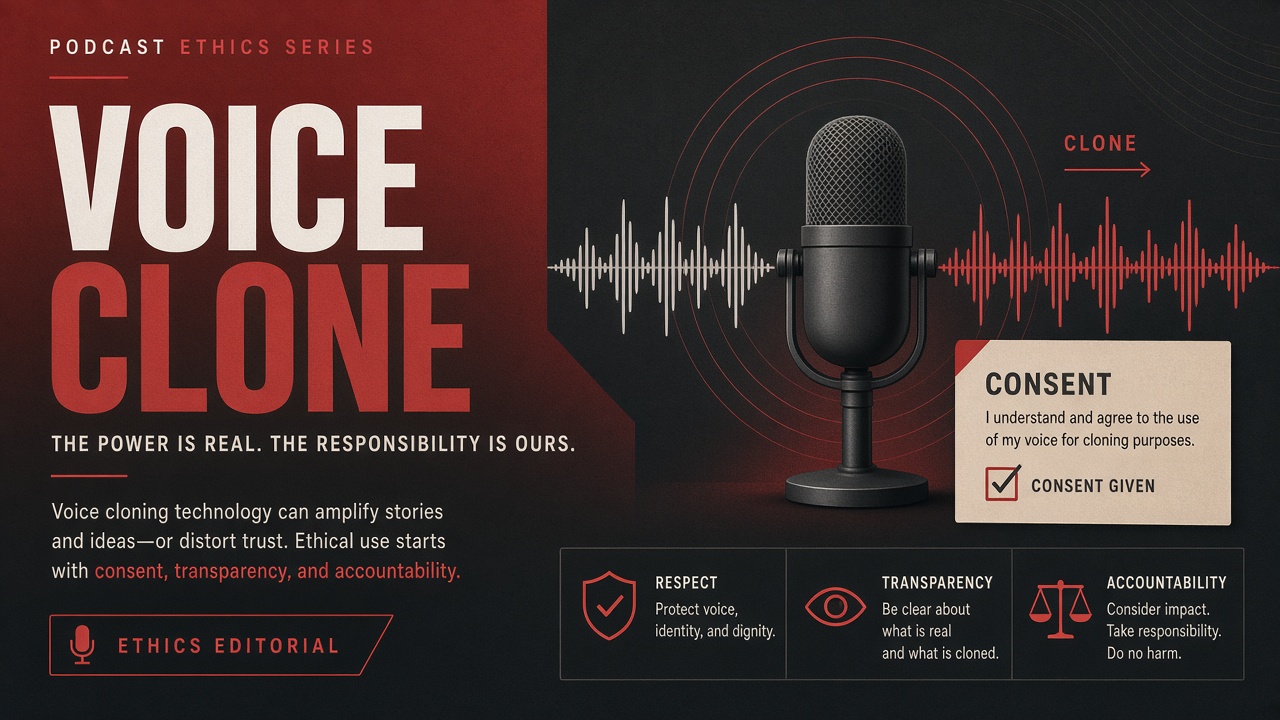
Before creating a voice model, obtain written consent from the voice owner covering scope, duration, sublicensing, and deletion rights. Consent forms should list permitted uses (internal ads only vs full episode synthesis), prohibited uses (political endorsements, other people's scripts without review), and what happens when the host leaves the show. Store signed agreements with the voice vendor contract. If a guest's voice is captured, do not clone it for promos without a separate release; guest releases often cover only the episode recording, not derivative AI models.
Vendors like ElevenLabs Professional Voice Cloning and similar enterprise tiers require identity verification for some accounts. Production teams should mirror that discipline internally: only security-reviewed staff trigger cloning jobs, and model weights sit behind access controls.
Disclosure Norms
Disclose synthetic host speech when a reasonable listener would assume the person spoke live in that session. FTC endorsement guides require clear sponsorship disclosure; synthetic ad reads still need "#ad" or equivalent clarity. For sick-day episodes, a short intro ("Host voice synthesized for this segment while Alex recovers") sets expectations. Fully synthetic episodes without any live host participation should say so in title or description, not only in fine print.
Industry practice in 2026 is still evolving. Some networks adopt a standard bumper: "This message uses AI-generated speech approved by [Name]." Others disclose only in show notes. Err toward audible disclosure for trust-sensitive genres (news, health, finance). Fiction and comedy may use synthetic voices as a creative device if marketed honestly.
Technical Quality and Misuse
Poorly tuned clones with robotic cadence can damage show quality even when ethics paperwork is complete. Limit clone usage to contexts where listeners expect polished studio delivery (ads, disclaimers) rather than emotional confessionals that need human breath and hesitation. Review cloned audio on phone speakers and car stereos; artifacts that pass in headphones may fail in real listener environments. Misuse also includes generating clone audio for internal jokes that leak externally; treat voice model access like production credentials.
Platform Rules
Spotify, Apple Podcasts, YouTube, and ad marketplaces increasingly ask whether content includes synthetic media or manipulated audio. YouTube's policies on deceptive synthetic content target impersonation and misleading news; disclosed podcast clones for authorized hosts differ from banned deepfake harassment. Spotify's advertising guidelines restrict misleading claims regardless of whether voice is human or synthetic. Check platform terms at upload time because rules updated through 2025 and 2026.
Dynamic ad hosts (Spotify Ad Studio, Acast, etc.) may require proof of voice rights for cloned reads. Keep consent PDFs ready for ad ops review. RSS feeds that syndicate to multiple platforms inherit the strictest rule set.
Documentation Template
Maintain a single source of truth listing voice model vendor, creation date, consent form link, permitted use cases, disclosure text, and deletion procedure. Production coordinators should complete a pre-flight checklist before any cloned segment publishes: script approved by named host, disclosure recorded or show-notes updated, platform synthetic-media flag set, sponsor notified if applicable. Store audio stems of cloned renders with hash metadata for dispute resolution if a listener claims the host never said a controversial line.
Deepfake Risk and Red Lines
Crossing the line means cloning without consent, faking interviews, putting words in a host's mouth they never approved, or using a clone after the person revoked permission. Criminal and civil cases around non-consensual voice deepfakes increased through 2026; podcasters are not exempt because the medium is intimate. Red lines also include cloning deceased hosts without estate approval and simulating listener call-ins that never happened.
Technical controls reduce risk: watermarking from some AI voice APIs, provenance metadata in production logs, and human approval queues before publish. Maintain a kill switch to delete voice models when contracts end.
Legal and Regulatory Landscape
U.S. state deepfake laws, EU AI Act transparency expectations, and FTC truth-in-advertising rules converge on consent and disclosure for synthetic voices. Tennessee's ELVIS Act and similar state statutes address voice likeness rights; podcast networks with multi-state audiences should assume the strictest applicable standard. The FTC's guidance on AI-generated endorsements applies when cloned host voices read sponsor copy: listeners must understand material connections and synthetic speech must not exaggerate product experience the host never had.
Union and guild contracts for SAG-AFTRA voice talent increasingly specify AI reuse windows and compensation. Indie podcasts without union talent still benefit from mirroring those clauses in host agreements to avoid disputes when a show sells to a network that inherits voice models.
Practical Ethics Workflow
- Define allowed clone use cases in show bible.
- Sign voice consent and store with legal records.
- Script review: no synthetic statements host would not endorse.
- Record disclosure standard per use case.
- Platform upload checklist for synthetic media flags.
- Annual re-consent and model deletion if host departs.
International and Translated Feeds
Cloning plus machine translation lets networks launch localized feeds faster, but translated meaning must be reviewed by fluent speakers before synthetic hosts deliver it. A host's reputation attaches to words they never spoke in that language. Workflow: human translation, legal review for market-specific claims, native editor listen, then clone render with disclosure that audio is AI-translated and synthetic. Some audiences prefer subtitles over dubbed synthetic hosts; offer choice where platforms allow multiple audio tracks.
Listener Trust and Brand Risk
Undisclosed synthetic host segments erode trust faster than imperfect audio quality. Podcast audiences form parasocial relationships with hosts; discovering a "live" rant was cloned damages credibility across unrelated episodes. Run internal red-team tests: would a longtime listener feel misled? If yes, add disclosure or record live. Sponsors increasingly ask whether ad reads are synthetic because brand safety teams track deepfake controversy in adjacent media.
Frequently Asked Questions
Must we disclose every AI ad read?
Sponsorship disclosure is legally required in many jurisdictions; synthetic voice does not remove that duty. Many shows also disclose AI voice for transparency beyond minimum law.
Can guests opt out of cloning?
Yes. Default guest releases should not assume AI voice model training. Offer opt-out before recording if you use recordings to tune models.
Is cloning OK for entire episodes?
Only with explicit host consent and clear audience disclosure. Listeners who expect authentic conversation may feel deceived if entire episodes are synthetic without notice.
What if the host's voice changes?
Retrain or retire the model. Using an outdated clone after illness or transition can misrepresent the person.
Do platforms ban all voice clones?
No. Policies target deception and unauthorized impersonation. Authorized, disclosed podcast production is generally permitted but subject to changing terms.
How does this relate to full AI podcast tools?
End-to-end AI podcast generators that invent hosts differ from cloning an existing person. Cloning carries identity ethics; fully synthetic shows carry transparency about machine authorship.
Should sponsors know about cloned reads?
Yes. Brand safety teams increasingly ask whether host delivery is live or synthetic. Proactive disclosure in ad ops paperwork prevents last-minute campaign pulls when synthetic voice surfaces in media coverage.
Can co-hosts clone each other?
Only with mutual written consent scoped to the show. Friendship does not imply perpetual voice rights; document what happens if one host leaves and the remaining host wants to keep using the clone for backlog ads.
Do listeners care about disclosure?
Survey data is mixed, but scandal-driven episodes show audiences punish perceived deception more than synthetic media itself. Transparent disclosure builds long-term trust with minimal friction when normalized in show intros.
Should networks standardize policies?
Multi-show networks benefit from a shared voice cloning policy template so producers do not reinvent ethics rules per feed. Central legal review of consent forms and disclosure bumpers reduces inconsistent standards across AI podcast properties in the same portfolio.