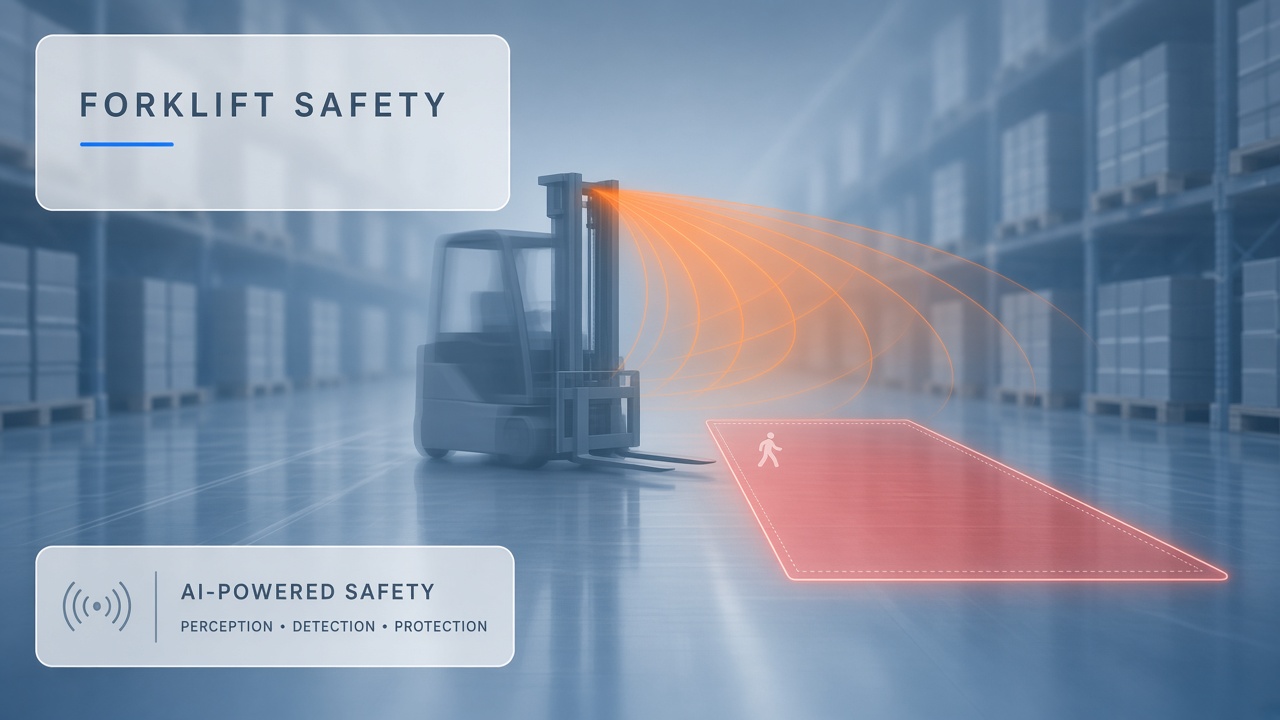
Warehouses run forklifts within inches of pedestrians, rack legs, and loading docks. A self-driving forklift must detect people behind pallets, brake when a manual truck cuts across an aisle, and still hit throughput targets. Self driving forklift AI safety is the combination of perception, motion planning, fail-safe braking, facility layout rules, and human procedures that keep autonomous lift trucks from becoming collision hazards. Unlike highway autonomy, warehouse safety is a mixed-traffic problem: autonomous mobile robots (AMRs), automated guided vehicles (AGVs), and human-operated forklifts often share the same floor with incomplete separation.
Safety managers evaluating automation need clarity on standards, vendor claims, and audit evidence. Teams using AI chatbot tools for training documentation still must meet OSHA operator certification rules and ANSI guidance for driverless industrial trucks. For related technical explainers, visit the EliteAI.tools blog index.
What Self-Driving Forklift Safety Means in Plain Language
Self-driving forklift safety means an autonomous lift truck can navigate a facility, pick and place loads, and stop or slow before harming people or property, including when sensors degrade, networks drop, or unexpected obstacles appear. Safety spans hardware (LiDAR, cameras, bumpers, e-stops), software (obstacle classification, path planning, speed zoning), and process (training, signage, maintenance, incident logging). A safe system assumes humans will cross marked paths and that manual forklifts will not always obey digital maps.
Vendors market "safety-rated personnel detection" and "layered LiDAR," but buyers should translate marketing into testable requirements: maximum speed near pedestrians, stopping distance at full load, behavior when a pallet overhangs the forks, and recovery after an emergency stop without silent restart into traffic.
| Safety layer | Function | Typical failure if neglected |
|---|---|---|
| Perception | Detect people, forks, racks, floor debris | Missed pedestrian behind load |
| Planning and zoning | Limit speed, enforce one-way aisles | High-speed turns at blind corners |
| Braking and e-stop | Hardware cutoffs independent of software | Software hang with load elevated |
| Human procedures | Training, lockout, maintenance mode | Maintenance with autonomy still armed |
Autonomous forklifts versus pallet AMRs
Autonomous forklifts lift loads to rack height and carry heavier pallets; pallet AMRs often stay low and follow different clearance profiles. ANSI/ITSDF B56.5 covers automated guided industrial vehicles broadly, but fork height, tip-over risk, and load stability add hazards AMR-only deployments avoid. Safety analysis must include elevated travel and mast dynamics, not just floor-level path following.
How the Underlying AI Pipeline Works
Warehouse autonomous forklift stacks combine SLAM localization, 2D and 3D LiDAR perception, rule-based speed zones, and machine-learning classifiers for people and obstacles, all supervised by safety PLCs or equivalent rated stop chains. AI handles pattern recognition; rated stops must not depend solely on a single GPU inference thread.
Localization without facility retrofits
Seegrid's Lift CR1 and similar AMRs use infrastructure-free LiDAR SLAM with Grid Engine localization to map aisles without magnetic tape or QR grids. Maps update as layouts change, but safety teams must revalidate zones after rack reconfiguration. Toyota, Raymond, Crown, and other OEMs offer varying blends of SLAM, reflectors, and fleet software; integration depth differs by vendor and dealer network.
Perception and pedestrian detection
Production systems stack multiple 2D and 3D LiDAR units for redundant coverage around forks and mast travel. Computer vision supplements LiDAR for reflective vests and protruding limbs, though lighting and dust affect camera reliability. AI classifiers label humans versus static racks, but safety margins rely on conservative stopping distances and lower speed caps in pedestrian zones rather than perfect classification at full speed.
Fleet orchestration and mixed traffic
Warehouse management systems assign missions; fleet managers deconflict routes among autonomous units. Mixed fleets add human unpredictability. Real-time location systems (UWB, RFID, or camera analytics) increasingly log vehicle and pedestrian positions to enforce clearance rules aligned with ANSI B56.5 guidance on guide path separation and hazard zones. Without positional awareness of manual forklifts, autonomous units cannot guarantee B56.5-style clearances digitally.
- Facility survey: aisle widths, blind corners, pedestrian crossings, dock interfaces.
- Map building and zone design: speed limits, one-way rules, keep-out areas under rack overhangs.
- Safety case review: stopping distances at max load, mast-up travel restrictions, e-stop placement.
- Staged rollout: off-shift testing, partial aisle automation, then mixed-shift operation with spotters.
- Operator and maintainer training per OSHA 1910.178 and vendor-specific autonomy modules.
- Continuous logging: near-miss events, forced stops, zone violations, maintenance lockouts.
Real Deployments and Published Evidence
Autonomous forklift and heavy-lift AMR deployments accelerated in 2024 as vendors ship direct-to-customer models with documented safety sensor suites and record enterprise sales. Seegrid unveiled the Lift CR1 in early 2024 with 4,000-pound capacity, 15-foot lift height, layered 2D and 3D LiDAR, safety-rated personnel detection, and three emergency stop buttons. The company reported record end-user sales driven by autonomous lift truck demand, then shifted to direct sales after ending distribution through Raymond Corporation (a Toyota subsidiary) in late 2024.
Injury statistics and the safety case for automation
OSHA powered industrial truck data document roughly 70 forklift-related fatalities and thousands of injuries annually in U.S. workplaces, with many incidents tied to operator error, tip-overs, and pedestrian strikes. Automation vendors argue autonomous systems reduce human exposure to high-risk tasks (long horizontal transport, repetitive high-bay putaway). Independent evidence is mixed: automation removes some failure modes while introducing software, sensor, and mixed-traffic risks. Peer-reviewed warehouse injury reductions require multi-site longitudinal studies rarely published by vendors.
Standards and regulatory momentum
OSHA's existing Powered Industrial Trucks standard (29 CFR 1910.178) assumes human operators for training and evaluation. Automated vehicles also fall under the General Duty Clause requiring employers to abate recognized hazards. ANSI/ITSDF B56.5 specifies safety requirements for automated guided industrial vehicles, including obstacle detection, emergency braking, path clearance, and hazard zone marking. Industry commentary in 2025 and 2026 notes OSHA movement toward incorporating B56.5 references into powered industrial truck rules, which would formalize requirements many early adopters already follow voluntarily. EN 1175:2025 updates electrical safety for industrial trucks, relevant as lithium autonomy packs proliferate.
Typical warehouse integration workflow
Successful deployments treat autonomy as a facility redesign project, not a forklift swap. Engineers map traffic flows, identify choke points, and often repaint aisles before the first autonomous mission. Vendors such as Seegrid emphasize live-operation deployment without shutting the building, but safety teams still schedule off-peak validation windows. Integration teams connect warehouse management systems for mission dispatch, then tune retry logic when picks fail because pallet overhangs violate expected dimensions. Post-go-live, weekly reviews of forced-stop logs catch recurring perception blind spots before they become collisions.
Limits, Risks, and Ethical Guardrails
Self-driving forklifts fail when perception misses low obstacles, when loads shift center of gravity, or when maintenance staff override safety devices during troubleshooting. OSHA notes many robot incidents occur during non-routine operations: programming, testing, calibration, and repair. Ethical deployment protects workers from pressure to disable sensors to meet productivity targets.
- Mixed-fleet blind spots: Manual forklifts without telematics remain invisible to fleet software unless separate tracking is deployed.
- Elevated load strikes: Mast-up travel can hit conduit and sprinklers even when floor-level LiDAR is clear.
- Weather and floor conditions: Wet docks and debris reduce braking predictability; autonomy parameters tuned on dry concrete may slip.
- Cybersecurity: Networked fleets introduce remote hijack and ransomware risks requiring segmentation and signed updates.
- Workforce impact: Automation shifts jobs rather than eliminating hazards; retraining and role redesign are safety issues too.
Guardrails include physical barriers where feasible, visible zone markings, mandatory slow zones at intersections, lockout/tagout during maintenance, prohibition on bypassing e-stops, and incident investigations that treat near-miss logs as seriously as collisions. Employers remain liable under OSHA even when vendors supply autonomy software.
Who Should Use This and Who Should Wait
Large distribution centers with repetitive horizontal transport, heavy manufacturing plants with parts-to-line flows, and safety programs willing to redesign traffic patterns should pilot autonomous forklifts with phased rollouts and B56.5-aligned documentation. Small facilities with ad hoc traffic, high manual forklift density without separation, or weak maintenance cultures should fix baseline OSHA compliance before buying autonomy.
| Audience | Recommendation | Caveat |
|---|---|---|
| High-bay warehouse operator | Evaluate heavy-lift AMRs with documented mast-up safety cases | Validate tip-over limits at max height |
| Safety manager | Audit against B56.5 before OSHA formal incorporation | Require timestamped near-miss logs from vendor |
| 3PL with mixed clients | Segment autonomous lanes where possible | Layout changes invalidate maps frequently |
| Small job shop | Wait; invest in operator training and floor marking first | ROI rarely clears without scale |
Maintenance lockout and autonomy bypass risks
A disproportionate share of industrial incidents occur during maintenance, not routine transport. Autonomous forklifts introduce new bypass paths: technicians may disable sensors to move a unit manually, leave autonomy enabled while testing mast functions, or override zones to "save time" during peak season. ANSI B56.5 and OSHA lockout/tagout expectations still apply: rated stops, key switches, and documented procedures must prevent unexpected motion when humans enter the mast envelope. Vendors should ship maintenance modes that visibly differ from production autonomy (different LED patterns, audible warnings, hard speed caps). Safety managers should audit whether night-shift crews treat sensor bypass as normalized practice; that culture erases the benefit of redundant LiDAR faster than any algorithm improvement restores it.
Site acceptance testing protocol
Before declaring an autonomous aisle production-ready, staged acceptance tests should cover worst-case loads at maximum lift height, blind-corner pedestrian crossings at operational speed, sudden pallet protrusions, and recovery after e-stop reset. Each test needs timestamped logs from the fleet manager: commanded speed, detected obstacles, stop reason codes. Compare measured stopping distance against vendor datasheets under your floor friction and load center, not brochure values from ideal conditions. Re-run a subset after every layout change, seasonal lighting shift (dock doors open in summer glare), or firmware update. Treat acceptance as a living document tied to map versions, not a one-time sign-off slide deck.
Third-party logistics operators running mixed client inventories should segment autonomous lanes by customer when rack layouts differ weekly. Shared maps without client-specific zone overlays increase the risk that a unit trained on one aisle width enters a narrower corridor with outdated clearance parameters.
Frequently Asked Questions
How accurate is AI pedestrian detection on autonomous forklifts?
Vendor systems use redundant LiDAR and rated stop chains, but accuracy varies with load occlusion, dust, and lighting; no public universal benchmark exists across vendors. Require site acceptance tests with staged pedestrian crossings at operational speeds before go-live.
Does OSHA regulate self-driving forklifts separately?
OSHA applies 29 CFR 1910.178 powered industrial truck requirements plus the General Duty Clause; proposed updates may incorporate ANSI/ITSDF B56.5 for driverless vehicles. Employers must train and certify personnel who operate or supervise autonomous systems, with refresher training at least every three years per existing forklift rules.
Can autonomous and manual forklifts share the same aisles safely?
Yes, with engineered controls: speed zones, visibility mirrors, pedestrian walkways, optional real-time tracking of manual equipment, and strict right-of-way rules. B56.5 clearance logic assumes known positions; mixed fleets without tracking rely heavily on conservative autonomous stopping behavior and human discipline.
What data do autonomous forklifts need to operate safely?
Facilities need accurate SLAM maps, zone polygons, load dimensions, and maintenance records; fleets benefit from logged telemetry (speed, stops, faults) for audits. Re-map after layout changes. Do not deploy on outdated CAD drawings alone.
What should buyers ask vendors about safety?
Ask for stopping distance tables at max load, sensor redundancy diagrams, behavior after e-stop reset, maintenance lockout procedures, and sample incident logs from comparable deployments. Marketing videos are not safety cases.
Who is liable when an autonomous forklift injures someone?
Employers retain primary OSHA liability; vendors may share product liability depending on contract and defect claims. Insurance and indemnification clauses should be negotiated before deployment, not after an incident.
Conclusion
Self-driving forklift AI safety combines redundant sensing, conservative motion planning, ANSI B56.5-aligned zone design, and rigorous human training in mixed-traffic warehouses. Seegrid's Lift CR1 and similar platforms show commercial momentum with layered LiDAR and direct enterprise sales, while OSHA and ANSI frameworks catch up to driverless industrial vehicles. Automation can reduce exposure to repetitive high-risk driving but introduces new failure modes during maintenance and mixed-fleet operations. Safety managers should demand site-specific validation, continuous logging, and culture that never treats sensor bypass as a productivity hack.