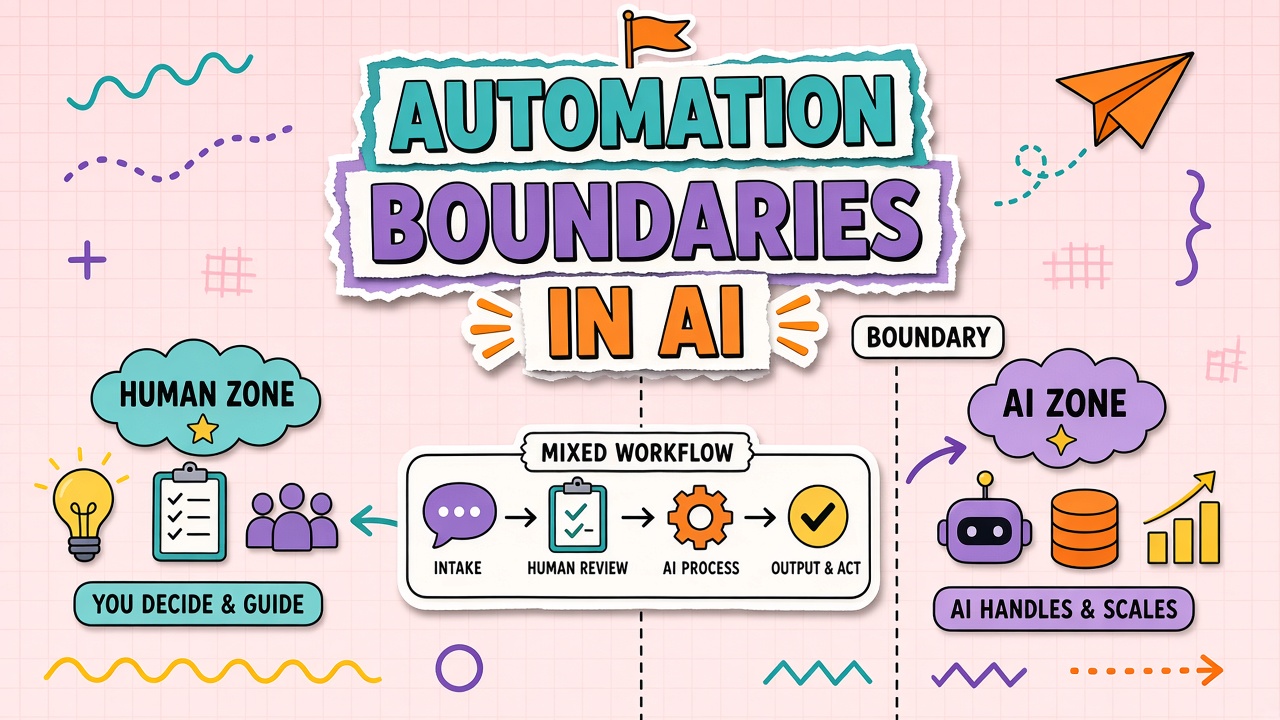
The demo auto-sent refund approvals in under two seconds. Legal pointed out that half the cases needed human judgment on fraud signals. Engineering had already wired the webhook. Drawing boundaries late costs rework, customer trust, and sometimes regulatory exposure.
Automation boundaries in mixed AI workflows define what runs without humans, what requires review, and how exceptions flow. This guide offers criteria matrices, industry risk examples, and documentation patterns for teams combining AI automation with productivity assistants.
Involve customer support leads when drawing boundaries for customer-visible automation. They see edge cases engineering test suites miss: angry customers, regulatory complaints, VIP handling. Boundary workshops with real ticket examples beat abstract risk scores alone.
Document partial automation paths explicitly: AI drafts, human edits, human sends. Partial paths still need logging and quality sampling even when no webhook fires autonomously. Copy-paste automation is still automation for compliance purposes when volume scales.
Automate: Repetitive, Low-Risk, Reversible
Strong automation candidates share three traits: high repetition, low consequence if wrong, and easy rollback. Internal meeting summaries, first-draft FAQ answers from approved KB, and routing tickets to the right queue often qualify when outputs stay internal or draft-only.
- Repetitive: same structure, similar inputs, stable policy source
- Low-risk: no single action moves money, medical advice, or legal rights
- Reversible: undo, resend, or human correction before external visibility
Even "safe" automations need logging and rate limits. A runaway loop sending thousands of internal Slack messages is still an incident.
Logging should capture who approved automated actions and which policy version applied. When regulators or clients ask "why did the system do X," logs must show gate decisions, not only model output. Retention aligns with compliance requirements for your industry.
Human Required: Legal, Medical, Financial Decisions
Decisions that affect rights, safety, or material financial outcomes require human accountability in most industries. AI may draft or recommend; a named role approves before execution.
| Domain | Automate with guardrails | Human gate required |
|---|---|---|
| Support | Draft reply from KB | Send refund over threshold, account deletion |
| Finance | Categorize expenses for review queue | Approve payments, tax filings |
| Healthcare | Administrative scheduling suggestions | Diagnosis, treatment plans, clinical notes to patients |
| Legal | Internal research summaries | Advice to clients, court filings |
Map your workflows against this matrix with legal and compliance input. Generic automation platforms will not enforce industry gates unless you configure them.
Revisit the matrix when entering new markets or product lines. A workflow automated for US consumer support may need different gates for EU users under GDPR or for B2B contracts with custom liability caps. Boundaries are properties of workflow plus jurisdiction, not of the model alone.
Document Gates in Workflow Diagrams
Publish diagrams that show AI steps, human gates, and data sources. Label each gate with owner role and SLA (for example "Tier 2 approves within 4 business hours"). Store diagrams next to runbooks in version control.
When productivity tools sit in the middle of a chain, mark where copy-paste introduces manual risk versus API-bound automation.
Exception Handling Process
Exceptions happen: model outage, policy edge case, VIP customer. Define how workflows fail closed (stop and queue for human) vs fail open (continue with warning). Default to fail closed for external customer actions.
- Detect exception (rule, confidence score, missing data)
- Route to human queue with context bundle
- Log reason code for monthly boundary review
- Update rules if same exception repeats above threshold
Boundary Criteria Matrix
Score each workflow step on impact (1 to 5), reversibility (1 to 5), and policy clarity (1 to 5). Steps with high impact and low reversibility require human gates regardless of model confidence scores. Do not let vendor "auto-approve above 90%" marketing override your matrix without validation on your data.
Periodic Boundary Reviews
Review automation boundaries quarterly and after every major vendor feature release. Vendors ship "auto-approve" toggles that bypass gates configured last quarter. Change logs for automation platforms should trigger boundary revalidation, not only engineering regression tests.
Involve legal and workflow champions in reviews, not only engineering. Engineers see integration health; champions see whether gates still match how work actually happens after process drift.
Customer Disclosure at Boundaries
Where AI assists but humans decide, say so in customer-facing help and contracts where required. Where AI executes autonomously within bounds, disclose categories of actions and escalation paths. Disclosure does not replace gates; it sets expectations when productivity assistants sit close to customer-visible outputs.
Product managers should review boundary diagrams before roadmap commitments on "full autopilot" features. Sales demos that skip gates create customer expectations engineering cannot safely meet. Align demo scripts with production boundary configs.
Rollback and Kill Switch Requirements
Every automated external action needs a kill switch tested quarterly. Operators should reach disable controls without deploying code. Document who may flip kill switches and how customer comms triggers when automation stops mid-queue.
Testing Boundaries Before Production
Stage environments should mirror production gates, not bypass them for speed. Teams that disable compliance checkpoints in staging forget to re-enable them at cutover. Checklist the gate configuration as part of go-live sign-off alongside functional tests.
Red-team exercises attempt to trigger autonomous actions outside boundaries: crafted prompts, malformed API payloads, edge-case CRM records. Findings feed boundary matrix updates before real customers hit the same paths.
Boundary Documentation for Auditors
Auditors request workflow diagrams showing human gates, data sources, and automated actions. Keep diagram versions aligned with production configuration dates. Diagrams that show gates engineering disabled last sprint are worse than no diagram.
Include exception volume metrics on diagrams reviewed quarterly. High exception rates signal boundaries misaligned with real work and may require matrix update rather than more human firefighting alone.
Frequently Asked Questions
How do boundaries affect customer trust?
Customers trust brands that admit limits. Disclose when AI assists and when humans decide material outcomes. Hidden full automation on sensitive topics erodes trust faster than slower human-in-the-loop service.
What brand risks come from over-automation?
Off-brand tone, public hallucinations, and social media misfires scale instantly when auto-publish gates are missing. Marketing workflows should keep human approval on anything customer-facing until sampling proves quality.
Can confidence scores replace human gates?
Only after calibrated eval on your data and only for low-impact steps. Scores without calibration often correlate poorly with actual error rates on long-tail queries.
What is partial automation?
AI drafts; humans edit and click send. Partial automation captures much of the efficiency gain with lower risk than end-to-end auto execution. Boundaries often land here first.
Governance Review for Boundary Changes
Any proposal to remove a human gate requires steering committee or delegated risk owner sign-off with updated eval evidence. Engineering convenience is not sufficient justification when impact scores high on the boundary matrix.
Track boundary change requests in the same backlog as continuous improvement items. Approvals without tickets leave no audit trail when regulators ask why auto-send expanded last quarter.
Pair boundary reviews with automation vendor release notes. Features marketed as productivity often imply new autonomous actions your matrix still marks human-required.
Vendor Defaults vs Org Boundaries
Disable vendor default automations that conflict with your matrix before enabling integrations. Platforms often ship with auto-reply or auto-close enabled in trial tenants. Configuration audits compare vendor defaults to approved boundary diagrams monthly.
Document boundary exceptions with expiry dates. Temporary auto-send for low-risk seasonal campaigns should revert automatically; permanent exceptions without review become undeclared policy changes auditors discover later.
Scaling Boundaries With Volume
As AI volume grows, human gates need staffing models tied to boundary diagrams. Approving auto-send expansion without reviewer capacity planning guarantees SLA breaches and silent bypass. Model reviewer hours per thousand automated drafts using pilot data before scaling.
Partial automation may be the stable end state for high-impact workflows rather than a stepping stone to full auto. Document when partial automation is intentional permanent design, not temporary caution.
Security teams should review boundary diagrams for data exfiltration paths: can automated actions send data to external webhooks or personal email integrations? Data boundaries complement decision boundaries.
Revisit boundaries after organizational reorgs when approval roles empty. Orphan gates that route to departed managers fail open or stall depending on platform defaults; both are risky.
Document boundary decisions in steering minutes when new auto-send capabilities are approved. Minutes create accountability when post-incident reviews ask who authorized expanded automation scope.
Review vendor default confidence thresholds during boundary workshops. Uncalibrated scores should not override matrix scores without eval evidence on your traffic.
Include boundary diagrams in new hire training for teams operating semi-automated workflows. Operators who understand gates spot misconfiguration faster than central governance teams reviewing logs after incidents.
When integrating new connectors, repeat boundary workshop for that connector's actions alone. Connectors often introduce send, update, or delete capabilities absent from original workflow scope.
Document who may approve temporary boundary exceptions and maximum duration. Undocumented exceptions during launch weeks often become permanent production configuration discovered only after incidents.
Revisit boundary diagrams when organizational reorgs change approver roles. Empty gates routed to departed managers fail open or stall depending on platform defaults; both outcomes create risk during busy operational periods.
Include boundary ownership in RACI matrices so engineering, legal, and operations know who approves gate changes. Unowned boundaries drift whenever platforms ship new autonomous action types.
Automate With Explicit Edges
AI can do more than you should let it do unattended. Document boundaries before wiring webhooks. Use criteria matrices, human gates on high-impact steps, and exception paths that fail closed. Teams building automation and productivity stacks should review boundaries whenever a vendor ships "one-click auto" features.