Most robots that avoid obstacles run digital neural networks on GPUs or embedded ARM chips. A September 2026 Nature Communications paper demonstrates a different path: physical waves in a tank perform the computation. Distance readings from an ultrasonic sensor excite water waves; a camera captures the interference pattern; a lightweight readout layer maps patterns to turn-or-forward commands. An Arduino car navigates a real obstacle course under closed-loop control with no GPU in the loop. Micromagnetic simulations extend the concept to gigahertz spin waves in magnetic nanodevices. For readers following AI research beyond silicon or AI automation at the edge, wave-based neuromorphic hardware offers a radically different energy and architecture story.
What Wave Computing Is
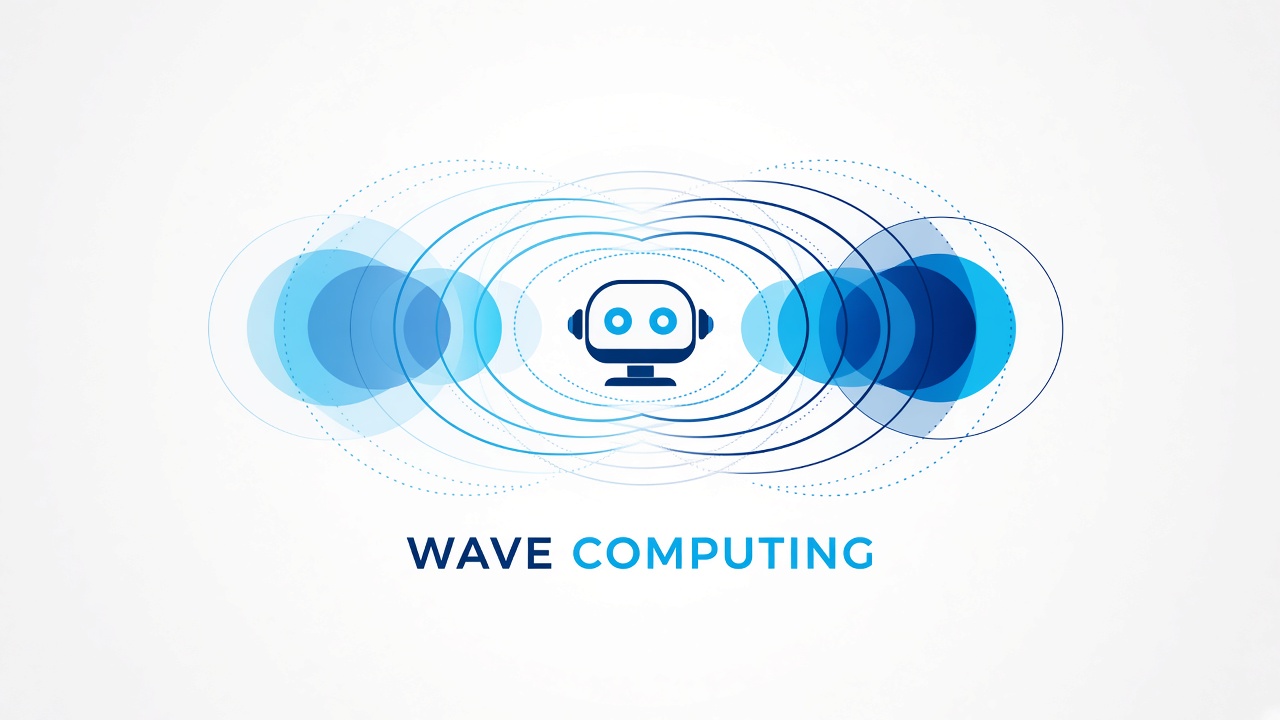
Wave computing uses the natural dynamics of wave interference as a high-dimensional computational reservoir; only a small trainable readout layer sits in digital software. Reservoir computing (RC) fixes a large, recurrent dynamical system (the reservoir) and trains only linear weights connecting reservoir states to outputs. In classical RC, reservoirs were simulated neural nets. In wave RC, the reservoir is physical: ripples on water, spin waves in magnetic films, or acoustic modes in structured media. Input signals perturb the wave field; the resulting spatiotemporal pattern encodes input history nonlinearly.
Training avoids backpropagation through the reservoir. Collect wave images or sensor taps for labeled examples, then fit a readout (often ridge regression or a shallow classifier). Inference is fast once the readout is trained: inject input, let waves settle, read pattern, apply weights. Energy costs concentrate in input transducers and readout electronics, not in billions of multiply-accumulate operations per second on a GPU.
Water Experiment Demo: Obstacle Avoidance in Practice
Researchers built a water-wave reservoir where six directional distance inputs generate distinct interference patterns classified with near-perfect accuracy for obstacle layout recognition, then drive real-time steering commands. Two demonstrations appear in supplementary videos: a Pygame virtual car in a simulated room and a physical Arduino car in a 3 m by 2 m wooden enclosure.
Virtual Car Loop
Every 500 ms, a simulated sensor ray measures distances at six angles around the vehicle. Those values modulate wave sources in the tank. A camera records the steady-state interference image. The trained readout selects forward motion or turning. The loop repeats autonomously with obstacles of varied shapes in the virtual room.
Arduino Car Loop
An ultrasonic sensor on the physical car measures distances and sends them via Bluetooth to the wave reservoir input stage. After pattern evaluation, maneuver commands return through the same wireless channel. The onboard Arduino executes motor control; wave hardware performs the pattern recognition that would normally require a digital neural network inference pass. Supplementary video speeds up footage 50 times for presentation; control runs in real time.
| Stage | Hardware | Role |
|---|---|---|
| Sensing | Ultrasonic or simulated rays | Six-angle distance vector every 500 ms |
| Reservoir | Water tank plus wave generators | Nonlinear spatiotemporal mixing |
| Readout | Camera plus trained classifier | Map pattern to steer or forward |
| Actuation | Arduino motor driver | Execute command on wheels |
Spin-Wave Future: Solid-State Path
Micromagnetic simulations show electrically excited spin waves in nanoscale magnetic devices could replicate reservoir dynamics at gigahertz frequencies suitable for compact chips. Water tanks teach principles with visible physics; they cannot ship inside phones. Spin waves in yttrium iron garnet (YIG) and related materials propagate with low charge transport losses, a focus of spintronics research. Prior experimental work demonstrated spin-wave reservoir computing for digit recognition using nonlinear interfered spin wave multidetection, but not closed-loop robotics.
The Nature Communications paper positions spin-wave RC as a roadmap toward solid-state robotic neuromorphic chips. Simulated spin-wave obstacle tasks required minutes per input in reported conditions, slower than the water demo. Engineering challenges include reproducible nanofabrication, stable readout taps, and integration with CMOS periphery without negating energy savings.
Energy Efficiency Claims
Wave-based RC separates fixed physical dynamics from a tiny trainable readout, avoiding weight programming and dense digital matrix multiplies characteristic of GPU inference and many spiking neural network chips. Supplementary comparisons contrast spin-wave RC architectures against Intel Loihi, IBM TrueNorth, memristor crossbars, spintronic nano-oscillator reservoirs, and photonic RC on metrics including architectural simplicity and projected energy per inference. Claims are architecture-level; the Arduino demo does not yet publish a joules-per-decision benchmark against a GPU baseline on identical tasks.
Physical reservoirs excel when the task maps naturally to spatial interference and when readout dimension stays moderate. Tasks requiring precise symbolic reasoning or billion-parameter language modeling remain poor fits. Obstacle layout discrimination with six sensor inputs sits in the favorable zone.
Training the Readout Without a GPU
Wave reservoir training collects labeled interference images for each obstacle sensor vector, then fits a linear or shallow nonlinear readout that maps patterns to steering classes. Because the reservoir is fixed, dataset collection dominates setup time: move the robot or virtual car through representative poses, record six-angle distances, excite waves, capture images, and label safe forward versus turn commands. No backpropagation through millions of digital weights is required, which is why authors emphasize architectural simplicity relative to CMOS spiking chips that must program every synapse.
Generalization depends on reservoir richness. Water turbulence, boundary reflections, and camera noise become part of the feature space. Regularization on the readout prevents overfitting to speckle patterns that do not recur in deployment. The near-perfect obstacle recognition accuracy reported in the paper applies to the trained course family; new obstacle morphologies require additional labeled wave images, analogous to fine-tuning a digital classifier on new object shapes but without GPU retraining of a deep backbone.
Bluetooth links between the Arduino car and the reservoir computer keep actuation microcontrollers simple while the wave tank occupies bench space impractical for portable products. That split mirrors edge AI automation architectures where sensing and motors sit in the field but heavy inference runs centrally, except here "inference" is literal wave physics rather than a data-center GPU.
Vs Digital Neuromorphic Platforms
Digital neuromorphic chips emulate spiking neurons in silicon with programmable synaptic weights, while wave RC uses physics as the reservoir with training limited to the readout layer. Loihi and TrueNorth target flexible spiking network programs at the cost of complex chip design and training pipelines. Memristor crossbars promise in-memory multiply but face yield and drift challenges. Wave RC trades programmability for simplicity: change the task by retraining readout weights, not reprogramming every synapse.
| Approach | Training burden | Hardware complexity | Robotics demo (2026 paper) |
|---|---|---|---|
| GPU + deep network | Full network backprop | High power GPU | Baseline industry path |
| Digital SNN chips | Spike timing learning rules | Specialized ASIC | Not shown in this study |
| Water-wave RC | Readout only | Tank, transducers, camera | Arduino obstacle avoidance |
| Spin-wave RC (simulated) | Readout only | Nanomagnetic device | Simulated, not closed-loop yet |
Authors note extensions to richer behaviors by increasing input fan-in, combining reservoirs at multiple scales, and adding readout terminals. That roadmap parallels modular digital systems but keeps the reservoir physical. Reviewers asked for comparisons to MLP and CNN models; supplementary sections compare on benchmark tasks like 2D XOR separability rather than retraining large networks on the robotic obstacle task itself, which was designed as proof-of-principle closed-loop control.
Frequently Asked Questions
Does the robot use a GPU?
No. Obstacle pattern recognition runs on a physical water-wave reservoir with a camera readout. The Arduino handles motor actuation. Digital compute is limited to readout classification, not full neural network inference on a GPU.
What is reservoir computing?
Reservoir computing uses a fixed high-dimensional dynamical system to nonlinearly expand inputs. Only the readout layer is trained. Here the reservoir is literal water waves rather than a simulated recurrent neural network.
Is spin-wave hardware proven for robots?
Not yet in closed-loop physical robots. The paper reports micromagnetic simulations of spin-wave RC at gigahertz frequencies as a future solid-state direction. Water experiments provide the working robotic proof of principle.
How accurate is obstacle recognition?
The wave-based framework achieved near-perfect accuracy on robotic vehicle obstacle recognition in reported experiments before autonomous motion with avoidance. Accuracy applies to the classification task feeding control, not general vision benchmarks like ImageNet.
When will wave chips ship in products?
No product timeline exists. Water demos are laboratory science. Spin-wave chips require nanofabrication maturity, packaged readout, and reliability testing. Treat energy efficiency comparisons as architectural motivation, not shipping specifications.
What task suits wave RC best?
Low-dimensional sensor fusion with smooth nonlinear decision boundaries, such as six-beam obstacle layouts, fits wave reservoirs well. Large language models, high-resolution vision, and symbolic planning remain the domain of digital GPUs and structured software stacks. Edge AI automation teams should map tasks to physics-friendly encodings before assuming wave hardware replaces existing inference pipelines.
What DOI documents the robot demo?
The closed-loop water-wave and Arduino demonstrations are described in Nature Communications, published September 10, 2026 (s41467-026-77661-3), titled "Autonomous robotic operation controlled by wave-based neuromorphic hardware." Supplementary videos show virtual Pygame and physical Arduino cars performing obstacle avoidance under wave reservoir control.
The study's proof-of-principle scope deliberately avoids claiming parity with GPU-trained deep networks on ImageNet-scale vision. Obstacle avoidance with six ultrasonic beams is the task physics encodes well. Scaling to LIDAR point clouds or semantic mapping would require larger reservoirs or hybrid digital readouts, a research direction authors outline in supplementary discussion rather than in the current hardware demo.