A person with amyotrophic lateral sclerosis (ALS) cannot move fingers to strike keys, yet needs to send email, adjust a ventilator message, or participate in a video call. A brain-computer interface speller displays letters on screen while algorithms read scalp EEG for signatures of attention, visual tracking, or imagined movement. When the system infers the intended character, text accumulates on screen. Motor imagery BCI typing refers specifically to spellers that decode imagined limb movement (left hand, right hand, feet) without requiring overt muscle contraction. Pure motor imagery spellers are slower and harder to train than P300 or steady-state visual evoked potential (SSVEP) designs, but motor imagery enables self-paced "brain switches" and stimulus-free control modes that matter for users who cannot tolerate flicker or who need asynchronous operation. This guide walks through definitions, AI signal processing stages, published performance data, risks, and practical guidance for patients, clinicians, and engineers. Related consumer AI patterns appear in AI chatbot interfaces that also map noisy human intent to structured output; broader context lives on the EliteAI.tools blog.
What Is Motor Imagery BCI Typing?
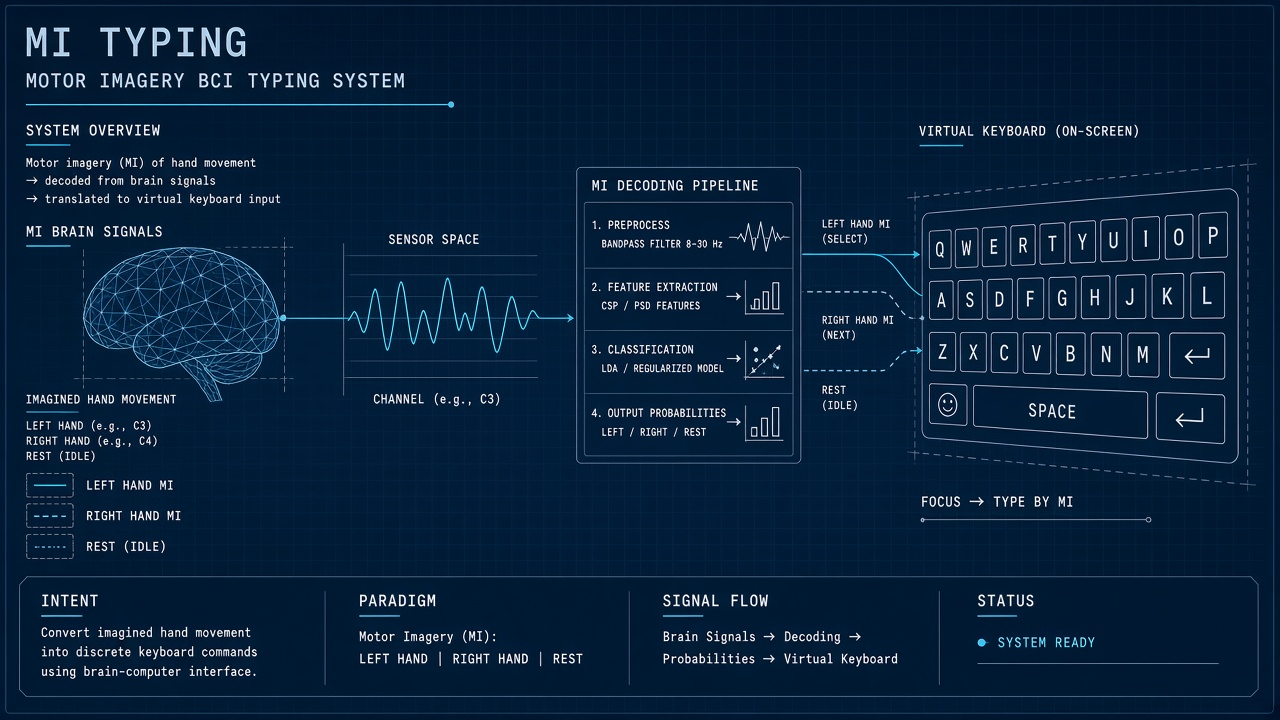
Motor imagery BCI typing lets users select characters or control cursors by imagining movement of body parts, while EEG records correlated changes in sensorimotor rhythms over motor cortex. Imagining right-hand movement typically suppresses power in the mu band (8 to 13 Hz) over left sensorimotor cortex (channel C3); left-hand imagery affects C4 symmetrically. Classifiers map these spatial-spectral patterns to commands such as "move highlight left," "confirm selection," or "activate speller."
Full alphabetic spelling with motor imagery alone is uncommon because binary or ternary classes (left, right, rest) select slowly through hierarchical menus. Most practical "typing" systems therefore hybridize paradigms: motor imagery toggles the speller on and off while P300 or SSVEP handles rapid letter picking, or motor imagery navigates grouped characters before a faster visual paradigm confirms the target. Neural interfaces span non-invasive EEG caps, invasive ECoG grids, and intracortical arrays; this article focuses on non-invasive EEG spellers while noting where invasive recordings change the decoding problem.
| BCI speller paradigm | User action | Typical speed | Motor imagery role |
|---|---|---|---|
| P300 | Count flashes toward target row/column | Moderate ITR, training often shorter | MI brain switch for self-paced on/off |
| SSVEP | Gaze at flickering target frequency | Often fastest non-invasive option | MI navigates groups before SSVEP pick |
| Pure motor imagery | Imagine left/right hand or feet | Slowest character rate | Primary selection mechanism |
| Hybrid sequential | MI then P300/SSVEP stages | Balanced in published hybrids | Gating plus fast visual spelling |
The 2023 Frontiers in Human Neuroscience mini-review on EEG BCI spellers identifies P300, motor imagery, and SSVEP as the three dominant non-invasive paradigms for communication in severe motor disorders, with hybrid spellers emerging to offset individual weaknesses. Users with locked-in syndrome may lack reliable eye movement for gaze-based SSVEP, making motor imagery or auditory P300 variants more relevant despite lower throughput.
AI Signal Processing Pipeline for MI Typing
Motor imagery typing systems chain EEG acquisition, artifact rejection, spatial-spectral feature extraction or deep representation learning, classification, and UI state machines that convert class labels into characters. Latency, calibration drift, and error correction UX determine whether laboratory accuracy translates into usable communication.
EEG Acquisition and Channel Selection
Consumer and clinical spellers use 8 to 64 channels, with motor imagery tasks emphasizing centro-parietal electrodes (C3, Cz, C4, CP3, CP4). Sampling rates of 250 to 512 Hz capture mu and beta band dynamics. Reference montages (common average, linked mastoids) affect classifier generalization; pipelines often re-reference offline and online consistently. Session start includes impedance checks because poor contact dominates failure modes more often than model architecture in field reports.
Preprocessing and Artifact Handling
Eye blinks and facial muscle activity contaminate motor imagery trials. Independent component analysis, linear discriminant analysis-based artifact removal, and notch filtering for power-line noise are standard. Some spellers reject trials when amplitude exceeds thresholds. For hybrid P300 spellers, ocular artifacts overlap with parietal P300 components, so preprocessing must preserve late positive potentials while removing blink transients.
Spatial-Spectral Features and Deep Models
Classical motor imagery decoders estimate covariance matrices per class and apply common spatial patterns to maximize variance for one class while minimizing others. Modern pipelines feed raw or band-filtered epochs into EEGNet, shallow ConvNets, or transformer encoders that learn spatial filters implicitly. Transfer learning from multi-subject datasets (BCI Competition IV, MOABB repositories) can reduce per-user calibration when fine-tuned with a small local session. Reported offline accuracies for two-class motor imagery often exceed 70 to 85% in able-bodied subjects; disabled users in clinical settings may need more adaptive calibration and longer training.
P300 and SSVEP Decoders in Hybrid Typers
P300 spellers flash rows and columns of a character matrix; target flashes evoke a positive deflection around 300 ms post-stimulus. Decoders use stepwise linear discriminant analysis, xDAWN spatial filters, or CNNs on epoched responses. SSVEP spellers tag each target with a unique flicker frequency; canonical correlation analysis or filter-bank CCA match EEG power at those frequencies. A sequential hybrid BCI speller published in ACM literature combined two-class motor imagery for group navigation with SSVEP character selection, reporting about 8.28 characters per minute at roughly 92.35% accuracy across six participants. A separate hybrid merged motor imagery brain switches with P300 spelling, yielding about 42.61 bits per minute in eleven participants with self-paced on/off control. These figures are trial-specific and should not be quoted as universal typing speeds.
Language Models and Autocomplete Layers
Post-decoder language models predict next words from partial strings, reducing the number of BCI selections required. This layer is not unique to motor imagery: any speller with low throughput benefits from dictionary pruning and large language model suggestions, provided the UI makes corrections easy when autocomplete guesses wrong. Engineers should log both raw character error rate and end-to-end word error rate because autocomplete can mask or amplify mistakes.
Feedback, Calibration, and Co-Adaptive Training
Motor imagery proficiency improves with neurofeedback displaying classifier confidence in real time. Co-adaptive systems update decoder weights during use when the user and model jointly drift. Session timeouts trigger recalibration if accuracy falls below configured thresholds. Pure P300/SSVEP spellers may need less motor imagery training but still require per-user template estimation for SSVEP frequencies.
Real Deployments, Evidence, and Paradigm Comparisons
BCI spellers have decades of laboratory history; motor imagery typing evidence is strongest for hybrid and switch applications rather than standalone high-speed keyboards. Invasive neural interfaces achieve higher throughput for cursor control in selected trial participants but follow different regulatory and surgical paths.
Non-Invasive Speller Landscape
The Frontiers 2023 mini-review summarizes evolution from P300 matrix spellers (Farwell, 1988 lineage) through SSVEP frequency-coded keyboards to motor imagery and hybrid designs. P300 and SSVEP generally deliver higher information transfer rates (ITR) than pure motor imagery in controlled settings; industry guides commonly cite SSVEP accuracies above 95% and ITR approaching 100 bits per minute in optimized lab configurations, though disabled-user cohorts and home lighting add variance. Motor imagery remains the primary option for asynchronous control: users initiate spelling without waiting for an external stimulus clock, valuable when visual fatigue or photic sensitivity limits SSVEP.
Hybrid MI-P300 and MI-SSVEP Results
Sequential hybrids illustrate how motor imagery contributes to typing without carrying the full character rate burden. The MI-plus-SSVEP speller (ACM, 2023) used motor imagery to move among character groups, then SSVEP to select within a group, integrating punctuation, digits, and backspace operators. The MI-gated P300 approach (International Journal of Human-Computer Interaction, 2016) let users voluntarily turn spelling on and off, addressing a core limitation of synchronous spellers that decode continuously even when the user is not trying to communicate. Self-paced hybrids reduce false positives at the cost of more complex mental strategies users must learn.
Invasive and ECoG Communication Contrast
Intracortical BCIs in BrainGate and related trials demonstrate typing and cursor control by decoding spiking activity from motor cortex, with multi-year safety data in fourteen participants reported through 2025 medRxiv analyses. ECoG-based home systems have restored grasp control with roughly 88 to 91% decoding accuracy over years in individual spinal cord injury cases. These invasive pathways can outperform EEG spellers on bits per minute when participants control two-dimensional cursors or discrete grids, but they are clinical investigations, not retail typing products. Motor imagery typing discussions for EEG should not promise invasive-tier speeds without qualifying the recording modality.
Clinical User Populations
BCI spellers target ALS, brainstem stroke, cerebral palsy with severe dyskinesia, and locked-in syndrome when eye-trackers fail. Motor imagery requires cognitive ability to sustain kinesthetic imagination; users with frontal injury may struggle. Oculomotor-limited patients may prefer auditory or tactile P300 variants over SSVEP. Teams should match paradigm to residual function rather than defaulting to the highest published ITR from healthy subject studies.
Limits, Risks, and Ethics
Motor imagery BCI typing introduces cognitive load, error recovery challenges, privacy concerns, and hype risk that signal processing papers rarely emphasize.
- Throughput ceiling: Pure motor imagery selects few symbols per minute. Even hybrid systems in published trials often remain below conversational speech rates or skilled eye-gaze typing.
- Training burden: BCI illiteracy affects a non-trivial fraction of users. Weeks of supervised practice may precede functional spelling.
- Error correction UX: Backspace and undo must be faster than re-spelling entire words. Poor correction design makes accurate decoders feel unusable.
- Photic and cognitive fatigue: SSVEP and P300 hybrids reintroduce visual stress; motor imagery alone reduces flicker but increases mental effort.
- False positives in self-paced mode: Brain switches can activate spellers unintentionally if rest-state classifiers drift.
- Data governance: Spellers capture health and communication content. Vendors need clear policies on cloud storage, caregiver access, and law enforcement requests for neural logs.
- Autonomy and consent: Locked-in users depend on caregivers for electrode setup. Ethical trials ensure continued assent and alternative communication if BCI sessions fail.
Qualify public claims: a hybrid reaching 8 characters per minute in six participants is promising research, not proof that motor imagery typing replaces commercial accessibility keyboards for the general disability market.
Who Should Adopt vs Who Should Wait
Motor imagery BCI typing fits users who lack reliable motor and oculomotor channels yet can sustain imagined movement tasks, usually within clinical or research programs today.
| User or team | Guidance | Notes |
|---|---|---|
| ALS patient losing eye-gaze ability | Explore hybrid MI-P300/SSVEP trials | Prioritize self-paced gating |
| User with functional eye tracking | Use eye-gaze keyboard first | Higher commercial maturity |
| Engineer prototyping assistive comms | Start with open P300/SSVEP baselines | Add MI brain switch second |
| Clinic evaluating invasive BCI | Separate EEG speller from implant trials | Different endpoints and risks |
| Photic-sensitive patient | Favor MI or auditory P300 | Avoid high-frequency SSVEP flicker |
Speech-language pathologists and rehabilitation engineers should benchmark BCI spelling against low-tech partner assisted scanning and high-tech eye gaze before committing months to motor imagery training. If eye gaze remains viable, BCI typing is rarely the first-line solution in 2026 clinical practice outside specialized centers.
Frequently Asked Questions
What is motor imagery BCI typing?
Motor imagery BCI typing uses imagined limb movement patterns recorded by EEG to control character selection or speller state machines, often combined with P300 or SSVEP for faster letter picking. No overt muscle movement is required.
How does motor imagery compare to P300 and SSVEP spellers?
P300 and SSVEP generally offer higher typing throughput and may need less motor imagery training; motor imagery enables asynchronous, stimulus-free control and brain-switch gating. Hybrids merge strengths in sequential designs.
How fast is motor imagery typing?
Pure motor imagery spellers are slow; published hybrid systems report on the order of single-digit to low double-digit characters per minute in small cohorts. Do not expect QWERTY keyboard speeds without invasive interfaces or substantial autocomplete assistance.
How long does training take?
Training varies widely; some users achieve reliable two-class motor imagery in days, others need weeks or never reach stable performance. Neurofeedback and co-adaptive decoders can shorten calibration but add system complexity.
Which AI models process motor imagery spelling EEG?
Common spatial patterns with LDA, EEGNet, CNN and transformer hybrids, CCA for SSVEP, and xDAWN-enhanced P300 decoders appear across the literature. Preprocessing and UI design often dominate user experience more than marginal architecture changes.
Is motor imagery typing only non-invasive?
Motor imagery tasks are paradigm-level instructions; they can pair with EEG, ECoG, or intracortical recordings, but consumer discussions usually mean scalp EEG spellers. Invasive trials pursue higher bandwidth cursor control rather than retail MI keyboards.
What is a motor imagery brain switch?
A brain switch uses motor imagery to toggle a speller between idle and active states so decoding runs only when the user intends to communicate. This reduces false selections in P300 and SSVEP systems.
Are motor imagery spellers commercially available?
Research platforms and specialized clinics offer experimental spellers; widely cleared home EEG typing products with pure motor imagery remain limited as of 2026. Verify regulatory status before clinical deployment outside trials.
Conclusion
Motor imagery BCI typing occupies a specialized niche in neural interface communication: imagined movement supplies self-paced control and brain switches while faster visual paradigms handle character throughput. AI pipelines filter EEG, learn spatial-spectral discriminants, fuse hybrid decoders, and layer language models for correction. Evidence from hybrid MI-SSVEP and MI-P300 studies shows practical spelling rates in small groups, but non-invasive motor imagery alone does not yet rival eye gaze or invasive cursor BCIs for speed. Teams should match paradigm to patient capabilities, qualify throughput claims, and treat neural data as sensitive health information. Motor imagery BCI typing remains a vital research direction for locked-in users without other channels, not a universal replacement keyboard. Continue exploring assistive AI on the blog index and compare interaction loops with AI chatbot systems that also translate ambiguous human input into reliable text.