Investment memos compress months of research into a few pages that portfolio managers use to size positions, defend ideas in investment committee, and document risk. Analysts spend disproportionate time extracting facts from 10-K filings, earnings call transcripts, and supplier disclosures before they ever write a thesis paragraph.
An AI workflow for investment analyst memo drafts accelerates ingestion and first-pass structure while keeping the investment thesis, position sizing logic, and compliance sign-off firmly human-owned. This guide covers research operations for equity and credit analysts at funds with formal memo requirements. Pair filing extraction with AI transcription for call audio and AI chatbot tools only inside approved research environments with citation verification.
What an AI Memo Workflow Does Not Replace
AI does not replace analyst judgment on catalysts, variant perception, or position sizing; it replaces repetitive extraction and outline scaffolding. Funds that treat model output as finished research invite compliance failures and bad trades. The workflow below assumes every numeric claim and quoted management statement traces to a source document before the memo reaches a portfolio manager.
- Thesis ownership stays with the covering analyst and sector lead.
- Valuation assumptions and scenario weights require explicit human inputs.
- Short ideas and negative catalysts need the same citation rigor as long pitches.
- Compliance reviews MNPI boundaries before external distribution.
- Models in Excel or internal tools remain the system of record for numbers.
Ingest 10-K Excerpts and Transcripts
Start each memo cycle by loading authoritative source excerpts into an approved research workspace: annual report risk factors, MD&A paragraphs, segment footnotes, and verbatim earnings transcript Q&A. AI summarizes faster when prompts specify filing date, fiscal period, and exhibit reference. Never upload entire unrestricted data rooms to consumer chat tools.
- Pull the latest 10-K, 10-Q, and 8-K items from EDGAR or your data vendor feed.
- Attach earnings transcript PDFs with speaker labels and timestamps when available.
- Redact deal-room materials that have not cleared compliance for AI processing.
- Chunk long filings by section so the model cites page or item numbers accurately.
- Log which model version and prompt template processed each source batch.
| Source type | Typical AI task | Human verification |
|---|---|---|
| 10-K risk factors | Cluster themes and compare year over year | Analyst confirms materiality ranking |
| Earnings transcript | Extract guidance changes and tone shifts | Quote check against audio or vendor text |
| Supplier 10-K | Map customer concentration disclosures | Cross-foot to issuer 10-K customer note |
| Industry trade press | Summarize for context only | Exclude from compliance-grade citations |
Transcript Ingestion Hygiene
Vendor transcripts differ from raw audio; mismatches appear in numbers and speaker attribution. Transcription tools help when you control the audio source and retention policy. Compare AI-extracted quotes to the vendor transcript line by line for any sentence that enters the memo body or footnotes.
Draft Thesis, Risks, and Valuation Sections
After source ingestion, AI drafts memo sections from a fixed template: investment thesis, key debates, risk register, valuation summary, and catalyst calendar. The analyst supplies variant perception bullets and explicit bull, base, and bear assumptions before generation. AI fills gaps in prose; it does not invent conviction levels.
A practical section order keeps portfolio managers oriented:
- Recommendation and position: Long, short, or watch; not for AI to set.
- Thesis in three sentences: Analyst writes first; AI suggests clarity edits only on request.
- Variant perception: What the market misses; requires analyst-owned bullets.
- Risks and mitigants: AI lists filing risks; analyst ranks and adds idiosyncratic items.
- Valuation: Pull multiples and DCF outputs from the model; AI narrates methodology.
- Catalysts: Dated events from filings and management commentary with source tags.
Valuation Narrative Without Model Drift
Link valuation paragraphs to frozen model tabs exported as PDF or screenshot with version hash. When AI paraphrases model output, small rounding errors become investment mistakes. Prompts should reference cell ranges or exported tables, not live spreadsheets the model cannot see reliably.
Verify Citations Against Sources
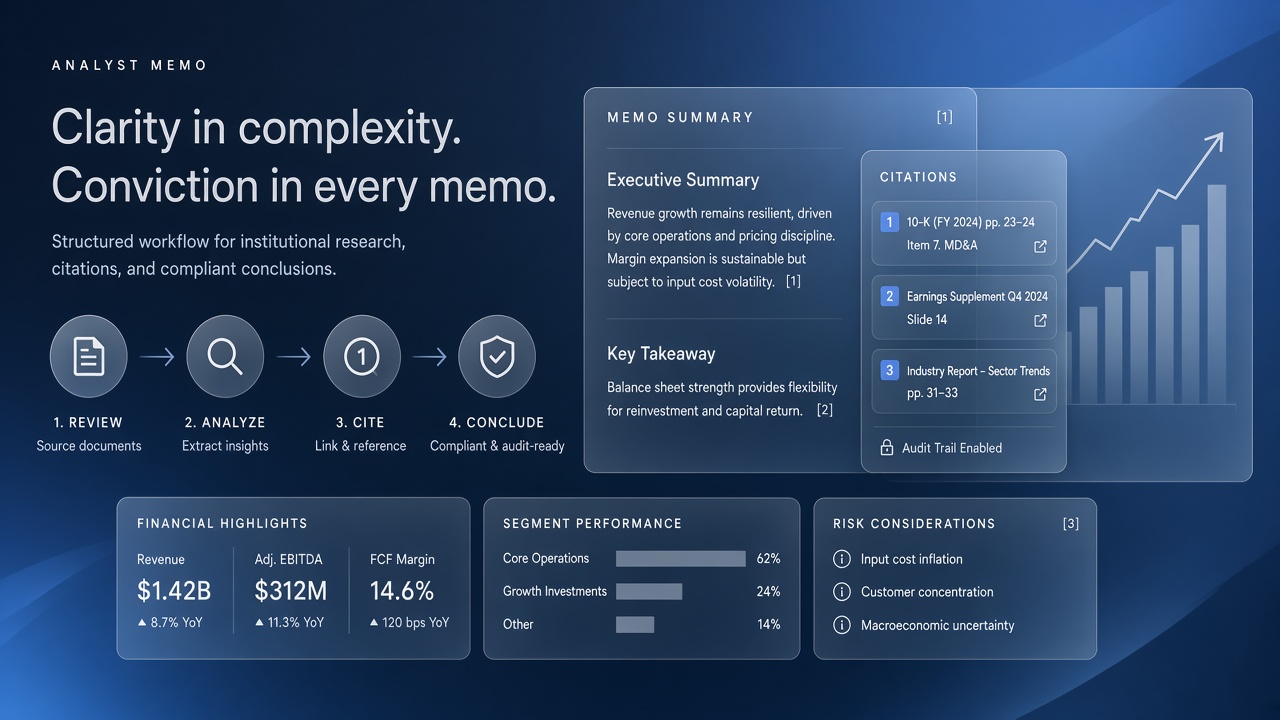
Every factual sentence in an AI-assisted memo needs a citation pass where the analyst opens the source document and confirms the claim, page reference, and fiscal period. Hallucinated footnotes are the primary failure mode. Build verification into the workflow as a gate, not an optional cleanup step.
- Highlight AI-drafted paragraphs in a distinct color until verified.
- Require exhibit, page, or transcript timestamp for each quoted management statement.
- Reject paraphrases that upgrade cautious filing language into definitive claims.
- Run a second analyst or associate spot-check on risk and accounting sections.
- Archive source PDFs with the memo version in the research management system.
| Citation element | Pass criteria | Common AI error |
|---|---|---|
| Revenue guidance | Matches exact wording in transcript | Blends prior quarter language |
| Segment margin | Matches 10-K table and fiscal year | Uses interim press release only |
| Legal contingency | Quotes risk factor or legal note | Overstates probability of loss |
Chatbot Boundaries in Research
General-purpose chatbots lack audit trails and may train on prompts unless enterprise terms forbid it. Restrict memo drafting to vendor instances with zero-retention settings, SSO, and exportable conversation logs. Prohibit uploading MNPI or pre-announcement materials regardless of vendor marketing claims.
PM Review and Compliance Clearance
Portfolio managers review thesis and risk before compliance clears language for internal circulation or external distribution. AI accelerates draft turnaround; it does not shorten accountability. Compliance checks MNPI policies, fair disclosure, and side-pocket rules before the memo lands in shared drives.
- PM review: Is the thesis actionable? Does risk match position size?
- Sector lead review: Consistency with house view and cross-name exposures.
- Compliance review: MNPI, personal trading, and marketing rule alignment.
- Archive: Final PDF with approver names and model version metadata.
Investment Committee Packets
IC packets combine the memo, model summary, and dissent notes when PM and analyst views diverge. AI can format appendix tables from verified exports but should not generate new arguments after PM sign-off. Any post-IC edit triggers a compliance re-read when distribution widens.
Memo Cadence and Version Control
Update memos on catalyst events, not on every model tweak. Version memos with dates and change summaries so PMs know what shifted. AI diff tools help compare filing language year over year; analysts interpret why the change matters for the thesis.
Short Idea Documentation
Short memos require the same citation discipline and compliance path as long pitches. Document borrow availability, squeeze risk, and accounting red flags with primary sources. AI can structure bear cases from filings; the analyst owns the timing and sizing decision.
Sector Comparison Appendices
AI can draft peer comparison tables from public filings when analysts supply the peer set and metrics list. Verify every cell against the source 10-K or data vendor field. Do not let the model add peers without sector lead approval. Comparison appendices support IC discussion but rarely belong in external research without compliance edit.
Earnings Season Throughput
During earnings season, run a lighter memo update workflow: transcript diff, guidance table refresh, and thesis flag only when numbers change the variant perception. Full memo rewrites every quarter waste PM attention. AI accelerates the diff step; analysts decide whether the quarter was noise or signal for position size.
Credit and Equity Handoffs
Cross-asset teams should share filing excerpts through the research system, not ad hoc chat exports. When credit analysts contribute to equity memos, citation standards stay identical. AI summaries of bond indentures or covenant packages need lawyer or credit lead review before they influence equity risk sections.
Prompt Library Governance
Maintain approved prompt templates for memo sections so junior analysts do not improvise instructions that weaken citation requirements. Research ops owns template versions, effective dates, and retirement of prompts tied to deprecated model endpoints. Quarterly reviews sample AI-assisted memos for template compliance and citation accuracy trends.
Frequently Asked Questions
How do we keep MNPI out of AI memo workflows?
Block upload of non-public deal materials, board materials, and pre-release financials to any AI tool without compliance approval. Use allowlisted enterprise endpoints with logging. Train analysts to run public-filing-only prompts in shared templates. Compliance audits sample prompts quarterly.
Can AI draft short investment memos?
Yes for structure and filing extraction, but shorts need explicit human ownership of catalyst timing and risk of being wrong. AI should not infer undisclosed investigations or channel checks. Every negative claim cites a public source or is labeled analyst estimate with model reference.
Should AI update our Excel models?
Keep models in Excel or internal quant tools; use AI to narrate outputs, not to write live formulas without review. When AI suggests formula changes, a second analyst validates links and circular references. Export frozen outputs into the memo workflow after model sign-off.
What changes for client-facing research?
Client memos need marketing and compliance review beyond internal IC standards. Remove draft markers, verify no AI placeholder language remains, and confirm disclaimers match jurisdiction. External distribution lists are not the place to experiment with new AI vendors.
Structured Memos, Human-Owned Thesis
Investment analysts gain speed when AI ingests filings and drafts memo scaffolding while citation verification, PM review, and compliance clearance stay non-negotiable. The edge remains in variant perception and risk judgment, not in faster hallucinations.