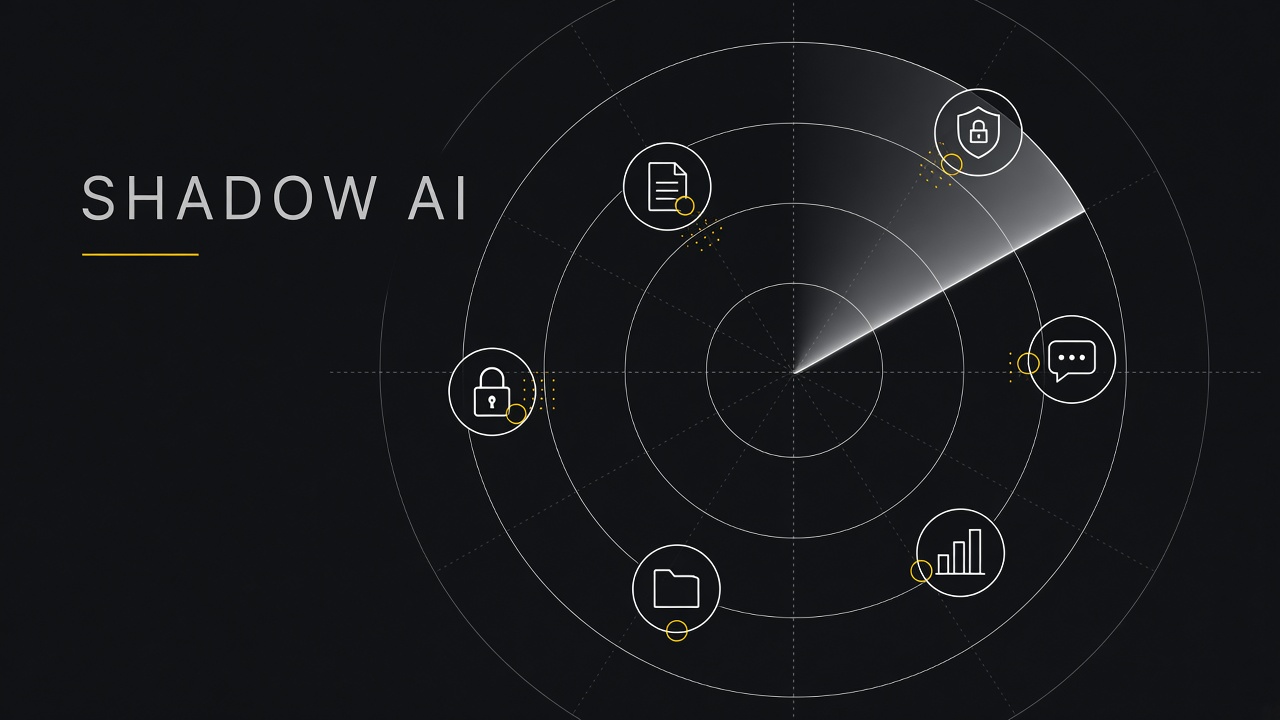
Employees adopt ChatGPT, Claude, Copilot, image generators, and browser extensions faster than IT can approve them. Security teams learn about shadow AI from data loss alerts, customer questionnaires, or board questions, not from proactive visibility. By then, confidential documents may already sit in vendor training pipelines or personal accounts outside DPAs and audit scope.
A shadow AI discovery program systematically detects unapproved AI tool usage through technical and administrative signals, triages findings without punishing reporters, converts discoveries into inventory entries, and tracks metrics leadership can report. This guide helps security, IT, and governance owners find unauthorized tools before auditors do, covering AI productivity apps and AI chatbot services across corporate and remote environments.
Definition: Shadow AI vs Approved Exceptions
Shadow AI is any AI tool processing organizational data outside your approved inventory, foundation model policy, and procurement path; approved exceptions are time-boxed, documented deviations with named risk owners. Personal experimentation on public data without company content is lower priority than shadow use involving customer PII, source code, or financial records. Discovery programs must distinguish benign personal use from policy violations to preserve employee trust.
| Category | Definition | Discovery response |
|---|---|---|
| Sanctioned | In inventory register, active approval | Monitor usage; no remediation |
| Approved exception | Time-boxed pilot with sign-off | Track expiry; promote or retire |
| Shadow AI | Unapproved tool with org data | Triage, remediate, or fast-track approval |
| Embedded shadow | AI feature in otherwise approved SaaS | Vendor assessment and config review |
| Personal use | No org data on personal account | Policy reminder; low enforcement priority |
Embedded AI Features
Shadow AI includes AI toggles inside approved CRM, productivity, and developer tools when those features were never assessed for your data classes. Discovery must scan feature flags and OAuth scopes, not only standalone AI domains.
Agentic Desktop Apps
Local AI agents (desktop chat clients, Ollama, coding agents) create shadow risk on endpoints even without cloud SSO. Microsoft 365 admin center Shadow AI preview detects several desktop agents via Defender for Endpoint when enabled.
Detection Signals: DNS, CASB, Expense, Browser Extensions
Combine multiple detection signals because no single source catches every shadow AI path: DNS and proxy logs, CASB cloud app discovery, SSO OAuth grants, expense report keywords, browser extension inventories, DLP uploads, and employee surveys. Forrester 2026 analysis cited organizations reducing untracked AI usage significantly within 30 days of automated detection. Multi-source correlation reduces false positives.
| Signal | Tool examples | False positive handling |
|---|---|---|
| DNS and proxy egress | SWG, Zscaler, Netskope categorization | Marketing site visits vs authenticated sessions |
| CASB / SSPM | Cloud app discovery, OAuth monitoring | Personal Microsoft/Google tenant separation |
| Expense reports | Keyword scan: OpenAI, Anthropic, Midjourney | Verify business purpose before escalation |
| Browser extensions | MDM, Defender, extension allowlists | Benign grammar tools vs data-exfil extensions |
| DLP uploads | Alerts on paste to known AI domains | Sample content review before accusation |
| Employee survey | Anonymous tools-in-use questionnaire | Triangulate with technical signals |
AI Domain Catalog
Maintain a curated catalog of generative AI domains and API endpoints updated monthly; correlate with AI chatbot and AI productivity vendor lists from your procurement team. Community blocklists drift quickly as new tools launch.
SIEM Integration
Feed high-confidence discovery events into SIEM for correlation with identity anomalies and DLP incidents. Credo AI and similar platforms integrate shadow AI signals with governance workflows.
Triage Workflow and Amnesty Windows
Triage discoveries by data sensitivity, user count, and integration depth; offer amnesty windows where employees self-report tools without disciplinary action to accelerate inventory completeness. Punitive first responses drive concealment. Amnesty pairs with clear deadline and requirement to migrate to approved alternatives or request formal exception.
- Automated alert or survey finding creates discovery ticket.
- Analyst validates signal (false positive filter within 48 hours).
- Classify data classes involved via interview or DLP sample.
- Assign risk tier: critical (regulated data), high, medium, low.
- Notify user manager and tool user with remediation options.
- Amnesty path: self-report before deadline avoids escalation.
- Escalate repeat offenders or critical data exposure to security incident process.
Communications Templates
Prepare non-accusatory notification templates explaining policy, approved alternatives, and exception request links. Frame discovery as governance enablement, not surveillance punishment.
Legal and HR Coordination
Coordinate with HR and legal before monitoring expands; document lawful basis and scope in employee privacy notices where required. Works council consultation may apply in EU entities.
Convert Discoveries to Inventory Entries
Every validated shadow AI finding becomes a draft inventory register entry with discovery source, data classes observed, user population, and remediation status until promoted to sanctioned or decommissioned. Discovery without inventory integration recreates the problem next quarter. Link entries to foundation model policy exceptions or new procurement workflows.
- Draft entry: minimum fields from inventory register standard.
- Fast-track security review for tools with demonstrated business value.
- Block and migrate when no approval path exists.
- Document decommission evidence: account closure, extension removal.
- Update SSO and proxy allowlists to reflect final state.
Approved Alternative Catalog
Publish an internal catalog of approved AI tools by use case so remediation means migration, not deprivation. Employees adopt shadow tools when approved paths are slower than signup friction.
Procurement Acceleration
Pre-negotiate enterprise agreements for top shadow candidates to convert discoveries into sanctioned tools within SLA. Shadow discovery data informs which vendors to prioritize.
Metrics: Discovery Rate, Time-to-Classify, Repeat Offenders
Track discovery rate (new shadow tools per quarter), mean time to classify, remediation completion rate, inventory coverage percentage, and repeat offender count by department. Leadership dashboards prove program value. Declining critical-tier discoveries with rising sanctioned adoption indicates healthy governance.
| Metric | Definition | Target direction |
|---|---|---|
| Discovery rate | New validated shadow tools per quarter | Decrease after initial baseline |
| Time-to-classify | Hours from alert to risk tier assignment | Under 72 hours for high signals |
| Remediation rate | Closed findings within SLA | Above 90 percent |
| Inventory coverage | Estimated AI usage captured in register | Increase quarterly |
| Repeat offenders | Users with multiple post-remediation violations | Decrease with training and alternatives |
Baseline and Reporting
Establish a 30-day discovery baseline before enforcement intensifies; report month-one and month-three progress to governance council. Knostic and similar programs cite preliminary visibility within 30 days when combining knowledge-layer and network signals.
Continuous Monitoring
Configure CASB and SSPM alerts for new AI app OAuth grants and uncategorized generative AI traffic; review weekly, not annually. Shadow AI is ongoing discipline, not a one-time sweep.
90-Day Program Roadmap
Days 1 to 30 focus on visibility and baselining; days 31 to 60 on triage workflow and amnesty; days 61 to 90 on inventory integration and continuous monitoring. Avoid enforcement-heavy day-one rollout that triggers resistance before you understand true usage patterns.
Week One Actions
Define shadow AI policy scope, enable cloud app discovery logs, publish amnesty announcement, and assign discovery analysts. Quick wins build executive confidence.
Department Champions
Recruit department AI champions who receive early visibility into approved tools and help triangulate survey findings with team-specific workflows. Champions reduce adversarial dynamics between security and business units. They escalate novel tools before wide adoption makes remediation painful.
Vendor-Embedded Discovery
Review existing SaaS contracts for newly announced AI features during quarterly vendor business reviews; ask account teams which models power embedded assists and whether your data classes are supported. Embedded shadow AI often appears in CRM, ticketing, and design tools before standalone AI apps show up in proxy logs.
Board Reporting
Summarize shadow AI metrics quarterly for board risk committees: critical-tier open findings, inventory coverage trend, and top unapproved tools by user count. Boards increasingly ask about AI governance maturity; discovery metrics demonstrate proactive control rather than reactive incident response. Include year-over-year comparison once baseline data exists.
Frequently Asked Questions
Does shadow AI discovery violate employee privacy?
Discovery should use employer-owned systems metadata (network, SSO, managed devices) under documented acceptable use policy, not read personal messages or unrelated browsing history. Minimize data collection to domains and apps necessary to identify AI tool use. Consult legal on jurisdiction-specific monitoring rules.
How do we discover shadow AI for remote workers?
Remote discovery relies on VPN or SWG egress when traffic routes through corporate controls, MDM on managed devices, and SSO on cloud identity regardless of location. Unmanaged personal devices on guest networks remain blind spots; policy should prohibit processing company data on unmanaged endpoints.
What about personal devices and BYOD?
BYOD environments cannot fully instrument shadow AI; enforce data handling policy prohibiting company data on personal AI accounts and use VDI or managed browser for sensitive work. Discovery focuses on corporate-controlled channels where policy is enforceable.
Should we block all unapproved AI domains immediately?
Block high-risk data exfiltration paths first; use monitor-mode on broader categories during amnesty to build inventory before hard blocks. Sudden blanket blocks without alternatives increase circumvention via personal hotspots.
Implementation Roadmap
Week one: policy definition and signal enablement; weeks two to four: baseline and amnesty; month two: triage SLAs and inventory backfill; month three: continuous monitoring and leadership metrics. Integrate with AI governance council quarterly reviews. Pair discovery with faster approved-tool provisioning so governance enables productivity rather than blocking it.
Conclusion
Shadow AI discovery succeeds when definitions separate violations from exceptions, detection combines DNS, CASB, expense, extension, and survey signals with false-positive handling, triage uses amnesty to build trust, discoveries convert to inventory entries, and metrics prove shrinking blind spots. Security and governance teams who find unapproved tools proactively close the gap between employee innovation speed and audit-ready AI oversight.