Your team runs a customer support bot, a code review assistant, and a compliance classifier on the same platform. One request needs a fast, cheap reply. The next needs deep reasoning over a long policy document. A third must stay inside a specific region and never touch a general-purpose cloud endpoint. If every call hits the same flagship model, you overpay on simple tasks and under-serve complex ones.
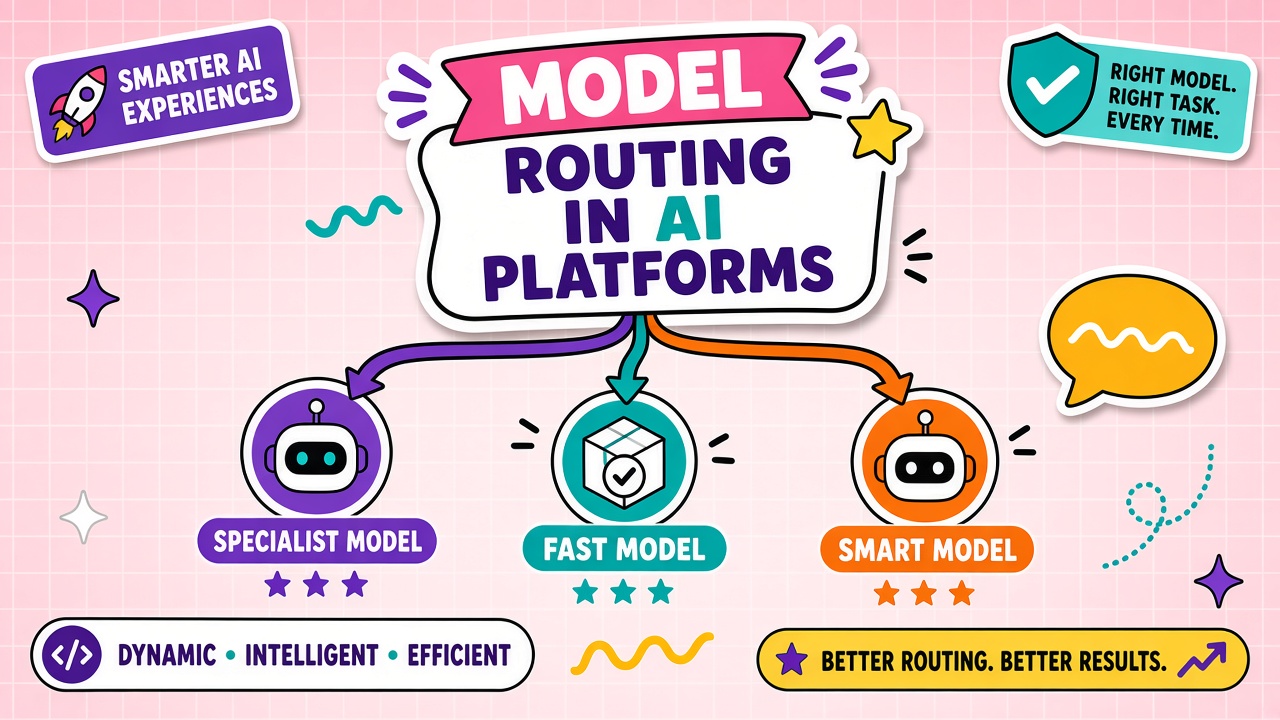
Model routing in AI platforms is the practice of selecting which foundation model handles each request based on rules, classifiers, or a meta-model decision layer. Instead of hard-coding one model for all traffic, routing systems evaluate inputs and constraints, then dispatch work to the model that best balances cost, latency, output quality, and compliance. OpenAI, Anthropic, Google, AWS Bedrock, Azure OpenAI, OpenRouter, and LiteLLM all expose multiple models per account; routing is how production teams use that catalog without asking users to pick model names manually. This guide explains how model routing works, what goals it optimizes, how to verify routing decisions in invoices and logs, and the risks when routing goes wrong. Teams building AI productivity workflows or evaluating a private AI chatbot should understand routing before trusting a single "auto" setting.
What Model Routing Does: Pick a Model Per Request
Model routing sits between your application and the model API. When a request arrives, the router inspects metadata (task type, token count, user tier, data sensitivity) and chooses a target model or endpoint. The caller may see one unified API; behind it, different models handle different traffic slices.
Routing is not the same as load balancing across identical replicas. Load balancing spreads identical work across servers. Model routing sends different work to different models because the models differ in capability, price, speed, and policy constraints.
Three common routing mechanisms
- Rule-based routing: Deterministic if-then logic. Example: requests under 500 tokens use a small model; requests tagged "legal review" use an enterprise model in a specific region.
- Classifier routing: A lightweight model or embedding classifier predicts task difficulty or intent, then maps the prediction to a model tier. Common for support bots that escalate complex tickets automatically.
- Meta-model routing: A separate model (or orchestration layer) reads the prompt and selects the best downstream model. Some platforms call this "model router" or "auto model selection." Latency increases because the routing step itself consumes tokens or compute.
Hybrid stacks are typical: rules enforce compliance boundaries, classifiers handle volume traffic, and meta-models resolve ambiguous cases. The routing layer may also fall back to a stronger model when the first attempt returns low confidence or fails validation.
Goals: Cost, Latency, Quality, and Compliance
Model routing exists to optimize multiple objectives at once. No single model wins on every dimension. Routing trades off those dimensions per request instead of forcing one global compromise.
| Goal | Routing tactic | Example |
|---|---|---|
| Cost | Route simple queries to smaller, cheaper models | FAQ lookups on a mini model; architecture reviews on a flagship model |
| Latency | Prefer faster models for real-time UI; reserve slow models for batch | Live chat uses a low-latency tier; nightly report generation uses a reasoning model |
| Quality | Escalate when classifiers detect complexity or low confidence | First pass on a mid-tier model; retry on a frontier model if validation fails |
| Compliance | Hard-route sensitive data to approved endpoints and regions | PII-containing prompts never leave a VPC-hosted model deployment |
Cost savings from routing are real but not automatic. A poorly tuned classifier that escalates too often erases savings. Quality gains from escalation only appear when the fallback model genuinely outperforms on the tasks you escalate. Define success metrics per route: p95 latency, cost per resolved ticket, human override rate, and policy violation count.
How enterprise gateways implement routing
Unified gateways like OpenRouter and LiteLLM expose one API key and route to OpenAI, Anthropic, Google, and open-weight providers based on configuration. Enterprise AI hubs inside AWS, Azure, and Google Cloud add policy layers: budget caps, allowed model lists, and region pins. Consumer chat products often hide routing entirely, surfacing only an "auto" mode that optimizes for vendor-defined cost targets.
Transparency: Invoices, Logs, and Routing Decisions
Opaque routing creates billing surprises and debugging nightmares. Production routing must expose which model handled each request, why it was chosen, and what fallback path executed if the first model failed.
Minimum observability for routed systems
- Model ID per request: The exact model name and version, not a generic "auto" label on invoices only.
- Routing reason: Rule name, classifier score, or meta-model decision metadata stored alongside the trace.
- Token and cost breakdown: Input tokens, output tokens, and per-model unit cost for chargeback to teams or customers.
- Fallback chain: If the first model timed out or failed validation, log which model ran next.
- Latency per hop: Routing overhead plus model inference time reported separately.
Cloud provider consoles (AWS Bedrock, Azure OpenAI, Google Vertex AI) break usage down by model in billing reports. Application-level tracing tools (OpenTelemetry, LangSmith, Helicone, custom middleware) should attach routing metadata to each span. Without that linkage, a user complaint about a bad answer cannot be tied back to which model produced it.
Ask vendors whether "smart routing" or "auto model" modes disclose the selected model in API responses and audit logs. If the answer is no, treat routing as a black box and test quality on your own eval set before relying on it for customer-facing workflows.
Risks: Wrong Model, Opaque Downgrades, and Silent Failures
Model routing fails when the router sends work to an underpowered model, when platforms downgrade quality without disclosure, or when fallback logic masks errors instead of surfacing them.
Wrong model for the task
A classifier trained on support tickets may mislabel a nuanced billing dispute as a simple FAQ. The small model gives a confident but wrong refund policy. Routing saved cents and cost a customer. Mitigate with confidence thresholds, human escalation paths, and periodic eval runs on production traffic samples.
Opaque downgrades
Some products advertise a flagship model in marketing but route a portion of traffic to cheaper models under load or for certain account tiers. Users perceive quality drops without understanding why. Read terms, test at peak hours, and compare outputs when you force a specific model versus "auto" mode.
Compliance routing gaps
A rule that routes "internal only" data to a private endpoint fails if a tool call or sub-agent bypasses the router and hits a public API. Multi-step agent workflows need routing enforced at every hop, not only the first LLM call.
Cascade and retry inflation
Aggressive fallback chains (try model A, then B, then C) multiply cost and latency on failures. Cap retries, alert on fallback rate spikes, and distinguish transient API errors from quality-based re-routing.
Implementing Model Routing in Practice
Start with explicit rules before adding ML classifiers. Rules are auditable and easy to explain to compliance teams. Add classifiers when rule maintenance becomes unwieldy and you have labeled data showing which tasks need stronger models.
- Inventory models available on your platform with price, latency, and context limits per tier.
- Segment traffic by task type: classification, summarization, code generation, creative writing, retrieval QA.
- Define hard compliance routes that cannot be overridden by classifiers.
- Build an eval set per segment; measure quality when each segment uses the cheapest eligible model.
- Log routing decisions from day one; retroactive logging is painful after an incident.
- Review routing rules quarterly as vendors release new models and retire old ones.
For a private AI chatbot deployed on-premises, routing may mean choosing between a local 7B model for drafts and a cloud frontier model for final review. The architecture is the same: explicit policy, logged decisions, and user-visible overrides when stakes are high.
Frequently Asked Questions
Is model routing the same as load balancing?
No. Load balancing distributes identical requests across redundant copies of the same service for availability and throughput. Model routing selects different models with different capabilities and prices for different requests. Both can coexist: routing picks the model tier, load balancing picks which replica within that tier.
What happens when the routed model fails?
Depends on your configuration. Common patterns: retry the same model once, fall back to a stronger model, return an error to the user, or queue for batch retry. Document your fallback chain and test timeout behavior. Silent fallback to a weaker model without user notification is a frequent source of quality complaints.
Can we define custom routing rules?
Yes on most self-hosted and API-gateway setups. Managed chat products may limit routing to preset tiers. If you control the application layer, middleware can inspect prompts, user roles, and metadata before calling any model API. Custom rules are the most transparent routing option for regulated industries.
Should we trust platform "auto" model selection?
Treat auto selection as a starting point, not a guarantee. Run your own eval set comparing auto mode against fixed model assignments on your real prompts. Verify that auto mode respects data residency requirements and does not downgrade quality on your highest-value workflows without logging the switch.
How much can routing save on API bills?
Savings vary by traffic mix. Teams with many simple, high-volume queries often see meaningful reductions when those queries move off frontier models. Complex, long-context workloads see smaller percentage savings. Measure before and after on identical traffic; routing that escalates too aggressively can increase total spend.
Choosing Platforms With Sensible Model Routing
Model routing is how production AI platforms match each request to the right model for cost, speed, quality, and compliance. Rule-based, classifier, and meta-model approaches each trade transparency for flexibility. The best setups log every routing decision, enforce compliance boundaries with hard rules, and validate quality per route on real workloads. When comparing AI productivity tools or deploying a private AI chatbot, ask how model selection works, what appears in logs and invoices, and whether you can override auto routing for critical workflows.