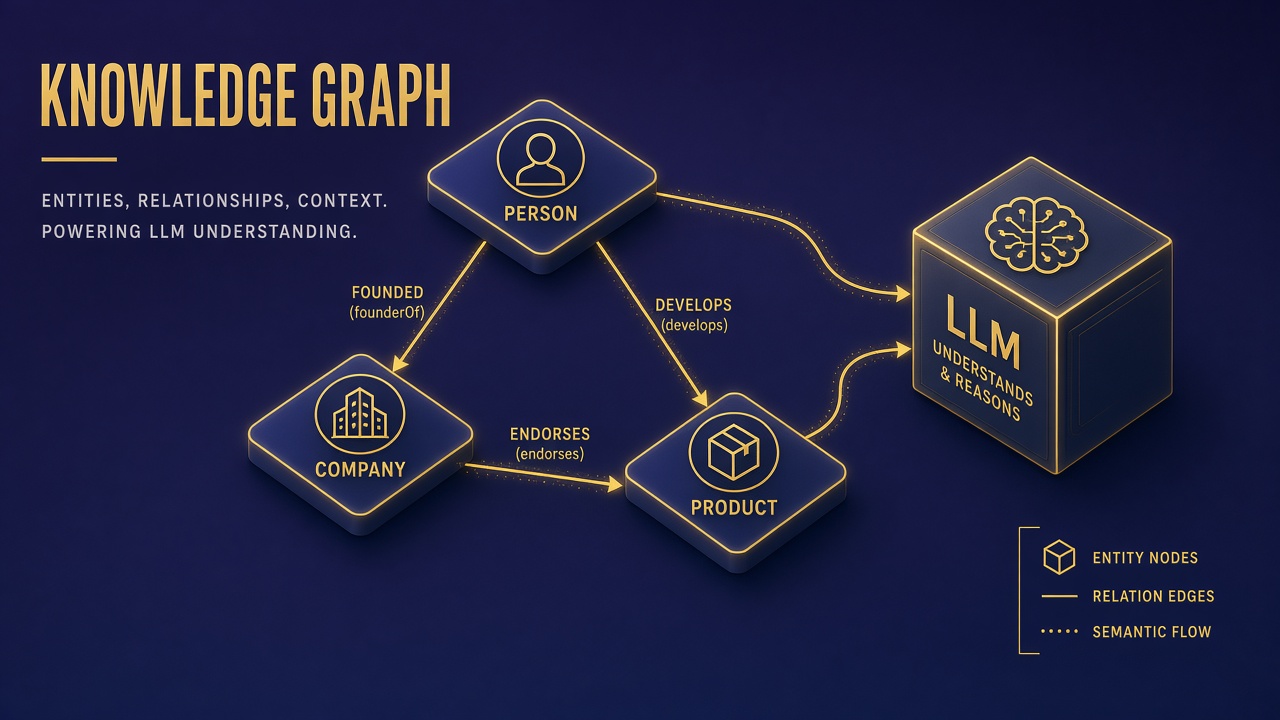
A user asks the pharma assistant, "Which trials is Drug X contraindicated with for patients on Medication Y?" Flat document search might return PDFs mentioning both names in separate paragraphs without stating the interaction. A knowledge graph stores `(Drug X, contraindicated_with, Medication Y)` as an explicit edge your system can traverse. Knowledge graph AI explained: structured networks of entities and relations that ground language models in checkable facts, not only similar text chunks. Graph-augmented retrieval appears in enterprise AI chatbot stacks for regulated domains and in multilingual AI translation pipelines that map terms to canonical concept IDs across languages.
Entities, Relations, and Triples
A knowledge graph models the world as nodes (entities) and directed edges (relations), often serialized as subject-predicate-object triples like `(Acme Corp, acquired, Beta LLC)`. Entities carry types (Person, Product, Regulation) and properties (founding year, SKU). Relations may be typed and constrained: only `Person` nodes may hold `CEO_of` edges to `Organization` nodes. Ontologies define allowed types and cardinalities so bad data fails validation at ingest instead of polluting answers months later.
Triple stores and property graph databases (Neo4j, Amazon Neptune, RDF triplestores) optimize pattern matching queries: "find all products supplied by vendors in country Z subject to tariff T." Vector search finds semantically similar paragraphs; graphs answer multi-hop structural questions with explicit provenance on each edge. Many products combine both in GraphRAG architectures.
| Concept | Example | Why it matters for AI |
|---|---|---|
| Entity | Drug X, Trial 442 | Canonical ID reduces ambiguity |
| Relation | contraindicated_with | Explicit logic, not inference from prose |
| Triple | (Drug X, interacts, Med Y) | Machine-checkable fact unit |
| Ontology | Pharma domain schema | Validates ingest and queries |
Building Graphs From Documents
Graph construction pipelines extract entities and relations from unstructured text using NER models, relation extraction models, or LLM-assisted parsing, then merge duplicates and link to existing canonical nodes. Human curators review high-impact edges before promotion to production graphs. Extraction from messy PDFs produces noise; confidence scores and source span citations (`page 12, paragraph 3`) let auditors verify each triple.
Structured sources (CRM, ERP, product catalogs) often sync directly into the graph via ETL, skipping LLM extraction for fields already relational. The graph becomes a integration hub: documents attach as evidence nodes linked to factual edges, not a replacement for the warehouse. Incremental sync jobs detect when a wiki page contradicts an existing edge and flag conflicts for resolution.
Entity resolution
Entity resolution merges "IBM," "International Business Machines," and stock ticker references into one node so traversals do not fragment. Blocking keys, fuzzy matching, and human merge tools prevent duplicate subgraphs. Poor resolution makes graph answers look incomplete even when data exists under another label.
Graph Traversal Plus LLM Synthesis
GraphRAG patterns run structured queries or subgraph expansions first, then pass compact neighborhood context to an LLM that narrates results in natural language with citations to nodes and edges. The LLM should not invent edges; it explains paths the graph returned. Query planners may translate natural language to Cypher, SPARQL, or Gremlin via fine-tuned parsers, or use iterative "expand one hop" loops guided by relevance scores.
Community detection on large graphs summarizes clusters ("supply chain risk group around Vendor A") for high-level questions that vector search handles poorly. Microsoft GraphRAG and academic variants popularized hierarchical summaries stored alongside raw triples. For customer-facing chatbots, cap traversal depth and node counts to control latency and prevent context window stuffing with entire subgraphs.
Maintenance, Drift, and Governance
Knowledge graphs decay when source systems change but edges are not updated, when extractors hallucinate relations, or when ontologies evolve without migration scripts. Assign graph stewards per domain. Version edges with `valid_from` and `valid_to` timestamps so historical questions use correct facts. Deprecate rather than delete nodes referenced in audit logs.
Drift detection compares new document extractions against existing triples and opens review tickets on conflicts. Lineage metadata records which pipeline version created each edge. Regulatory buyers expect reproducible answers: log graph query, result set, and model prompt hash per user question. Translation products linking terms to concept IDs in a graph reduce ambiguity when the same word maps to different entities across locales; coordinate with AI translation teams on canonical term lists.
| Risk | Symptom | Mitigation |
|---|---|---|
| Stale edges | Outdated policy relations | TTL alerts, source sync SLAs |
| Extractor noise | False drug interactions | Human review queue, confidence thresholds |
| Schema drift | Broken queries after deploy | Ontology versioning, migration tests |
| Over-merge entities | Wrong combined facts | Split tools, provenance on merges |
When Knowledge Graphs Are Overkill
Skip building a custom graph when a few thousand FAQ pages answer most questions, when facts change daily without stable entities, or when team lacks ontology maintenance capacity. Flat RAG with good chunking and hybrid search solves many internal helpdesk scenarios. Graphs earn investment when multi-hop reasoning is core to the product promise (compliance, supply chain, biomedical), when multiple apps must share one canonical entity layer, or when explainability requires showing the exact relations behind an answer.
Buy versus build: commercial knowledge platforms bundle extraction, governance UI, and query APIs. Custom Neo4j projects shine when domain ontologies are proprietary and integration depth exceeds vendor connectors. Pilot on one high-value entity type (products and suppliers) before graphing the entire enterprise.
Graph Storage and Query Languages
Property graph databases use labeled nodes and typed relationships queried with Cypher or Gremlin; RDF triplestores use SPARQL and emphasize interoperability with linked open data standards. Choose based on team skills and integration requirements. RDF shines when publishing externally shareable ontologies; property graphs often feel more ergonomic for application developers building GraphRAG services. Some teams mirror critical edges into both systems during migration, but dual-write complexity rarely lasts long.
Index strategy matters: index entity types, high-cardinality properties used in filters, and relationship types traversed in hot queries. Graph databases without careful indexing degrade on multi-hop expansions across millions of nodes. Shard or partition by domain (clinical vs commercial) when single-cluster memory limits approach.
Integrating Graphs With Existing Data Warehouses
The graph should not replace Snowflake or BigQuery; it links entities while warehouses hold historical metrics and event streams. Sync dimension tables into graph nodes nightly; stream high-velocity events into the warehouse only. Graph queries answer "who is connected to whom"; SQL answers "what was revenue last quarter." BI tools can call graph APIs for exploratory relationship views while finance keeps canonical numbers in SQL.
Evaluating Graph-Augmented AI
Benchmark graph systems on multi-hop questions with known paths, edge recall on newly ingested documents, and end-to-end answer correctness compared to vector-only RAG baselines. If graph retrieval rarely changes top answers, the graph may be ornamental. A/B tests should measure latency and curator workload alongside accuracy.
GraphRAG Implementation Roadmap
Month one: define ontology for one entity family and ingest structured sources. Month two: add LLM extraction with human review for unstructured docs. Month three: wire natural language to graph queries and compare answers against vector-only baseline. Skip building a custom UI until query accuracy beats RAG on ten benchmark questions stakeholders care about. Publish internal docs on which question types route to graph versus vector retrieval.
Frequently Asked Questions
Knowledge graph vs vector database?
Vector databases find similar text; knowledge graphs store explicit relations for structured traversal. Complementary in GraphRAG, not interchangeable.
How long does it take to build a useful graph?
Focused domain pilots can reach value in weeks when structured sources exist; enterprise-wide graphs often take quarters of ontology and curation work. Scope narrowly for first production use.
Is LLM relation extraction safe for regulated data?
LLM extraction requires human review or high-confidence automation with audit trails before edges affect patient or legal advice. Treat extractors as suggestions, not authoritative writes.
Are open-source graph databases production ready?
Neo4j, JanusGraph, and RDF stacks run large production workloads when staffed with graph DBA expertise. Managed cloud graph services reduce ops burden for smaller teams.
How large should the first graph be?
Start with thousands of curated nodes in one domain, not millions of noisy extractions across the whole company. Density and accuracy beat raw node count for user trust in AI answers.
Visualizing Graphs for Stakeholders
Interactive graph visualizations help curators spot orphan nodes, impossible edges, and duplicate entities before they reach production chatbots. Limit render depth in user-facing UIs to avoid hairball diagrams. Export subgraph PNGs for compliance packets showing which relations grounded a specific answer. Visualization is a governance tool, not vanity; tie each displayed edge to a source citation.
Knowledge Graph Maturity Model
Level 1 manual spreadsheets of entities; Level 2 automated ETL from systems of record; Level 3 LLM extraction with review queues; Level 4 GraphRAG in production with drift monitoring and ontology governance council. Skipping Level 2 and jumping to LLM extraction on wiki dumps creates graphs that look impressive in demos but fail auditors. Assign a named graph owner before Level 3 spend.
Knowledge Graph Security
Graph queries can leak information through multi-hop inference: learning one edge may reveal another through traversal even when direct edge ACLs looked safe. Run security reviews on common query templates. Rate-limit expensive traversals. Separate highly sensitive subgraphs into different databases with stricter network policies. Log graph queries with the same rigor as SQL audit trails.
Temporal and Probabilistic Edges
Real-world relations change: acquisitions reverse, drugs gain new contraindications, employees transfer departments. Model time on edges and attach confidence scores to LLM-extracted relations so downstream systems can threshold uncertain links. Probabilistic graphs help recommendation engines; regulated Q&A may require confidence above 0.95 or human-approved edges only. Never present probabilistic edges to end users as deterministic facts without disclosure.
Conclusion
Knowledge graph AI explained: entities and relations as first-class data, extraction and sync from documents and systems, traversal plus LLM narration for user-friendly answers, and continuous governance against drift. Graphs beat flat search when relationships matter and explainability is non-negotiable; they are overhead when FAQs suffice. Pair graph retrieval with vector RAG and clear maintenance ownership before marketing "enterprise knowledge graph" capabilities.
Pilot with subject matter experts who can validate edges, not only engineers who can deploy Neo4j. A graph that curators do not trust will be bypassed within weeks, and the LLM will again free-associate from unstructured text. Success looks like auditors nodding at cited triples, not like a impressive three-dimensional visualization in a sales deck. Revisit ontology decisions quarterly; stale entity types are the silent killer of graph ROI, because extractors keep minting nodes your query layer no longer understands. Budget curator hours the same way you budget GPU hours for embedding pipelines; unmaintained graphs decay faster than unmaintained vector indexes because wrong edges look authoritative. That discipline separates demo graphs from infrastructure your compliance team will actually approve. Tool buyers should ask vendors how graph updates propagate to live answers within hours, not weeks.