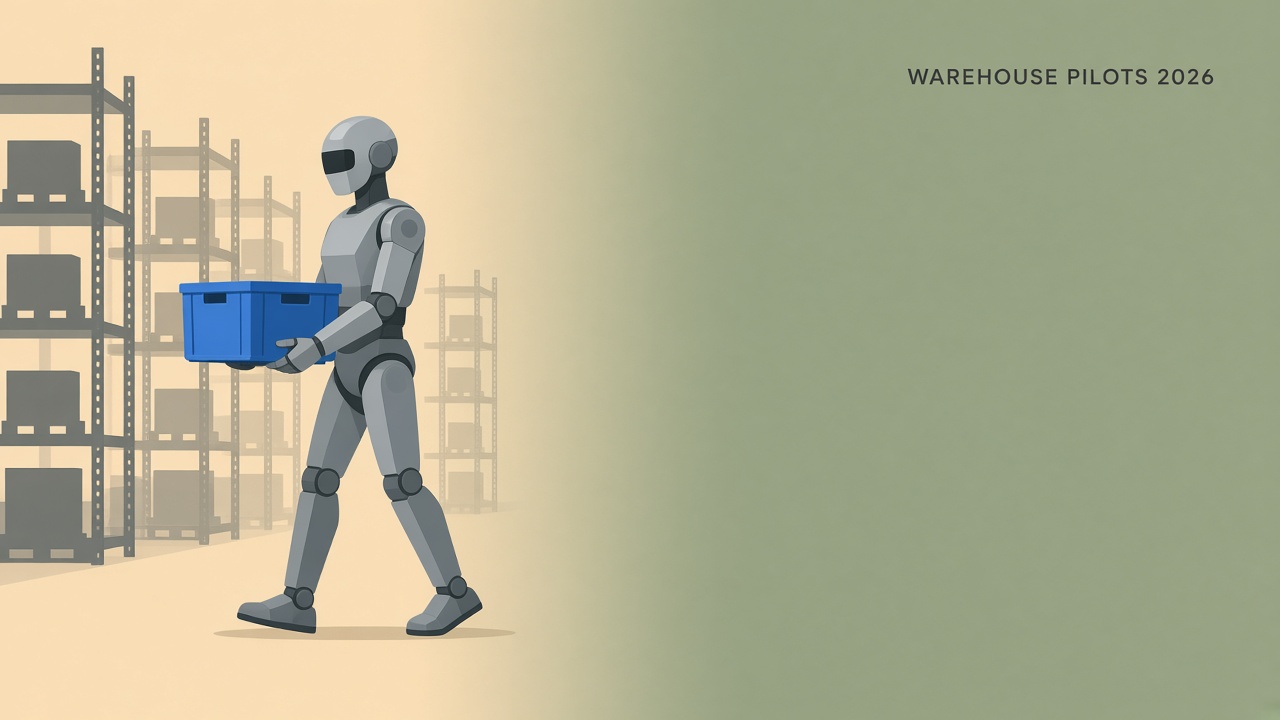
Humanoid warehouse robots in 2026 are proving narrow logistics tasks under supervision, not replacing entire fulfillment centers. Verified deployments include Agility Robotics Digit moving totes at GXO and Toyota sites (more than 100,000 totes at GXO with 98% workflow accuracy per company disclosures), BMW sequencing parts with Figure 03 at Plant Spartanburg, and Amazon continuing technical pilots with Digit. Agility reported roughly 65,000 operating hours across nine committed customer facilities as of May 2026. These numbers matter because they describe bounded workflows with defined KPIs, not marketing demos beside idle conveyors. Teams tracking AI research on embodied robotics or evaluating AI research infrastructure for warehouse automation should treat humanoid pilots as task-specific experiments, not default AMR replacements.
Why Warehouses Experiment With Humanoids
Warehouses test humanoids because existing automation struggles with legacy layouts, mixed-SKU manipulation, and tasks that require reaching, stepping, and pulling carts in the same motion. Fixed six-axis arms excel at repeatable pick points but fail when tote heights vary, aisles are narrow, or sequencing carts must move while the gripper holds parts. Autonomous mobile robots (AMRs) move pallets efficiently but cannot climb stairs or manipulate loose components inside bins without additional arms.
The humanoid form factor promises one platform for tote transfer, shelf replenishment, and sequencing without redesigning every rack for robot-specific tooling. BMW's Figure 03 deployment at Spartanburg illustrates the pitch: pick unsorted components from large containers, place them into sequencing trolley slots, and reposition the body while pulling a caster cart. Figure AI's Helix 02 vision-language-action model coordinates hands, torso, and feet for loco-manipulation that fixed gantries cannot replicate.
Labor availability and shift coverage also drive interest. Logistics operators face seasonal peaks, night-shift gaps, and ergonomic strain from repetitive lifting. Humanoids marketed as Robots-as-a-Service (RaaS) let facilities trial capacity without capitalizing full conveyor retrofits. Agility lists Schaeffler, GXO, Toyota Motor Manufacturing Canada, Mercado Libre, and Amazon among Digit customers or partners, signaling demand across automotive, e-commerce, and third-party logistics segments.
Investor narratives emphasize general-purpose hardware: one bipedal platform retrained across sites. Operational reality in 2026 remains workflow-specific. Each deployment defines success as totes per hour, sequencing accuracy, or parts placed per shift, not open-ended "do anything" autonomy.
Task Fit: Totes, Stairs, Legacy Racks
Humanoid warehouse robots fit best where the environment already matches human ergonomics: standard tote sizes, floor-level bins, mezzanine stairs, and rack heights designed for people. Digit v4 carries up to 35 lbs per Agility disclosures, aligning with common warehouse tote weights. GXO workflows move totes between zones; Mercado Libre reports roughly 25,000 totes handled at 98% accuracy in disclosed metrics.
Stairs and mezzanines remain a theoretical advantage over wheeled AMRs. Few published 2026 pilots document sustained stair-climbing throughput at production scale. Most verified hours accumulate on flat factory and DC floors. Legacy rack systems with variable shelf spacing challenge perception and reach planning; humanoids must see into deep bins and avoid collisions with protruding inventory.
BMW's progression from Figure 02 sheet-metal loading (90,000+ parts across 1,250 operating hours on X3 production) to Figure 03 logistics sequencing shows how task complexity escalates. Loading welding fixtures demands precision and repeatability; sequencing loose parts from containers demands visual recognition, dual-hand coordination, and dynamic balance while the cart moves.
| Task type | Humanoid fit | Specialized alternative |
|---|---|---|
| Tote transfer on flat floors | Strong; verified commercial hours | AMR + lift module often faster |
| Bin sequencing / loose parts | Emerging; BMW Figure 03 pilot | Pick cells with vision + delta arms |
| Stair and mezzanine access | Theoretical advantage; few published KPIs | Conveyors, lifts, or human assist |
| High-speed parcel sort | Weak; biped balance overhead | Cross-belt sorters, tilt-tray systems |
Safety Standards and Cage Deployments
Humanoid warehouse deployments in 2026 operate under existing industrial robot safety frameworks, often with physical separation, speed limits, and human supervisors on the floor. ISO 10218 governs industrial robot systems; ISO/TS 15066 addresses collaborative operation with force and speed monitoring. Humanoids blur the line between fixed manipulators and mobile coworkers because the entire body moves through shared aisles.
Published deployments describe supervised autonomous operation: robots run predefined workflows while staff monitor exceptions. Cage deployments and zone segregation remain common during pilots. BMW emphasized safety, repeatability, and integration into production workflows as evaluation criteria for both Figure 02 and Figure 03 programs.
Bipedal stability introduces fall risks absent from low-profile AMRs. Operators must plan for safe-stop behavior, tip-over detection, and clearance around swinging arms. Battery swaps, charging docks, and maintenance access add operational procedures not required for tethered arms. Insurance and liability frameworks are still maturing; most contracts treat the vendor RaaS provider as responsible for firmware updates and remote monitoring during early deployments.
Hexagon Robotics AEON humanoid pilots at BMW Plant Leipzig (starting summer 2026) and prior Spartanburg experience suggest European and North American OEMs are standardizing safety reviews before scaling hours. Expect human-in-the-loop oversight to remain mandatory through at least 2027 for mixed human-robot aisles.
Throughput vs Specialized AMRs
Specialized AMRs and conveyor systems still beat humanoids on raw throughput for defined lanes, while humanoids compete on flexibility per square foot of retrofit cost. Agility cites approximately $125,000 bill of materials for Digit v4 in investor materials, with RoboFab in Salem, Oregon designed for 10,000 units annually at scale. Compare that to deploying dozens of single-purpose tote AMRs with proven fleet management software.
Throughput metrics published in 2026 focus on accuracy and cumulative hours, not parcels per minute rivaling Amazon's Kiva successors. GXO's 98% tote workflow accuracy and 100,000+ tote milestone demonstrate reliability over speed records. For high-velocity sortation, gravity rollers and cross-belt sorters maintain dominance.
Humanoid value propositions emphasize reconfigurability: retrain the same hardware when SKU mix changes or when a new sequencing cart layout arrives. AMR vendors counter with modular attachments and software-defined zones at lower unit complexity. Facilities should model total cost per successful task, including supervision labor, downtime for battery charging, and intervention rate when perception fails on reflective packaging or damaged labels.
Figure 02's 1,250 hours across weekday ten-hour shifts at BMW quantifies utilization, not peak pick rate. Operations teams should ask vendors for interventions per hour, mean time between assists, and comparable AMR benchmarks on identical SKUs before approving capital shifts from proven automation.
Labor, Unions, and Retraining
Warehouse humanoid pilots sit inside broader labor negotiations about automation pace, job redesign, and retraining rather than immediate mass displacement. Unions at major logistics employers have pushed for notice periods, retraining funds, and limits on unsupervised deployment. Humanoids in 2026 typically augment tote movement and sequencing stations where labor shortages already constrain throughput, not eliminate entire pick modules overnight.
Retraining pathways focus on robot supervision, exception handling, and maintenance partnership with vendors. Workers who previously moved totes may shift to monitoring fleet dashboards, clearing jammed bins, or labeling training data when perception models misclassify parts. Facilities that skip change-management often face slower adoption even when hardware performs.
Public discourse conflates Tesla Optimus demos, startup funding rounds, and verified factory hours. Procurement teams should separate SEC-filed customer lists and OEM press releases from social media clips. The credible 2026 story is supervised pilots with published operating hours, not autonomous fleets replacing entire shifts without human oversight.
Ethical deployment frameworks emerging in Europe emphasize worker consultation before pilot expansion. U.S. operators often pilot in non-union sites first, then negotiate terms before broader rollout. Either way, humanoid projects succeed when labor stakeholders help define acceptable zones, escalation paths, and metrics that do not punish workers for robot failures.
Workforce planning should map which tasks remain human-only (irregular problem solving, customer-facing exceptions) versus robot-assisted (repetitive tote moves). Training curricula that teach digital twin monitoring and fault recovery create upward mobility rather than pure displacement narratives. Facilities publishing joint labor-management reports on pilot outcomes build trust faster than vendor-only press releases.
Amazon's continued Digit technical pilot illustrates how even the largest logistics employers treat humanoids as R&D adjacent to mature Kiva-style AMR fleets. Procurement teams should benchmark humanoid proposals against the best AMR quote for the identical workflow before approving bipedal complexity. When stairs or dual-hand sequencing genuinely block AMR deployment, humanoid pilots earn their place in the automation roadmap.
Frequently Asked Questions
Is Tesla Optimus working in warehouses?
As of 2026, verified warehouse operating hours are documented for Agility Digit, Figure at BMW, and select OEM pilots, not broad Tesla Optimus production logistics. Treat Optimus warehouse claims as developmental until independent operators publish shift-level KPIs comparable to GXO or BMW disclosures.
What does a humanoid warehouse robot cost?
Agility disclosed approximately $125,000 bill of materials for Digit v4, typically deployed via multi-year RaaS contracts rather than outright purchase. Total cost includes supervision, integration, charging infrastructure, and vendor support. Compare against AMR fleet quotes for the same tote workflow before assuming humanoids are cheaper.
How much maintenance do humanoids need?
Bipedal platforms have more joints, batteries, and balance controllers than flat AMRs. Expect firmware updates, actuator servicing, and perception recalibration when lighting or SKU packaging changes. Vendor RaaS models often bundle remote monitoring; ask for mean time between failure and spare robot availability before production reliance.
Will humanoids replace warehouse jobs?
2026 pilots augment specific tasks under supervision. Broader displacement risk depends on intervention rates falling, costs dropping, and unions agreeing to deployment terms. Retraining for robot oversight and exception handling is the near-term workforce impact most facilities plan for.
Why not just use AMRs?
AMRs win on throughput and maturity for flat-floor material transport. Humanoids target manipulation-plus-locomotion tasks that would otherwise require custom fixturing or human workers in legacy layouts. Many sites will run both: AMRs for bulk moves, humanoids or fixed arms for sequencing and bin picking.
What safety standards apply?
ISO 10218 and ISO/TS 15066 provide baselines for industrial and collaborative robots. Humanoid pilots add mobile manipulation risks requiring zone control, fall planning, and supervised operation. Engage safety engineers before removing cages or increasing operating speeds.
Where should I follow humanoid warehouse research?
Track verified operator disclosures, SEC filings from public vendors, and OEM manufacturing press releases rather than demo videos alone. For broader embodied AI context, browse AI research coverage and infrastructure notes via AI research search.