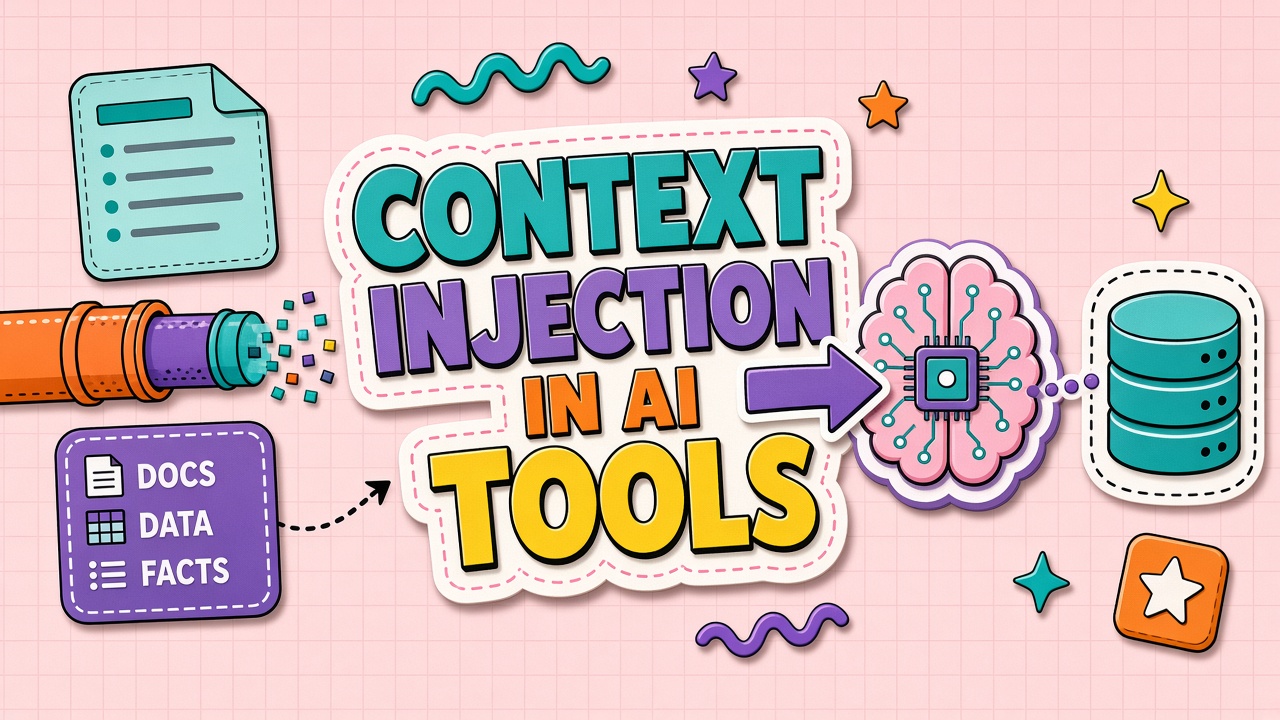
Before a language model answers "Draft a product launch email for our spring sale," your application assembles a bundle of text: brand voice rules, CRM segment details, retrieved campaign briefs, available tool schemas, and prior chat turns. That assembly process is context injection. It is how RAG chunks, function definitions, and system prompts reach the model in a single inference call. Done well, injection delivers relevant, on-brand, actionable answers. Done poorly, it wastes tokens on stale docs, buries instructions under noise, or leaks one tenant's data into another's session.
Context injection sits at the center of most AI workflows. Teams building with AI writing tools and AI marketing platforms should understand static versus dynamic context, ordering effects on model attention, token budget allocation, stale context risks, and isolation patterns for multi-tenant products.
What Context Injection Is: Building the Model Input
Context injection is the deliberate placement of information into the prompt payload the model receives. Unlike implicit "memory" marketing language, injection is implemented in application code or orchestration layers: fetch data, format it, order it, truncate to budget, then call the API. Everything the model "knows" about your business in that moment is what you injected plus its training, which you do not control per request.
Injection channels include system messages, developer messages, user messages, tool result messages, and attached files converted to text or multimodal parts. Mature stacks version each channel independently so teams can answer "which retrieval index and prompt template produced this answer?" during incidents.
Static vs Dynamic Context
Static context changes rarely: company policies, tone guidelines, legal disclaimers, product catalog snapshots refreshed nightly, and standard tool schemas. Static blocks are good candidates for caching, prompt prefix optimization, and precomputation on providers that support cached input discounts.
Dynamic context varies per request: the user's question, live CRM fields, retrieved RAG chunks, tool outputs from the current turn, and recent chat history. Dynamic material drives relevance but consumes the majority of token budgets and introduces stale data risk when caches lag behind source systems.
| Context type | Examples | Update frequency | Caching |
|---|---|---|---|
| Static system | Brand voice, safety rules | Weekly or on deploy | Strong candidate |
| Semi-static RAG | Help center, policy PDFs | On content publish | Embeddings cache; text on retrieve |
| Dynamic user | Form fields, locale, plan tier | Every request | Avoid cross-user cache |
| Dynamic tool | API JSON, SQL results | Per tool call | Short TTL only |
Ordering Effects: What the Model Notices First and Last
Models exhibit primacy and recency effects: content at the start and end of context often influences answers more than middle sections. System instructions traditionally lead the prompt so behavior rules anchor generation. Retrieved evidence placed just before the latest user message helps grounding on factual tasks. Middle placement suits long reference appendices the model should cite only when relevant.
Tool definitions consume tokens whether or not tools are invoked. Some teams inject only tools eligible for the current user role or intent classification result, reducing noise and mistaken tool picks. Conversation history ordering should preserve chronological coherence; summarizing older turns while keeping recent turns verbatim is a common compromise.
Patterns for writing and marketing workflows
Writing assistants often order context as: voice guide, audience persona, outline constraints, retrieved research snippets, then user draft instructions. Marketing copilots may place live performance metrics after static brand rules so numbers stay fresh without rewriting tone guidance each request. Test ordering changes on eval sets because optimal layouts differ by model family.
Token Budget Allocation Across Channels
Token budget allocation is a zero-sum design exercise. Reserve output tokens first, then system and tools, then dynamic retrieval and history. Explicit budgets prevent one verbose tool response from crowding out safety instructions or user questions.
// Illustrative budget for a 128k context model
const budget = {
  maxOutput: 4096,
  systemAndSafety: 6000,
  toolSchemas: 8000,
  chatHistory: 12000,
  retrieval: 24000,
  userMessage: 2000,
  buffer: 2000,
};
// Trim chatHistory and retrieval first when over limit
Allocation policies should be configurable per feature: code review agents need larger tool and retrieval slices; short FAQ bots can shrink history aggressively. Log actual token usage per channel after tokenizer measurement because character counts mislead across languages and markup.
- Measure baseline distribution over a representative traffic sample.
- Set hard caps per channel with graceful truncation rules.
- Prioritize dropping lowest-scored retrieval chunks before dropping system rules.
- Recompute budgets when switching models or context window sizes.
Stale Context Risks: When Injected Facts Lie
Injected context is a snapshot, not live truth. RAG indexes lag CMS publishes. CRM sync jobs miss overnight updates. Cached product prices expire silently. The model treats injected text as authoritative and may confidently cite outdated promotions or deprecated API endpoints.
Mitigations include timestamp metadata on every chunk ("Pricing valid as of 2026-09-01 UTC"), TTL-based re-fetch for high-volatility fields, live tool calls for numbers that must be exact, and user-visible staleness warnings when sources exceed age thresholds. Marketing teams should tie content launches to embedding reindex jobs the same way they tie them to CDN cache purges.
- Version tags: Include doc version in chunk headers for support debugging.
- Source of truth hierarchy: Tool API results override static retrieval on conflict.
- Conflict detection: Flag when two chunks disagree on the same fact.
- Human review gates: Require approval when stale context detected above risk threshold.
Combining RAG, Tools, and System Prompts
Real workflows blend all three. System prompts define role and constraints. RAG supplies documentary evidence. Tools fetch live state and perform actions. Injection orchestration decides what goes into turn one versus what loads after a tool call in turn two. Multi-turn agents loop: inject tools, model requests action, inject tool output, model continues.
Failure modes include retrieving irrelevant chunks that contradict system rules, tool outputs so large they push out safety text, and duplicated information (same policy in system prompt and RAG) wasting tokens. Deduplicate at injection time and maintain a single canonical source for each fact class where possible.
Multi-Tenant Isolation in Shared AI Infrastructure
SaaS products serving many customers from one stack must guarantee tenant A's injected documents, variables, and tool credentials never appear in tenant B's prompts. Isolation failures are among the highest-severity bugs in AI platforms because they are silent until discovered.
Controls include namespace-separated vector indexes, per-tenant encryption keys, request-scoped dependency injection for retrieval filters, automated tests that attempt cross-tenant ID guessing, and audit logs of every chunk ID injected per session. Session memory stores should key by tenant plus user plus workspace, never user alone on shared domains.
| Layer | Isolation tactic | Verification |
|---|---|---|
| Retrieval index | Tenant ID filter on every query | Automated cross-tenant probe tests |
| Prompt variables | Server-side binding only | Schema validation, no client override |
| Tool credentials | Vault per tenant, injected at execute | Secrets never in logged prompts |
| Cached prefixes | Separate cache keys per tenant | Chaos tests on shared cache layers |
Frequently Asked Questions
How is context injection different from prompt engineering?
Prompt engineering crafts wording of instructions. Context injection decides which data enters the prompt, in what order, and within what budget. Both matter; injection errors cannot be fixed by better adjectives alone.
Can too much context hurt answer quality?
Yes. Irrelevant chunks dilute attention, increase latency and cost, and raise contradiction risk. Retrieval precision and budget discipline often beat "send everything we have" strategies.
Is one shared model safe for all tenants?
Shared models are standard; shared unfiltered context is not. Safety comes from retrieval filters, credential scoping, and session isolation enforced in application code, not from assuming the model will ignore wrong data.
Should tools always replace RAG for live data?
Tools suit authoritative live fields (inventory, account status). RAG suits narrative policy and creative references. Many workflows inject both with explicit precedence rules when values conflict.
What should buyers ask workflow vendors?
Ask how static and dynamic layers are versioned, whether token budgets are configurable, how reindexing aligns with CMS updates, and what multi-tenant isolation tests they run before releases. Demos with tiny corpora hide stale context and leakage risks visible at scale.
Orchestrate Context Deliberately
Context injection in AI workflows determines what the model sees before it speaks. Separate static from dynamic layers, order content for task-specific attention, allocate token budgets explicitly, refresh or timestamp stale sources, and isolate tenants at every injection point. Products powered by AI writing and AI marketing stacks live or die on relevance and trust, both of which start in the injection layer, not the headline model name.
Treat injection pipelines as first-class architecture: versioned, measured, and tested like payment or auth code. When RAG, tools, and system prompts cooperate under clear budgets and isolation rules, users get answers grounded in the right facts without exposing the wrong ones.