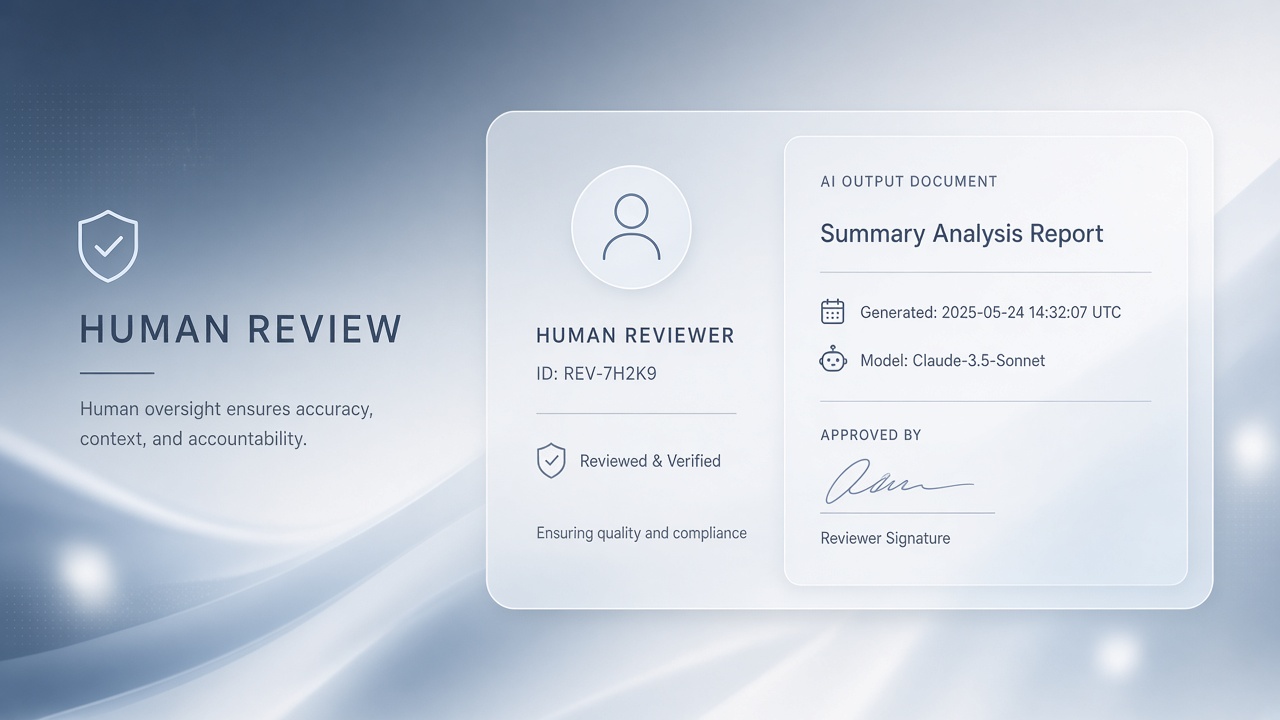
Regulators and enterprise customers no longer accept "humans reviewed it" as a verbal claim. When a AI research assistant drafts investment memos, or an AI video tool generates training content that affects compliance messaging, auditors ask for records proving a qualified person understood the AI output before it influenced a decision. Rubber-stamp clicks fail that test.
Human oversight documentation captures evidence that meaningful human review occurred on AI-assisted decisions: who reviewed, when, what they changed, and why they accepted or rejected model suggestions. This guide covers record fields, high-volume sampling strategies, overseer training evidence, and FAQ topics including automation bias and shift handoffs for compliance and operations leaders.
What Counts as Meaningful Oversight
Meaningful human oversight means a person with appropriate authority, training, and context can understand the AI output, detect material errors, override or correct the output, and bears accountability for the final decision. The EU AI Act high-risk requirements and emerging NIST AI RMF oversight practices converge on this standard. Checkbox approvals without reading, or reviewers who cannot explain the model's role, do not qualify.
| Oversight element | Meaningful standard | Insufficient pattern |
|---|---|---|
| Comprehension | Reviewer can summarize AI contribution and limitations | Blind approve without opening output |
| Detection | Reviewer checks facts, bias, policy alignment | Assumes vendor accuracy |
| Intervention | Reviewer can edit, reject, or escalate | UI disables override |
| Accountability | Named reviewer tied to professional duty | Anonymous team queue with no owner |
Oversight Models
Choose among human-in-the-loop (review before action), human-on-the-loop (monitor with interrupt authority), and human-in-command (AI advises, human decides) based on decision impact and volume. Document the selected model per use case in your AI inventory. High-risk employment or credit assists typically require human-in-the-loop or human-in-command, not passive monitoring alone.
Role Qualifications
Define minimum qualifications for overseers: domain expertise, security clearance where needed, completion of AI literacy training, and authority to stop automated workflows. A junior contractor approving AI research summaries for regulated filings without subject-matter review fails meaningful oversight even if timestamps exist.
Record Fields: Reviewer, Timestamp, Rationale
Every oversight record should capture at minimum: unique decision ID, AI system and model version, reviewer identity, review timestamp in authoritative timezone, action taken (approved, edited, rejected, escalated), and written rationale for the decision. Optional but valuable fields include input prompt hash, output hash, edit diff, time spent reviewing, and linked policy version.
| Field | Purpose | Implementation tip |
|---|---|---|
| Reviewer ID | Accountability and training lookup | Use SSO identity, not display names |
| Timestamp | Sequence and SLA proof | UTC storage, local display |
| Rationale | Proves comprehension, not rubber stamp | Require non-empty text or structured codes plus comment |
| Action code | Analytics on override rates | Standardize approve, edit, reject, escalate |
| Model version | Traceability after vendor updates | Pull from API metadata when available |
Rationale Quality
Reject rationales that are only "OK" or "reviewed"; require articulation of what was checked (facts, citations, policy clauses, demographic fairness) and what changed. Structured rationale templates per decision type speed reviewers while preserving audit quality. For AI video outputs, templates might require confirmation of rights-cleared assets, accurate captions, and brand compliance.
Immutable Audit Logs
Store oversight records in append-only audit logs with access controls; prohibit reviewers from deleting their own entries. Corrections add superseding records rather than silent edits. Export samples quarterly for internal audit.
Sampling Oversight for High-Volume Flows
When full human review of every AI-assisted decision is operationally impossible, document a statistically justified sampling plan with minimum review rates, stratification by risk segment, and escalation triggers when error rates exceed thresholds. Sampling is not an excuse to skip oversight on high-risk individual decisions; regulators expect 100% review where harm potential is severe.
- Define strata: customer tier, decision amount, sensitive attributes, model confidence score bands.
- Set base sample rate per stratum (e.g., 5% low-risk tickets, 100% credit denials).
- Auto-escalate to full review when AI confidence is low or policy keywords appear.
- Track override and error rates per stratum; increase sampling when rates spike.
- Document the sampling methodology and approval by compliance before production.
Sampling Evidence Pack
Maintain a sampling evidence pack: methodology memo, weekly sample manifests, completed oversight records for each sampled item, and aggregate metrics dashboard. Auditors often request 90 days of samples across risk strata. Automate manifest generation from your workflow tool rather than manual spreadsheets.
Human Review SLAs
Define maximum queue time before AI output reaches users or executes downstream actions; SLA breaches trigger fallback to human-only processing or workflow pause. Document SLA exceptions during incidents with post-incident oversight backfill where feasible.
Training Records for Overseers
Link each reviewer to training records covering AI system limitations, oversight procedures, bias awareness, data handling rules, and escalation paths; retrain on material model or policy changes. Training completion alone does not prove meaningful oversight, but missing training undermines defensibility when errors occur.
| Training module | Audience | Refresh trigger |
|---|---|---|
| AI literacy baseline | All overseers | Annual |
| Use-case SOP | Domain reviewers | On SOP version change |
| Bias and fairness | High-risk decision reviewers | Semi-annual |
| Tool-specific certification | Power users of named AI systems | On major model upgrade |
Competency Assessments
Supplement slide-based training with scenario assessments: reviewers correct deliberately flawed AI outputs in a sandbox before receiving production oversight rights. Store assessment scores and failure remediation in the same HR or LMS system as completion certificates.
Integration With Workflow Tools
Embed oversight capture in the systems where decisions happen (ticketing, CRM, CMS, loan origination) rather than separate attestations in email. If reviewers must leave the workflow to log oversight in a spreadsheet, compliance rates collapse. API hooks from AI gateways can pre-fill model metadata into review forms.
Separation of Duties
Prevent the same person from generating AI output and being the sole approver on high-risk decisions unless role scarcity is documented with compensating controls (secondary review sampling). Separation-of-duties violations appear frequently in audit findings for automated workflows.
Frequently Asked Questions
Does automation bias make oversight documentation pointless?
Automation bias increases the need for documentation, not less; records should show reviewers spent adequate time, cited independent checks, and overrode AI when appropriate. Monitor override rates; near-zero overrides on high-variance AI tasks suggest rubber stamping. Train reviewers explicitly on automation bias and require rationale fields that reference sources outside the model output.
How do we document oversight across shift handoffs?
Each shift handoff needs a transfer record: outgoing reviewer, incoming reviewer, timestamp, queue state, and acknowledgment of pending high-risk items. Do not allow unsigned AI recommendations to auto-execute during handoff windows. For 24/7 operations using AI research or support tools, define which decisions pause until the next qualified reviewer signs on.
Can we rely on vendor-provided audit logs alone?
Vendor logs supplement but rarely replace deployer oversight records; you must still prove your organization's reviewers performed meaningful review under your policies. Export vendor logs into your evidence repository and reconcile IDs with internal decision records.
What if we only have two people in the function?
Document role constraints, compensating controls (enhanced sampling, executive secondary review on material decisions), and a hiring or cross-training plan. Small teams face higher scrutiny on separation of duties; transparency in documentation beats pretending multi-layer review exists when it does not.
Decision-Type Playbooks
Publish oversight playbooks per decision type so reviewers know what "meaningful" means in context: financial approvals, medical content review, legal contract first pass, customer-facing AI video publication, and research report issuance. Each playbook lists mandatory checks, prohibited auto-approvals, escalation contacts, and minimum rationale templates.
| Decision type | Minimum checks | Oversight model |
|---|---|---|
| External research brief | Source verification, conflict check, hallucination scan | Human-in-command before distribution |
| Marketing video script | Brand, claims substantiation, rights clearance | Human-in-the-loop before render |
| High-volume ticket triage | Category sanity, PII redaction, policy keyword scan | Sampled human-on-the-loop |
| Regulated filing draft | Licensed reviewer sign-off, version compare to prior filing | Human-in-command, no batch approve |
AI Research Oversight
AI research tools accelerate literature review and competitive analysis, but oversight records must show reviewers validated citations and did not rely on fabricated references. Require rationale fields that list at least two independent sources checked outside the model output. Escalate when research informs investment or safety-critical decisions.
Technology Enforcement
Configure workflow tools to block downstream actions until oversight fields are complete: no email send, no CMS publish, no CRM stage advance without reviewer ID and rationale. Soft warnings fail under deadline pressure. Technical enforcement converts policy into default behavior.
AI gateways can inject review queues when confidence scores fall below thresholds or when content matches sensitive topic classifiers. Log classifier version alongside model version in oversight records so auditors understand why an item entered enhanced review.
Mobile and Off-Channel Risk
Document policies for oversight when employees use mobile apps or personal devices that bypass corporate logging. Approved tools with full audit trails beat unlogged copy-paste from consumer apps. Mobile approvals should require the same rationale fields as desktop workflows.
Incident and Override Review
When AI-assisted decisions cause incidents, preserve oversight records and add post-incident review entries: whether oversight occurred, whether rationale was adequate, and corrective actions. Periodic override analysis sessions ask why reviewers accepted flawed outputs and whether training or UI changes are needed.
- Monthly: sample 20 oversight records per high-risk system for quality review.
- Quarterly: report override rates and mean rationale length trends to governance council.
- After model change: compare oversight quality metrics pre and post upgrade.
- After incident: root cause tag on oversight failure modes (skipped, rushed, untrained reviewer).
Metrics and Continuous Improvement
Track oversight KPIs: median review time, override rate, escalation rate, SLA breaches, training compliance, and sampled error rate. Review metrics monthly with compliance and operations leads. Sudden drops in review time or overrides after a model upgrade should trigger investigation before auditors find the pattern.
Benchmark against internal baselines, not vendor marketing claims about accuracy. Meaningful oversight should produce non-zero edit rates on generative tasks and documented escalations when models refuse or hallucinate. Zero escalations over months may indicate reviewers are not reading outputs carefully.
Oversight for High-Volume Generative Outputs
Marketing, support, and content teams generating thousands of AI video scripts or email variants cannot human-read every token; combine automated policy scanners, blocked phrase lists, and stratified human sampling with documented rates. Automated pre-screening logs become part of oversight evidence when configured with versioned rule sets and false-positive review queues. Never claim 100% human review when automation filters first.
For research workflows using AI research tools, require spot checks on citation accuracy at defined intervals and full human review before external publication. Document the sampling rate and any auto-publish paths disabled by policy.
Escalation Paths in Oversight
Define when reviewers must escalate to senior domain experts, legal, or compliance: detected PII leakage, potential discrimination, factual claims about competitors, medical or financial advice, and outputs matching crisis keywords. Escalation records need the same fields as standard oversight plus resolver identity and resolution timestamp. Unresolved escalations should block workflow progression.
Regulatory Alignment
EU AI Act Article 14 human oversight requirements for high-risk systems expect deployers to assign oversight to natural persons with necessary competence, authority, and support. Your documentation package should map record fields to Article 14 themes: ability to understand system limitations, monitor operation, interpret output, decide not to use, and intervene or interrupt. US sector guidance from financial and employment regulators similarly emphasizes documented human judgment on material decisions.
Evidence for External Audit
Assemble quarterly oversight evidence packs: random sample of complete records, training completion report for sampled reviewers, sampling methodology memo, and metrics dashboard export. External auditors compare your described oversight model to actual records. Gaps between policy and practice drive findings faster than missing policies entirely.
Documentation Retention for Oversight Records
Oversight records follow your AI output retention schedule: high-risk decision logs often require multi-year retention aligned to employment, credit, or healthcare rules. Do not store oversight rationales only in ticketing tools with 90-day expiry when regulated decisions require seven-year trails. Export to corporate archive systems with immutable storage where SOX or similar rules apply.
Privacy in Oversight Logs
Rationale fields may contain sensitive details about individuals; apply access controls and redaction when producing oversight records for external parties. Train reviewers to write rationales suitable for audit without unnecessary personal data. Separate security incident narratives from routine approval logs.
Contractual Customer Requirements
Enterprise contracts increasingly require proof of human oversight on AI-influenced deliverables; export oversight logs with customer matter IDs when supporting professional services workflows. Professional liability insurers may ask whether oversight procedures were followed after incidents involving AI research or client-facing content. Contractual retention periods for oversight records may exceed internal defaults; align with records management policy.
Board and Executive Reporting
Quarterly executive summaries should include oversight KPI trends, notable escalations, training compliance gaps, and remediation status after incidents. Boards rarely read individual oversight records but need confidence that controls operate at scale. One-page dashboards beat raw log exports for leadership audiences.
Oversight You Can Prove
Human oversight documentation succeeds when records show meaningful review through qualified reviewers, timestamps, substantive rationale, appropriate sampling for volume, and current training evidence. Build capture into production workflows, treat shift handoffs and automation bias as first-class risks, and link every record to the AI system version that produced the output under review.