Teams cut over to a new AI tool on launch day because the demo looked convincing. A week later, support queues spike: macros read robotic, citations are wrong, or the integration drops fields the old process preserved. Rolling back is politically painful, so everyone patches forward while customers absorb the quality dip.
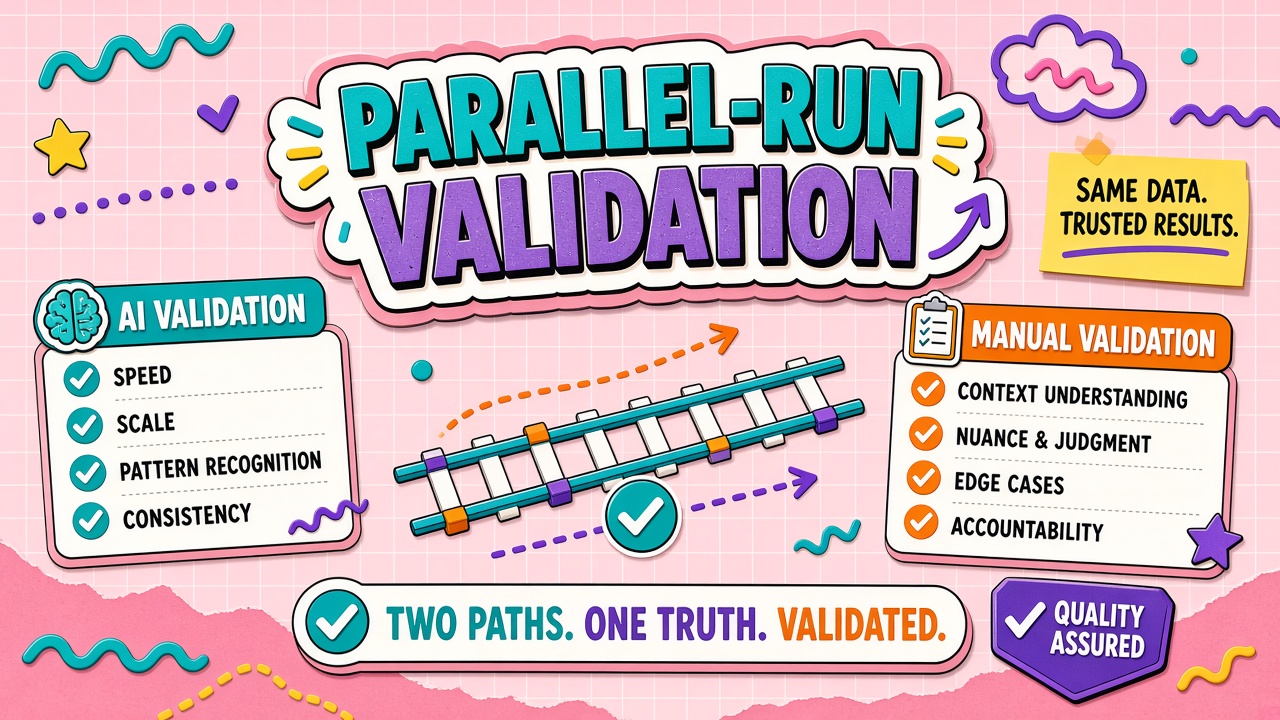
Parallel run validation means executing the legacy workflow and the new AI-assisted workflow on the same inputs for a defined window, comparing outputs with a rubric, and cutting over only when discrepancy rates fall within agreed limits. This guide covers design, sampling, reviewer roles, and cutover gates for customer-facing and internal rollouts. Evaluate candidates from AI customer service and AI chatbot categories after your parallel run charter is written.
What Parallel Run Validation Proves
Parallel runs answer one question: Is the new path safe to become primary? They do not prove long-term ROI alone; pilot exit criteria handle that. Parallel runs prove operational equivalence or acceptable improvement on real inputs before you retire the old tool, template library, or manual checklist.
Parallel validation is especially critical when:
- Customers see the output (support replies, chatbot answers, public KB articles).
- Downstream systems consume structured fields (CRM, ticketing, billing).
- Compliance requires audit trails comparing old vs new decisions.
- Model or vendor change alters tone, length, or factual behavior on the same prompts.
- Team habit strength makes silent regression likely without side-by-side review.
Designing a Parallel Run Charter
Document scope, duration, sample rate, rubric, and cutover thresholds before the first dual execution. The charter prevents "we will eyeball it" reviews that collapse under volume.
Charter minimum fields:
- Workflow ID and owner.
- Legacy path description (tool, steps, human gates).
- New path description (AI tool, prompts, integrations).
- Sample rate: Percentage or count of tasks run in parallel daily.
- Duration: Calendar days or until n comparisons complete.
- Comparison rubric: Dimensions scored pass/fail or 1-5.
- Cutover threshold: For example ninety-five percent pass on required dimensions.
- Rollback trigger: Critical failure types that halt parallel run immediately.
| Rubric dimension | What reviewers check | Fail example |
|---|---|---|
| Factual accuracy | Claims match approved knowledge base | Invented refund policy |
| Completeness | All required fields and next steps present | Missing escalation link |
| Tone and brand | Matches voice guide for channel | Overly casual in enterprise thread |
| Integration fidelity | CRM/ticket fields map correctly | Priority field dropped on sync |
| Safety and policy | No prohibited content or PII leakage | Customer data echoed in wrong channel |
Sampling Strategy and Volume
Sample enough tasks to see edge cases without doubling team workload indefinitely. High-volume customer service workflows might parallel-run ten to twenty percent of tickets for two weeks. Low-volume strategic workflows might run one hundred percent for a shorter window. Stratify samples across intent types (billing, technical, cancellation) so one easy category masks failures elsewhere.
Sampling guidelines:
- Minimum comparisons: At least fifty scored pairs per major intent category.
- Edge case quota: Deliberately include long threads, attachments, and non-English inputs.
- Time-of-day coverage: Model behavior can shift with load; avoid single-shift bias.
- Reviewer rotation: Two reviewers on a subset to calibrate rubric interpretation.
For AI chatbot rollouts, include handoff scenarios in the sample: bot unsure, user angry, user requests human, user sends PII. Parallel runs should compare not only final text but whether the correct escalation fired.
Execution Workflow and Tooling
Make dual execution easy or it will be skipped. Ideal setup: same ticket or task ID generates legacy output and new output stored in linked records. Reviewers open a comparison view; they do not hunt across tabs. If tooling is manual, use a spreadsheet with task ID, input hash, legacy output link, new output link, rubric scores, and reviewer initials.
Daily parallel run rhythm:
- Morning: sample generator assigns tasks to dual path.
- Intraday: reviewers score batch; flag critical failures in real time.
- End of day: owner summarizes pass rate and top failure themes.
- Weekly: adjust prompts or integration mapping; do not move cutover threshold without charter amendment.
Critical failures (policy violation, wrong legal guidance, data sent to wrong recipient) trigger pause, root cause analysis, and fix verification on a fresh sample before resuming.
Discrepancy Triage and Fix Priority
Not every discrepancy blocks cutover. Classify gaps as blocking, acceptable with documentation, or legacy defect (new path is better). Blocking gaps require prompt, integration, or training fixes and re-validation. Acceptable gaps need sponsor sign-off (for example intentional brevity in chatbot replies). Legacy defects justify cutover even when outputs differ.
Triage categories:
- Blocking: Factual error, policy breach, integration data loss.
- Fixable non-blocking: Tone drift, minor formatting; fix before cutover if quick.
- Accepted delta: Documented intentional behavior change approved by workflow owner.
- Legacy bug: Old path was wrong; new path corrects it with evidence.
Cutover Gates and Rollback
Cutover requires meeting threshold on all required rubric dimensions for the full sample window, plus sign-off from workflow owner and customer-facing lead if applicable. Schedule cutover at low- traffic window with support staffing elevated for forty-eight hours.
Cutover checklist:
- Final parallel run report attached to change ticket.
- Updated workflow documentation published.
- Agents trained on known acceptable deltas.
- Rollback steps tested (re-enable legacy templates, feature flag, routing rule).
- Monitoring dashboards live for error tags and CSAT.
Rollback triggers post-cutover: pass rate drops below threshold on spot checks, critical incident, or integration failure above agreed error rate. Rollback should be pre-authorized in the charter so teams act without waiting for a new executive meeting.
Reporting Results to Stakeholders
Parallel run reports should fit on one page for executives and link to evidence for practitioners. Include sample size, pass rate by rubric dimension, top three failure themes, blocking vs accepted gaps, and recommended cutover date. Attach anonymized examples for each failure theme so sponsors understand risk without reading hundreds of rows.
Executive summary template:
- Decision requested: Cutover, extend parallel window, or rollback.
- Sample: n tasks across k intent categories over d days.
- Pass rate: Overall and per required dimension vs threshold.
- Blocking gaps: Count and status (open, fixed, accepted).
- Customer impact forecast: Which queues change and when.
Publish the report in the change ticket and the workflow doc change log. Future model upgrades reuse the same template, which makes year-over-year comparison possible.
Chatbot-Specific Parallel Run Considerations
Chatbots add latency, confidence thresholds, and escalation routing to the comparison. Parallel runs should log not only final utterances but whether the bot attempted retrieval, which articles surfaced, and whether the handoff rule matched policy. A fluent wrong answer fails harder than an awkward correct escalation.
Extra rubric rows for chatbot parallel runs:
- Retrieval relevance: Sources support the answer; no orphan citations.
- Escalation timing: Human offered when confidence below threshold or user requests agent.
- Session continuity: Context preserved after handoff without repeated questions.
- Deflection accuracy: Self-serve path actually resolves issue when bot claims resolution.
Parallel Runs for Model Updates
Vendor model upgrades are mini-rollouts. Re-run a shortened parallel window on a stratified sample when the provider changes default models, context limits, or safety filters. Treat "silent upgrade" announcements as cutover events requiring the same rubric, not optional changelog reading.
Cost and Capacity Planning for Parallel Runs
Parallel execution doubles work temporarily. Budget reviewer hours, API credits, and agent time explicitly in the rollout project plan. If parallel runs strain capacity, reduce sample rate on low-risk intents while keeping full parallel on regulated or high-CSAT-impact categories. Finance should see parallel run cost as insurance against a botched cutover, not as unexpected overhead.
Common Parallel Run Mistakes
- Demo inputs only: Cherry-picked samples hide failure on messy real tickets.
- No legacy baseline stored: Comparisons become subjective memory.
- Rubric drift: Reviewers interpret pass/fail differently; calibrate weekly.
- Premature cutover under deadline pressure: Launch dates override thresholds.
- Missing rollback test: Teams discover legacy path atrophied when they need it.
Frequently Asked Questions
How long should a parallel run last?
Two to four weeks for most customer-facing workflows, or until minimum sample per intent is scored. Extend only when blocking fixes are in flight with a named owner and date.
Do we need one hundred percent parallel execution?
Rarely. Full parallel is for low-volume, high-risk workflows. High-volume teams use stratified sampling with explicit edge-case quotas.
Who should score parallel run comparisons?
Trained reviewers who perform the job today: senior agents, QA analysts, or workflow owners. Avoid scoring only by the vendor or implementation consultant.
How is parallel run different from a pilot?
Pilots decide whether to adopt a tool. Parallel runs decide whether to retire the old path after adoption is approved. Pilots measure value; parallel runs measure safe equivalence.
Can parallel comparison be automated?
Automate diff detection and field validation; keep human review for tone, policy, and nuanced accuracy. Browse AI customer service and AI chatbot tools that support logging, export, and side-by-side evaluation workflows.
When to Skip or Shorten Parallel Runs
Internal-only drafts with human review on every output may need a lighter comparison window than customer-facing chatbots. Skipping parallel runs entirely is appropriate only when blast radius is tiny, rollback is instant, and volume is low. Document the exception in the change ticket so teams do not treat shortcuts as default. Even shortened parallel windows should score at least twenty pairs on the highest-risk intent before cutover.
The Bottom Line
Parallel run validation protects customers and internal teams when AI workflows change. Run legacy and new paths on the same inputs, score with a clear rubric, triage discrepancies honestly, and cut over only when thresholds are met with rollback ready. Shortchanging parallel runs saves days and costs months of trust repair.